



Most electrical contractors track their van stock about as well as they track the spare change in their cup holders. You know there's inventory somewhere, but whether you have enough 12-2 Romex for tomorrow's kitchen remodel or enough breakers for that panel swap on Friday — that's anyone's guess until someone's standing in a supply house parking lot at 2pm, burning billable hours.
The problem isn't just the wasted time. When your journeyman texts you that they're out of 3/4" EMT connectors halfway through roughing in a commercial space, you're dealing with multiple failures at once. The job delay, the unplanned supply run, the customer wondering why their timeline just shifted, and the ripple effect on your afternoon schedule. Multiply that across three vans running five days a week and you're hemorrhaging productivity in ways that don't show up cleanly on your P&L.
What makes van stock particularly painful for electrical contractors is the sheer variety of parts involved. Unlike a plumber who might stock 20 core items, you're managing hundreds of SKUs across wire gauges, breaker types, conduit fittings, device boxes, and specialty items. Each van becomes a rolling warehouse that nobody really owns until something runs out.
Why electricians struggle with inventory more than other trades
The electrical trade creates inventory challenges that most generic stock management advice completely misses. Your apprentice might burn through 500 wire nuts on a big rough-in day, then barely touch them during a week of service calls. Meanwhile, that specialized AFCI breaker sits in the van for months until you need it urgently.
Contractors try everything from complicated spreadsheets to expensive inventory apps, and most fail for the same reason: they treat van stock like warehouse inventory. But van stock operates differently. It's decentralized, constantly moving, accessed by different skill levels, and needs to support both planned installations and unexpected service call discoveries.
A typical electrical van carries somewhere between $3,000 and $8,000 in parts. That's real money sitting in metal shelving, often poorly tracked and inconsistently replenished. And most contractors only discover they're out of something when they need it most. By then, you're already sending someone to the supply house during peak billing hours — or worse, rescheduling a customer.
Then there's the reality that different techs stock their vans differently. Your senior guy who mainly handles service calls loads up on troubleshooting parts and common replacement items. Your rough-in crew needs bulk materials and standard installation components. Your apprentice might not even know what half the bins should contain. Without clear standards, each van becomes its own puzzle that only its regular driver fully understands.
Building role-specific van stock lists that actually work
The solution starts with acknowledging that not all vans need the same inventory. A one-size-fits-all stock list wastes money and space while still leaving gaps. You need role-based configurations that match how each van actually operates.
Never miss a job or delay a dispatch again.
Voltzly helps you schedule, assign, and track every electrical job efficiently.
- Unified job scheduling
- Real-time technician tracking
- Automated client notifications
No credit card required
Service Van Configuration
| Configuration | Key items |
|---|---|
| Service Van Configuration | Circuit protection forms the backbone: 15A and 20A single-pole breakers (6–8 of each), a couple of 30A double-poles, at least one AFCI and one GFCI breaker. Carry 2–3 of each common breaker brand because you never know what panel you're walking into. For devices and covers, stock heavy on the items that fail or get damaged most: 8–10 standard receptacles, 4–6 GFCI outlets, 3–4 single-pole switches, 2–3 dimmers. Throw in a variety of cover plates — customers always want it to match, and that cracked plate becomes your problem. Wire and cable should reflect typical service repairs: 100 feet each of 14-2 and 12-2 Romex for small runs and patches, 50 feet of 10-3 for appliance connections, small rolls of THHN in common colors. You're not wiring whole rooms, just making repairs and short extensions. Consumables that disappear fastest: 500+ wire nuts in standard sizes, 200+ crimps and terminals, cable staples, straps, clips. Electrical tape — at least 10 rolls, because they genuinely disappear — plus wire pulling lubricant and marking supplies. |
| Rough-in/Installation Van Setup | Bulk wire is the priority here: 1000-foot rolls instead of 250-foot coils. Multiple rolls of 14-2 and 12-2, dedicated rolls of 14-3 and 12-3 for switching, full spools of THHN for conduit runs. These vans often carry $2,000 just in wire. Rough-in materials in quantity: boxes of outlet boxes rather than individual pieces, bundles of bar hangers, cases of wire nuts sorted by size, boxes of cable connectors. Everything organized for speed, not variety. The specialty items shift too. Instead of replacement breakers, they carry breaker blanks, panel accessories, and grounding materials in bulk. Fastener selection leans toward new construction — boxes of screws for metal studs, concrete anchors, beam clamps, strut materials. |
Rough-in/Installation Van Setup
The specialty items shift too. Instead of replacement breakers, they carry breaker blanks, panel accessories, and grounding materials in bulk. Fastener selection leans toward new construction — boxes of screws for metal studs, concrete anchors, beam clamps, strut materials.
Setting up reorder triggers that prevent stockouts
Most contractors wait until bins are empty to reorder. By then, you're already in crisis mode. Reorder triggers need to account for usage patterns and lead time.
The math isn't complicated, but it needs to reflect reality. For high-turnover items like wire nuts, your reorder point should equal roughly one week of average usage plus your supplier's delivery window. If you use 300 red wire nuts weekly and your supplier delivers twice a week, trigger reorder at 450 (1.5x weekly usage). That gives you buffer without tying up too much cash in overstock.
For specialty items with sporadic usage, the formula is simpler. That AFCI breaker might sit for months, but when you need it, you really need it. Minimum one in stock, reorder immediately upon use. The carrying cost of one extra breaker is nothing compared to a delayed installation.
Mid-frequency items need the most thought — standard breakers, common devices, popular wire gauges. Track your actual usage for a month (yes, this means counting), then set triggers at 2x weekly average. This prevents both stockouts and excess cash tied up in slow-moving inventory.
But triggers only work if someone actually monitors them, and that's usually where the system breaks down. Nobody wants to count wire nuts at 5pm after a long day. Vans get restocked haphazardly, usually only when something critical runs out.
The cycle-count routine that takes 8 minutes per van
Full inventory counts are fantasy. No electrician is spending an hour cataloging every item in their van every week. Targeted cycle counts, though — those actually happen when you structure them right.
Instead of counting everything, rotate through categories.
-
Monday
breakers and panels.
-
Tuesday
devices and covers.
-
Wednesday
wire and cable.
-
Thursday
fasteners and hardware.
-
Friday
consumables and supplies.
Each daily count takes 5–8 minutes and covers roughly 20% of your inventory.
Keep it stupid simple. A basic checklist on a clipboard with three columns: Item, Current Count, Reorder? The tech writes numbers and checks boxes. Takes less time than their morning coffee run.
In practice: your tech opens the breaker bin, counts "15A single pole: 4, 20A single pole: 6, 30A double: 2" and checks whether any hit the reorder trigger. They text a photo of the completed sheet to whoever handles ordering. Done. No apps, no spreadsheets.
Spreading counts across the week means you catch shortages before they become critical. Noticing you're low on 12-2 Romex on Wednesday gives you time to get it delivered before the weekend rush, instead of discovering you're out during Saturday's emergency call.
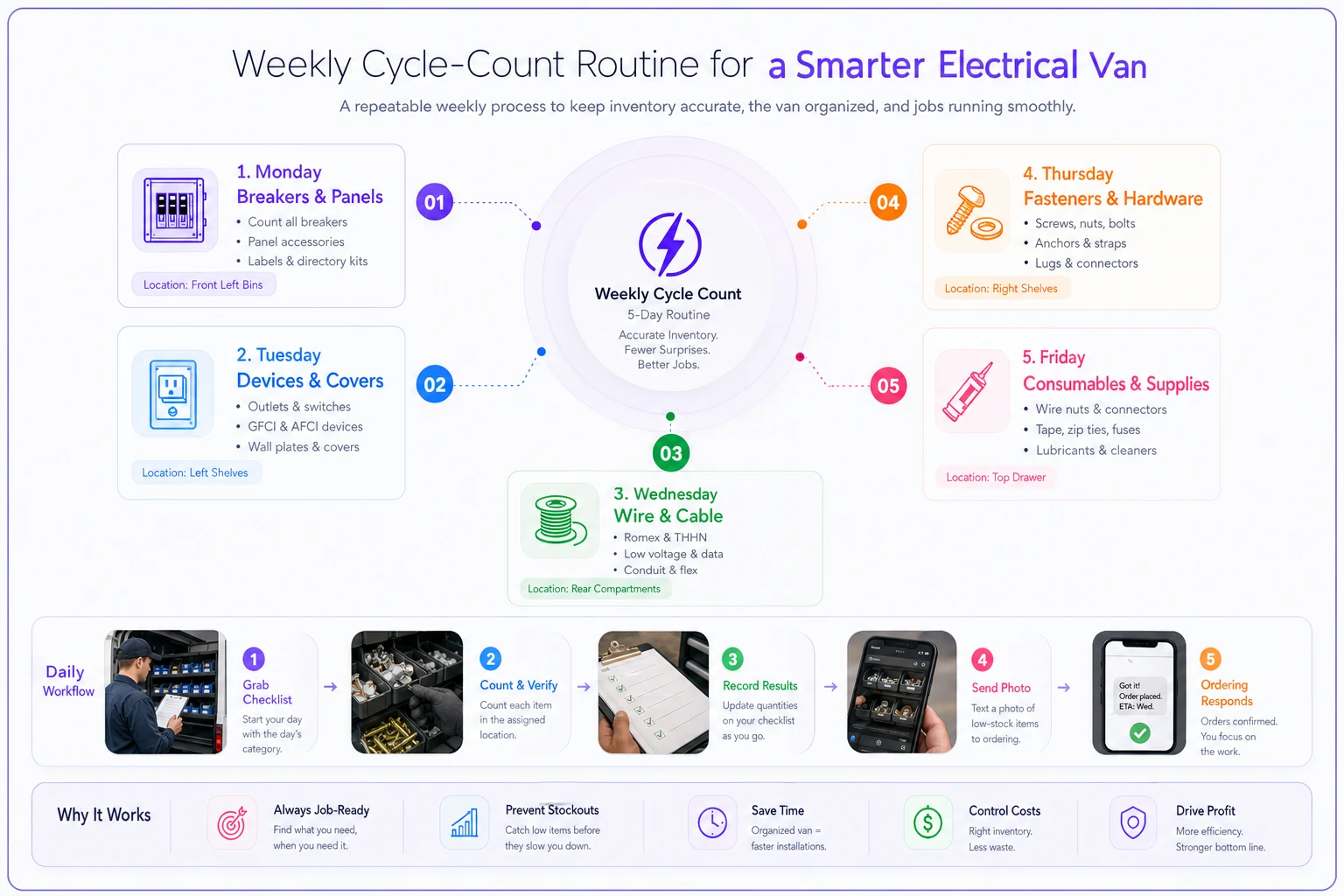
This simple rotation keeps counts quick and consistent.
For larger operations with 4+ vans, stagger the schedules so different vans count different categories each day. This smooths out ordering and prevents everyone from restocking simultaneously.
Replenishment math that keeps cash flow healthy
Inventory is cash sitting on shelves, and too many contractors treat van stock like it's free money. Smart replenishment isn't about having everything always available — it's about balancing availability against carrying cost.
Start with turnover rate. High-velocity items (wire nuts, common wire, basic devices) should turn over at least twice monthly. If you're carrying 1,000 red wire nuts but only using 200 monthly, that's five months of inventory collecting dust. Dead cash.
For fast-movers, order frequently in smaller quantities. You might pay slightly more per unit, but the cash flow benefit outweighs the unit cost difference. Order weekly what you'll use in 10–12 days. Inventory stays fresh and cash stays liquid.
Slow-moving specialty items need different logic. That $85 200-amp breaker might sit for three months, but the carrying cost beats a job delay. For items under $100 with sporadic but critical usage, keep one in stock. Over $100? Order as needed unless it's tied to a specific upcoming job.
The sweet spot for most electrical contractors is 2–3 weeks of inventory for regular items and just-in-time ordering for project-specific materials — roughly $4,000–$5,000 per van in rolling stock, not the $8,000+ you often see in overstocked vehicles.
Track your inventory investment monthly. If it's creeping up without corresponding revenue growth, you're hoarding, not stocking. Every dollar sitting in wire nuts is a dollar not available for payroll, equipment, or growth.
The Monday morning restock routine that prevents Thursday crises
The most effective restocking happens on schedule, not on demand. Monday morning — before the week gets away from you — should be restock time. But it only works with the right process.
Every Friday afternoon, each tech does a 10-minute "red flag" check. They're not counting inventory — just identifying anything that looks low. They snap photos of any bins that need attention and send them to whoever handles ordering.
Monday morning, while crews are loading up for first calls, one person handles all reordering based on Friday's flags plus any weekend emergency requests. Orders placed by 8am Monday usually arrive Tuesday or Wednesday, well before the Thursday/Friday crunch when everyone realizes they're short on something.
Physical restocking should also be consistent. When supplies arrive, they go into a staging area pre-sorted by van. Each tech grabs their bin when they return from calls, not during the morning rush. This prevents the chaos of everyone restocking simultaneously.
Some contractors designate Wednesday afternoon as van maintenance time — an hour where crews organize, restock, and reset for the back half of the week. It sounds like downtime. It prevents far more lost time from disorganization and emergency supply runs.
The trick is making restocking feel routine rather than reactive. When it becomes "just what we do Monday mornings," compliance goes up. When it's "restock whenever you notice you're low," it never happens until crisis hits.
Building accountability without micromanaging your team
Van stock accountability fails when it goes too loose ("everyone's responsible") or too rigid ("count every screw daily"). Clear ownership with simple verification is the sweet spot.
Assign each van a "stock captain" — typically the regular driver. They own the accuracy of counts and the organization of their van. The apprentice handles the physical counting while the journeyman verifies and signs off. This builds inventory awareness across experience levels without dumping everything on one person.
Track "stockout events" — any time someone has to leave a job for supplies. Make it visible but not punitive. A whiteboard showing days since the last stockout creates gentle peer pressure without feeling like surveillance.
For multi-van operations, monthly spot-checks keep everyone honest. Randomly audit one van's inventory against its recent counts. Major discrepancies warrant a deeper look. Minor variance is normal. The goal isn't perfection; it's preventing the extremes.
Share the cost impact of inventory mistakes. When techs understand that three emergency supply runs cost more than their weekly consumables budget, they start paying attention. Frame it around operational efficiency, not compliance.
The most successful contractors tie van organization into performance reviews but weight it appropriately — maybe 10% of the overall evaluation. Enough to matter, not enough to overshadow technical skills or customer service.
Real-world example: How Riverside Electric fixed their van chaos
Riverside Electric, a six-van residential operation in Ohio, was losing around $3,000 monthly in productivity from stock issues. Their senior electrician was making two supply runs daily. Apprentices were constantly borrowing parts from other vans. Nobody really knew what they actually had.
They started simple: role-based stock lists. Three vans for service, two for rough-in, one floater. Each configuration was laminated and mounted in the van. Just having a standard to compare against revealed how bad things were — one service van had 40 pounds of 3/4" EMT couplings and zero 1/2" couplings.
Next came Wednesday afternoon counts. Not everything — just the "Top 20 Problem Parts" causing most stockouts. Wire nuts, common breakers, device boxes, standard wire gauges. Fifteen minutes per van, recorded on a simple sheet.
Reorder triggers came from actual usage data. They tracked consumption for one month, found the patterns, and set triggers at 150% of weekly average usage. High enough to prevent stockouts, low enough to avoid hoarding.
Within two months, emergency supply runs dropped from 12–15 weekly to maybe 2–3. The time saved translated to roughly one additional billable service call per tech per week. At a $200 average ticket, that's about $1,200 weekly in recovered revenue — not counting the improved customer satisfaction from on-time completions.
The surprise benefit was that material costs dropped around 8%. Better visibility into actual usage meant they stopped over-ordering "just in case" and were able to negotiate better bulk rates on their true high-volume items. Turns out they'd been buying too many specialty items and not nearly enough of the basics.
When operational software makes sense (and when it doesn't)
At some point, paper checklists and photo texts hit their limit. Usually around 4–5 vans, manual tracking becomes a part-time job. This is where AI-powered operational software starts making sense — not as a magic fix, but as a tool that handles repetitive tracking so your team can focus on actual electrical work.
Modern operational platforms can automate the tedious parts: tracking usage patterns, calculating reorder points based on actual consumption, sending alerts before bins go empty. Some integrate directly with supplier systems for automatic reordering when triggers are hit.
The catch is that software only works if it matches your actual workflow. If your team won't use a complex app, that subscription is worthless. The best platforms feel like a natural extension of what you're already doing — just faster and more reliable.
For smaller operations (under 3 vans), manual systems are honestly fine. The overhead of learning and maintaining software probably outweighs the benefit. A clipboard, a routine, and basic discipline solve most of the problem.
For larger or fast-growing operations, operational software prevents van stock from becoming a full-time management headache. When AI automation handles the tracking and reorder logistics, your operations manager can focus on scheduling, customer relationships, and growth instead of counting wire nuts.
The key is choosing software that enhances your existing process rather than forcing you to completely rebuild around it. The best platforms learn your patterns and adapt to your business.
Making it stick: The first 30 days
Implementation stumbles in predictable places. Week one, everyone's bought in. Week two, compliance drops. Week three, old habits creep back. Week four is where it either takes hold or quietly dies.
Start with your highest-performing van. Get one crew fully bought in before rolling it out fleet-wide. When other techs see them finishing jobs without supply runs, they'll want the same result.
Make the first month's counts voluntary but incentivized. A $50 bonus for whoever maintains the most accurate inventory through the month. Small enough to not hurt, large enough to create engagement. Competition drives adoption better than mandates.
Don't aim for perfection right away. Going from zero inventory tracking to 70% accuracy is a real win. Build from there. Add categories gradually. Refine triggers based on actual data. Let the system evolve with your team's capability.
Be upfront about the objections. "This is extra work" — yes, 10 minutes daily to save 2 hours weekly. "I know what I have" — great, prove it with a quick count. "This is micromanagement" — it's actually the opposite, it's preventing scramble situations that make everyone look bad in front of customers.
After 30 days, reassess. Some triggers will be too high, others too low. Some count schedules won't fit your actual workflow. That's fine. The goal is a system that works for your specific operation, not one that looks perfect on paper.
The bottom line on van stock management
Van stock isn't exciting, but neither is standing in supply house lines while customers wait. The difference between contractors who scale and those who stay stuck often comes down to boring operational basics like this.
Role-based stock lists ensure each van carries what it actually needs. Reorder triggers prevent crisis-mode restocking. Simple cycle counts maintain accuracy without burning hours. Clear accountability keeps everyone engaged without micromanagement.
For most electrical contractors, fixing van stock management recovers 5–10 hours of productive time weekly — equivalent to adding half a tech without the hiring headache. More importantly, it's the difference between looking professional and scrambling constantly.
Start tomorrow with one simple step: pick your most problematic van and count just the top 10 items that cause supply runs. Set basic reorder triggers for those items. Do it for one week. The improvement will convince you — and your team — that the full system is worth building out.
Your vans are rolling warehouses that directly impact customer satisfaction and team productivity. Treat them like any other critical business asset. The payoff in reduced stress, better cash flow, and recovered billable hours is worth the effort.
Spend 10 minutes daily managing inventory, or lose hours weekly to emergency supply runs. One approach scales. The other keeps you stuck putting out fires.
Ready to optimize your electrical service operations?
Join 500+ electrical service companies using Voltzly to improve scheduling accuracy, enhance client satisfaction, and boost operational efficiency.