

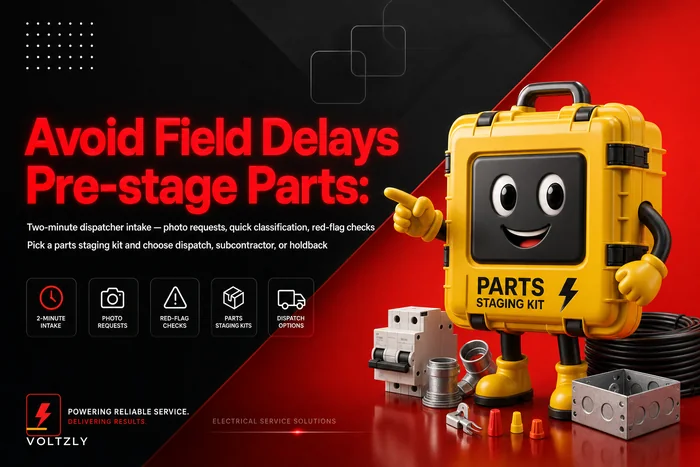
Dispatcher quick-assessment checklist to pre-stage parts for complex sites
Two-minute dispatcher flow with photo requests, red-flag triggers, parts staging rules and fallback plans (subcontractor/holdback)—designed for dispatchers, not estimators.

Actionable electrical service management tips, scheduling optimization, client retention strategies, revenue growth ideas, AI-powered job tracking, and practical advice for electrical business owners and teams.
Two-minute dispatcher flow with photo requests, red-flag triggers, parts staging rules and fallback plans (subcontractor/holdback)—designed for dispatchers, not estimators.
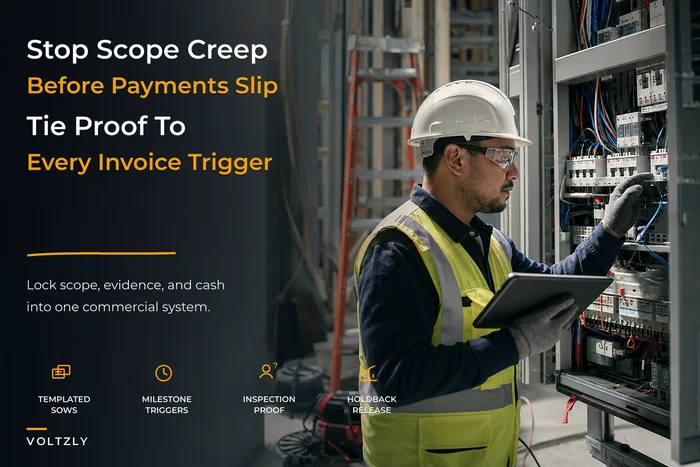
Owner-operable commercial-project OS with templated SOWs, staged invoicing triggers, inspection evidence requirements and subcontractor holdback rules to prevent scope creep and payment risk.

Summarize the DOE SPARK announcement and translate what unlocked grid capacity and lower electricity costs mean for local contractors: anticipate surges in EV charger and electrification retrofit work, update site‑assessment and pricing playbooks, rebalance van‑stock and reorder triggers for EVSE components, and adjust scheduling/dispatch and training to avoid overtime and callbacks.

Shop-level talent development OS: multi-year competency ladders, day-by-day mentor tasks, evidence sign-offs and promotion gates tied to pay bands and budget templates owners can adopt.

Owner-level governance layer tying product catalog, acceptance gates, contingency rules and renewal pricing into an owner‑operable decision matrix with escalation thresholds and worked examples.

Rule-engine recipes mapping inputs (photos, torque readings, timestamps) to accept/reject gates, QA actions, warranty decisions and low-code automations—examples and audit tables techs and ops can implement immediately.
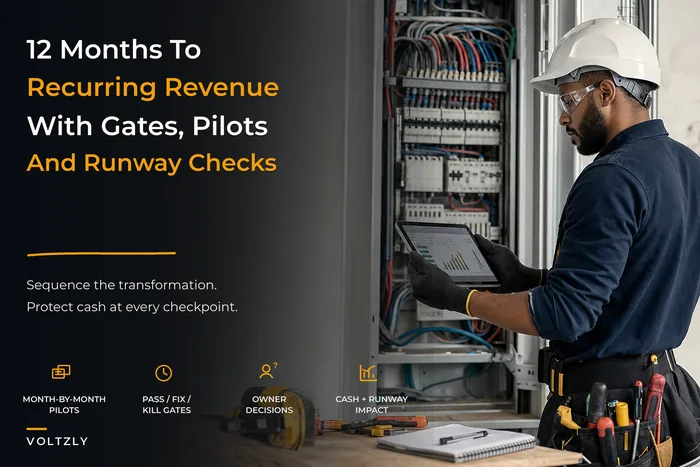
Month-by-month sequenced pilots, financial gates, KPI targets and cash/runway impact tables owners can follow—prioritized minimal‑viable pilots and decision checkpoints to move from reactive dispatch to recurring, margin‑stable revenue.

Pillar-level operational system owners can run: ties acquisition channel economics to qualification gates, lead-intake SLA mapping, rejection codes, product/SLA mapping and ops enforcement. Includes channel economics worksheets, sample SLA templates, rejection-code taxonomy, governance cadence, KPI measurement loops and a handoff RACI owners can implement.
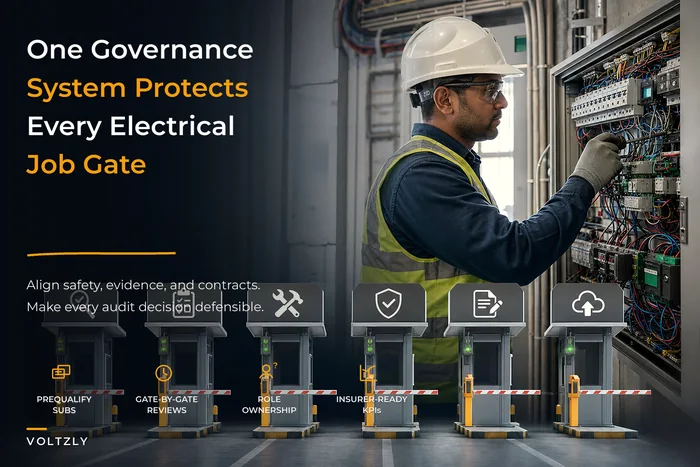
Systems-level governance playbook stitching safety, field-data standards, subcontractor prequalification/holdbacks, warranty/T&C and insurer-facing artifacts into a single resilience program. Delivers audit gates, roles and responsibilities, evidence standards, KPI thresholds, sample SOW/holdback language and an insurer-ready evidence pack owners can adopt.