


The worst call an electrical contractor can make at 10pm on a Friday isn't dispatching someone to an emergency—it's dispatching someone to what turns out to be nothing, while an actual hazard sits unaddressed until Monday morning.
The pattern across electrical service companies is pretty consistent: somewhere around 65% of emergency dispatches could have waited until normal business hours, while about 8% of "schedule for next week" calls actually needed immediate attention. That's a dangerous gap that costs most contractors somewhere between $35,000 and $52,000 a year in unnecessary overtime and missed critical issues.
The hidden cost structure of after-hours misclassification
Most electrical contractors treat after-hours calls as a simple overtime math problem. Pay the tech time-and-a-half, charge the customer an emergency fee, move on. The real financial damage happens in three less obvious places.
First is the opportunity cost cascade. When your on-call tech spends two hours driving out to a flickering light that turns out to be a loose bulb, they're unavailable when an actual emergency comes in 45 minutes later. Now you're calling your backup tech, wrecking their weekend, or worse—telling a customer with sparking outlets to wait until morning.
Second, unnecessary emergency dispatches create a customer expectation problem. Once you've sent someone out at midnight for a non-critical issue, that customer assumes the same response next time their outdoor lights stop working. You've trained them to treat everything like an emergency, and walking that back later is awkward at best.
The third cost rarely shows up in accounting: technician burnout. Every pointless 2am call chips away at your team's willingness to take on-call shifts. Eventually you're either paying premium rates to convince people to cover weekends or losing good techs who decide the lifestyle isn't worth it. One contractor in Phoenix figured out that reducing unnecessary after-hours calls by 40% extended their average technician retention by about 14 months.
Why standard triage questions fail for electrical issues
Asking customers whether something is an emergency fundamentally misunderstands how electrical problems look to non-electricians. A customer hearing a buzzing from their panel might think everything's fine because the lights still work. Another customer panics about a tripped GFCI in the bathroom and demands someone come out immediately.
Never miss a job or delay a dispatch again.
Voltzly helps you schedule, assign, and track every electrical job efficiently.
- Unified job scheduling
- Real-time technician tracking
- Automated client notifications
No credit card required
It gets worse because most triage happens through basic Q&A without any visual context. Your dispatcher asks, "Is anything sparking?" The customer says no because they don't see visible sparks—meanwhile there's charring behind an outlet cover they haven't touched. Or they describe "a burning smell" which could mean an overheating motor or someone reheating fish.
There's also the motivation problem. Customers unconsciously adjust their descriptions based on what they want. Someone hosting a party tomorrow makes a dead outlet sound like an imminent fire hazard. Someone who doesn't want to pay emergency rates downplays genuine warning signs. Without a process that captures objective information, you're making dispatch decisions based on unreliable narratives.
Building a photo-first triage workflow
Requiring visual documentation before making any dispatch decision changes the whole game. But just telling customers to "send photos" creates a mess—you get blurry images of random walls, extreme closeups showing nothing useful, or 40 photos from the same angle.
You need a scripted photo request sequence that guides customers to capture specific diagnostic images:
Initial Assessment Photos (always required):
-
Wide shot of the affected area showing the full wall or fixture
-
Close-up of the specific problem area with lights on
-
Electrical panel with door open showing all breakers
-
Any visible damage, discoloration, or unusual conditions
Conditional Follow-up Photos (based on issue type):
-
For outlet problems
Remove cover plate (if safe) and photograph internal components
-
For flickering lights
Video showing the flicker pattern over 30 seconds
-
For burning smells
Photos of all outlets/switches in the affected room
-
For power loss
Neighbor's house showing if they have power
The key is framing this as helpful rather than burdensome. "This helps us send the right technician with the right parts" lands much better than implying you're vetting whether it's worth your time. One contractor cut customer resistance to photo requests by roughly 70% just by explaining it helps avoid multiple trips and gets the problem fixed faster.
Ask customers to take a wide shot first, then a close-up, to reduce back-and-forth and get usable diagnostic images quickly.
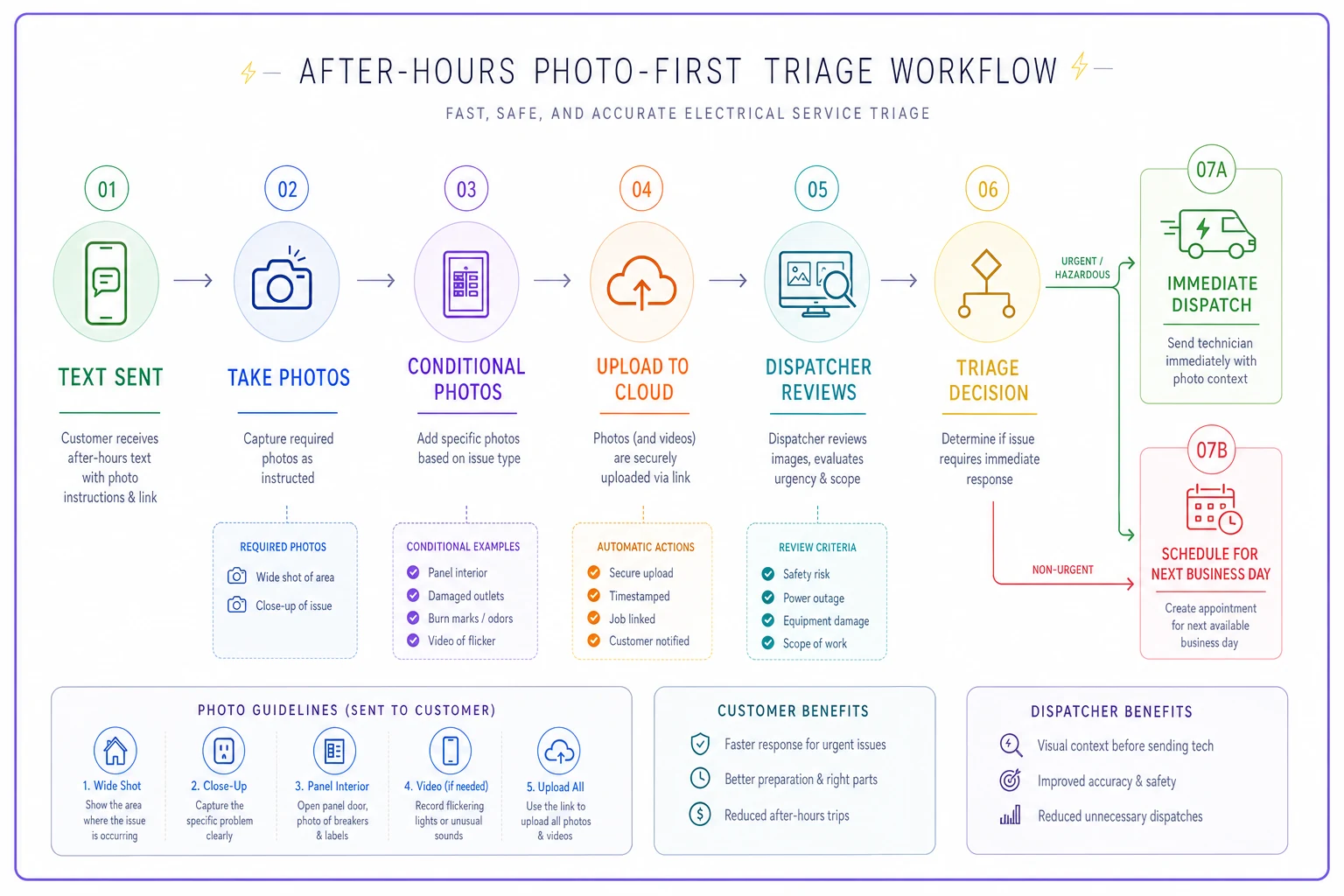
A quick visual of the workflow helps teams see where automation and human review fit together.
The decision matrix that removes guesswork
Once you have visual documentation, you need a clear decision framework. Not rigid rules for their own sake—consistent thresholds that protect both safety and profitability.
Immediate Dispatch Triggers (true emergencies):
| Visual/Reported Condition | Required Evidence | Response Time |
|---|---|---|
| Visible sparking/arcing | Photo or video showing active sparking | Within 1 hour |
| Charring/melting on outlets or panels | Clear photo of blackened or deformed plastic | Within 2 hours |
| Burning smell with visual evidence | Photo showing discoloration plus customer confirmation of active smell | Within 2 hours |
| Water actively entering electrical components | Photo/video of water dripping into panel or outlets | Within 1 hour |
| Exposed live wires accessible to occupants | Photo showing damaged insulation with copper visible | Within 1 hour |
| Complete power loss affecting life safety | Confirmation of medical equipment needs or extreme temperatures | Within 2 hours |
Next Business Day Scheduling (urgent but not emergency):
-
Partial power loss (some circuits working)
-
Dead outlets without burning signs
-
Tripped breakers that won't reset but no visual damage
-
Flickering lights in single room/circuit
-
GFCI outlets not resetting
-
Non-functional switches
Schedule Within 48-72 Hours (non-urgent):
-
Intermittent issues without pattern
-
Outdoor lighting failures
-
Garage door opener electrical issues
-
Minor buzzing sounds without visual problems
-
Single dead outlet in non-critical location
The combination of visual evidence with specific criteria is where this actually works. A burning smell gets scheduled for normal hours if photos show no discoloration. That same smell with even slight browning around an outlet triggers immediate dispatch.
Training dispatchers to navigate customer pushback
Even with clear protocols, customers push. The midnight caller whose outdoor lights went out "needs them fixed NOW" over security concerns. The business owner who can't accept that their sign lighting can wait until Monday. Dispatchers need to redirect urgency without dismissing legitimate concerns.
"I understand how concerning it is to have those security lights out. Based on the photos you've sent, we can see this isn't presenting an immediate electrical hazard, which means we can address it first thing Monday without the emergency service charge. I can note your security concern for the technician so they prioritize your call. Would you like me to also suggest some temporary lighting options for tonight?"
Acknowledge, explain, offer alternatives. Track these interactions over time and you'll notice patterns—the same customers tend to push for emergency service repeatedly. After three non-emergency situations a customer has classified as urgent, it's probably time for a direct conversation about expectations and potentially adjusting the service agreement.
Creating accountability without alienation
Telling a customer no at 11pm is uncomfortable. But framing matters here. Share your triage criteria openly—put it on your website, include it in service agreements. When customers understand you're following safety-based protocols rather than making arbitrary calls, resistance drops noticeably. One contractor in Dallas created a simple infographic showing "Emergency vs. Non-Emergency" examples and saw after-hours call volume drop around 30% as customers started self-screening before picking up the phone.
Build in safety margins that protect your decision-making. If there's genuine doubt about whether something is a hazard, dispatch. But track borderline calls separately. Over time you'll identify which visual indicators actually correlate with dangerous conditions versus which ones just look alarming. That data refines your matrix without compromising safety.
Common patterns in false emergency calls
A few patterns come up repeatedly in unnecessary after-hours dispatches.
"Event-driven panic" accounts for roughly 35% of them. These come in the 24-48 hours before holidays, parties, or family gatherings. A dead outlet in the spare bedroom suddenly becomes critical because guests arrive Saturday. The fix isn't dismissing these concerns—it's proactively identifying upcoming events during regular service calls and addressing potential issues beforehand.
Weather-triggered false alarms spike during storms, but not always for the obvious reasons. Yes, actual storm damage warrants emergency response. But a significant portion of storm-related calls come from normal protective device operation—GFCIs tripping from moisture, breakers tripping from grid fluctuations, or temporary outages that resolve on their own. Teaching customers to check basic reset procedures before calling cuts these by around 60%.
Then there's what you might call the "Google diagnosis disaster"—customers who research symptoms online and convince themselves they're facing imminent catastrophe. A slight buzzing from the panel becomes "my house is about to burn down" after three forum posts. Having your own educational content that ranks well for common electrical problem searches gives customers a more grounded resource to find first.
Measuring success beyond reduced callouts
Counting fewer emergency dispatches is the obvious metric, but it misses some critical indicators of whether the system actually works.
Track your false negative rate—times you didn't dispatch but should have. This requires following up on all declined emergency requests within 24-48 hours. If techs are regularly finding conditions that warranted immediate response, your triage criteria need adjustment. Even a 2-3% false negative rate represents unacceptable risk.
Get technician feedback on dispatch appropriateness. Your field team knows whether that 11pm call was justified. A simple rating system where techs score each after-hours call as "emergency," "could have waited," or "borderline" creates useful frontline intelligence for refining your matrix.
Customer satisfaction measurement also needs nuance. Track not just complaints about declined emergency service, but appreciation for avoiding unnecessary charges. Customers who experience proper triage—being told their issue can wait, then having it efficiently resolved during normal hours—tend to show meaningfully higher lifetime value than those who got immediate emergency response for something that wasn't actually urgent.
Technology integration without overcomplication
The photo-based triage system works with basic tools. Any smartphone captures images, any email system receives them. But a few enhancements can streamline the process without major investment.
Automated photo request sequences remove dispatcher workload from the initial contact. When a customer calls after hours, they immediately receive a text with specific photo instructions based on their described problem—before a dispatcher is even involved. This collects diagnostic information while the dispatcher finishes with other calls.
Cloud-based photo storage with automatic organization prevents the chaos of managing hundreds of emergency assessment images. Tag photos with customer information, date, disposition, and actual findings. Over time this becomes a searchable database for training new dispatchers and refining triage criteria.
The sweet spot for most contractors is partial automation—technology handles routine tasks like photo collection and initial sorting, while humans make final dispatch decisions. Full automation might sound appealing, but electrical hazards require contextual human judgment that pure automation isn't reliably providing yet.
For contractors looking to streamline the coordination layer further, AI-powered operational software can help manage after-hours workflows—automatically routing photo submissions, flagging criteria matches, and maintaining records of triage decisions without building out a complex custom tech stack. It removes the administrative friction that causes protocols to break down in practice.
Real scenario: How one company cut after-hours costs by 70%
Lightning Electric in Austin implemented this photo-first triage system after calculating they were spending $67,000 annually on unnecessary after-hours dispatches. Their previous approach relied on customer descriptions and dispatcher judgment—techs regularly showed up to non-issues at 2am while genuine hazards waited until Monday.
Implementation took three weeks. Week one was building the photo request scripts and training dispatchers on the new workflow. Week two involved testing with willing customers during regular hours, refining based on what actually worked. Week three launched the system for all after-hours calls with careful monitoring.
Results showed up fast. First month brought a 40% reduction in emergency dispatches with zero safety incidents. By month three, unnecessary callouts were down 70% while customer satisfaction had actually improved—people appreciated not getting charged emergency rates for non-critical issues. False negative rate held under 1%, caught through systematic follow-up protocols.
The unexpected win was technician retention. On-call shifts became manageable when techs knew they'd only get dispatched for genuine emergencies. Lightning Electric went from struggling to fill weekend rotations to having technicians volunteer for extra shifts. The owner calculated total annual savings around $84,000 when factoring in reduced overtime, better retention, and improved customer lifetime value.
The path forward for electrical contractors
After-hours triage isn't just an efficiency play—it's about building a service model that holds up over time. Every unnecessary midnight dispatch burns money, exhausts technicians, and ties up capacity for actual emergencies. Every missed genuine hazard is a different kind of failure entirely.
The photo-first triage system with clear decision matrices removes most of the guesswork from that critical decision point. It's not a perfect system—nothing is when you're dealing with electrical hazards and human judgment. But it's dramatically better than relying on customer descriptions and dispatcher instinct alone.
Implementation doesn't require massive investment or complex technology. Start with basic photo requirements, simple decision criteria, and systematic tracking. Refine based on what your specific market actually needs. The contractors seeing the best results treat triage as an evolving system, not a fixed protocol they set and forget.
The business case is straightforward: reduced overtime costs, better technician retention, stronger customer relationships, and appropriate response to genuine hazards. In an industry where the difference between an emergency and a Monday morning appointment can mean thousands in unnecessary costs—or a serious safety failure—getting triage right isn't optional. It's just good operations.
The business case is straightforward: reduced overtime costs, better technician retention, stronger customer relationships, and appropriate response to genuine hazards. In an industry where the difference between an emergency and a Monday morning appointment can mean thousands in unnecessary costs—or a serious safety failure—getting triage right isn't optional. It's just good operations.
Ready to optimize your electrical service operations?
Join 500+ electrical service companies using Voltzly to improve scheduling accuracy, enhance client satisfaction, and boost operational efficiency.