



Most electrical shops assume their margin problems live in pricing. Bad quote, thin markup, forgot to charge for the second trip. So they tighten the estimate and move on. But the biggest profit leaks in a service business rarely happen in one place — they happen in the seams between departments. The gap where scheduling hands off to dispatch. Where dispatch hands off to job-prep. Where the tech finishes and QA either happens or doesn't. Where billing is supposed to fire but sits for four days because nobody closed the ticket.
That's what an operations playbook for electrical contractors is really about. Not a binder of rules nobody reads. A defined set of handoffs, decision triggers, and standard operating procedures that keep information moving cleanly from the moment a call comes in to the moment cash hits the account.
These leaks are almost invisible on any single job. You lose 20 minutes here, one extra truck roll there, a two-day billing delay somewhere else. None of it shows up as a fire. It shows up at the end of the quarter when revenue looks fine but profit is soft and nobody can point to why.
Why the seams break in almost every shop
There's a pattern worth understanding: individual roles get better as shops grow, but the connections between them get worse.
When you're a two-truck operation, the owner handles scheduling, dispatch, and quality control in their head. Handoffs are instant because they're happening inside one person. Nothing gets lost because the same person who took the call is standing in the driveway.
Then you hit five, six, eight techs. Now you've got an office coordinator, a dispatcher, maybe a lead tech handling QA informally. Information has to travel between people, and every time it travels, it degrades. The customer mentioned a subpanel in the garage. The dispatcher didn't note it. The tech shows up expecting a straight panel swap and finds a mess. That's a truck roll, a reschedule, and an annoyed customer — all from one dropped detail across a single handoff.
What shows up repeatedly across small field-service operations is that the shop doesn't outgrow its people. It outgrows its communication defaults. The informal system that worked at two trucks quietly fails at six, and because it fails quietly, owners keep blaming individuals instead of fixing the handoff.
The five handoffs that decide your margin
Every residential and light-commercial electrical job moves through roughly the same chain. Money leaks at each transition point, and each one has a distinct failure mode.
Never miss a job or delay a dispatch again.
Voltzly helps you schedule, assign, and track every electrical job efficiently.
- Unified job scheduling
- Real-time technician tracking
- Automated client notifications
No credit card required
| Handoff | What's supposed to transfer | Common failure | What it actually costs |
|---|---|---|---|
| Scheduling → Dispatch | Full scope, site notes, access details, parts flags | Vague job description, missing site conditions | Wrong truck sent, missing parts, extra trip |
| Dispatch → Job-prep | Materials list, permit status, tech skill match | Parts not staged, no permit confirmation | Tech waits or drives to supply house |
| Job-prep → Field | Clear scope, customer expectations, safety flags | Tech re-discovers scope on site | Scope creep, unbilled labor, delays |
| Field → QA | Completion photos, test results, punch items | QA skipped when busy | Callbacks, warranty claims, reputation hits |
| QA → Billing | Signed approval, final materials, change orders | Ticket sits "almost done" | Delayed invoicing, forgotten line items |
The thing most owners miss: a failure early in the chain gets more expensive the later you catch it. A scope detail missed at scheduling costs a note. The same detail missed until the tech is on site costs a truck roll. Missed until billing costs an argument over a change order that was never documented. Same root cause, wildly different price tag depending on which seam it slips through.
What a clean handoff actually looks like
The scheduling-to-dispatch handoff is worth going through in detail, because it sets up everything downstream and it's the one shops consistently get wrong.
When a call comes in, the person booking it is under pressure to move on to the next one. So they write "panel work — Tuesday AM" and close the tab. That single line is where the trouble starts. The dispatcher has to guess at scope, the job-prep person doesn't know what to stage, and the tech walks in blind.
-
Scope in plain language — not "panel work" but "customer reports breakers tripping in kitchen, wants panel assessed, may need upgrade."
-
Site conditions — panel location, access, parking, pets, gate codes, whether it's an occupied home.
-
Parts and skill flags — anything that tells the prep team what to stage and helps dispatch assign the right tech.
-
Customer expectations — what were they told about price, timing, and what "done" looks like.
The whole point is that the next person in the chain should never need to call back to the previous person just to do their job. Every callback across a handoff is a signal that the handoff is broken. Track how often dispatch calls the office to clarify a job, and you've got a direct readout on how leaky that first seam actually is.
This diagram shows the ideal scheduling→dispatch→job-prep→field→QA workflow and where handoffs and decision triggers should sit.
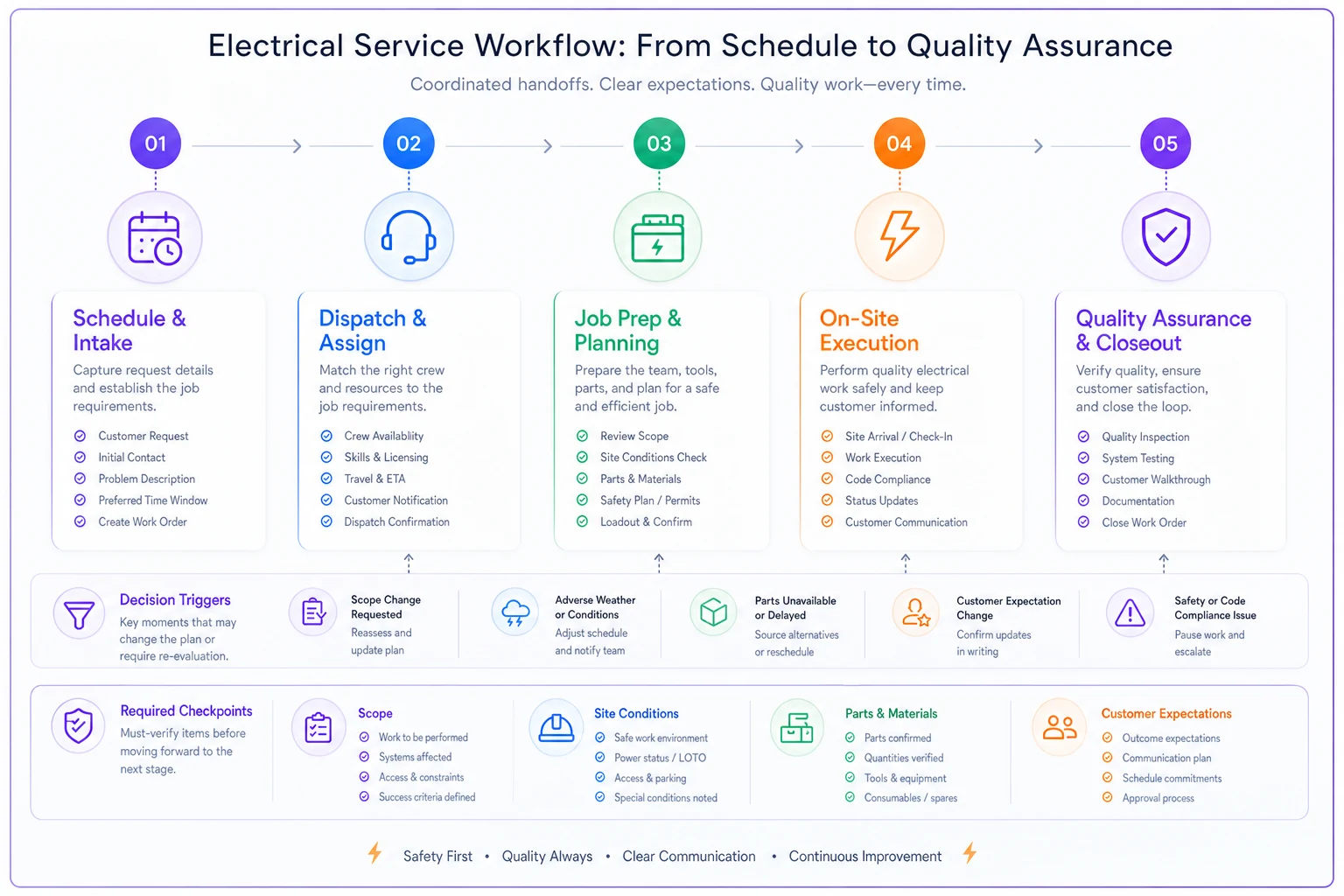
Track how often dispatch calls the office to clarify a job, and you've got a direct readout on how leaky that first seam actually is.
Decision triggers: the part everyone forgets
SOPs tell people what to do in the normal case. Decision triggers tell people what to do when reality doesn't cooperate — and that's where money is actually made or lost.
-
If on-site scope exceeds the quoted amount by more than roughly $400 → tech stops, calls the office, documents with photos before proceeding.
-
If a safety hazard is found that wasn't quoted → job pauses, escalate to lead, generate a written change order before any work continues.
-
If a job runs past its scheduled window by more than an hour → dispatch gets notified so the next appointment receives a proactive call instead of a no-show surprise.
-
If parts aren't on the truck → don't drive to the supply house on instinct; check with prep first, because half the time it's staged and forgotten.
Make dollar thresholds round (about $400) so techs can make quick, consistent decisions in the field.
The reason triggers matter more as you scale: at two trucks, the owner catches these judgment calls. At eight trucks, the owner isn't available and the tech is making a $600 decision alone. Triggers turn scattered judgment into consistent policy — and that's the difference between a shop that scales cleanly and one that just gets bigger and messier.
Where automation quietly earns its keep
None of this requires software to start. A real playbook can run on a whiteboard and a group chat, and plenty of shops should build it that way before buying anything. But there's a ceiling.
That ceiling shows up when handoffs get too frequent to babysit manually. Somewhere around the point where daily job volume is high enough that the coordinator can't personally confirm each stage, the manual system starts dropping stitches again — not because the SOPs are wrong, but because nobody has the bandwidth to check that every handoff actually completed.
This is where an AI-assisted operational platform stops being optional. The value isn't flashy. A ticket can't move to "dispatched" until scope and site notes are filled in. QA photos are required before a job can be marked billable. When a job blows past its window, the platform flags it automatically and the next customer gets a heads-up instead of waiting for a dispatcher to notice. AI automation genuinely earns its keep on the boring connective work — reading a completed job ticket and flagging that a change order was mentioned in the tech's notes but never billed, for instance. A human catches that maybe 70% of the time. A system catches it every time.
The point isn't to replace judgment. It's to make sure the handoff never silently fails, which is the one thing a manual system can't guarantee once volume climbs.
When a formal playbook is overkill
Not every shop needs this.
If you're a solo electrician or a two-person shop where the owner touches every job, a heavy SOP-and-trigger system is just bureaucracy you'll resent. You are the handoff. Write down three things — your standard close-out checklist, your escalation rule for scope changes, your billing trigger — and stop there.
The formal system starts paying off when:
-
You've got enough techs that the owner no longer sees every job.
-
Handoffs happen between different people, not inside one head.
-
You're seeing callbacks, billing delays, or "wait, who was supposed to order that?" moments.
-
You want to hire without quality dropping every time someone new joins.
And a 40-page playbook nobody reads is genuinely a waste of time. The shops that get this right build it in layers — nail the scheduling-to-dispatch handoff first, live with it for a month, then add the next seam. A playbook that grows one enforced rule at a time beats a comprehensive binder that gets ignored on day one.
A real scenario
A residential electrical shop running six techs was doing solid revenue — somewhere around $1.4M a year — but the owner couldn't figure out why profit felt thin. Nothing was obviously broken. Jobs were getting done.
When they actually mapped the handoffs, two leaks showed up. Billing first. Completed jobs were averaging five or six days before invoicing because tickets sat in a "basically done" limbo until someone got around to closing them. Second, change orders. Techs were doing extra work on site — an outlet here, a fixture there — and roughly one in four of those never made it onto the invoice because there was no trigger forcing documentation before the work happened.
They didn't overhaul everything. They fixed two seams. A hard rule that no job closes without a completion photo and a change-order check, and a billing trigger that fired the invoice within a day of QA sign-off. Within about two months, average time-to-invoice dropped to under two days, and the recovered change-order work added a few thousand dollars a month that had simply been evaporating. Same techs, same trucks, same jobs. The only thing that changed was that the handoffs stopped leaking.
Start with the seam that hurts most
The mistake is trying to document everything at once. You don't need a complete operations manual by Friday. You need to find the single handoff where jobs most often stall or details most often vanish, and put a real SOP plus a trigger on that one seam.
For most growing electrical shops, that's either the scheduling-to-dispatch handoff — because it poisons everything downstream — or the QA-to-billing handoff, because that's where finished work quietly fails to turn into cash. Pick the one that's costing you sleep, define the four things that must transfer, add two or three triggers that handle the off-ramps, and enforce it for a month before touching anything else.
Build it seam by seam, and the profit that's been quietly disappearing between your departments starts showing up where it belongs.
A playbook isn't a document. It's the set of connections that keep your shop's information — and therefore its money — moving in one direction without leaking out the sides. Build it seam by seam, and the profit that's been quietly disappearing between your departments starts showing up where it belongs.
Ready to optimize your electrical service operations?
Join 500+ electrical service companies using Voltzly to improve scheduling accuracy, enhance client satisfaction, and boost operational efficiency.