



Running dispatch for a small electrical crew is weird. You've got maybe four techs, twelve service calls scattered across town, and everyone's looking at you like you're supposed to magically know whether Jake should hit the nursing home rewire before or after Mrs. Chen's outlet repair.
The big shops have their fancy route optimization platforms that cost $400 per tech per month. When you're running a lean operation, that's $2,400 monthly just to figure out who drives where. And those systems need clean addresses, accurate job durations, and someone tech-savvy enough to troubleshoot when the algorithm sends your panel upgrade specialist to three basic outlet swaps in a row.
Most small electrical contractors I've talked to have landed on something counterintuitive: simple sequencing rules often beat algorithmic routing for crews under six techs. Not because the rules are smarter, but because they're easier to adjust when reality hits. When a customer reschedules, when a job runs long, when your lead tech calls in sick—you need flexibility, not optimization scores.
The morning dispatch problem that kills productivity
At most 2–6 tech shops, morning dispatch looks something like this: everyone's standing around at 7:45am, coffee in hand, waiting for assignments. The dispatcher—usually the owner—is frantically checking texts from customers, reviewing yesterday's incomplete jobs, trying to remember who's certified for what, and basically winging it.
By 8:15am, everyone finally rolls out. Except Tom's heading north for a 9am while Steve drives past the same neighborhood going south for his 10:30. They'll cross paths twice without knowing it. Meanwhile, your apprentice sits in traffic for 45 minutes to reach a basic switch replacement that your journeyman could've knocked out on his way past.
The real killer isn't the wasted gas—though at current prices, that stings. It's the compound effect. Every extra 20 minutes of windshield time is 20 minutes not generating revenue. Across four techs working around 220 days a year, routing inefficiencies can eat 350–400 billable hours. At shop rates around $150/hour, that's $50k–$60k in lost revenue, not counting overtime you're paying because jobs ran late.
Geographic clustering beats pure time optimization
The most effective dispatch rule I've seen small shops implement is dead simple: assign geographic zones and stick to them unless absolutely necessary.
Never miss a job or delay a dispatch again.
Voltzly helps you schedule, assign, and track every electrical job efficiently.
- Unified job scheduling
- Real-time technician tracking
- Automated client notifications
No credit card required
Take a typical suburban service area. Break it into quadrants—northeast, northwest, southeast, southwest. Each morning, assign techs to quadrants based on their first appointment. That tech owns that quadrant for the day. New calls that come in go to whoever's already working that area, assuming basic skill match.
Anchor techs to the quadrant of their first appointment and avoid mid-day zone swaps unless the value of switching clearly outweighs the disruption.
This isn't sophisticated, but it stops the ping-pong effect. Your techs aren't running diagonal routes across town chasing theoretical efficiency. They're working a contained area, learning the traffic patterns, figuring out where to grab lunch, and sometimes even building relationships with the commercial property managers who see the same van every week.
A shop in Phoenix tracked their numbers after six months of quadrant dispatch: average daily windshield time dropped from 2.8 hours to 1.9 hours per tech. Sounds minor until you realize that's almost an extra billable call per day per tech.
Time windows: the 2-hour block reality
Customers want specific times. You want flexibility. The standard compromise is the dreaded "we'll be there between 8am and noon" window that everybody hates.
-
8am–10am (early morning)
-
10am–12pm (late morning)
-
12pm–2pm (early afternoon)
-
2pm–4pm (late afternoon)
The float zone is the key piece. Jobs starting in the 8–10am block can slide until 11am before you need to notify the customer. That gives your tech a realistic buffer without blowing up the customer's entire day.
Within each quadrant, you sequence jobs by time block priority, not pure geography. A 10am–12pm commitment in the northwest corner comes before a 2pm–4pm job that's technically closer to where your tech finished their 8am call. Respect the time windows first, optimize routing second.
The AM dispatch meeting that actually works
Forget the chaotic morning scramble. Here's a dispatch routine that takes about 8 minutes and prevents the majority of routing mistakes:
7:30am – Pre-meeting prep (dispatcher only)
-
Check overnight messages for cancellations or emergencies
-
Mark time-sensitive jobs with red magnets on the board
-
Note which customers explicitly requested specific techs
7:40am – Tech arrival and self-check
-
Techs grab their zone assignment card
-
Review their job list for missing info or concerns
-
Flag any jobs they're not equipped to handle
7:45am – Rapid round-robin
-
Each tech states their first job and estimated completion
-
Dispatcher adjusts only if there's a major conflict
-
No discussion of individual job details—save that for one-on-ones
7:50am – Final sequencing
-
Techs arrange their jobs within their zone
-
Dispatcher approves or adjusts based on time windows
-
Everyone photographs the board for reference
7:55am – Roll out
This isn't a strategy meeting. It's an execution checkpoint. The actual planning happened the night before when you pre-assigned zones based on the next day's first appointments.
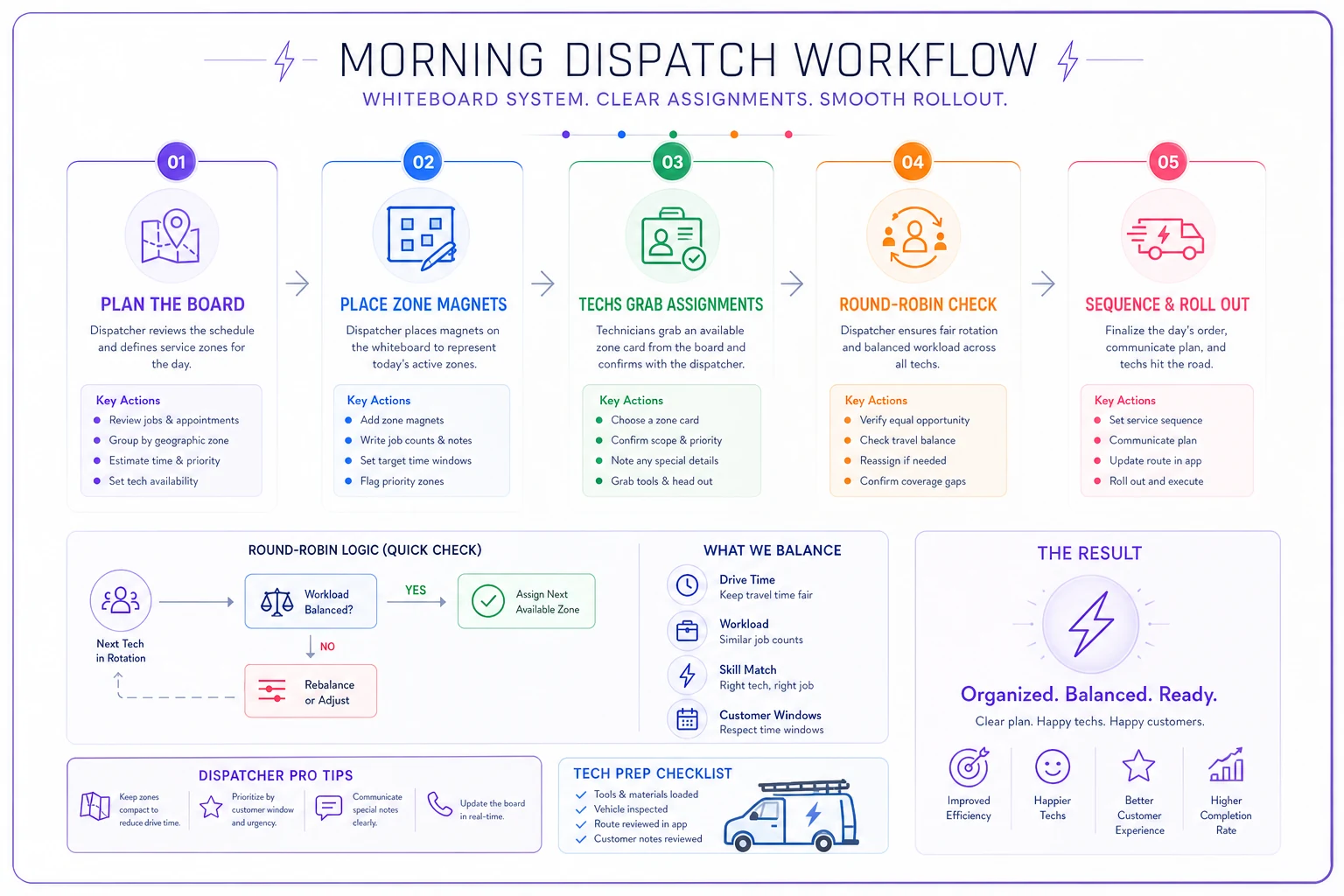
A quick visual like this helps keep the team aligned and speeds the 8-minute routine.
Sequencing rules that respect both profit and promises
Within each geographic zone, the sequencing priority order should go:
-
Emergency/safety calls – These jump the queue, period
-
Time-committed jobs – Sort by earliest window end time
-
High-margin commercial work – Your $800/hour emergency rate beats $150 residential
-
Quick-wins near other jobs – 20-minute outlet swaps between bigger calls
-
Flexible residential work – Customers who said "anytime today is fine"
-
Quotes and assessments – These can almost always slide
You also need escape hatches built in. When a two-hour panel upgrade turns into a six-hour nightmare because of corroded connections, your sequencing plan falls apart.
Circuit breakers that work:
-
Any job running 60+ minutes over estimate triggers a dispatcher check-in
-
Tech can bump one afternoon job to tomorrow without approval
-
After 2pm, all remaining jobs get re-evaluated for same-day viability
Circuit breakers that work:
The two-tech handoff that prevents disaster
Small shops often run two-person crews for bigger jobs. The sequencing challenge is coordinating their schedules without creating dead time.
The rule that works: the senior tech owns the schedule, the junior tech floats.
Your master electrician hits their jobs in sequence. Your apprentice handles prep, parts runs, and fill-in work between assists. When they converge for a two-person job, it's always at the senior tech's location—not some mutual meeting point.
This sounds unbalanced, but it maximizes billable output. Your $85/hour master stays on-site generating revenue while your $35/hour apprentice handles logistics. The apprentice might drive more, but their windshield time costs less than having your master sitting idle.
Real-world example: Tuesday chaos at Morrison Electric
Morrison Electric runs four techs plus the owner who still takes calls. Last Tuesday looked like this:
Initial morning assignments:
-
Jake (journeyman)
Northwest zone, 6 jobs, first at 8am
-
Maria (master)
Northeast zone, 4 jobs, first at 9am
-
Devon (apprentice)
Southwest zone, 8 jobs, first at 8:30am
-
Kyle (journeyman)
Southeast zone, 5 jobs, first at 8am
By 10:30am, Jake's running behind on a tricky panel upgrade—aluminum wiring nobody mentioned. He texts dispatch that he needs two extra hours.
Old way: Panic. Call every customer. Shuffle everything. Lose half the day.
With zone-based sequencing: Dispatcher checks Jake's remaining jobs. Two have open time windows, one's a quote that can slide. Only one needs rescheduling—a 2pm time-committed repair. Devon's already in the southwest zone with capacity. One job moves, everyone else stays on track.
By end of day:
-
23 of 23 jobs completed
-
Average windshield time
1.7 hours per tech
-
Only one customer rescheduled
-
No overtime required
That's the difference. Not perfect optimization, but workable flexibility.
When to break your own rules
Every sequencing system needs override triggers.
Break geography rules when:
-
A high-value commercial client has an emergency
-
You can complete a $2k job by sending someone 20 minutes out of zone
-
A tech has unique certification for a specific job (pool wiring, solar, etc.)
Break time-window rules when:
-
A safety issue requires immediate response
-
The customer explicitly agrees to a later arrival for same-day service
-
Weather or traffic makes the original window impossible
Break the skills-match rules when:
-
A simple job pays premium rates (emergency or after-hours fees)
-
The customer relationship matters more than efficiency
-
A training opportunity justifies an apprentice taking longer
The point isn't to override constantly. It's knowing when the exception generates more value than the rule.
Building tomorrow's route tonight
The best routing happens before anyone shows up. A 15-minute end-of-day routine that makes morning dispatch actually function:
4:30pm – Collect tomorrow's confirmed jobs
-
Pull all scheduled appointments
-
Add carryovers from today
-
Check tomorrow's time windows
4:35pm – Assign zones based on first appointments
-
Each tech gets anchored to their first job's location
-
That determines their zone for the entire day
-
Fill in remaining jobs within those zones
4:40pm – Balance the load
-
Count jobs per tech
-
Factor in complexity (panel upgrade = 2–3 basic jobs)
-
Shift flexible jobs to even out workload
4:45pm – Flag the problems
-
Mark any time conflicts
-
Note jobs requiring specific tools or certifications
-
Highlight customer requests for specific techs
This pre-planning turns morning dispatch into execution rather than strategy. You're adjusting a plan, not building one from scratch while everyone stands around waiting.
Software isn't magic (but it helps)
After a few months of running these manual rules, most shops realize the human overhead starts to add up. Tracking zones on a whiteboard works, but someone still has to update it. The 15-minute evening planning session is great until the owner's at their kid's soccer game.
That's where operational software starts making sense—not as a replacement for these rules, but as a way to enforce them automatically. A decent dispatch platform can maintain your zones, respect your time windows, and flag conflicts without someone manually checking everything each morning.
The AI automation piece particularly helps with constant re-sequencing when jobs run long or customers reschedule. Instead of the dispatcher mentally rebuilding the day every time something shifts, the system can suggest reassignments based on your actual rules. Tech marks a job as running late, platform checks who else is in that zone with capacity.
What matters most: you need the rules first, the software second. Too many shops buy routing software hoping it'll solve their dispatch chaos. It won't. It'll just digitize the chaos and make it harder to override when human judgment is needed.
Making it stick: the first 30 days
Rolling out new dispatch rules in a small shop is mostly about breaking old habits. Your techs are used to their routes. Your dispatcher's used to the morning scramble. Some customers even get trained to expect certain patterns.
Week 1: Run zones for morning appointments only. Let afternoon stay flexible while people adjust.
Week 2: Extend zones through lunch. Start tracking windshield time so improvements become visible.
Week 3: Full-day zone assignments. Begin enforcing time-window priorities.
Week 4: Add the evening pre-planning routine. Measure how much the morning dispatch time drops.
The resistance points are predictable. Techs complain about "their" customers being in someone else's zone. The dispatcher feels like they're losing control. Some customers notice different techs showing up.
Push through it. After 30 days, the efficiency gains are hard to argue with. Techs start getting home earlier. The dispatcher stops getting panicked texts all afternoon. Revenue per tech climbs because more time goes toward billable work.
The numbers that actually matter
Forget complex routing metrics. For a small electrical shop, track these three:
-
Average windshield time per tech per day – Should be under 2 hours
-
Percentage of time-window promises kept – Target 85% or better
-
Jobs completed per tech per day – Should increase 15–20% with solid sequencing
A four-tech shop running proper zone dispatch typically sees:
-
20–30% reduction in daily drive time
-
10–15% increase in daily job completion
-
40–50% reduction in customer reschedules
At standard shop rates, that's roughly $40k–$60k in additional annual revenue without adding techs or extending hours. Just better sequencing of the same work.
| Metric | Target/Note |
|---|---|
| Average windshield time per tech per day | Should be under 2 hours |
| Percentage of time-window promises kept | Target 85% or better |
| Jobs completed per tech per day | Should increase 15–20% with solid sequencing |
At standard shop rates, that's roughly $40k–$60k in additional annual revenue without adding techs or extending hours. Just better sequencing of the same work.
Why simple rules beat complex algorithms
The endgame isn't to avoid technology forever. Once you're running 8+ techs, covering hundreds of square miles, juggling complex commercial contracts—yeah, you need real routing software. But for the 2–6 tech shop, which is the majority of electrical contractors, simple rules deliver most of the value with none of the complexity.
These sequencing tactics work because they match how small shops actually operate. You know your techs' strengths. You know which customers are flexible and which throw fits. You know Tuesday traffic is hell on the eastside and Thursday afternoons are dead downtown.
An algorithm doesn't know that Mrs. Patterson always offers cookies and adds 20 minutes of chatting to a simple job. It doesn't know Jake's going through a rough stretch personally and probably shouldn't be routed near certain parts of town. It doesn't know the country club always adds extra work once you're on-site.
You know these things. These rules let you use that knowledge while still maintaining enough structure to avoid daily chaos.
The route sequencing challenge for small crews isn't about finding the mathematically optimal path. It's about building sustainable patterns that respect both operational efficiency and human reality. Get the basics right—zones, time windows, evening prep—and you'll capture most of the possible gains with a fraction of the complexity.
Your techs want predictability. Your customers want reliability. Your business needs profitability. Simple sequencing rules deliver all three without requiring a computer science degree or a massive software investment. Start with the whiteboard and magnets. Let the patterns prove themselves. Then, if it makes sense, look at letting software handle the repetitive parts while you stay focused on the exceptions that actually require human judgment.
Better rules, not better algorithms.
Ready to optimize your electrical service operations?
Join 500+ electrical service companies using Voltzly to improve scheduling accuracy, enhance client satisfaction, and boost operational efficiency.