


Most electrical contractors draw service territories wrong. They look at a map, draw some circles around their shop, maybe split things by zip codes, and call it done. Then they wonder why some techs drive 90 minutes between calls while others sit idle, why certain neighborhoods always get emergency callbacks at 4pm, and why their best technicians keep threatening to quit.
The real problem isn't the territories themselves—it's treating territory design like a geography exercise instead of a capacity equation. When you're running 2 techs, you can wing it. But somewhere around 5–6 techs, the informal system breaks. By 15 techs, bad territory design costs you $8,000–12,000 monthly in windshield time alone. And if you actually make it to 30+ techs with poor territory structure, you're basically running three separate companies that hate each other.
Why electrical shops hit the same scaling walls at predictable tech counts
There's a pattern electrical contractors follow when growing their field teams. At 3–4 techs, everything still works because the owner dispatches from memory. Everyone knows which tech handles commercial panel work, who's good with old knob-and-tube, who lives near the industrial park.
Around 6–8 techs, the wheels start wobbling. The dispatcher—usually the owner's spouse at this point—starts mixing up who covers what area. Techs begin crossing paths on the highway. That one guy who lives 45 minutes north keeps getting sent south because "he's really good with service upgrades." Daily windshield time jumps from 1.5 hours per tech to 2.5 hours, but nobody notices because revenue is growing.
The 12–15 tech range is where most shops either fix their territory system or plateau forever. This is when you discover your "zones" don't match actual call volumes. The west side that seemed busy actually generates 8 calls daily while the east side you barely covered generates 22. Senior techs cherry-pick profitable neighborhoods. New guys get sent wherever there's a gap. Nobody knows who's supposed to handle that new subdivision going up on the county line.
What kills me is watching shops try to muscle through these problems by just hiring more techs. They think adding bodies solves coverage issues. Instead, they end up with 20 technicians generating the same profit as when they had 12—except now with higher overhead and more headaches.
The three territory design approaches and which actually works for electrical contractors
There are only three ways to split service territories for electrical work, and two of them guarantee failure at scale.
Never miss a job or delay a dispatch again.
Voltzly helps you schedule, assign, and track every electrical job efficiently.
- Unified job scheduling
- Real-time technician tracking
- Automated client notifications
No credit card required
Geographic splits seem logical. North, South, East, West. Clean lines on a map. Except electrical work doesn't distribute evenly by geography. That historic downtown district might generate 40 service calls monthly across six square blocks. The suburban sprawl zone might produce 15 calls across thirty square miles. Geographic splits create feast-or-famine territories where some techs run ragged while others scroll their phones in parking lots.
Customer-type splits make sense until you try dispatching them. Residential tech, commercial tech, industrial specialist. Sounds professional. Then your residential guy is booked solid for three weeks while your commercial tech has four half-days open because permits got delayed. Plus, that restaurant owner who needs an emergency panel repair doesn't care that your commercial tech is sitting in traffic 30 miles away when your residential tech is fixing an outlet two blocks over.
Capacity-based territories actually work, but almost nobody uses them because they require math. You calculate actual service density, drive-time polygons, and seasonal patterns. Then you draw weird, gerrymandered-looking territories that make no visual sense but balance workload well. Your territories look drunk, but each tech handles 6–8 calls daily with under 90 minutes windshield time.
Shops that scale past 20 techs successfully all use some version of capacity-based territories. They just don't advertise it because it looks chaotic to competitors who still think in zip codes.
Building your first real capacity model without fancy software
Here's a framework that works for electrical contractors sizing territories. Forget population density or geographic size—track service intensity per square mile.
Start with your last 90 days of service calls. Plot them on a map (Google Maps works fine, just use different colored pins for service types). You'll immediately see clusters you never noticed. That apartment complex that calls weekly. The strip mall generating three calls monthly. The new development where every third house needs electrical work.
Count calls per square mile for each area. Most residential zones generate 2–4 calls per square mile monthly. Mixed commercial areas hit 6–8. Dense urban cores can reach 12–15. Industrial parks vary wildly—either 0–1 or 10+ depending on tenant types.
Now calculate drive-time polygons, not distance circles. A tech can cover more ground on highways than surface streets. Use Google Maps during your actual service hours (usually 8am–4pm) to measure real coverage areas. That 10-mile radius becomes a weird amoeba shape that follows traffic patterns.
-
Average tech capacity
7 calls per day (accounting for complexity mix)
-
Usable hours
7.5 (after breaks, shop time)
-
Target windshield time
1.5 hours maximum
-
Coverage area
whatever produces 7–8 calls at your service intensity
A typical suburban territory might cover 25 square miles at 3 calls per square mile density (75 calls monthly, or 3.5 calls daily). An urban territory might be 4 square miles at 15 calls per square mile density (60 calls monthly, or about 3 calls daily—but these are usually more complex jobs).
Measure drive-time polygons during your actual service windows to avoid underestimating windshield time.
This is where AI-powered operational software makes a real difference. Instead of manually tracking call densities and recalculating territories every quarter, the system continuously updates heat maps based on actual service patterns. When a new subdivision starts generating consistent calls, the platform flags that you need to redraw boundaries before techs start burning time in traffic.
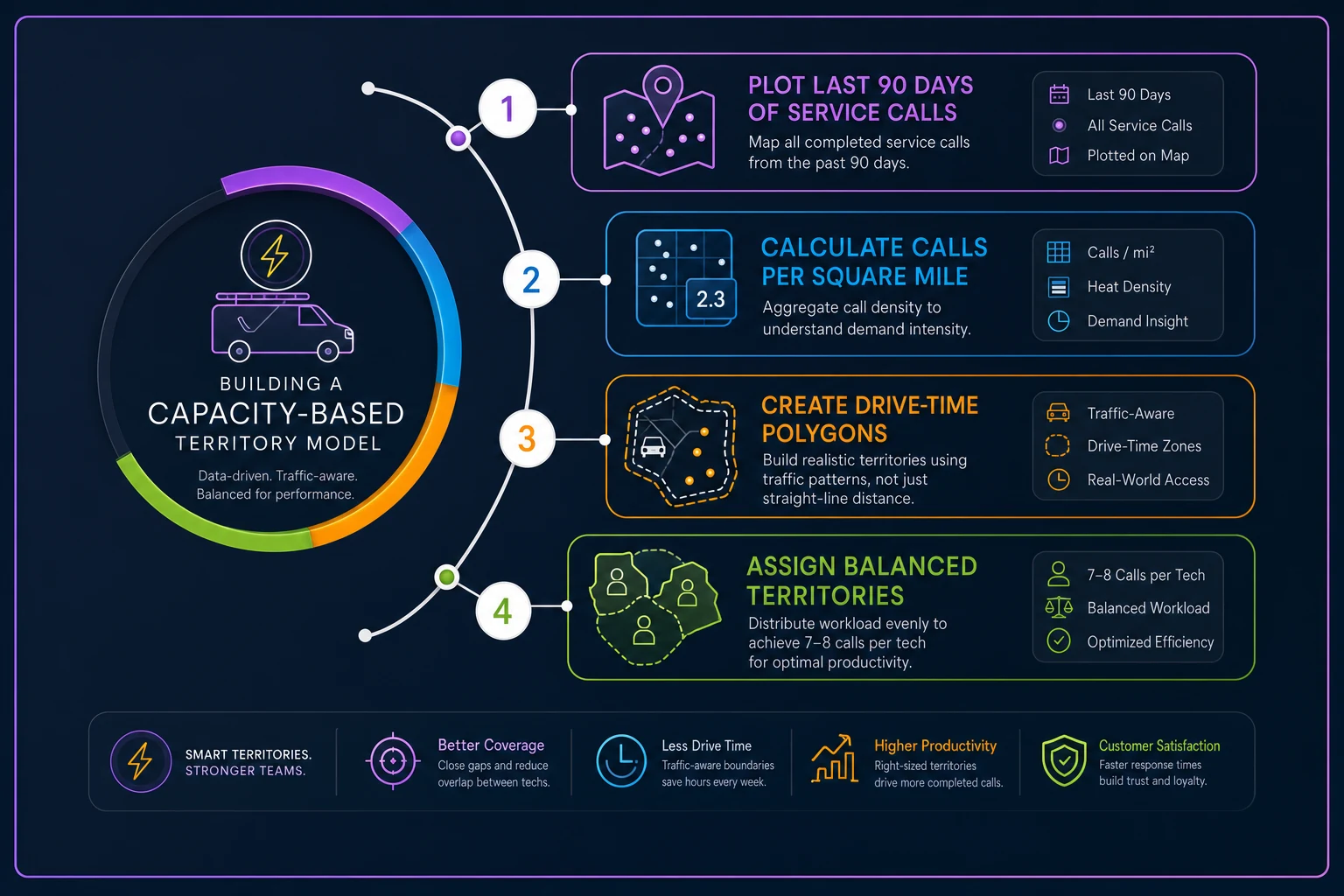
Here's a simple visual of those steps to share with your dispatcher or ops team.
The phased hiring triggers that prevent both understaffing and bloated payroll
Growing electrical shops usually hire techs wrong. They wait until everyone's drowning, panic-hire whoever has a pulse and a license, then wonder why quality drops and callbacks spike. Or they hire "ahead of growth," carry extra payroll for months, and watch cash reserves evaporate.
| Stage | Trigger |
|---|---|
| Stage 1 (2–4 techs): | Hire when your lead time exceeds 4 days for standard service calls. Not emergency calls—those always get handled. Standard outlet replacements, fixture installs, basic troubleshooting. When customers wait more than 4 days for routine work, they start shopping competitors. |
| Stage 2 (5–8 techs): | Hire when overtime hours exceed 15% of total tech hours for two consecutive pay periods. Some overtime is profitable. Consistent overtime burns out good techs and hides capacity problems. At this stage, also track callback rates—if they exceed 3%, you're pushing techs too hard. |
| Stage 3 (9–15 techs): | Hire based on territory density metrics. When any territory consistently generates more than 9 calls daily, split it. When drive time averages exceed 2 hours per tech per day for a full week, redraw boundaries or add coverage. This is also when you need a dedicated dispatcher—the owner can't juggle 12+ schedules effectively. |
| Stage 4 (16–30 techs): | Hire using a capacity utilization model. Target 85% utilization (actual billable hours divided by available hours). Below 75%, you're overstaffed. Above 90%, you're heading for quality problems and resignations. At this scale, track utilization by territory—one overloaded zone can mask three underutilized ones. |
| Stage 5 (30–50 techs): | Hire based on revenue per tech trends. When revenue per tech drops below 85% of your historical average for 60 days, stop hiring and fix operational efficiency first. When it exceeds 115% for 60 days, add headcount before burnout hits. Gut feelings don't work at this scale anymore. |
Shops that scale smoothly build these triggers into their operational dashboards. They know exactly when to post job ads, when to call that promising apprentice back, and when to promote internally versus hiring experienced techs from outside.
Your rollout template for restructuring territories without chaos
Redrawing territories while maintaining service levels feels like rebuilding a plane mid-flight. Customers expect their usual tech. Dispatchers have mental maps they've used for years. Techs know every supply house and parking spot in their zones. Change everything at once and your operation implodes.
Weeks 1–2: Data gathering without announcement Track every call with precise location data. Note actual drive times, not estimates. Record which techs handle which customer types successfully. Don't tell the team you're analyzing territories yet—you'll get biased data as techs try to protect their preferred zones.
Week 3: Build the new map privately Create capacity-based territories using your actual service density data. Each territory should produce 30–35 calls weekly (6–7 daily per tech). Draw boundaries along major roads when possible—techs hate territories where they can see jobs across the highway they can't take. Plan for 20% overlap zones where adjacent techs can flex coverage.
Week 4: Individual tech meetings Show each tech their new territory individually before any group announcement. Let them point out problems you missed—the bridge that backs up every morning, the apartment complex that should stay together despite spanning two zones, the commercial client who specifically requests them. Adjust the map based on legitimate operational feedback, not personal preference.
Week 5: Soft launch with overlap Run both systems simultaneously. New territories for new calls, old territories for already-scheduled work. This feels chaotic but prevents dropping balls. Track which tech actually runs each call versus who should have under the new system. You'll discover edge cases immediately.
Week 6–7: Full transition with daily adjustments Switch dispatching to new territories completely. Hold brief daily standups to address issues—that weird industrial pocket nobody noticed, the senior living complex that generates calls but wasn't assigned to anyone. Fix problems in real-time rather than letting resentment build.
Week 8: Lock and monitor Freeze territory changes for at least 60 days. Let everyone adapt. Track metrics obsessively—windshield time, calls per tech, overtime hours, customer complaints about response time. Small problems are normal. If major issues emerge, you miscalculated capacity somewhere.
Most shops try to skip steps or compress timeframes. They announce new territories on Monday and expect smooth operations by Tuesday. That's how you lose good techs and create customer service disasters that take months to recover from.
The warning signs your territory system is failing before techs quit
Your territories are failing long before techs start resigning or customers complain about response times. The early signals are subtle but consistent.
Technicians start showing up late to first calls—not because they're lazy, but because they've learned morning traffic makes their territory nearly impossible to navigate. They'd rather take the attendance hit than sit in gridlock.
Your dispatch board develops permanent "problem zones." Areas where calls always seem to get rescheduled, pushed to overtime, or handled by whoever's available rather than the assigned tech. These aren't actually problem areas; they're symptoms of territories that don't match reality.
Experienced techs develop elaborate unofficial territory trades. "I'll take your downtown calls if you handle my suburban stuff." They've figured out the territory system doesn't work and built their own workaround. When techs are actively trading zones every day, your fundamental structure is broken.
Parts runs become contentious. Techs start complaining about driving to supply houses outside "their" area. They're not being petty—they're highlighting that your territories don't align with actual service infrastructure. A territory without accessible supply houses is set up for failure from the start.
Customer complaints shift from quality issues to timing issues. Not "the work was done wrong" but "they said morning and showed up at 3pm" or "we've been waiting two weeks for a basic repair." These aren't scheduling problems—they're capacity distribution failures wearing a scheduling disguise.
The afternoon callback surge becomes predictable. Every day around 2pm, certain territories flood with urgent requests while others stay quiet. This happens when morning routes consistently run long in dense territories, compressing everything into afternoon windows.
Your best techs stop taking overtime. Not because they don't want the money, but because they've been running at 110% for months. When reliable techs start protecting their time aggressively, your territory design is burning them out.
What changes when you cross 10, 20, and 40 tech thresholds
Every electrical shop hits predictable transformation points as field teams grow. These aren't gradual shifts—they're sudden operational breaks where yesterday's systems stop working entirely.
Crossing 10 techs kills owner-dispatch models for good. Below 10, a sharp owner can juggle schedules, remember customer preferences, and dispatch efficiently from experience. At 10+, human memory fails. You need actual dispatch software, documented territories, and someone whose only job is coordination. This transition usually runs $3,000–5,000 monthly in new overhead between software and dispatcher salary. Shops that resist stay stuck at 8–9 techs indefinitely.
Crossing 20 techs breaks single-dispatcher systems. One person cannot effectively coordinate 20+ schedules, handle customer calls, manage territory assignments, and deal with daily chaos. You need dispatch teams, not dispatchers. That means shift handoffs, coverage protocols, and standardized communication. It also means accepting that no single person knows everything happening in the field anymore—your operation becomes too complex for any individual to fully grasp. The 20-tech threshold also demands formal territory managers or lead techs. Someone needs to own the north side's performance, someone else handles downtown. These aren't just senior techs—they're quasi-managers handling quality control, training, and escalations within their zones. Budget another $15,000–20,000 annually per lead tech role.
Crossing 40 techs transforms you into a different business entirely. You're not really running one electrical company anymore—you're running four or five mini-companies that share a brand and back office. Each territory group needs its own lead, its own supply relationships, its own culture. The downtown commercial team operates completely differently than the suburban residential crew. At 40+ techs, geographic coverage stops being your constraint. You can reach anywhere in your metro area. Specialization becomes the real lever. The tech who's brilliant at troubleshooting old industrial controls shouldn't waste time on residential service changes. Territory design becomes three-dimensional—geography, specialty, and customer type all factor in. Traditional communication breaks down at this scale too. Group texts don't work with 40 people. All-hands meetings become unproductive. You need structured communication channels, formal escalation paths, and AI-assisted coordination to keep critical information from getting buried.
The hidden economics of poor territory design
Bad territory design bleeds money in ways that don't show up cleanly on your P&L. The costs hide inside other line items, making the problem invisible until you're genuinely hemorrhaging cash.
Fuel costs are obvious but consistently underestimated. An extra 30 minutes of windshield time per tech daily adds up to roughly $18,000 annually per tech in fuel and vehicle wear (assuming $4/gallon gas and $0.65/mile total vehicle cost). For a 15-tech shop, that's around $270,000 yearly—enough to hire three more technicians.
The productivity hit hurts worse. Techs driving between calls can't bill hours. If poor territories add 45 minutes of unbillable time daily, you lose 187 or so billable hours annually per tech. At $125/hour average billing rate, that's over $23,000 in lost revenue per technician. Multiply that across your team.
Customer lifetime value evaporates in badly designed territories. When response times stretch because your nearest tech is 40 minutes out, customers don't wait for next time—they find another electrician. A typical electrical customer is worth around $2,800 over five years. Lose just two customers monthly to slow response times and you're down roughly $67,000 in lifetime revenue annually.
Overtime premiums mask capacity problems. When territories create artificial busy/slow zones, you pay overtime to cover "busy" areas while techs in "slow" areas go home early. At 1.5x, you're paying $45–60 extra per hour for work that should run at regular rates. A shop running 200 unnecessary overtime hours monthly is wasting $100,000+ yearly.
Tech turnover accelerates with unbalanced territories. The tech whose territory requires 3 hours daily windshield time will quit. Replacing an experienced electrician costs $12,000–15,000 between recruiting, training, and productivity ramp-up. Shops bleeding 4–5 techs annually due to territory frustration lose $48,000–75,000 in replacement costs alone.
Quality problems multiply in oversized territories. Rushed techs make mistakes. Callbacks for poor quality average around $180 in lost productivity plus reputation damage. When territory pressure bumps callback rates from 2% to 5%, a shop running 500 calls monthly faces nearly $2,700 in additional monthly callback costs—over $32,000 annually.
The compound effect is what actually kills businesses. It's not just fuel or just overtime or just turnover. It's all of them running simultaneously, creating a spiral where problems compound faster than revenue grows.
Simple capacity math that actually works
The math for territory planning isn't complex, but most contractors either overthink it or ignore it entirely. Here's the framework that works for shops between 2 and 50 techs.
Basic capacity calculation: Start with available hours. A tech works 8 hours but isn't productive for all 8. Subtract lunch (30 minutes), shop time (45 minutes total), and buffer time (15 minutes). You have roughly 6.5 productive hours daily. Standard service calls average 75 minutes including diagnostic time, work, and basic cleanup. Complex calls (panel upgrades, troubleshooting) average 3 hours. Emergency calls average 90 minutes but disrupt everything around them. A typical day might include 2 standard calls (2.5 hours), 1 complex call (3 hours), and driving (1 hour). That's your available capacity. Push beyond this consistently and quality drops or overtime spikes—usually both.
Territory density calculation: Map your last 180 days of calls. Count calls per square mile per month. Residential areas typically generate 2–4 calls per square mile. Commercial zones hit 5–10. Industrial areas vary wildly—either near zero or 10+ depending on tenants. A tech handling 7 calls daily needs a territory generating 140–154 calls monthly (accounting for 20 working days). In a residential area generating 3 calls per square mile monthly, that's roughly 47–51 square miles. In a dense commercial zone generating 8 calls per square mile, that shrinks to 17–19 square miles.
Drive time reality check: Google says it's 10 miles between two points. During morning rush, that's 25 minutes. During midday, it's 15. During evening rush, it's 30. Average drive time between calls should stay under 20 minutes. Beyond that, productivity drops fast. Use actual traffic data from your service hours, not theoretical distances. A territory might look reasonable on a map but become unworkable during school pickup hours or downtown lunch rushes.
Seasonal adjustment factors: Electrical demand isn't flat. Summer A/C problems spike service calls 30–40%. Holiday lighting season (November–December) adds around 20% volume. Spring storm season brings emergency calls. Winter is typically slower except for heating-related electrical issues. Build territories for 85% of peak capacity. During busy seasons, techs can handle the surge with modest overtime. During slow seasons, they maintain decent utilization without sitting idle.
This math reveals why so many shops plateau around 12–15 techs. That's where gut-feel territory management hits its ceiling. Beyond that point, you need actual calculations—not instinct.
Making the transition from reactive dispatch to predictive coverage
Most electrical shops dispatch reactively until the day they can't anymore. A call comes in, the dispatcher looks at the board, sends whoever's closest or available. This works until about 8 techs, then creates cascading failures that compound throughout the day.
-
Day of week patterns (Mondays are heavy commercial, Fridays tend residential)
-
Time patterns (emergency calls spike 7–9am and 5–7pm)
-
Location patterns (certain buildings or neighborhoods consistently need service)
-
Seasonal patterns (specific areas flood and need electrical work after storms)
-
Customer patterns (property management companies that batch service requests monthly)
With pattern data, you can pre-position techs for likely call volumes. Instead of scrambling when downtown has its predictable Wednesday morning surge, you already have coverage in that zone before the calls start.
Buffer zones become critical at scale. These are overlap areas where 2–3 adjacent territories meet. When one zone gets slammed, buffer zone calls can shift to available adjacent techs. Without buffers, you get rigid boundaries where a tech drives past a service call because it's one block outside his territory.
The morning huddle evolves from status updates to strategic positioning. Instead of "here's today's schedule," it becomes "downtown's heavy today, so Mike starts there instead of his usual zone, Sarah covers Mike's morning calls, and Tom stays flexible for emergencies."
This system requires trust and compensation alignment. Techs need to trust they won't get shortchanged by taking overflow calls. Commission structures need to reward flexibility, not just territory ownership. The tech who constantly helps adjacent zones shouldn't make less than the tech who guards his territory jealously.
AI-powered operational platforms are genuinely useful here. They analyze historical patterns, weather forecasts, local events, and real-time conditions to suggest optimal daily positioning—so instead of a dispatcher guessing where problems might emerge, there's actual data behind those decisions.
Your territory design isn't just lines on a map—it's the invisible architecture that determines whether your electrical business can scale profitably or stalls out around 15 techs like most shops do.
Shops stuck at 8–10 techs usually have owner-heroes dispatching from memory while techs waste 2–3 hours daily driving between poorly planned calls. The ones that break through to 25–30 techs have systematic territory design based on actual capacity math, not geographic convenience. The rare ones reaching 40–50 techs treat territory management like a core competency and constantly optimize based on data patterns most contractors don't even track.
The math isn't complicated. Seven calls per tech daily, 90 minutes maximum windshield time, territories sized by call density not square miles. But execution requires discipline most shops lack—tracking real patterns, admitting when territories fail, and restructuring before problems become crises.
The phased approach works: gather data quietly, build capacity-based maps, present changes individually, run parallel systems briefly, then lock and monitor. Skip steps and you'll face resignations and service failures that take months to recover from.
Small operational improvements compound. Reducing windshield time from 2.5 to 1.5 hours daily adds 250 billable hours annually per tech. For a 20-tech shop at $125/hour, that's $625,000 in additional revenue capacity without hiring anyone. Fix your territories and you might not need those three additional techs you were planning to bring on.
The question isn't whether your current territory system will eventually break—it will. The question is whether you fix it proactively with data and planning, or reactively after your best techs quit and customers move on to competitors who actually show up on time.
Territory design isn't exciting. It's not revolutionary technology or an innovative service offering. It's operational blocking and tackling. But for electrical contractors trying to scale field teams profitably, it's the difference between sustainable growth and expensive chaos.
Ready to optimize your electrical service operations?
Join 500+ electrical service companies using Voltzly to improve scheduling accuracy, enhance client satisfaction, and boost operational efficiency.