


Your estimator quotes $1,800 for a straightforward Level 2 charger installation. The homeowner accepts. Three hours into the job, your lead tech discovers the main panel sits 85 feet from the garage, there's no viable conduit path without breaking through a finished basement ceiling, and the panel needs a sub-panel addition because every breaker slot is occupied. What started as a profitable half-day job becomes a two-day grind that barely breaks even.
This scenario plays out constantly in residential EV charger installations. The problem isn't incompetent estimators or dishonest homeowners. It's that EV install pricing requires a completely different assessment framework than traditional electrical work. The variables that actually determine cost often stay invisible during a standard walkthrough.
Why standard electrical pricing models fail for EV installations
Traditional residential electrical pricing relies on relatively predictable variables. Running a new circuit for a dryer? You know the amperage, the typical distance, and the panel requirements. Adding outlets to a bedroom? The scope rarely shifts dramatically once you see the space.
EV charger installations break this model because the cost spread between simple and complex jobs is enormous. A straightforward garage install with an adjacent panel might take 3 hours and $400 in materials. The same charger in the same neighborhood could require 16 hours and $2,200 in materials if the panel sits on the opposite side of the house with no accessible conduit path.
The real challenge: homeowners don't understand these variables. They see neighbors posting about $800 installations online and expect similar pricing. Meanwhile, you're staring at their detached garage 95 feet from a maxed-out panel and calculating $3,400 in legitimate costs.
The site assessment framework that captures true installation complexity
After tracking dozens of EV installations across different property types, clear patterns emerge around which site conditions actually drive costs. The most profitable electrical contractors use a scoring system during assessment rather than eyeballing each job individually.
Never miss a job or delay a dispatch again.
Voltzly helps you schedule, assign, and track every electrical job efficiently.
- Unified job scheduling
- Real-time technician tracking
- Automated client notifications
No credit card required
Start with the panel-to-charger pathway. This single factor determines roughly 60% of your total labor cost. Measure actual cable distance, not straight-line distance. An attached garage with panel access through an unfinished basement rates as "simple" — under 30 feet, clear path. A detached garage requiring underground conduit rates as "complex" — over 60 feet, trenching required. Everything else falls somewhere in the middle.
Next, evaluate panel readiness. Check available capacity first. Many residential panels can't support a 50-amp EV circuit without load management devices or a panel upgrade. Count open breaker spaces. Look at panel age and condition. A 200-amp panel with available dual-pole breaker space is straightforward. A maxed-out 100-amp panel from 1978 triggers entirely different pricing.
Surface penetrations create another cost multiplier. Running cable through unfinished spaces costs almost nothing. Cutting through stucco, brick, or finished drywall adds hours of labor plus restoration work. Count each finished surface penetration separately — one hole through drywall is very different from three penetrations through brick veneer.
The mounting location itself affects installation time more than most contractors initially expect. Mounting on wooden studs in an unfinished garage takes maybe 20 minutes. Mounting on concrete block requires hammer drilling and concrete anchors. Outdoor installations need weatherproof enclosures and often dedicated posts or pedestals.
Building your pricing matrix with real margin protection
Once you understand the cost drivers, you need a pricing structure that protects margins while staying competitive. Contractors who consistently profit from EV installations use tiered pricing based on installation complexity scores.
Basic Installation Tier ($1,200–$1,800)
-
Panel within 30 feet of charger location
-
Available 50-amp breaker space
-
Unfinished garage mounting
-
No significant obstacles
-
Target margin
42–48%
Moderate Installation Tier ($2,200–$3,400)
-
Panel 30–60 feet from charger
-
One finished surface penetration
-
Minor panel work required (new breaker only)
-
Basic conduit run through accessible spaces
-
Target margin
38–45%
Complex Installation Tier ($3,800–$6,500)
-
Panel beyond 60 feet or requires trenching
-
Multiple finished surface penetrations
-
Sub-panel or load management required
-
Concrete mounting or pedestal installation
-
Target margin
35–42%
Premium Installation Tier ($7,000+)
-
Full panel upgrade required
-
Underground boring through landscaping
-
Historic home considerations
-
Multiple chargers or fleet installations
-
Target margin
40–50%
| Tier | Price Range | Criteria | Target margin |
|---|---|---|---|
| Basic Installation Tier | $1,200–$1,800 | Panel within 30 feet; Available 50-amp breaker space; Unfinished garage mounting; No significant obstacles | 42–48% |
| Moderate Installation Tier | $2,200–$3,400 | Panel 30–60 feet; One finished surface penetration; Minor panel work; Basic conduit run | 38–45% |
| Complex Installation Tier | $3,800–$6,500 | Panel beyond 60 feet or trenching; Multiple finished penetrations; Sub-panel or load management; Concrete mounting | 35–42% |
| Premium Installation Tier | $7,000+ | Full panel upgrade; Underground boring; Historic home considerations; Multiple chargers | 40–50% |
Notice how margins actually increase on premium installations. Complex jobs scare away trunk-slammers and handymen, which reduces price pressure. Homeowners also tend to psychologically accept higher margins on obviously difficult projects.
The pre-quote checklist that prevents margin erosion
Your estimator needs a systematic approach to capture every cost factor before quoting. Missing one element during assessment almost guarantees margin loss.
Electrical Infrastructure Assessment
-
Main panel amperage and manufacturer
-
Available capacity calculation (actual loads, not labeled breakers)
-
Physical breaker spaces available
-
Panel location relative to charger
-
Existing grounding system condition
Pathway Evaluation
-
Exact measured distance (not estimated)
-
Number of direction changes required
-
Finished surfaces to penetrate (count and type)
-
Accessibility of pathway (crawlspace height, attic access)
-
Exterior trenching requirements
Mounting Location Details
-
Wall material (wood, concrete, brick)
-
Indoor vs outdoor placement
-
Height requirements for cable management
-
Proximity to water sources or HVAC equipment
-
Local code requirements for EV charger placement
Permitting and Compliance Factors
-
Local permit costs (varies from $50 to $500)
-
Inspection requirements (rough-in, final, or both)
-
Utility notification requirements
-
HOA approval process if applicable
-
Required disconnect location
Customer-Specific Variables
-
Desired charger brand/model
-
Smart features or load management needs
-
Multiple vehicle considerations
-
Future expansion possibilities
-
Aesthetic requirements (surface mount vs flush)
Photograph panel labels and breaker positions during assessment to avoid revisiting panel details later.
Your estimator needs a systematic approach to capture every cost factor before quoting. Missing one element during assessment almost guarantees margin loss.
When to walk away: the red flags that signal unprofitable jobs
Some EV installations will never be profitable at market-acceptable prices. Recognizing these situations early saves everyone frustration.
Walk away when the customer has already received multiple quotes below your minimum viable price. If three contractors quoted $1,400 for what you assess as a $3,200 job, either they missed something and will create bad reviews when they upcharge, or they're operating at unsustainable margins. You're not going to educate the customer into paying double.
Homes with aluminum wiring or Federal Pacific panels create liability beyond the installation itself. The moment you touch these systems, you inherit responsibility for pre-existing hazards. Either price in full panel replacement or decline the work.
Customers who insist on providing their own charger equipment are often a warning sign. They'll blame installation issues on your work rather than their Amazon bargain charger. They'll expect warranty support you can't provide. And they'll leave reviews complaining about problems that were never your fault.
Historic districts or extreme HOA requirements can turn simple installations into permitting nightmares. One contractor spent 14 hours in meetings getting approval for a charger that took 4 hours to actually install. Unless you price in administrative time generously, these jobs eat productivity fast.
The load calculation trap that's costing you thousands
This one consistently wrecks margins: incorrectly assessing available electrical capacity. Your estimator walks in, sees a 200-amp panel with open breaker spaces, quotes standard installation pricing. During installation, you realize the actual load calculation shows only 20 amps of available capacity. Now you need load management devices or a service upgrade that nobody budgeted for.
Most existing homes can't actually support a 50-amp continuous EV load without exceeding code requirements. The labeled breaker ratings mean nothing — you need actual load calculations. A 200-amp panel with electric heat, electric water heater, electric range, and central AC might only have 15–20 amps of real capacity available.
Calculate actual loads during assessment, not after contract signing. Use the 220.83 calculation method for existing dwellings. Add up heating and cooling loads at 100% of the largest, plus 40% of remaining connected loads. Subtract from service size. That number tells you whether you need simple installation or complex load management.
Contractors lose roughly $1,800 per job on average when they discover capacity issues during installation rather than assessment. The customer feels blindsided by the upcharge. You eat costs to protect your reputation. Nobody wins.
Material cost variables that destroy standard pricing models
EV installations consume wildly different material quantities based on specifics. Your standard pricing assumes 50 feet of 6-gauge THHN. This job needs 180 feet of 4-gauge underground cable. That $120 wire allocation just became $780.
The charger distance drives wire costs exponentially, not linearly. Longer runs require larger gauge wire to prevent voltage drop — code requires no more than 3% voltage drop for EV charging circuits. At 100 feet, you jump from 6-gauge to 4-gauge. At 150 feet, you might need 2-gauge. Each gauge increase roughly doubles material cost.
Conduit requirements vary dramatically based on the pathway. Interior runs through unfinished spaces might need no conduit. Exterior underground runs require Schedule 80 PVC. Exposed garage runs need EMT or liquid-tight flexible conduit. One contractor absorbed $400 in unexpected conduit costs because the estimator didn't note an exposed ceiling run.
Breakers range from around $40 for standard brands to $190 for obsolete or specialty panels. GFCI breakers — required for outdoor installations — cost triple standard breakers. Some panels require tandem breakers or modifications to create space. These "minor" oversights compound fast.
The time estimation mistakes that kill profitability
Contractors consistently underestimate installation time for complex EV setups. They price based on best-case scenarios and then hit real-world complications.
Trenching takes forever when you hit unexpected obstacles. That 50-foot trench through the lawn? Budgeted at 3 hours. Then you find tree roots, irrigation lines, and buried cable TV lines. Now it's an 8-hour ordeal with hand digging around utilities.
Wire pulling through existing construction varies wildly too. Pulling wire through a straight conduit takes minutes. Fishing wire through insulated walls with fire blocks takes hours. One 90-degree turn in a wall cavity can triple installation time. Older homes with balloon framing seem easier until the wire drops into the basement instead of traveling horizontally.
Panel work typically exceeds estimates. Moving breakers to create space takes time. Older panels fight you — corroded screws, brittle plastic, non-standard configurations. What looks like "just adding a breaker" becomes a 90-minute wrestling match with a 40-year-old panel.
Permitting and inspection coordination steals hours too. Waiting for inspectors, explaining installations to skeptical building officials, returning for reinspection after minor corrections. One contractor lost $400 in labor because the inspector required a disconnect switch the estimator hadn't caught in local code amendments.
Converting assessment data to quotes that actually close
You've assessed thoroughly. You understand the real costs. Now you need to present pricing that customers accept while protecting margins.
Break the quote into clear categories: Basic Installation Labor, Additional Complexity Factors, Materials, and Permits/Compliance. This structure helps customers understand why their installation costs more than their neighbor's simple setup.
Under Additional Complexity Factors, list specific cost drivers: "Extended cable run (85 feet): $440" or "Panel capacity evaluation and load management: $350." Customers accept higher prices when they understand the reasoning. They push back against single-line quotes showing just a total.
Include explicit contingencies for hidden conditions. Something like: "Quote assumes clear pathway as discussed. Unforeseen obstacles such as fire blocks or abandoned utilities may increase costs by $200–400." This prevents angry customers when you hit complications mid-install.
Offer value engineering options where it makes sense. "Standard quote includes underground trenching for $1,200. Alternative: aerial cable run with weather-head entrance reduces cost to $400 but requires HOA approval." Let customers choose between cost and aesthetics.
The operational workflow that maintains margins
Protecting margins requires operational discipline beyond accurate pricing.
This workflow keeps margins intact from estimate through completion.
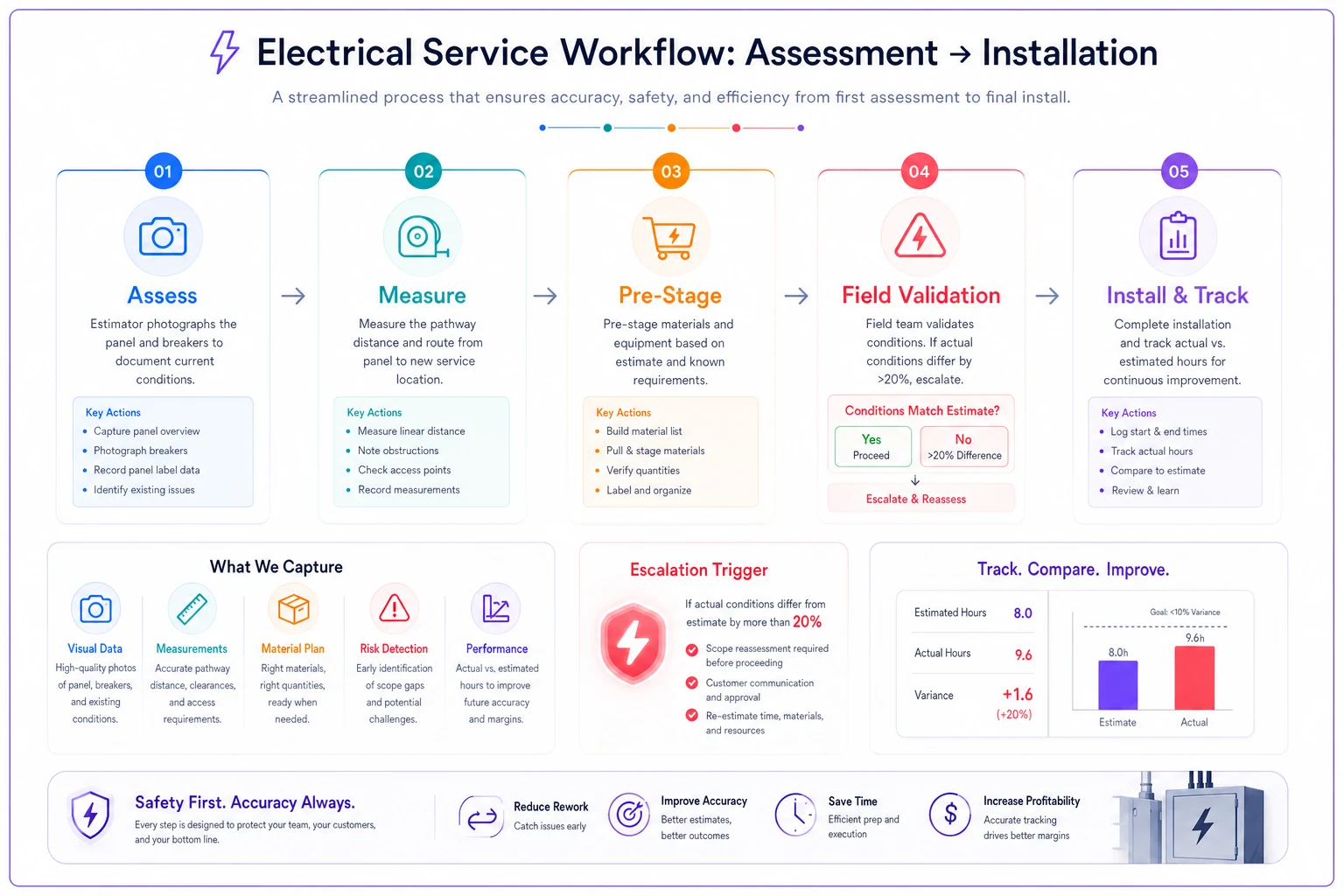
The estimator documents everything photographically. Panel photos showing every breaker. Pathway photos showing obstacles. Measurement photos proving distances. When the install team arrives three weeks later, they see exactly what the estimator saw — no surprises, no forgotten complications.
Pre-stage materials based on assessment data, not generic assumptions. Pull correct wire lengths, confirm breaker compatibility, verify mounting hardware before leaving the shop. Running back for forgotten materials destroys productivity.
Create clear escalation triggers for field teams. If they encounter conditions varying from assessment notes by more than 20%, they stop and photograph before proceeding. This protects against customer disputes and helps identify where assessments keep falling short.
Track actual versus estimated hours religiously. Most contractors only discover they're consistently underpricing specific installation types after losing money on them repeatedly. Trenching through clay soil takes 3x longer than sandy soil. Mounting on brick requires twice the budgeted time. Without tracking, you never fix these patterns.
Building systematic pricing improvement through job tracking
The electrical contractors who dominate profitable EV installation markets treat each job as pricing data. They track which assessment factors actually correlated with cost overruns. They identify which estimators consistently miss specific complications. They adjust pricing based on what's happening in the field, not theoretical calculations.
Modern operational software makes this tracking much more manageable. Field teams photograph and note complications directly in the job record. Actual hours get captured through digital timekeeping. Material usage links to specific job phases. Patterns become obvious after even a dozen installations.
One contractor found their estimators were consistently underpricing installations requiring attic wire runs by roughly $380 per job. Another discovered that jobs in 1960s-era neighborhoods averaged 40% more labor hours due to obsolete panel types. These insights only surfaced through systematic tracking — nobody would have guessed it otherwise.
The same operational platform can automate customer communication around project complexity. When the estimator documents a difficult pathway or panel limitations, the system automatically includes educational material in the customer proposal. It preemptively addresses price objections while positioning you as the thorough, professional option.
The margin protection framework that scales
As your EV installation volume grows, maintaining margins requires systematic effort rather than relying on individual heroics.
First, establish non-negotiable minimum margins by installation tier. Basic installations below 40% margin get rejected. Complex installations below 35% trigger review. This prevents estimators from chasing volume with unprofitable work.
Second, require documentation for any margin override. If an estimator wants to price below guidelines, they write down why. Maybe it's a property management company promising 50 installations. Maybe it's a showcase home for marketing. Without documentation, margins drift downward through accumulated exceptions that nobody tracks.
Third, track margin performance by estimator, not just company-wide. Some estimators consistently hit 45% margins through thorough assessment and confident pricing. Others barely reach 30% because they underprice to avoid difficult conversations. Individual tracking drives improvement through peer comparison and targeted coaching.
Finally, adjust pricing quarterly based on actual cost data. Wire prices fluctuate. Labor availability changes. Permit requirements evolve. Pricing that worked in January might lose money by September. Regular reviews prevent the gradual margin erosion that catches contractors off guard.
The residential EV charger installation market will grow significantly over the next several years. Tesla alone has committed to major infrastructure expansion. Every major auto manufacturer is pushing electric vehicles. The contractors who build systematic assessment and pricing capabilities now will capture this growth profitably.
The framework here — systematic site assessment, tiered complexity pricing, comprehensive checklists, operational discipline — transforms EV installations from margin-eating headaches into predictable profit centers. But it requires real commitment to process.
Start with one change: use the assessment checklist on your next five estimates. Track what you discover. Compare actual costs to your predictions. Let field data guide your pricing. Within twenty installations, you'll have identified your specific margin leakage points and have enough data to fix them.
The contractors winning in this space don't just install chargers. They've built operational systems that consistently identify job complexity, price it appropriately, and execute efficiently. They treat each installation as data for improving the next quote. The chaos of variable installation conditions becomes a manageable, predictable service line.
The question isn't whether you'll install EV chargers — the demand guarantees you'll get these calls. The question is whether you'll build the capability to price them profitably, or join the growing list of contractors losing money while trying to figure out why every EV job runs over budget.
Ready to optimize your electrical service operations?
Join 500+ electrical service companies using Voltzly to improve scheduling accuracy, enhance client satisfaction, and boost operational efficiency.