



Panel upgrades should be your most profitable residential service. Fixed scope, predictable labor, clear material costs. Yet electrical contractors consistently leave $800 to $2,400 on the table per panel upgrade because their quoting process ignores operational reality.
The problem starts with how most contractors quote these jobs. They calculate materials, add standard labor hours, throw on a percentage markup, and send it out. Then reality hits. The permit takes three trips instead of one. The existing wiring needs more cleanup than expected. That "straightforward" 100-amp to 200-amp upgrade suddenly requires an extra half day because the service entrance cable routing wasn't what you thought.
Your crew finishes the job professionally. The customer's happy. But when you run the actual numbers two weeks later, that healthy margin has quietly disappeared into unpaid overtime and extra supply runs.
Why panel upgrade quotes go sideways
Panel upgrades feel standardized until you're standing in someone's basement at 3 PM realizing the job's going to run into tomorrow. The core work stays consistent—swap the panel, update the grounding, reconnect circuits. But residential retrofits come with variables that compound fast.
Take permit coordination. Your quote probably includes one trip to pull permits. In practice, residential permits often need corrections, additional documentation, or inspector clarifications. Each trip costs an hour of drive time plus administrative overhead. Three permit trips instead of one means $180 to $240 in unbilled labor, just from that.
Or consider existing wiring conditions. That 1960s house with cloth wiring? Every circuit connection takes longer because the insulation crumbles when you touch it. Those extra minutes per circuit multiply across 20 to 30 circuits. Suddenly you're looking at two additional labor hours that weren't in your quote.
Utility coordination creates its own headaches. Some areas require the utility to pull the meter before work begins. If they're running behind, your crew sits idle or you reschedule—eating mobilization costs twice. Other times, the utility requires specific disconnect procedures that add complexity to what seemed like a standard install.
Then there's the discovery work once you open things up. Improper grounding that needs complete replacement. Double-tapped breakers throughout the old panel requiring new home runs. Previous work that created code violations you now have to address. Each discovery adds labor, materials, and time that your original quote didn't account for.
Building quotes that protect margins
Accurate panel upgrade quotes start with breaking down every operational step, not just the installation itself. Your quote needs to reflect the entire job lifecycle—from initial assessment through final inspection.
Never miss a job or delay a dispatch again.
Voltzly helps you schedule, assign, and track every electrical job efficiently.
- Unified job scheduling
- Real-time technician tracking
- Automated client notifications
No credit card required
Start with a proper line-item structure:
Pre-installation tasks
-
Permit application and processing
2–3 hours
-
Utility coordination and scheduling
1–2 hours
-
Material ordering and pickup
2–3 hours
-
Site preparation and protection
1 hour
Core installation labor
-
Panel removal and disposal
1–2 hours
-
New panel mounting and setup
2–3 hours
-
Circuit transfer (per circuit)
15–25 minutes
-
Grounding system updates
2–4 hours
-
Service entrance work
2–4 hours
Post-installation requirements
-
Initial testing and documentation
1–2 hours
-
Inspection scheduling and support
2–3 hours
-
Final commissioning
1 hour
-
Cleanup and customer walkthrough
1 hour
Notice how the actual panel swap represents maybe 40% of total labor hours. The rest comes from all the coordination, compliance, and customer-facing work that makes a panel upgrade actually successful.
Material calculations need the same level of detail. Don't just price the panel and breakers. Include:
Material calculations need the same level of detail. Don't just price the panel and breakers. Include:
-
Panel and breakers
$400–$800
-
Service entrance cable
$200–$500
-
Grounding materials
$75–$150
-
Connectors and hardware
$50–$100
-
Code-required updates (AFCI/GFCI)
$200–$600
-
Miscellaneous supplies
$75–$125
Always include a separate material contingency line when quoting older homes.
Add a 15% material contingency for discoveries. That old Federal Pacific panel might have damaged more wiring than you can see. The grounding system might need complete replacement instead of just updates. These aren't rare exceptions—they show up on roughly one in three residential panel upgrades.
Contingency rules that match reality
Generic percentage markups don't capture the operational risk in residential retrofits. You need contingency rules tied to specific job characteristics.
For homes built before 1970, add 25% to your base labor estimate. Older homes consistently bring complications—unusual wiring methods, deteriorated insulation, non-standard construction that makes cable routing a puzzle. This isn't padding; it's acknowledging a real pattern.
Homes with previous electrical work by non-professionals need a 30% labor contingency. You'll spend extra time correcting violations, dealing with creative wiring, and explaining to homeowners why their uncle's handiwork has to come out.
If the existing panel sits in a finished space, add around 20% for access and protection. Working in a finished basement means drop cloths, careful staging, and extra cleanup. Every task takes longer when you're protecting someone's living area.
For jobs requiring utility coordination, build in schedule flexibility worth 4–6 hours of labor cost. Utility companies run on their timeline, not yours. That morning disconnect might happen at 2 PM. Your quote needs to absorb that without destroying your margin.
Real cost tracking for real improvement
Most contractors track job costs at the project level—total labor, total materials, total profit. That aggregate view hides exactly where quotes are consistently missing reality.
Track by phase instead:
-
Permitting and coordination time
-
Actual installation hours
-
Inspection and correction time
-
Administrative and follow-up work
After 10 or 15 jobs, patterns emerge. Maybe permitting always runs 3.5 hours instead of the 2 hours you quote. Maybe circuit transfers average 18 minutes in newer homes but 27 minutes in older ones. Specific insights like these let you adjust quotes based on actual operational data rather than guesswork.
A simple tracking sheet helps:
| Job Element | Quoted Hours | Actual Hours | Variance | Notes |
|---|---|---|---|---|
| Permit work | 2.0 | 3.5 | +1.5 | Required two trips for corrections |
| Panel install | 8.0 | 9.0 | +1.0 | Cloth wiring slowed circuit transfers |
| Inspection | 2.0 | 2.0 | 0 | Passed first attempt |
| Cleanup | 1.0 | 1.5 | +0.5 | Customer requested additional explanation |
This granular tracking shows where you're systematically underestimating effort. It also gives you data to back up higher quotes with price-sensitive customers. "Based on similar panel upgrades in homes this age, we average 2.3 permit trips and about 22 minutes per circuit transfer" carries a lot more weight than "it might take a bit longer."
A simple workflow for tracking job costs looks like this.
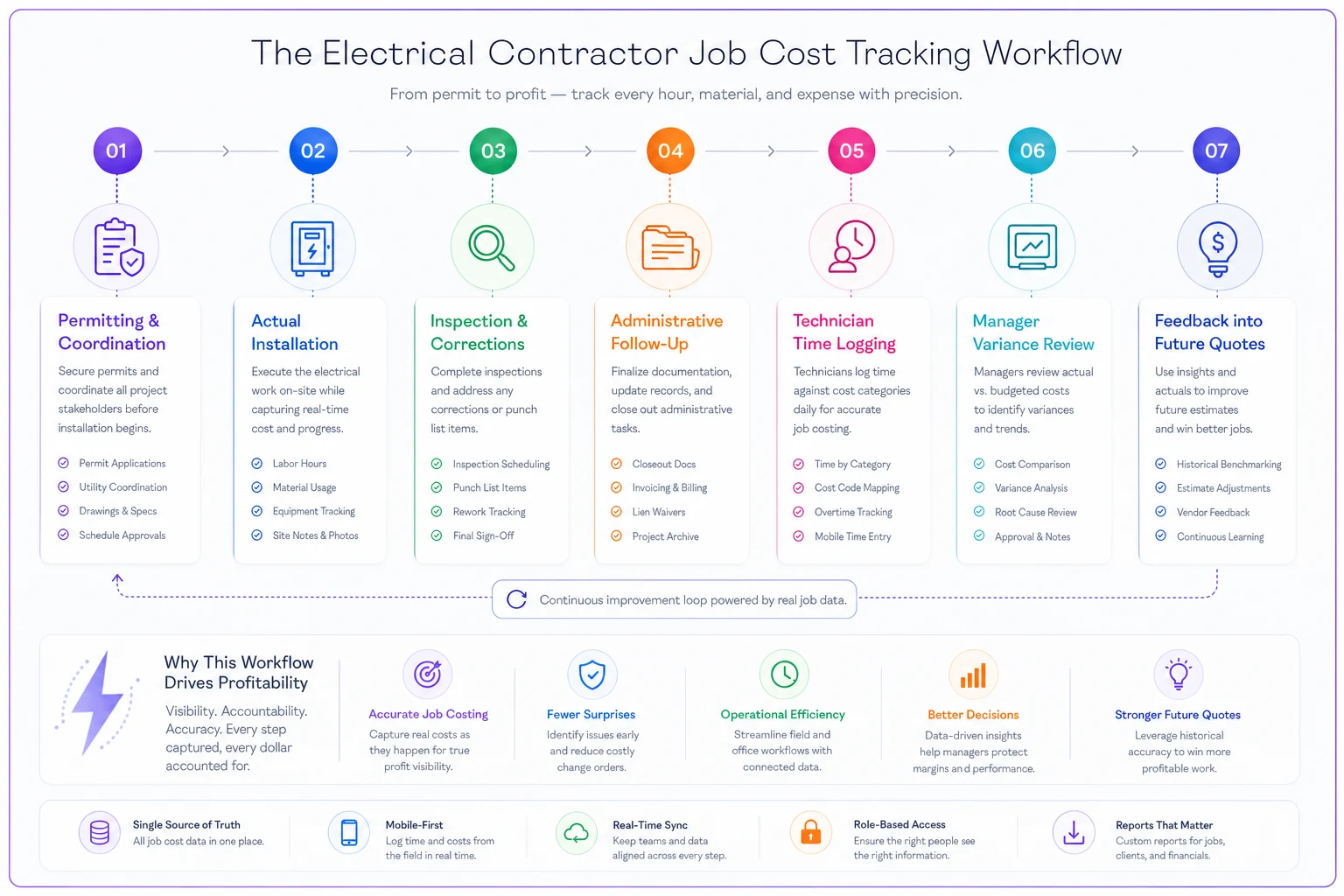
Use this workflow to guide your tracking and adjustments.
Margin guardrails and walkaway triggers
Not every panel upgrade deserves your time. Some jobs carry enough operational risk that even aggressive contingencies won't protect your margins.
Set a minimum gross margin target of 42% for standard panel upgrades. That margin absorbs inevitable complications while still leaving reasonable profit. If you can't hit 42% after reasonable contingencies, the job probably has hidden complexities that will surface during work.
Know your walkaway triggers:
-
Extensive knob-and-tube wiring visible
-
Evidence of significant unpermitted work
-
Customer unwilling to pay for code-required updates
-
Access requiring scaffolding or major furniture moving
-
Panels with known dangerous defects requiring specialist handling
These jobs can be profitable for someone. If your operation isn't built for extreme retrofits, taking them disrupts your schedule and crew efficiency in ways that ripple out for weeks.
For borderline jobs, use graduated pricing. Quote the base panel upgrade, then add explicit line items for likely discoveries:
-
"Correction of existing code violations
$400–$800"
-
"Additional grounding work if required
$300–$600"
-
"Circuit cleanup and organization
$35 per circuit"
This transparency helps customers understand why your quote is higher than the guy promising to "swap it out for $1,500." It also protects you when discoveries happen—the customer already knows additional work comes with additional cost.
Template components for consistent quoting
Your panel upgrade quotes need a consistent structure so you're not missing cost elements or reinventing the wheel on every job.
Section 1: Defined scope
-
Specific panel model and amperage
-
Number of circuits to transfer
-
Included code updates (AFCI, GFCI requirements)
-
Permit and inspection handling
Section 2: Exclusions and discoveries
-
Existing code violations (quoted separately upon discovery)
-
Utility service upgrades beyond panel
-
Drywall repair or finishing
-
Circuit additions or modifications
Section 3: Labor breakdown
-
Installation labor
X hours @ $rate
-
Permit/coordination
X hours @ $rate
-
Testing and commissioning
X hours @ $rate
-
Contingency allowance
X hours @ $rate
Section 4: Materials with ranges
-
Panel and breakers
$X–Y
-
Service entrance materials
$X–Y
-
Grounding and bonding
$X–Y
-
Miscellaneous supplies
$X–Y
-
Material contingency
15%
Section 5: Terms and conditions
-
Payment schedule tied to milestones
-
Change order process for discoveries
-
Warranty terms and limitations
-
Schedule dependencies (utility coordination, inspections)
This structure ensures you capture all cost elements while setting clear expectations upfront about what's included and what triggers additional charges.
Example quote breakdown
Here's what a properly detailed quote looks like for a typical 100-to-200 amp panel upgrade in a 1975 home:
Base Installation
-
Labor
14 hours @ $95 = $1,330
-
Permit coordination
3 hours @ $95 = $285
-
Materials (panel, breakers, cable)
$850
-
Miscellaneous supplies
$125
-
Subtotal
$2,590
Contingencies and allowances
-
Labor contingency (25% for home age)
$333
-
Material contingency (15%)
$127
-
Discovery allowance
$400
Total quote: $3,450
Compare that to the typical flat-rate quote of $2,200 a lot of contractors throw out. That $1,250 difference isn't overcharging—it's the real cost of handling permits properly, dealing with older home complications, and keeping margins sustainable.
The detailed breakdown also makes customer conversations easier. When they ask why you're more expensive, you can point to specific line items: "We include three hours for permit handling because residential permits in this jurisdiction average more than one trip. We also build in contingency for wiring conditions common in 1970s homes."
Operational software and margin protection
Manual quote tracking makes it genuinely hard to spot margin erosion until it's already a problem. You might notice panel upgrades are less profitable, but without detailed data, you can't tell whether it's permit delays, discovery work, or installation inefficiencies doing the damage.
AI-powered operational software changes this by automatically tracking time against quote categories. When your technician logs hours, the system categorizes them—permit work, installation, inspection support. After a few months, you can see exactly where quotes miss reality.
The software can also flag quotes that fall outside normal parameters. If you typically quote 14–16 hours for standard panel upgrades but a draft quote comes in at 10 hours, the system flags it for review. That kind of guardrail prevents accidentally sending lowball quotes when you're rushing through estimates.
More usefully, good operational software tracks actual costs against quoted amounts at the line-item level. Instead of just knowing a job went over budget, you know that permit coordination took 5 hours instead of 3, or that circuit transfers averaged 24 minutes instead of 18. Those specific numbers are what actually improve future quotes.
Some platforms now use AI automation to suggest contingency adjustments based on job characteristics. Input the home's age, existing panel type, and access conditions, and the system recommends contingency percentages based on past jobs with similar profiles. It removes guesswork while keeping your quotes consistent across the whole team.
The operational benefit that often gets overlooked is the connection between quotes and scheduling. When a panel upgrade runs long, the system can adjust future schedule blocks for similar jobs automatically—preventing the slow cascade of delays that happens when every panel upgrade takes "just a few hours more" than planned.
Protection strategies for your business
Your quoting process needs systematic protection against margin erosion—not just added contingencies, but operational discipline and a habit of continuous improvement.
Standardize your assessment process. Create a checklist for quote visits that captures all relevant factors: home age, existing panel type, visible wire conditions, access restrictions, evidence of previous work quality. Consistent assessment leads to consistent quoting.
Track quote-to-actual variance on every completed job. Every panel upgrade should generate a simple variance report comparing quoted hours and materials to actual. Look for patterns across jobs. If quotes consistently miss by 20% on older homes, your contingency rules need updating.
Train your team on discovery communication. When technicians find unexpected issues, they need to document them immediately and communicate clearly with customers. "We found double-tapped breakers throughout the old panel, which requires running new circuits. That adds approximately 3 hours of labor at $285" is far better than a surprise at final billing.
Build a monthly review into your operations. Look at panel upgrade margins across the month. Are they holding? Declining? Which job types consistently underperform? Catching margin erosion early beats addressing it in crisis mode.
And don't be afraid to raise prices when the data supports it. If your tracking shows panel upgrades actually average 16 hours but you've been quoting 12, adjust your template. Customers who value quality work will pay for proper execution. Those shopping purely on price probably weren't going to be easy clients anyway.
The path forward
Panel upgrades don't have to be margin killers. With detailed cost tracking, realistic contingencies, and disciplined quoting, they can become your most predictable revenue source. The key is acknowledging operational reality instead of hoping each job will somehow go perfectly.
Start by tracking your next five panel upgrades in detail. Note every hour spent on permits, every unexpected discovery, every material run that wasn't in the original plan. Build your contingency rules from that real data, not industry averages or best-case assumptions.
Your quotes should reflect the full scope of professional panel upgrade work—from the first permit application through final inspection approval. When you capture those real costs and add appropriate margins, panel upgrades stop being necessary evils and start becoming profitable core services.
The contractors who do well long-term aren't the ones lowballing quotes hoping to make it up in volume. They price jobs accurately, execute professionally, and protect the margins that keep their business running. In residential electrical work, that means accepting that panel upgrades are complex retrofits—not commodity swaps—and pricing them accordingly.
Stop leaving money on every panel upgrade. Start quoting the job that actually exists, not the perfect scenario that never happens.
Ready to optimize your electrical service operations?
Join 500+ electrical service companies using Voltzly to improve scheduling accuracy, enhance client satisfaction, and boost operational efficiency.