

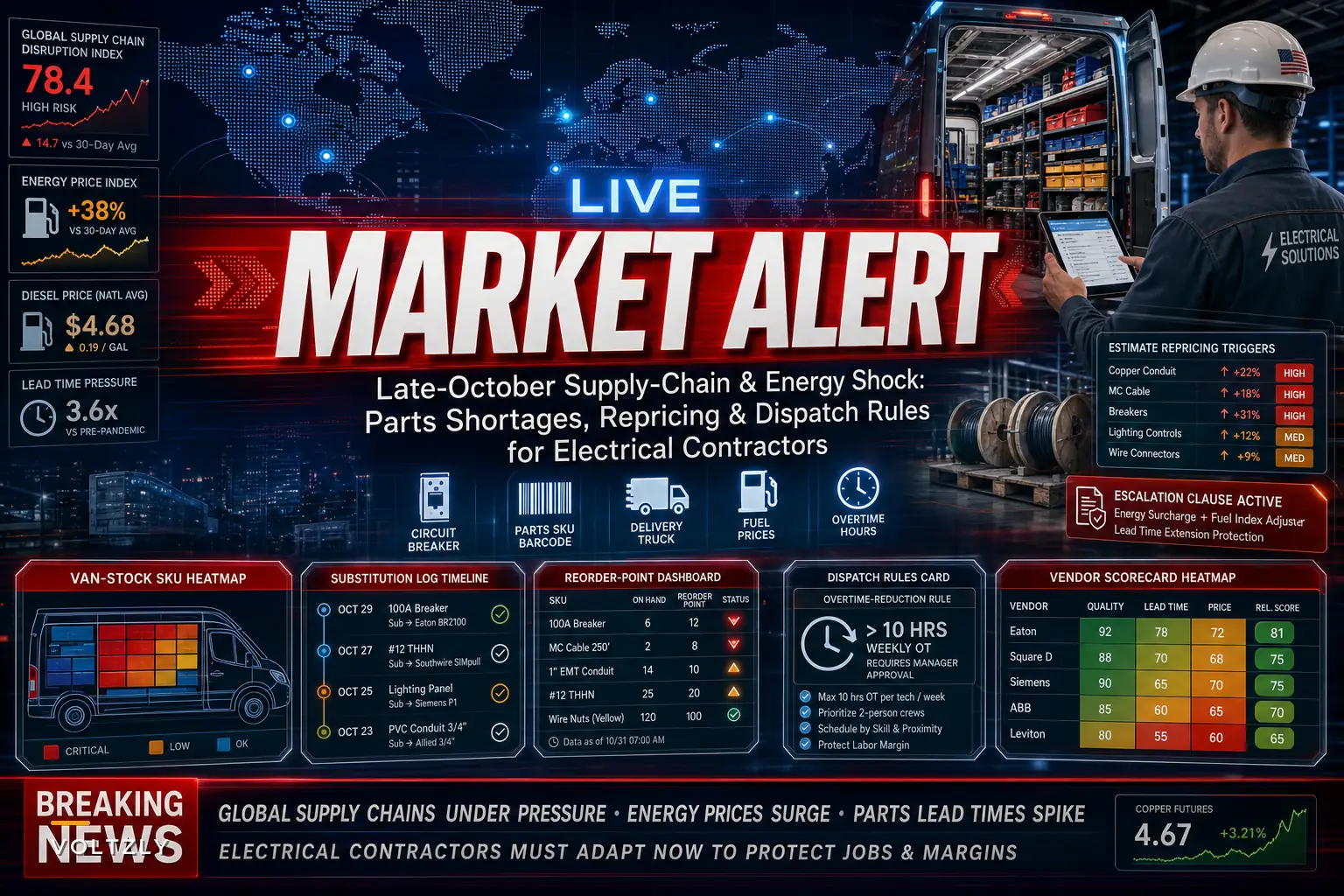

The late-October business activity data landed with two unpleasant messages for anyone who buys materials and runs a dispatch board. Supply-chain pressure is building again—suppliers are quoting longer lead times and nudging prices up because demand is holding steady. And energy-driven costs aren't cooling the way a lot of people hoped. Reuters reported that strong demand is fueling fresh price pressures even as overall activity cools, and the EIA's monthly electricity data shows end-use electricity costs climbing in a way that quietly feeds into everything from your shop's overhead to the freight you pay on a pallet of panels.
That's the headline. But the headline isn't actually the problem for electrical contractors. The real problem is that parts shortages rarely show up as a clean "out of stock" message. They show up as a slow bleed—a two-week lead time that becomes four, a substitution nobody flagged, an emergency trip to a competitor's counter at retail pricing. By the time you feel it, the margin is already gone.
So skip the economics lecture. What matters is what actually happens on the ground when lead times stretch and energy costs push SKU prices up—and what you can do about it before your Q4 jobs eat the difference.
The real damage isn't the shortage—it's the delay nobody priced in
When supply tightens, the obvious SKUs get the attention. Everybody watches panels, breakers, and anything with copper in it. Those get reordered early, buffered, and tracked.
The damage almost always comes from the boring middle-tier parts—the stuff nobody thinks to buffer because it's "always available." Weatherheads, specific GFCI/AFCI breakers for older panels, meter sockets, certain conduit fittings, the one transformer size a commercial job happens to need. These don't trigger alarms. They just quietly go to a six-week lead time, and suddenly a job that was 90% done sits open because of a $40 part.
A typical scenario looks like this: a residential crew finishes a service upgrade in a day, but utility coordination needs a specific meter socket the supplier now says is three weeks out. The job can't be inspected. Can't be invoiced. You've got labor already sunk, a customer calling, and a payment that just slid a month to the right—all over a part that used to be on the shelf.
That's the part of a shortage that doesn't make the news. The cost isn't the price increase on the SKU. It's the frozen job value sitting in your receivables because one line item is missing.
Why energy-driven cost pressure makes this worse than a normal shortage
A plain shortage is annoying but manageable—you buffer, you wait, you move on. What makes this moment different is the energy cost layer underneath it.
Never miss a job or delay a dispatch again.
Voltzly helps you schedule, assign, and track every electrical job efficiently.
- Unified job scheduling
- Real-time technician tracking
- Automated client notifications
No credit card required
-
Supplier pricing drifts upward because their own overhead and freight climb. Quotes you pulled in August aren't valid in November.
-
Your shop overhead rises quietly—the building, the equipment, the fleet. It doesn't show up on any one job, so it's easy to miss until month-end looks worse than expected.
-
Demand stays strong, especially anything electrification-related, which keeps popular SKUs tight and keeps suppliers from needing to discount.
The combination means you can't treat this like a temporary gap. You're not waiting for a part to come back at the old price. You're repricing into a market where the baseline has shifted. Contractors who buffer inventory but keep quoting off stale cost sheets end up protecting their schedule and losing their margin at the same time.
A quick way to find which SKUs will actually hurt you
Before you reorder anything, sort your parts list by exposure, not by volume. The parts you use most aren't always the ones that will sink a job. The dangerous ones sit at the intersection of hard to substitute and stops the whole job if missing.
| Part category | Lead-time risk right now | Job-stopping if missing? | Priority action |
|---|---|---|---|
| Panels & load centers | High | Yes | Buffer + lock pricing on open quotes |
| Specialty breakers (AFCI/older panels) | High | Yes | Pre-stage per scheduled job |
| Meter sockets / utility coordination parts | Medium–High | Yes (blocks inspection) | Order at job sign, not at dispatch |
| EV charger hardware | High | Yes | Confirm stock before quoting a date |
| Common conduit / fittings | Low–Medium | No | Normal reorder, slightly larger buffer |
| Wire & cable (copper-heavy) | Medium | Sometimes | Watch pricing weekly, quote with escalation |
| Standard devices (receptacles, switches) | Low | No | No change needed |
The thing most shops miss: a part can be low volume and still be your biggest risk. A single meter socket you use twice a month can freeze more job value than the receptacles you buy by the case. Prioritize by what stops the job, not by what fills the van.
The mistake that quietly kills margin during a shortage
The most common error isn't failing to buffer. It's buffering without repricing. Shops react to shortage news by throwing cash at inventory—bigger orders, more safety stock—which is reasonable. But they keep sending out quotes at last quarter's material costs because updating the estimate template is a hassle and nobody owns it.
So the schedule stays protected. The customer gets their job on time. And three months later the month-end numbers show a margin drop nobody can explain, because every job absorbed a 6–9% material cost increase that was never passed through.
The second common mistake is silent substitution. A tech can't get the spec'd part, grabs an approved alternate, installs it, and nobody updates the quote or the job cost. The alternate often costs more. Multiply that across dozens of jobs and you've got a real leak that never shows up as a single obvious event.
Both mistakes share the same root cause: the gap between what the field actually buys and installs, and what the office quoted and costed. When supply is stable, that gap is small enough to ignore. When supply is volatile, that gap is where your profit goes.
A real scenario: the $40 part that cost $2,800
A small commercial-leaning shop—six techs, mostly service and tenant improvement work—ran into this during a tight supply stretch. They were completing a panel and feeder upgrade for a retail space. Labor was nearly done, the GC was waiting, and the final piece was a specific disconnect and a handful of fittings the usual supplier suddenly couldn't deliver for four weeks.
-
The job sat open for 9 extra days while parts were being chased, pushing a ~$14k progress invoice into the next billing cycle.
-
The premium parts added close to $300 over quote—never passed through.
-
The crew leader burned the better part of a day driving and calling instead of running the next job—another $500–$600 in lost productive labor.
Add the office time chasing it and the GC's slightly cooled confidence, and a $40 part that went out of stock cost somewhere around $2,500–$2,800 all-in. Not because the part was expensive. Because nothing in their system flagged the exposure early, and nothing captured the overage once it happened.
After that job they did one simple thing: they started confirming availability on job-stopping parts at the time of quote for anything scheduled more than a week out. Not fancy. Just a decision point that didn't exist before. The next two months had zero frozen-job surprises.
What to actually do over the next 90 days
This isn't the moment for a full procurement overhaul. It's the moment for a handful of targeted moves that protect schedule and margin at the same time. Here's the order worth running them in:
Confirm availability on job-stopping parts at the time of quote for anything scheduled more than a week out.
-
Re-pull supplier pricing on anything with an open quote. Quotes older than ~30 days are probably stale. Flag anything copper-heavy or energy-sensitive first.
-
Build (or update) your exposure list using the "stops the job?" test above—not your volume reports. Twenty SKUs max. Keep it brutal.
-
Add a confirmation step for job-stopping parts at quote time, not at dispatch. Knowing a part is four weeks out before you promise a date is worth more than any buffer.
-
Put a repricing trigger on your estimate template. If a key material cost jumps more than a set threshold—say 5%—the quote gets updated before it goes out. Someone has to own this.
-
Add escalation clauses on longer commercial quotes. For jobs quoted now but installed in 60–90 days, a simple material-escalation line protects you without scaring the customer.
-
Close the substitution loop. When a tech uses an alternate, the cost difference gets captured on the job. If it's not written down, it's a leak.
A quick checklist to run before any job you schedule this quarter
-
[ ] Are the job-stopping parts confirmed in stock or on a committed delivery date?
-
[ ] Is the quote priced on current supplier costs, not last quarter's?
-
[ ] For commercial jobs 60+ days out—is there an escalation clause?
-
[ ] Does the crew know the approved alternates and how to log the cost difference?
-
[ ] Is there a buffer on the two or three SKUs that would freeze this specific job?
-
[ ] Is the utility-coordination part (meter socket, etc.) ordered early enough to not block inspection?
Close the substitution loop. When a tech uses an alternate, the cost difference gets captured on the job. If it's not written down, it's a leak.
When bigger buffers make sense—and when they don't
Buffering inventory is the default reaction, but it's not always right. Cash tied up in stock is cash you can't use on payroll or growth, and energy-driven overhead makes holding inventory slightly more expensive too.
Bigger buffers make sense when: the part is job-stopping, hard to substitute, used regularly, and has a lead time that's genuinely unpredictable. Panels, specialty breakers, meter sockets for your common service sizes—buffer those.
Bigger buffers are a bad idea when: the part is low-risk, easily substituted, or specific to one-off jobs you can order against at sign. Stockpiling specialty transformers "just in case" for commercial work you don't have booked just converts cash into shelf dust.
Who should skip the buffering conversation entirely: very small residential-only shops running mostly same-day service work. For them, the better lever is pre-staging per job and tightening the quote-to-dispatch handoff—not sinking cash into a stockroom they don't have space for anyway.
Where this all connects: your procurement process is the real fix
Every move above—exposure lists, repricing triggers, substitution logging, escalation clauses—works a lot better when it lives inside a repeatable process instead of in someone's head. The shops that ride out volatile supply stretches without bleeding margin aren't the ones with the biggest warehouse. They're the ones whose buying, quoting, and job costing actually talk to each other, so a lead-time change or a cost jump reaches the estimate before it goes out the door.
That's less about software and more about discipline, but good operational tooling makes the discipline stick—flagging stale quotes, catching substitution overages, reconciling supplier credits at month-end so you're not leaving money on the table.
Here's a simple visual of the procurement workflow that ties buying, quoting, and job costing.
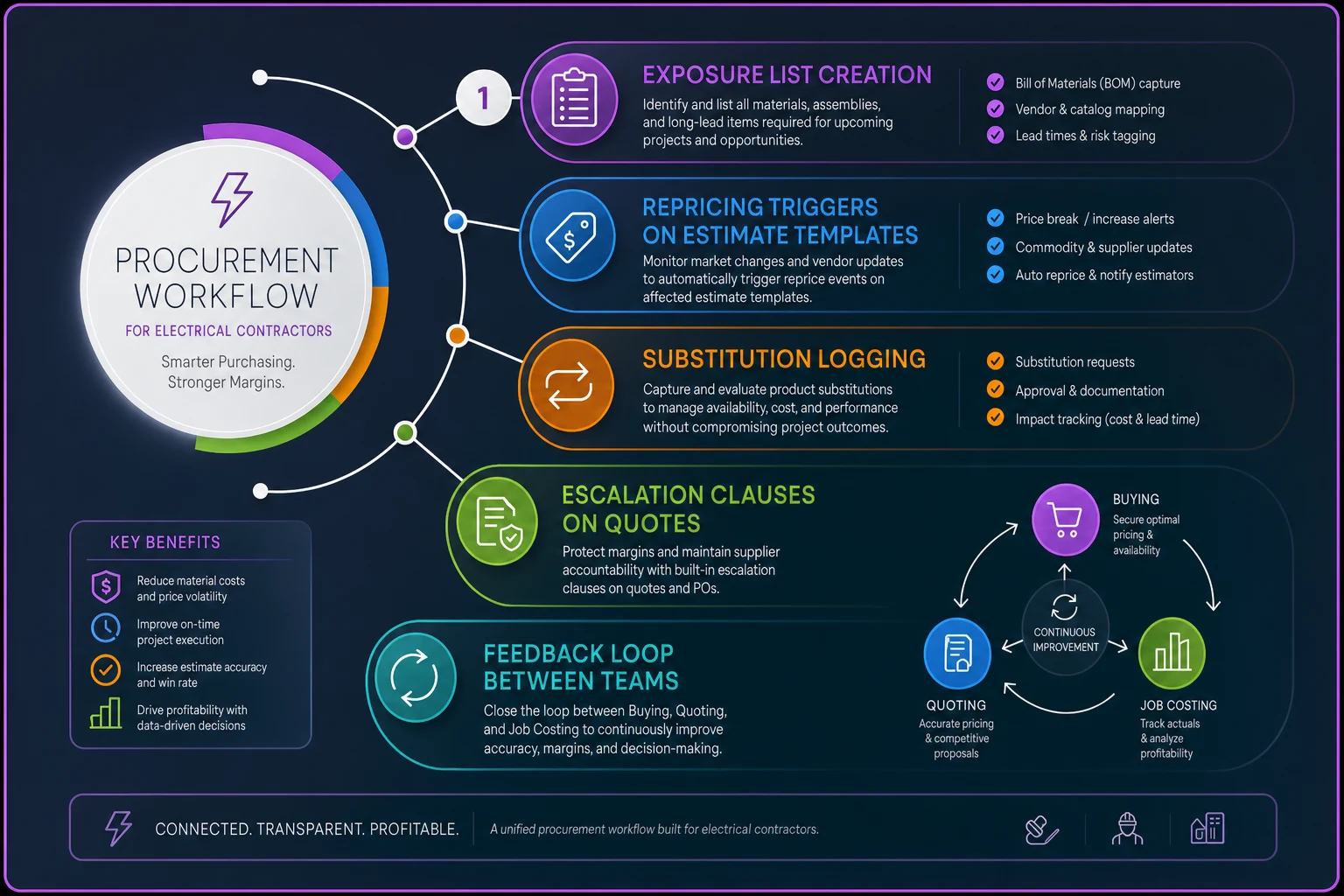
If you want the templates and controls to build that out properly, the procurement playbook with vendor scorecards, reorder rules, and month-end credit reconciliation walks through the whole system in detail.
The late-October data is a reminder, not a crisis. Lead times are stretching and energy costs are feeding into prices—but the contractors who get hurt won't be the ones who saw the shortage coming. They'll be the ones who protected their schedule and forgot to protect their margin, who bought more inventory but kept quoting off old numbers, who let silent substitutions pile up unlogged.
Spend the next few weeks sorting your real exposure, refreshing your pricing, and closing the gap between what the field buys and what the office quotes. Do that, and the next supply squeeze becomes an inconvenience instead of a quarter you'd rather forget.
Ready to optimize your electrical service operations?
Join 500+ electrical service companies using Voltzly to improve scheduling accuracy, enhance client satisfaction, and boost operational efficiency.