



The Fed just held rates steady at 3.50%-3.75% yesterday, and the CNBC report shows three members actually wanted to hike. For electrical contractors, that means another quarter minimum of expensive consumer financing — which hits directly on demand for $8,000 panel upgrades and $3,500 EV charger installs.
This exact scenario played out in late 2022 when rates first started climbing. Shops that waited to adjust got crushed — jobs dried up, techs sat idle, and receivables stretched from 30 days to 90+. The ones that moved fast on specific operational changes actually held their margins through the downturn.
The contractor cashflow Fed rate hold impact isn't theoretical anymore. Residential electrical shops are reporting 15-20% drops in big-ticket quotes converting to actual jobs. Homeowners are balking at financing rates north of 12% for home improvement loans. The monthly payment on a $10,000 panel upgrade just went from manageable to painful for most middle-income households.
The financing squeeze is creating a cascading operational problem
When consumer financing gets expensive, homeowners don't cancel electrical work entirely — they postpone, downgrade, or demand aggressive payment terms. A full panel upgrade becomes "just fix what's broken." The whole-house surge protection gets pushed to next year. The Level 2 EV charger install becomes "we'll stick with Level 1 for now."
This creates four immediate problems for electrical contractors:
First, your job mix shifts toward lower-margin emergency work. Instead of scheduled $5,000+ installs running 40% gross margins, you're running more $400 troubleshooting calls at 25%. Your average ticket drops while your truck rolls stay the same.
Second, cashflow timing gets brutal. Customers who would normally pay 50% upfront for a big install now want nothing down and 60-90 day payment terms. Some shops are seeing receivables age jump from 28 days average to 47 days since spring.
Third, tech utilization becomes harder to manage. Big installs are predictable 4-8 hour blocks. Service calls are unpredictable 1-2 hour scattered jobs. You end up with techs driving more, logging fewer billable hours, and sitting idle between calls.
Fourth, materials become a working capital trap. You're still buying wire and breakers upfront, but getting paid slower. Every job ties up cash for longer.
Move 1: Implement deposit requirements on everything over $1,500
This one change alone can prevent a cashflow crater. Set a hard rule: any job over $1,500 requires 40% down before scheduling. No exceptions for "good customers" or "quick jobs."
Never miss a job or delay a dispatch again.
Voltzly helps you schedule, assign, and track every electrical job efficiently.
- Unified job scheduling
- Real-time technician tracking
- Automated client notifications
No credit card required
The pushback will be immediate. Your office manager will hear sob stories about waiting for paychecks or insurance settlements. Estimators will say they're losing sales. But customers who can't put down $600 on a $1,500 job were probably never going to pay you promptly anyway.
| Tier | Terms |
|---|---|
| Under $500 | Net 15 payment terms |
| $500–$1,500 | Payment due on completion |
| Over $1,500 | 40% deposit to schedule, balance on completion |
Make the deposit collection friction-free. Accept credit cards, even with the 2.9% fee. Offer ACH. Make it possible to pay the deposit right during the estimate presentation — don't give them time to go home and reconsider.
Move 2: Shift your pricing strategy from markup to time-based minimums
When big jobs dry up, shops make the mistake of chasing volume by cutting prices. That's the wrong move. Protect margins by implementing minimum charges that actually reflect your operational costs.
Here's a simple framework:
-
Diagnostic/troubleshooting minimum
$295 (covers truck roll + 90 minutes)
-
Half-day minimum for any install
$850
-
Full-day minimum for complex work
$1,650
These minimums should include the first hour or two of labor, then your hourly rate kicks in. This stops you from losing money on small jobs that eat up windshield time and scheduling slots.
Track what percentage of jobs hit only the minimum. If it's consistently above 30%, your minimums are too low for current market conditions. The goal is making every truck roll profitable — not maximizing job count.
Move 3: Create a rapid invoice-to-payment workflow
The gap between getting paid in 48 hours versus 30 days could determine whether you make payroll next month. Most shops treat invoicing as an afterthought — something the office handles when they get around to it.
Build this sequence and make it non-negotiable:
Day of service:
-
Tech completes work by 3 PM
-
Tech uploads photos and completes job notes by 4 PM
-
Office generates invoice by 5 PM
-
Invoice sent to customer by 5
30 PM
Day after service:
-
Automated payment reminder at 10 AM if not paid
-
Personal call from office at 2 PM if still unpaid
-
Text message at 4 PM with payment link
48 hours after service:
-
Second automated reminder
-
Email to decision maker if different from primary contact
-
Note in system for collections follow-up
The key is making this systematic, not personality-dependent. When cashflow tightens, you can't afford to wait for customers to remember to pay. Our earlier post on job finalization checklists goes deeper into the documentation side that makes this speed possible.
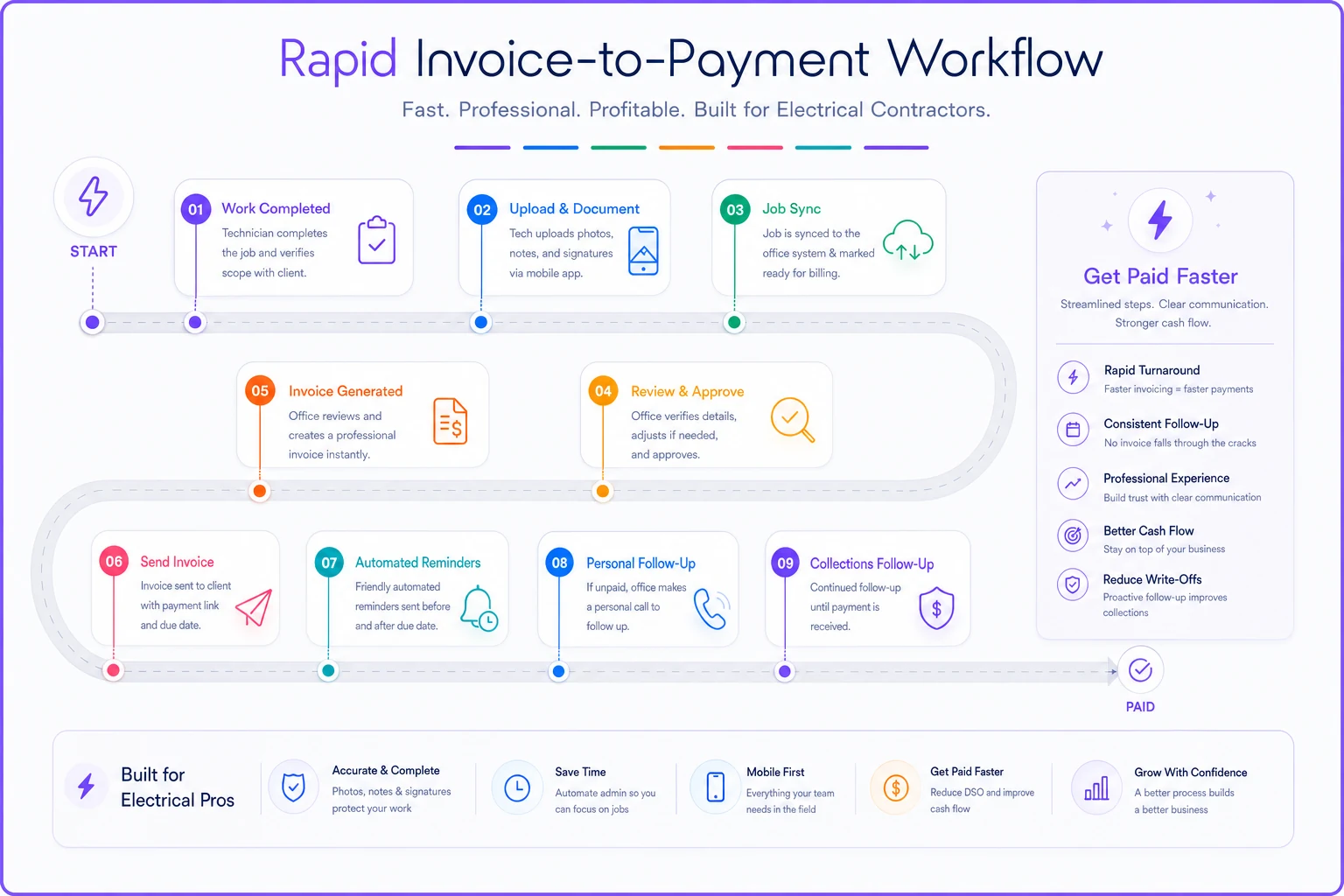
Automate the 10 AM reminder so it sends without office intervention to keep the process reliable.
The key is making this systematic, not personality-dependent. When cashflow tightens, you can't afford to wait for customers to remember to pay.
Move 4: Restructure your schedule around cashflow timing
Start scheduling based on payment reliability, not just operational efficiency. Prioritize customer types that pay fastest.
Rank your categories:
-
Commercial/property management (usually pay in 15-20 days)
-
Insurance jobs (slow but guaranteed)
-
Cash/check customers (immediate payment)
-
Financing customers (30-60 day payment)
-
Net 30 residential (actually means 45-60 days in practice)
During tight cashflow periods, fill Monday through Wednesday with categories 1-3. Push categories 4-5 to Thursday-Friday. This front-loads the week with faster-paying work.
Also pull back on scheduling density. Instead of running at 90% capacity, drop to around 75% and use the gaps for collections calls, deposit pickups, and quick cash-only repairs. It sounds counterintuitive, but protecting cashflow timing matters more than filling every slot right now.
Move 5: Build material float into your vendor relationships
Material costs are squeezing shops because they're paying suppliers faster than customers pay them. A $2,000 wire order for a job that pays in 45 days means you're effectively financing your customer's project out of pocket.
Renegotiate with your top three suppliers. Ask for:
-
Net 45 terms instead of Net 30
-
2% discount for payment within 10 days (only take this when cashflow is healthy)
-
Consignment stock on high-turn items
-
Job accounts where the customer pays the supplier directly
If your current suppliers won't move, open accounts with alternates. Regional suppliers tend to be more flexible than national chains. Some will do job-specific billing where they invoice your customer directly for materials over a certain threshold.
For jobs with over $5,000 in materials, consider having customers purchase materials directly. You lose the markup, but you also eliminate the cashflow burden. Bump your labor rates up 8-10% to compensate.
Move 6: Launch a membership program for recurring revenue
This is the move that separates shops that survive downturns from those that actually come out stronger. A membership program creates predictable monthly revenue regardless of whether the phone is ringing.
Keep the structure simple:
-
$39/month
Annual electrical safety inspection
-
$89/month
Inspection plus one emergency call waiver
-
$149/month
Inspection, emergency waiver, plus 15% off all work
Price these based on your local market, but make the middle tier feel like the obvious choice. Most homeowners will pick $89 because it feels like insurance.
On the operational side — batch your membership service calls. Don't run them one-off throughout the month. Schedule "membership weeks" where techs knock out inspections in specific neighborhoods back to back. Keeps efficiency up even on lower-revenue work.
Target 100 members in the first 90 days. That's roughly $8,900 in monthly recurring revenue — enough to cover a tech's base salary. By month six, aim for 250. That cushion lets you be more selective about which big jobs are worth chasing.
The compound effect of operational discipline
The shops that survive this Fed-induced demand squeeze won't be the ones with the best marketing or the lowest prices. They'll be the ones that moved fast on fundamentals.
Each of these moves compounds. Deposits improve immediate cashflow. Minimums protect margins on smaller jobs. Fast invoicing accelerates cash conversion. Strategic scheduling prioritizes reliable payers. Vendor float reduces working capital pressure. Memberships create a baseline revenue floor.
Together, these changes could mean the difference between laying off techs in October or having enough cushion to pick up good people when competitors start downsizing.
The Federal Reserve's decision to hold steady signals at least another quarter of this environment. Consumer financing won't get cheaper until late 2026 at the earliest. The shops making these moves now will be the ones taking market share when demand eventually comes back.
Start with deposits and rapid invoicing — those have the fastest cashflow impact. Then layer in the rest as your team gets comfortable. The current environment just makes these changes non-negotiable rather than nice-to-have.
Ready to optimize your electrical service operations?
Join 500+ electrical service companies using Voltzly to improve scheduling accuracy, enhance client satisfaction, and boost operational efficiency.