



The June 2026 jobs report dropped last week, and it wasn't what most contractors wanted to hear. According to the Bureau of Labor Statistics, the economy added significantly more jobs than expected, keeping unemployment low and wage pressure high across skilled trades. For electrical contractors running shops with 2–50 techs, that translates directly into higher payroll costs and longer hiring timelines.
Three electrical shops in my network lost bidding wars for journeymen last month — losing out to larger commercial contractors offering $4–6 more per hour plus signing bonuses. One shop owner in Phoenix told me he's been trying to fill two positions for eleven weeks. Those same positions took three weeks to fill eighteen months ago.
The math is brutal. When your lead tech at $38/hour gets poached for $44, you either match it or start over. Match it, and every other tech on your crew suddenly expects a bump. Start over, and you're looking at 8–12 weeks of reduced capacity while someone new gets up to speed. Fixed costs don't pause either, and summer demand doesn't care about your staffing problems.
Why traditional hiring and retention strategies are breaking down
Most electrical contractors still approach labor management like it's 2019. Post on Indeed, offer competitive hourly rates, maybe throw in a tool allowance. But when every contractor within 50 miles is fishing from the same shrinking pool of licensed electricians, those tactics don't move the needle anymore.
The real problem isn't just finding people — it's maintaining profitable operations while labor costs eat into margins. Looking at payroll data from around forty electrical shops over the past year, the ones struggling most were still running static pricing from early 2025, dispatch rules that assumed full crews, and compensation structures that hadn't evolved beyond hourly wages plus overtime.
One shop in Denver was hemorrhaging money on residential service calls because they hadn't touched their flat-rate book since January 2025, while their average tech wage had climbed 18%. They were subsidizing customers with their own margins. Another shop in Tampa kept dispatching solo techs to two-person jobs, creating safety issues and callbacks that destroyed profitability.
The shops that adapted quickly made three key moves: they built flexibility into their pricing, redesigned dispatch around actual staffing levels, and created retention systems that went beyond matching competitor pay.
Building wage escalation triggers into your pricing model
Static pricing kills electrical contractors in tight labor markets. You need automatic adjustment mechanisms that protect margins when labor costs move.
Never miss a job or delay a dispatch again.
Voltzly helps you schedule, assign, and track every electrical job efficiently.
- Unified job scheduling
- Real-time technician tracking
- Automated client notifications
No credit card required
Start with your actual labor burden — take your average tech's hourly rate, add payroll taxes, workers comp, benefits, and vehicle costs. For most shops, that lands somewhere between $65–85 per hour all-in. Then build in escalation triggers. When average tech wages in your market rise 5%, your labor rate should adjust by roughly 6–7% to maintain margin. Not every customer gets the new rate immediately — existing service agreements might have caps — but new quotes reflect current costs.
Here's what that looks like practically:
| Base Tech Wage | Full Labor Burden | Standard Markup | Customer Rate |
|---|---|---|---|
| $32/hour | $68/hour | 2.2x | $150/hour |
| $34/hour | $72/hour | 2.2x | $158/hour |
| $36/hour | $76/hour | 2.2x | $167/hour |
| $38/hour | $80/hour | 2.2x | $176/hour |
The key is making these adjustments systematic, not reactive. Set quarterly review dates. Pull local wage data from trade associations or labor market reports. Adjust your rate cards before you're forced to give emergency raises.
One residential contractor in Austin built this into their quoting software — when they update base wages, flat rates across all standard jobs recalculate automatically. Panel upgrades that quoted at $2,800 in January now quote at $3,150, maintaining their 42% gross margin despite paying techs $5/hour more.
Restructuring dispatch for incomplete crews
Perfect staffing is dead. You're going to have gaps, unexpected quits, and stretches running at 70–80% capacity. Your dispatch system needs to account for that reality, not pretend it doesn't exist.
Traditional dispatch assumes full availability — book jobs, assign techs, figure it out if someone calls in sick. That worked when you could grab a temp or shuffle crews easily. Now, with everyone stretched thin, you need proactive capacity management.
Map your jobs by actual crew requirements:
-
True one-person jobs (basic troubleshooting, device swaps)
-
Flexible jobs (can be done solo but faster with two)
-
Mandatory two-person jobs (heavy panel work, commercial installations)
-
Training opportunities (experienced tech plus apprentice)
Then build your dispatch rules around available combinations, not ideal ones. If you're down to three journeymen and two apprentices this week, you can handle a different mix of work than with five journeymen. The dispatch system should know this and route accordingly.
A shop in Portland restructured their whole booking system around this. Every job type is coded with minimum and optimal crew requirements. Their scheduler sees real capacity — "we can handle four panel upgrades this week with current staffing" — instead of the old "we have five crews, book whatever." Overtime dropped 30% because they stopped overpromising and scrambling.
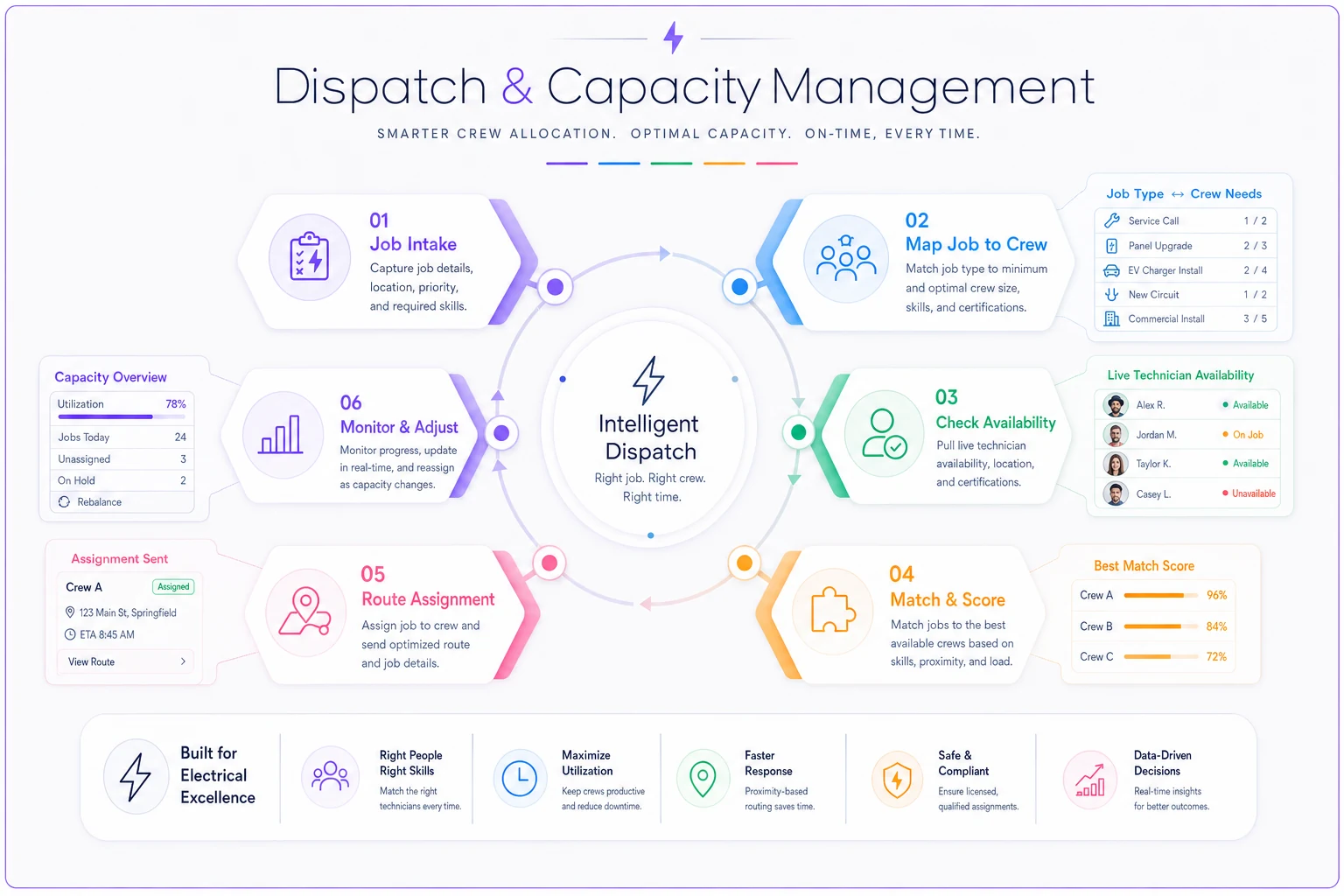
This shows how jobs flow from booking to crew assignment based on live staffing and job requirements.
Creating retention leverage beyond wage matching
Throwing money at retention eventually hits a wall. You can't outbid everyone forever, and even if you could, margins disappear. The shops keeping good techs are building structural advantages that money alone doesn't replicate.
Territory ownership changes things. Instead of rotating techs randomly, assign geographic zones. Joe owns everything north of Highway 40. Maria handles downtown commercial. When customers call back requesting "their electrician," that tech gets the call. Techs with regular customers and familiar routes consistently report higher job satisfaction. One shop saw turnover drop from 35% to 18% just by implementing stable territories.
Give high-performing techs first right of refusal on nearby jobs to strengthen territory ownership and customer continuity.
Skill development paths matter more than most owners realize. A tech making $38/hour will jump for $42 elsewhere — unless they see a clear path to $45 with you through certification programs or specialty training. Budget $2,000–3,000 per tech annually for development. It sounds steep until you calculate what replacing a trained tech actually costs — typically somewhere between $15,000–20,000 in recruitment, onboarding, and lost productivity.
Schedule flexibility beats most benefits packages for retention. The ability to start early and leave early for school pickup. Four-day weeks during slow seasons. These cost almost nothing but mean a lot to techs with families. One contractor in Nashville lets senior techs choose their own schedules — they work around 38 hours but pick when. They haven't lost a senior tech in two years.
Adjusting your hiring funnel for extended timelines
If it's taking 8–12 weeks to fill positions instead of 2–3, your entire hiring process needs to change. Most shops still recruit reactively — someone quits, post the job, interview, hire. In this market, that guarantees extended gaps.
You need continuous pipeline development. Always be talking to candidates, even when fully staffed. Keep a bench of pre-qualified people warm. This doesn't mean stringing anyone along. Be straight with them: "We don't have an opening right now, but we like to stay connected with quality electricians. Mind if we check in quarterly?"
Expand your candidate pool beyond licensed journeymen. The traditional approach — hire experienced techs only — doesn't work when experienced techs aren't available. Consider:
Helper-to-tech programs: Hire motivated helpers at $18–22/hour, pair them with experienced techs, and build a 24-month path to apprentice electrician. Slower, yes. But someone you train tends to stay longer than someone you poach.
Career-changer programs: HVAC techs, low-voltage specialists, and mechanical contractors often have transferable skills. A structured 90-day transition can convert them to productive electrical techs. One shop in Charlotte hired three former HVAC installers, put them through intensive electrical code training, and now they handle 60% of residential service calls.
Part-time senior techs: Retired or semi-retired electricians who want 20–25 hours weekly. Expensive per hour, but invaluable for training and complex troubleshooting. And they're not going anywhere.
Building operational cushions for labor volatility
The shops surviving this labor crunch built buffers before they needed them. That means intentionally operating at 85–90% capacity during normal periods, maintaining relationships with subcontractors, and having clear protocols for when staffing drops.
Think about capacity differently. Instead of "we have five crews, so we can handle 25 service calls daily," frame it as "we can reliably handle 20 calls at normal staffing, surge to 25 with overtime, and scale back to 15 if we lose someone." That framing prevents overcommitment and the service disasters that follow.
Your subcontractor network is basically illness insurance for your business. Maintain relationships with 2–3 reliable electrical contractors who can take overflow. Yes, you'll make less margin on subbed work. But maintaining service levels and customer relationships during gaps preserves long-term value. Set up predetermined rates and quality standards before you actually need them — not during a crisis.
Also establish clear job prioritization rules for when you're short-staffed:
-
Emergency safety issues
-
Contracted maintenance agreements
-
High-margin commercial work
-
Standard residential service
-
Low-margin installations
Everyone needs to know this — dispatch, sales, the office. When you're down two techs, you don't take on that barely-profitable apartment complex rewire. You protect margins and relationships.
When to actually turn down work
This is the hardest lesson for growth-oriented contractors: sometimes saying no protects your business more than saying yes.
A shop in Phoenix nearly came apart trying to maintain growth targets after losing three senior techs. They kept booking jobs, assuming they'd figure it out. The result was rushed work, a spike in callbacks, overtime running over 60 hours per week, and two more techs quitting from burnout. Revenue grew 15%. Profit dropped 40%.
Know when to push back:
-
Jobs requiring skills you've lost to turnover
-
Projects with penalty clauses when you're understaffed
-
Low-margin work that ties up capacity for weeks
-
Customers with historically high callback rates
-
Rush jobs that demand excessive overtime
Build formal circuit breaker rules. When overtime exceeds 15% of total hours for two consecutive weeks, stop booking new work. When you're operating below 75% staffing, decline anything outside your core competencies. When a customer wants a two-week project and you're down to skeleton crews, offer to schedule eight weeks out or refer to a partner.
The technology piece: managing complexity with fewer people
Running lean operations requires better coordination than running fat ones. Miscommunication, forgotten job details, duplicated work — these are expensive when every tech hour counts. Operational software becomes critical infrastructure in this environment, not a nice-to-have.
The shops handling labor shortages best have centralized everything into platforms that reduce coordination overhead. When your dispatcher, techs, and office staff all work from the same real-time information, you cut the constant back-and-forth that burns hours. Job details, customer history, inventory, scheduling changes — it all lives in one system, updating as things change.
AI-powered scheduling helps these shops optimize routes automatically based on actual availability, not theoretical full staffing. Instead of manually reshuffling when someone calls in sick, the system redistributes jobs based on location, skills, and capacity. One shop told me this saved their dispatcher close to two hours a day — time now going toward customer communication and quality control.
The margin protection side comes from automated pricing adjustments and real-time job costing. When labor rates change, new quotes automatically reflect updated costs. When a job runs over, managers see it immediately, not weeks later buried in a P&L. That visibility lets lean teams make better decisions faster.
For shops thinking about building more scalable field operations, I covered territory design and capacity planning in more depth here: territory design and capacity math for growing electrical teams. Those principles become even more critical when you're managing through a staffing crunch.
A real example: How one shop restructured for profitability
Here's what this actually looked like for a residential electrical contractor in Raleigh running 12 techs — down from 15 in January.
They lost three journeymen to a large commercial contractor in February and March. Recruitment was stalling — seven weeks, four interviews, zero hires. Callbacks increased 40% as remaining techs rushed through jobs. Overtime hit $14,000 in March alone.
First move: they stopped taking new construction jobs temporarily and focused only on service and repair work. Revenue dropped, but margins improved right away.
Second: they restructured from five territory zones to four, giving each senior tech ownership over specific neighborhoods. Windshield time dropped 25% and customer relationships improved.
Third: dynamic pricing — all new quotes included a 12% labor cost increase. Existing service agreement customers got grandfathered rates through contract end, but renewals reflected the new reality.
Fourth: they hired two electrical apprentices and one career-changer from HVAC, accepting the training investment as necessary. They also brought on a semi-retired master electrician for 20 hours weekly to handle training and complex troubleshooting.
Results after four months:
-
Revenue down 8% from peak but up 5% year-over-year
-
Gross margins recovered to 38% from a low of 31%
-
Overtime down to 6% of hours from 18%
-
Zero additional turnover
-
Two techs returned after their new employers couldn't deliver on promised working conditions
They got smaller but stronger — more profitable at 12 techs than they'd been at 15.
Moving forward: Your 90-day action plan
The June 2026 jobs report confirms what you're already feeling in your payroll and your hiring pipeline. This pressure isn't temporary, and band-aids won't hold. You need structural changes.
Start with pricing this week. Calculate your actual labor burden with current wages. Compare it to your billing rates. If the margin isn't there, adjust immediately for new work. Don't wait for a better moment.
Next, audit your dispatch system. List every job type you handle. Mark minimum and optimal crew requirements. Build scheduling rules that reflect reality. If you're still running on paper or basic spreadsheets, it's probably time to upgrade to something that can handle this complexity without constant manual intervention.
Then address retention. Survey your techs — anonymously — about what would make them stay beyond a raise. You'll often find it's schedule flexibility, better tools, or clearer advancement. Pick two things you can act on within 30 days.
Finally, start building your hiring pipeline now, not when you're desperate. Monthly coffee meetings with potential candidates. Relationships with local trade schools. That helper-to-tech program you've been putting off.
The labor market isn't fixing itself anytime soon, but how you respond to it will determine whether you come out of this period stronger or just worn down. The electrical shops that make it through won't necessarily be the ones that paid the most or pushed their teams hardest. They'll be the ones that restructured operations for efficiency, protected margins intentionally, and built sustainable advantages that go beyond wage competition.
Ready to optimize your electrical service operations?
Join 500+ electrical service companies using Voltzly to improve scheduling accuracy, enhance client satisfaction, and boost operational efficiency.