

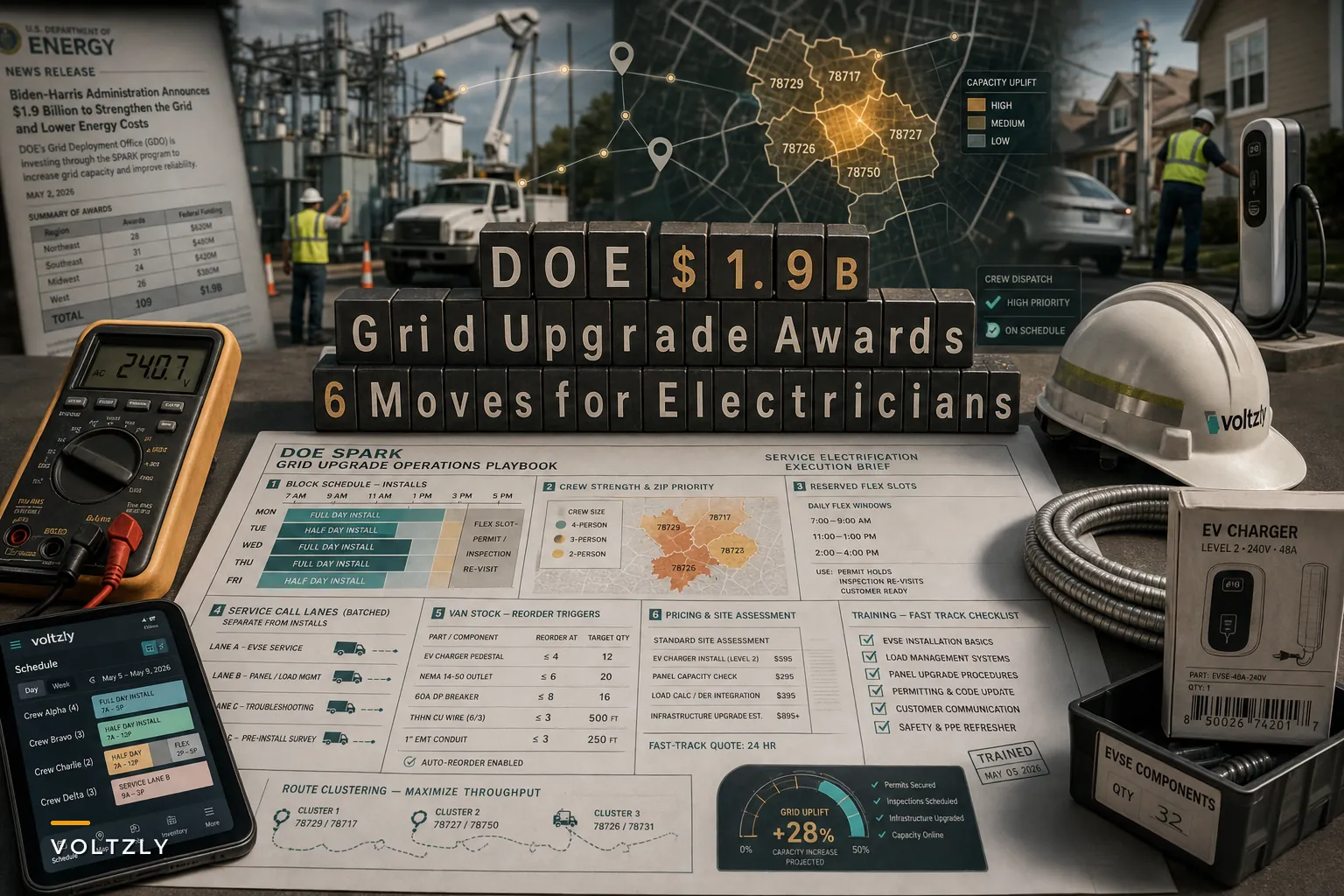

When the Department of Energy announced its selections for 31 SPARK grid-improvement projects across 26 states, directing $1.9 billion toward reconductoring lines and deploying grid-enhancing tech, the headline number everyone fixated on was the ~23 GW of freed-up capacity. That's real, and it's big. But for a shop running 3 to 15 techs, the GW figure isn't the operational signal. The operational signal is quieter: once regional capacity constraints loosen and utilities stop slow-walking service upgrades, the bottleneck that's been protecting you from a flood of electrification work disappears.
That's the part most contractors are going to miss. For the last couple of years, a lot of residential electrification demand has been suppressed, not absent. Homeowners who wanted a heat pump or a Level 2 charger ran into utility interconnection delays, panel capacity limits, or quotes that priced in the hassle of a service upgrade. When the grid-side constraint eases in a funded region, that suppressed demand releases — and it doesn't release evenly. It comes in clusters, geographically tied to where the upgrades land.
So this isn't really an article about federal funding. It's about what happens to your booking board, your van stock, and your margin structure when a backlog of hesitant buyers suddenly becomes buyers. Below are six moves worth making before the demand curve actually bends.
Move 1: Map your demand *before* it shows up, by zip code
Most shops forecast demand by looking backward — last month's calls, last year's same quarter. That works fine in a steady market. It's useless when a policy-driven supply change is about to reshape where the work concentrates.
The funded SPARK projects are tied to specific transmission corridors and regions. Capacity relief won't be national — it'll be lumpy. Some of your service area might see utility upgrade queues clear out over the next 12 months while neighboring counties stay constrained. If you're pricing and staffing the same across your whole territory, you'll be understaffed where demand pops and overstaffed where it doesn't.
A practical version of this: pull your service area into three tiers.
-
Tier A — zips inside or adjacent to a funded project region, with older housing stock (pre-2000 panels, 100A or 60A services common)
-
Tier B — zips with newer homes but strong EV adoption signals (you can eyeball this from the chargers you already see in driveways)
-
Tier C — everything else, your baseline demand
The insight isn't complicated, but almost nobody does it: the overlap between aging electrical infrastructure and newly unlocked grid capacity is where your panel-upgrade-plus-charger combo jobs are going to concentrate. Those are your highest-ticket electrification jobs. Knowing which 4–6 zip codes to watch lets you pre-position marketing spend and crew availability instead of reacting three weeks late.
Move 2: Rebuild your van stock around electrification turnover, not break-fix
The parts mix for electrification work is fundamentally different from service-call work, and shops that don't adjust get caught mid-surge.
Never miss a job or delay a dispatch again.
Voltzly helps you schedule, assign, and track every electrical job efficiently.
- Unified job scheduling
- Real-time technician tracking
- Automated client notifications
No credit card required
A break-fix-oriented van carries a wide, shallow inventory — a little of everything. Electrification work is the opposite: narrow and deep. You burn through EVSE units, 50A and 60A breakers, 2-pole breakers for heat pump circuits, load centers, grounding materials, and 6 AWG / 4 AWG wire at a much faster clip, and you need multiples on the van because you're often doing two or three similar installs in a week.
Here's a rough comparison of how the stocking logic shifts:
| Item category | Break-fix stocking logic | Electrification-surge logic |
|---|---|---|
| EVSE / chargers | 0–1, order per job | 2–3 common models staged |
| Panels / load centers | 1 as backup | 2–3, pre-staged by amperage |
| High-amp breakers (40–60A) | A few, assorted | Deep stock, fast reorder trigger |
| 6/4 AWG copper | Partial spool | Full spools, multiple |
| Meter sockets / mast parts | Order as needed | Stocked for service upgrades |
| Low-amp break-fix parts | Deep, varied | Trimmed back |
The mistake that keeps showing up: shops ride into a demand surge with their old stocking ratios, hit a stockout on EVSE units or high-amp breakers mid-week, and either idle a crew or burn a tech's half-day running to the supply house. On a $2,800 charger-plus-circuit job, two lost half-days of crew time can eat most of the margin.
Reset your high-amp breaker reorder triggers to the expected electrification pace before installs cluster to avoid mid-week stockouts.
Reorder triggers matter more than reorder quantities here. If your 60A breaker trigger was calibrated for break-fix pace, it'll fire too late once installs start clustering. Reset the triggers before the volume hits, not after you've already stocked out twice.
Move 3: Protect your scheduling against surge compression
Electrification demand doesn't just increase volume — it compresses it. Rebates, utility program windows, and homeowner tax-year timing all push people to book in the same stretches. You end up with three weeks of flat calendar followed by a wall of installs everyone wants done "before the end of the quarter."
-
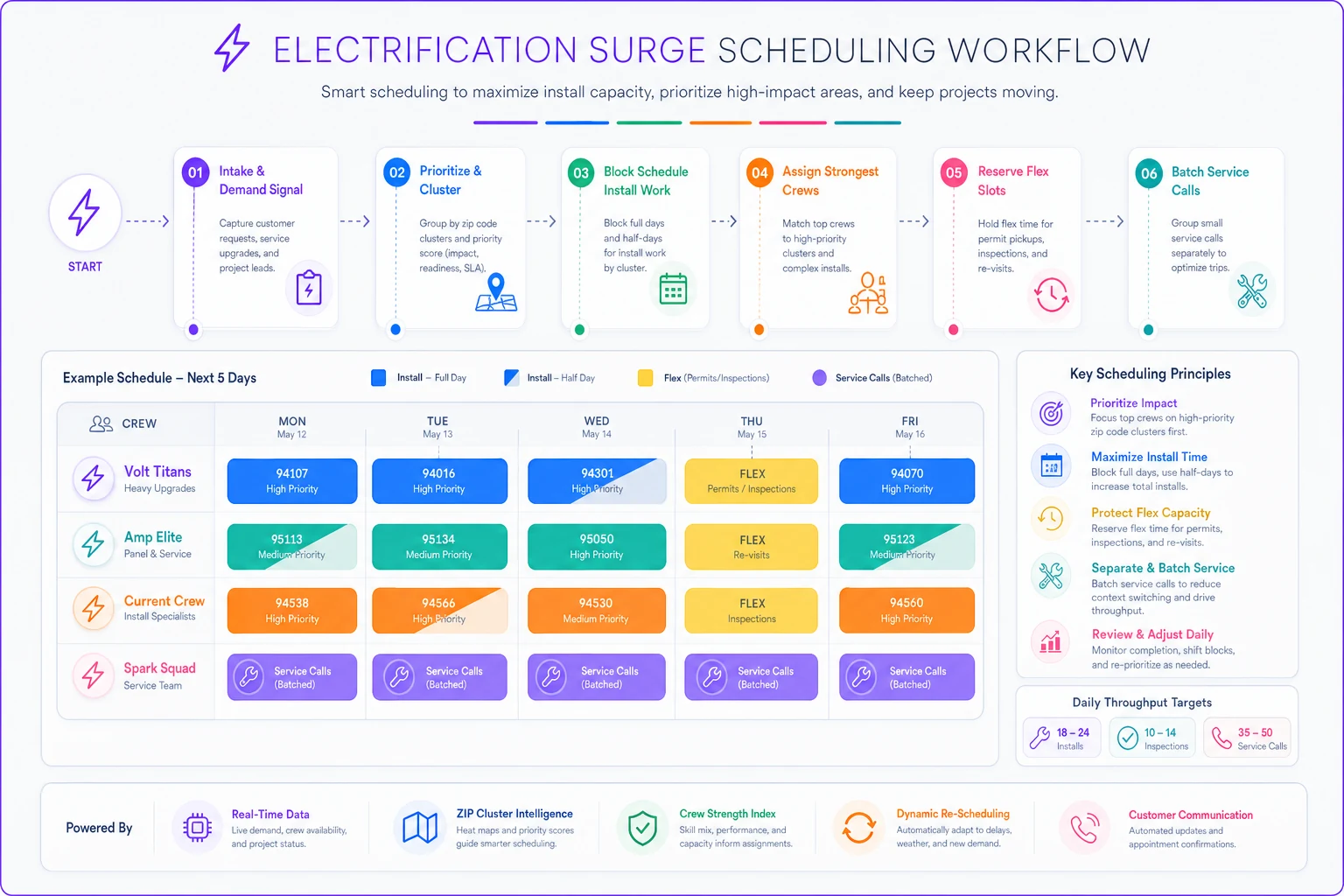
Block-schedule electrification work. Dedicate whole days or half-days to install work, and batch service calls into their own windows.
-
Assign your strongest install crew to the Tier A zips you mapped in Move 1, so your highest-value work gets your most efficient hands.
-
Hold a flex slot — roughly one open half-day per crew per week — specifically for the permit-and-inspection re-visits that electrification jobs generate.
-
Stop promising same-week installs on complex combo jobs during peak windows. Set a realistic 2–3 week lead time and defend it.
That last one is where owners bleed margin without realizing it. Overpromising during a surge forces overtime, rushed site assessments, and callbacks — all margin killers that don't show up on any single invoice but quietly drain the month.
A quick visual of the scheduling workflow during a surge:
That last one is where owners bleed margin without realizing it. Overpromising during a surge forces overtime, rushed site assessments, and callbacks — all margin killers that don't show up on any single invoice but quietly drain the month.
Move 4: Fix pre-site assessment before volume exposes your weak spots
This is the one that quietly determines whether a surge makes you money or just makes you busy.
When you're running four or five electrification quotes a week, a sloppy site assessment process compounds fast. Every job where a tech shows up and discovers the panel can't take the load, or the run is 40 feet longer than quoted, or the service needs an upgrade nobody priced — that's a rescheduled crew, a re-quote, an awkward homeowner conversation, and usually a margin hit you eat to save the relationship.
Shops that handle electrification volume cleanly treat the site assessment as a pricing decision point, not just a measurement visit. They know which variables move the quote — panel capacity, run distance, service amperage, whether a service upgrade is in play — and they've turned that into a repeatable decision structure instead of letting each estimator wing it. If you haven't built that out yet, our breakdown on site-assessment pricing for EV charger installs walks through a decision tree and margin guardrails that hold up under volume. The principle extends directly to heat pump and panel-upgrade work too.
The pattern worth internalizing: underquoting at the assessment stage is more expensive during a surge than during a slow season, because every mispriced job also costs you a slot you could've filled with a correctly priced one. Scarcity of crew time changes the math on every estimating mistake.
Move 5: Decide deliberately whether to chase this demand at all
Not every shop should lean into an electrification surge, and pretending otherwise is how good contractors overextend into trouble.
When leaning in makes sense:
-
You already do EV and panel work regularly and have at least one or two techs comfortable with load calcs and service upgrades.
-
You can stage parts capital for a few weeks of elevated stock without straining cash.
-
Your assessment and quoting process is tight enough to handle 2–3x the quote volume without collapsing into chaos.
-
Your service area overlaps a funded region or has visible EV adoption.
When leaning in is a bad idea:
-
You're already running your crews at capacity on profitable service work with good margins. Chasing surge volume by stretching thin usually trades reliable margin for busy, lower-margin work.
-
Your estimating is inconsistent tech-to-tech. Volume will expose and multiply that inconsistency fast.
-
You don't have the cash to float both increased WIP and slower-paying permit-gated jobs. Electrification jobs often have longer cash cycles than quick service calls.
Who should actively sit this out: single-truck shops with no bench depth and no estimating system. Surge demand with a one-person operation almost always means overcommitting, quality slipping, and a reputation hit that outlasts the demand spike. Better to stay in your lane and raise prices on the work you already do well.
The underlying point: a demand wave is only an opportunity if your operation can actually convert it to margin. Otherwise it's just stress with extra steps.
Move 6: Stage your upskilling now, not when you're drowning
The skilled-labor crunch is the constraint that'll bite hardest. You can't hire your way out of an electrification surge in a region where every shop is suddenly hiring at once — the labor just isn't sitting there waiting.
The more durable move is broadening what your existing crew can handle. A tech who's solid on service work but hasn't done many load calculations or service upgrades can become electrification-capable in a few focused weeks if you deliberately pair them with someone who has the reps. The mistake is waiting until you're buried to start that pairing — by which point nobody has time to teach and everyone's rushing.
-
Identify the 2–3 skills that gate your electrification throughput (usually load calcs, service upgrades, and clean EVSE commissioning).
-
Pair your developing techs with your strong ones on real jobs now, while volume is still manageable.
-
Document the install sequence so a newer tech can follow it without re-asking every step — this is where standardized job documentation earns its keep.
A real scenario that illustrates the stakes: a seven-tech residential shop in a mid-sized metro saw charger and panel inquiries climb noticeably after regional utility upgrades cleared their interconnection backlog — something like a jump from a handful of electrification quotes a month to 15 or 18. They had the leads. What they didn't have was enough techs comfortable running service upgrades, so complex jobs bottlenecked onto one senior guy. Lead times stretched past three weeks, a few prospects walked, and the senior tech was fried. The fix wasn't hiring — it was pulling two mid-level techs into a deliberate pairing rotation over about six weeks so three crews could run combo jobs instead of one. Throughput on the high-ticket work roughly doubled without adding a single headcount, and the senior tech stopped being a single point of failure.
That's the whole game: the shops that win the next 24 months aren't the ones with the most leads — they're the ones whose operations can actually absorb the leads without breaking.
The real test isn't demand. It's conversion.
Grid upgrades easing capacity constraints is genuinely good news for anyone doing electrification work. More homeowners will finally be able to say yes. But demand has a way of flattering shops into thinking they're winning when they're really just overloaded — more quotes, more busy days, and somehow margins that don't move or quietly slip.
The difference comes down to whether your operation treats a surge as something to process or something to manage. Mapping where demand will actually land, stocking for electrification turnover instead of break-fix, protecting your schedule from compression, tightening assessment before volume exposes the cracks, being honest about whether you should chase it, and building crew capacity ahead of time — none of that is glamorous. But it's the difference between a surge that builds your shop and one that burns it out. The capacity is coming. The question is whether your operation is ready to turn it into margin instead of just motion.
Ready to optimize your electrical service operations?
Join 500+ electrical service companies using Voltzly to improve scheduling accuracy, enhance client satisfaction, and boost operational efficiency.