



Last week's PCE inflation report from the Bureau of Economic Analysis landed hard—4.1% year-over-year. Not the 3.2% economists predicted. Not the comfortable 2.8% from last quarter. A full 4.1%, and still climbing.
For electrical contractors, this number hits differently than it does for other trades. Copper wire costs are up 18% since January. That $85 breaker panel you quoted last month? Now $97. And homeowners who were already stretching budgets for whole-house surge protection are pulling back entirely.
What gets missed in most inflation conversations is the operational cascade. When material costs spike this fast, your entire dispatch strategy starts breaking down. Margin protection rules fail. Estimating templates become outdated almost immediately. And those KPI triggers you set up six months ago? They're firing false positives left and right.
Material cost jumps are just the visible problem
Walk into any supply house right now and watch contractors stare at price sheets. A 250-foot roll of 12-2 Romex that ran $142 in March is now $171. Standard 20-amp breakers went from $7.50 to $9.25. Even basic wire nuts jumped 22%.
The obvious response is to add 15% across all quotes and move on. Except that's exactly how you end up losing profitable work while keeping the jobs nobody else wants.
When inflation spikes this hard, your work mix shifts dramatically. Customers postpone panel upgrades but can't delay emergency repairs. They cancel smart home installs but need immediate fixes when outlets fail. The profitable, planned work dries up while emergency calls—with all their scheduling inefficiencies and overtime costs—multiply.
A contractor I worked with in Phoenix ran into this exact pattern. He raised prices 12% across the board, revenue stayed flat, but profit dropped 31%. Why? His work mix had shifted almost entirely toward reactive service calls—more windshield time, more overtime, more return trips for parts he didn't have on the truck.
The repricing strategy needs to account for that mix shift, not just raw material costs.
Why blanket price increases destroy your dispatch efficiency
Raising all prices equally seems logical until you see what it does to technician routing. Higher prices reduce total job volume—expected. But they don't reduce it evenly across job types or locations.
Never miss a job or delay a dispatch again.
Voltzly helps you schedule, assign, and track every electrical job efficiently.
- Unified job scheduling
- Real-time technician tracking
- Automated client notifications
No credit card required
Panel upgrades in newer developments might drop 40%. Service calls in older neighborhoods? Maybe 5%. Suddenly your techs are spending Tuesday morning driving 47 minutes between two jobs instead of hitting four houses in the same subdivision.
A Jacksonville contractor tracked this after a 14% across-the-board increase. Average daily windshield time per tech jumped from 2.1 hours to 3.4 hours. Same number of completed jobs. Same revenue per job. But 64% more dead time eating into margins.
The inflation reprice needs geographic and service-type granularity. Emergency calls in dense urban areas might absorb an 8% increase just fine. Panel upgrades in the suburbs might handle 18%. The dispatch impact determines your real margin—not the number on the quote.
Three repricing moves that protect margins without killing volume
1. Service-tier pricing with inflation adjustments
| Tier | Adjustment |
|---|---|
| Same-day emergency: | Base rate + 22% inflation adjustment |
| Next-day priority: | Base rate + 14% inflation adjustment |
| Flexible scheduling (3-5 days): | Base rate + 9% inflation adjustment |
This captures more margin from time-sensitive work while keeping price-sensitive customers in your pipeline. The flexible-scheduling tier also helps with dispatch density—you can cluster those jobs geographically and cut dead time.
2. Material-labor split pricing
Break every quote into explicit material and labor components. Material prices float with current costs plus a 4% handling buffer. Labor stays fixed for 30 days.
Customers understand material volatility—they see it at Home Depot. But they expect labor to be stable. When you explain that materials went up $340 but your labor rate hasn't changed, they process that very differently than hearing the total just went up $340. That framing difference affects close rates by somewhere in the 20-25% range based on what I've seen across different markets.
3. Geographic zone multipliers
-
Zone 1 (0-15 minutes)
Standard inflation adjustment
-
Zone 2 (15-30 minutes)
Inflation + 6%
-
Zone 3 (30-45 minutes)
Inflation + 11%
-
Zone 4 (45+ minutes)
Inflation + 18% or pass on the work
These aren't travel charges—they're baked into the base quote. Customers see a total price that protects your margin despite the dispatch inefficiency, not a line item that feels like a penalty for living far away.
Operational adjustments that inflation forces
Beyond repricing, inflation at this level breaks several standard operating procedures.
Van stock reorder points need immediate adjustment. That rule about reordering at 20% inventory? Bump it to 35%. Lead times have stretched and prices can jump between when you place an order and when it actually arrives. Running out of a basic part means either eating a supply house run at retail or losing the job.
Buy critical, fast-moving parts in larger quantities to avoid costly supply-house retail runs.
Quote validity periods need to shorten. Those 30-day quotes you've been issuing? Cut them to 10 days, maybe 14 for established customers. Include explicit language about material price adjustments after expiration. It feels aggressive, but eating a 7% material increase on a job you quoted three weeks ago feels worse.
Overtime thresholds change. When materials cost more, the relative cost of overtime labor actually drops. Paying time-and-a-half to finish a job today might make more sense than a return trip tomorrow. The break-even calculation shifted—run the numbers fresh.
The dispatch problem nobody talks about
Reuters noted that consumer spending remains surprisingly strong despite the inflation spike. For electrical contractors, that creates a peculiar problem: demand stays high but becomes erratic.
Customers call for quotes, then ghost you. They schedule installations, then postpone last minute. They approve work, then want to phase it differently. This kind of chaos wrecks dispatch efficiency worse than a simple volume decline.
Traditional dispatch assumes relatively predictable customer behavior. When inflation anxiety sets in, that predictability disappears. Your Monday morning schedule that looked solid Friday afternoon? By 10 AM, two jobs have canceled, one wants to reschedule "maybe next month," and three emergency calls came in from people who've been delaying repairs for weeks.
Better scheduling software won't fix this. Different capacity planning will. Instead of running at 85-90% capacity, you probably need to drop to 70-75% to stay flexible when things inevitably shift. That means pricing needs to support margins at lower utilization.
KPI triggers that need immediate recalibration
Your existing dashboard probably tracks revenue per job, jobs per tech per day, and gross margin percentage. When inflation spikes this fast, those metrics need different trigger points—or in some cases, different metrics entirely.
Revenue per job jumping 15% from price increases doesn't mean performance improved. Jobs per tech per day dropping might reflect dispatch inefficiency, not a productivity problem. Gross margin percentage becomes hard to interpret if your job mix completely changed.
Better inflation-adjusted KPIs to track:
-
Materials cost as a percentage of quote (should stay stable even as prices rise)
-
Drive time per revenue dollar (captures dispatch efficiency directly)
-
Quote-to-close rate by service type (shows exactly where pricing hurt most)
-
Same-customer repeat rate (signals whether prices are pushing loyal customers away)
These metrics need to connect directly to decisions. Your KPI dashboard needs to trigger specific actions—when materials hit 47% of quote value, you reprice. When drive time per revenue dollar exceeds $0.12, you adjust zone pricing. When quote-to-close drops below 22% for any service type, you revisit that tier specifically.
Protecting margins during inflation requires different thinking
The standard playbook says raise prices to match cost increases. That works when operations are stable, customer behavior is predictable, and demand is uniform. None of those conditions hold at 4.1% inflation.
Variable pricing by service type and location. Emergency repairs in dense areas can absorb more than planned installations in distant suburbs. Price them differently.
Explicit material-labor splits in quotes. Customers accept material volatility more easily than total price increases. Show them where the number is coming from.
Capacity planning for chaos. Lower utilization targets, more scheduling flexibility, recalculated overtime thresholds.
Adjusted KPI triggers. Revenue per job going up might be a warning sign right now, not a win. Make sure your dashboard reflects that.
Larger inventory buffers. Holding more stock costs money, but running out costs margins and customer relationships. That trade-off calculation changed.
Implementation sequence matters
Adjusting everything at once creates its own chaos. A more practical sequence:
-
Week 1 Implement service-tier pricing with inflation adjustments. This immediately protects margins on new quotes without disrupting existing operations.
-
Week 2 Update van stock reorder triggers and place orders for critical items even if current stock looks fine. Prices between now and next month's reorder could wipe margin on several jobs.
-
Week 3 Roll out geographic zone multipliers, starting with Zone 3 and Zone 4. Those long-distance jobs hurt margins most right now, so fix them first.
-
Week 4 Revise quote validity periods, add material adjustment language, and train your team on how to explain it to customers without losing the call.
-
Week 5 Recalibrate KPI triggers and walk dispatchers through the new capacity planning approach.
Here's a simple visual to follow as you rollout the sequence.
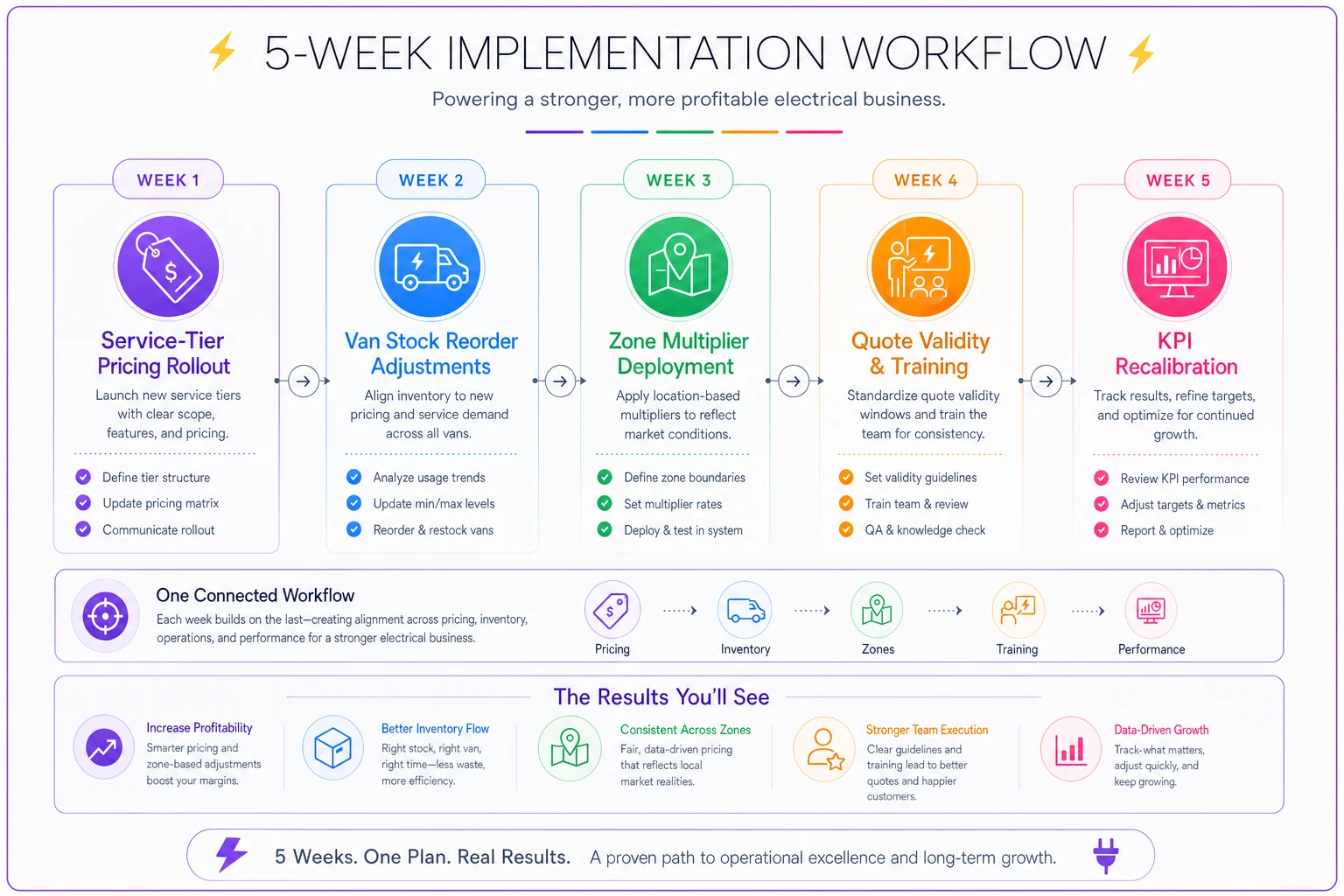
This sequence addresses the highest-impact margin leaks quickly while giving your team time to adapt.
The competitive advantage hidden in inflation response
Most contractors will either freeze—holding old prices too long—or overreact with blanket increases that kill volume. The more nuanced response creates a real gap between you and whoever else is quoting that job.
You'll win profitable work that competitors underpriced. You'll pass on unprofitable work that competitors desperately accept. Your dispatch efficiency stays reasonable while theirs falls apart. And your team will actually understand why things are changing instead of just being told to "add 15% to everything."
Beyond surviving this spike, you're building systems that handle the next one better. Contractors who had solid operational dashboards and margin protection in place before this hit are adjusting relatively quickly. Those flying blind are scrambling to figure out why revenue went up but profit disappeared.
The inflation reprice for electrical contractors isn't only about raising prices. It's about restructuring how you price, dispatch, measure, and manage in a volatile environment. Do it right, and this becomes a catalyst for operational improvement. Do it wrong, and you'll spend the next six months confused by the gap between your revenue numbers and your bank account.
The inflation reprice for electrical contractors isn't only about raising prices. It's about restructuring how you price, dispatch, measure, and manage in a volatile environment. Do it right, and this becomes a catalyst for operational improvement. Do it wrong, and you'll spend the next six months confused by the gap between your revenue numbers and your bank account.
Ready to optimize your electrical service operations?
Join 500+ electrical service companies using Voltzly to improve scheduling accuracy, enhance client satisfaction, and boost operational efficiency.