

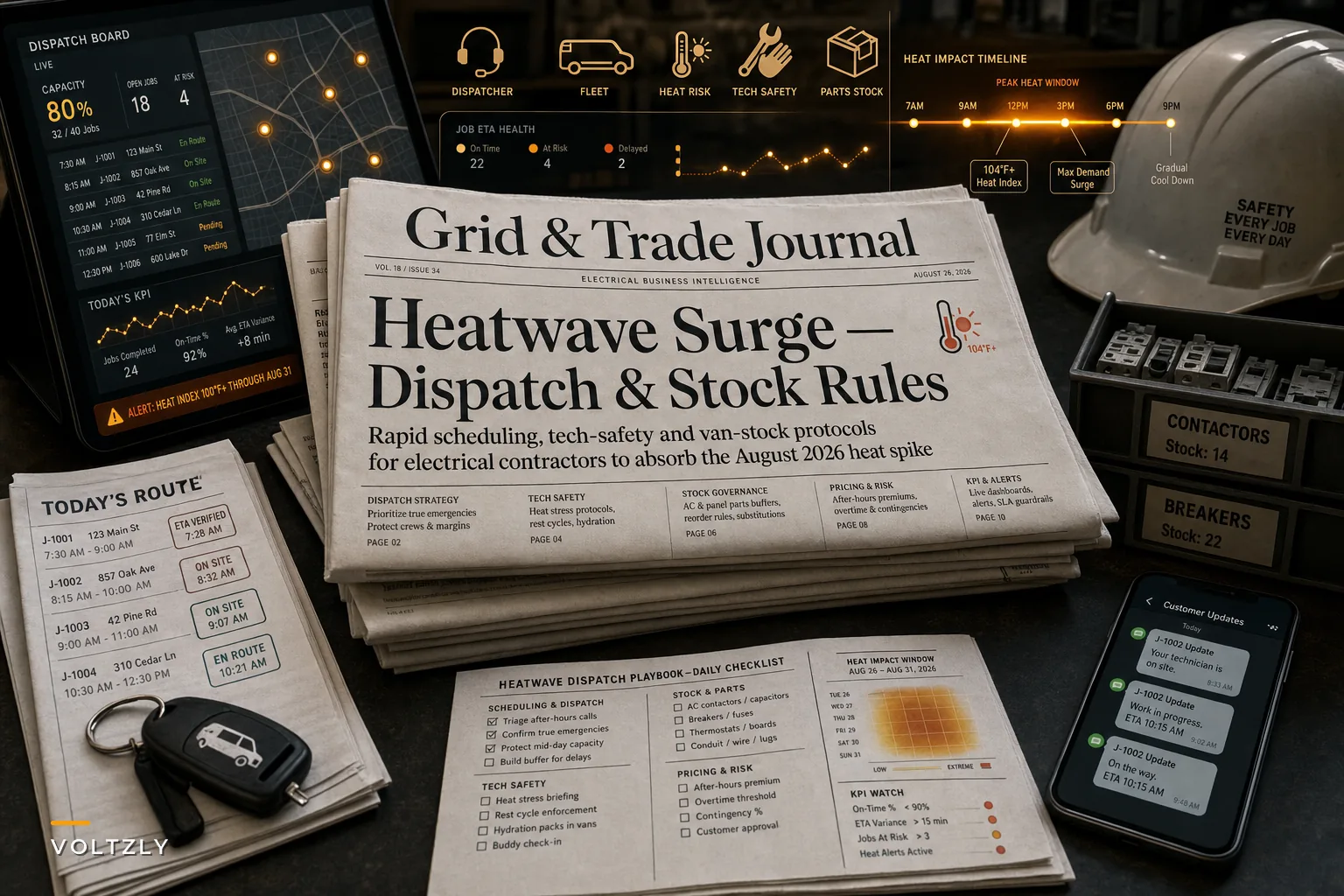

When the National Weather Service starts issuing extreme‑heat warnings across half the country, most residential electrical shops don't feel it on day one. They feel it on day three, when the grid has been under load long enough that breakers start tripping, condenser units start failing, and every homeowner with a marginal panel suddenly discovers exactly how marginal it is.
The late‑August 2026 heat wave is a good example. NPR reported that the stretch of extreme heat blanketing large parts of the U.S. was almost certainly made worse by a warming climate, and that these events are becoming both more frequent and more prolonged. You can read the NPR coverage here. For a homeowner, that's a weather story. For a shop running anywhere from 2 to 50 techs, it's an operational stress test that exposes every weak spot in your scheduling, dispatch, and stocking — all at once.
This post isn't about the weather. It's about what heat wave electrician operations actually look like when demand spikes for a week straight, and the specific rules you can put in place before the next one to keep your margins and your crews intact.
What breaks first (and it isn't your calendar)
The instinct during a heat spike is to fix scheduling — cram more jobs in, extend hours, push everyone harder. But scheduling isn't usually what breaks first. Three other things go, and they go quietly.
Parts depletion happens faster than anyone tracks. During a normal week, a van carrying two or three common breakers, a couple of whips, and a handful of double‑pole 30s and 40s is fine. During a heat wave, that same van can burn through its breaker stock by mid‑morning because every third call needs a breaker replaced or a subpanel touched. The tech doesn't call it in — he just improvises, drives to the supply house, or defers the job and promises to come back. Now you've got a half‑finished ticket and a customer sitting in a hot house.
Job times stretch without anyone updating the schedule. A "quick" AC circuit call that normally runs 45 minutes becomes 90 because the tech finds a scorched lug, a heat‑soaked disconnect, or a panel that's clearly been running hot. He's right to slow down — that's a safety call. But the dispatcher three jobs down the line has no idea, and the customer at 2 PM gets a tech showing up at 4:30 with no warning.
Triage collapses under volume. This is the real one. When the phone rings 40 times before noon, whoever's answering stops triaging and starts booking. Everything becomes "emergency." A tripped GFCI that a homeowner could reset themselves gets the same priority as a panel that's warm to the touch and smells like melting plastic. That's how you end up sending a tech across town for a $0 reset while a genuinely dangerous situation waits four hours.
That last problem is the one most shops underestimate, and it's the one that quietly drives your overtime bill through the roof.
The underlying problem: everything becomes an "emergency" at once
Under normal load, your team has slack. That slack absorbs bad triage, extra drive time, and the occasional missing part. During a heat wave, the slack is gone by 10 AM, and every small inefficiency compounds.
Never miss a job or delay a dispatch again.
Voltzly helps you schedule, assign, and track every electrical job efficiently.
- Unified job scheduling
- Real-time technician tracking
- Automated client notifications
No credit card required
A missing breaker isn't a five‑minute problem anymore — it's a supply‑house run that blows a whole appointment window. A poorly triaged call isn't a minor annoyance — it's a tech burned for two hours you desperately needed. Overtime that would normally be a Friday‑evening thing becomes an every‑night thing, and your labor cost per ticket climbs while your first‑time‑fix rate drops.
The shops that handle heat waves well aren't the ones with more techs. They're the ones who decided in advance what counts as an emergency, what can wait, and what can be solved over the phone. If you're rebuilding that logic on the fly while the phone is ringing, you've already lost the week. This is exactly why having a defined after‑hours triage script and decision matrix matters — not as a nice‑to‑have, but as the thing that keeps your dispatch board from turning into chaos when volume triples.
Rule set 1: Triage tiers you set before the heat, not during it
The mistake is treating every heat‑wave call as urgent. Set three tiers and give whoever answers the phone the authority to slot calls without checking with you.
| Tier | What it looks like | Response |
|---|---|---|
| True emergency | Warm/hot panel, burning smell, sparking, partial outage with heat‑related load, no A/C for a medically vulnerable household | Same‑day, bump lower‑priority work |
| Urgent but stable | Tripped breaker that won't hold, dead outlet on A/C circuit, one HVAC unit down in a multi‑zone home | Same or next day, standard window |
| Deferrable / phone‑resolvable | GFCI reset, single tripped breaker that resets fine, "it happened once yesterday" calls | Phone guidance first, schedule only if it recurs |
The tier‑three bucket is where you save the most money. A lot of heat‑wave calls are homeowners who tripped a breaker running a window unit on the same circuit as the microwave. A 90‑second phone conversation resolves it. Sending a truck on those calls doesn't make you more money — it costs you a slot you needed for real work.
Rule set 2: Heat‑wave van stock, not everyday van stock
Your normal replenishment triggers are built for normal weeks. During a spike, you need a temporary "heat surge" stock level that kicks in the day warnings hit.
Label surge‑stock parts in vans clearly so techs can spot when a kit is low without inventorying.
-
Double the breaker count on the most common residential amperages (15, 20, 30, 40, 50). These move fastest during heat demand.
-
Add 2–3 A/C disconnects and whips per van. Heat‑soaked disconnects fail constantly, and they're cheap insurance against a mid‑day supply‑house run.
-
Stock extra lugs and anti‑oxidant compound. Scorched and loosened lugs are one of the most common findings on panels that have been running hot.
-
Carry a spare surge protective device or two. Post‑outage power restoration causes surges, and these move quickly after a grid event.
-
Keep a small generator interlock kit or transfer switch parts if you serve neighborhoods prone to outages.
The trigger rule is simple: when an extreme‑heat warning hits your service area, every van goes to surge stock levels that evening — you don't wait for the normal cycle count to catch the depletion. If you wait on your standard replenishment logic, you'll be restocking a day behind demand the entire week.
Rule set 3: Dynamic dispatch that respects real job times
The scheduling failure during heat waves isn't overbooking — it's pretending job times are stable when they aren't. Bake buffer into the day and update it live.
A workflow that holds up under pressure:
-
Build the morning board at 80% capacity, not 100%. The extra 20% is your absorption for jobs that run long and true emergencies that come in mid‑day.
-
Require a status ping when a job crosses its expected window. The tech doesn't need to call — a quick "running 45 over, found a scorched lug" is enough for dispatch to adjust the next stop.
-
Re‑sequence at midday, not just in the morning. By noon you know which jobs blew up and which closed fast. Rebuild the afternoon around reality instead of the plan you made at 7 AM.
-
Protect one tech as a floater if you have the headcount. That person absorbs the true emergencies so your scheduled work doesn't get shredded every time a hot panel comes in.
-
Confirm windows with customers as they shift. A "we're running about two hours behind, still coming today" text prevents half your callbacks and complaints.
Shops that skip step 2 are the ones whose whole afternoon falls apart from a single long job nobody flagged. Real‑time visibility into where crews actually are — versus where the schedule says they should be — is what separates a rough week from a disaster week. Field management software earns its keep during a spike not by doing anything fancy, but by keeping dispatch, tech status, and customer windows in sync automatically instead of relying on someone to manually chase updates while the phone won't stop ringing.
Here’s a quick diagram of the dispatch workflow during a heat wave.
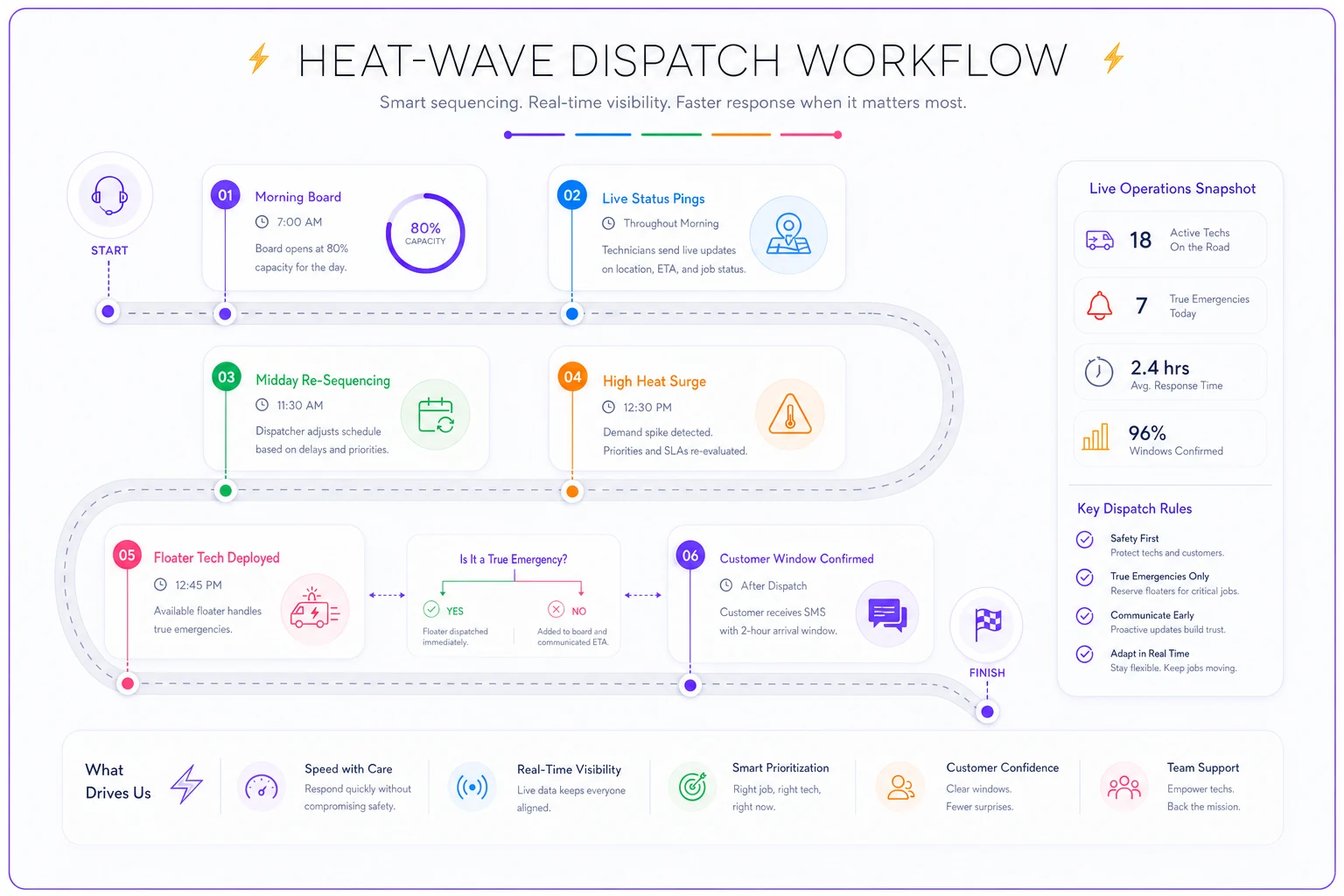
This workflow keeps dispatch, tech status, and customer windows in sync so you're reacting to reality, not the plan you made at 7 AM.
Rule set 4: Crew heat safety is an operational line item, not an afterthought
This gets overlooked because it doesn't show up on an invoice, but a heat‑related incident will cost you far more than any deferred job. During extended extreme heat, working in attics, unshaded panels, and hot equipment rooms is genuinely dangerous — and it can attract OSHA attention if you're not managing it.
A few practical rules that don't slow you down much:
-
Front‑load attic and outdoor work to mornings wherever the schedule allows. An attic at 8 AM versus 3 PM is a completely different environment.
-
Mandate water and scheduled cooling breaks, and don't let a tech skip them to "just finish the job."
-
Watch job times as a fatigue signal. A tech whose ticket times are creeping up across the day may be overheating, not slacking.
-
Have a hard stop rule for attic and confined hot‑space work above a certain temperature. Reschedule the non‑urgent stuff for a cooler window.
Shops that push crews through peak‑heat hours to hit more tickets usually end up with more callbacks and more mistakes, because heat‑exhausted techs miss things. You don't actually gain the throughput you think you're gaining.
A realistic scenario
Take a residential shop running six techs in a hot inland market. In a normal August week they'll handle somewhere around 110–130 residential calls. During the peak of a heat wave, inbound volume roughly doubled — but the part that really hurt was overtime running close to double the norm, and first‑time‑fix rate dropping noticeably because vans kept running out of breakers and disconnects by early afternoon.
After they put a surge‑stock trigger and a three‑tier triage rule in place before the next event, the picture changed. Phone‑resolvable calls got filtered before a truck ever rolled, which freed up roughly a fifth of their capacity for actual emergencies. Vans stayed stocked through the day, so the mid‑afternoon supply‑house runs mostly disappeared. Overtime still went up — you can't fully avoid that during a real spike — but it landed somewhere far more manageable, and the callback rate stayed close to their normal baseline instead of spiking with call volume.
Nothing about that required more people or more trucks. It required deciding the rules before the heat hit.
When these rules make sense (and when they don't)
When this makes sense: You serve a market that gets genuine heat spikes, you run enough volume that a demand surge actually strains your capacity, and you've felt the pain of a chaotic week where nobody knew where anyone was. If you've ever had a tech deferring jobs because the van ran dry, these rules are for you.
When it's overkill: If you're a one‑ or two‑person shop in a mild climate doing mostly scheduled installs, building a full surge protocol may be more structure than you need. A simple "keep extra breakers on hand in summer" reminder might be enough.
Who should not just wing it: Any shop that leaned on overtime and improvisation to survive the last heat wave. Winging it worked because your slack absorbed it. As these events get longer and more frequent, that slack runs out, and the improvised approach starts costing real money and real safety risk.
Heat waves don't create new problems in an electrical shop. They take the small inefficiencies you already tolerate — sloppy triage, everyday van stock, static scheduling — and amplify them until they hurt. The shops that come through a spike with their margins and their crews intact are the ones who set their triage tiers, surge stock levels, and dispatch buffers before the warnings went out.
Set those rules now, while the phone is quiet. The next extreme‑heat stretch is a question of when, not if, and the difference between a rough week and a profitable one is almost entirely decided before the first hot day.
Ready to optimize your electrical service operations?
Join 500+ electrical service companies using Voltzly to improve scheduling accuracy, enhance client satisfaction, and boost operational efficiency.