



Most electrical shops don't fail at improvement because they lack ideas. They fail because the ideas live in someone's head, get tried once, and never get measured. A tech mentions that a certain neighborhood always eats an extra 20 minutes of drive time. The owner nods. Nothing changes. Two months later the same complaint surfaces, and everyone has quietly accepted it as "just how that area is."
That's the gap this article is about. Not a big Lean transformation, not a wall of process maps — just a repeatable way to run one small experiment at a time, measure whether it actually worked, and keep the ones that pay off. The phrase continuous improvement electricians Kaizen sounds heavy, but for a 3-to-15 person shop it should feel more like a weekly habit than a program.
The whole point is to make change small enough that it can't blow up your week, and structured enough that you actually know if it worked.
Why most shop "improvements" never stick
The usual pattern goes like this. Somebody has a good idea in the truck bay. It gets tried by one tech for a few days. It either feels better or it doesn't, based purely on gut. Then a busy week hits, the idea gets dropped, and nobody can say whether it helped because nothing was ever written down.
The core problem is that improvements get treated as permanent policy changes instead of experiments. When you announce a new rule to the whole crew, you're committing before you have any proof. That raises the stakes, invites pushback, and makes it awkward to reverse course when it doesn't work. So people stop suggesting things.
A Kaizen approach flips that. You're not rolling out policy — you're running a two-week test with one crew, measuring one number, and deciding afterward. Low stakes, easy to reverse, and everyone knows it's temporary. That single reframe — "test," not "rule" — removes most of the resistance.
The other reason improvements die: shops try to measure everything at once. If your experiment is tracking drive time, callbacks, first-time-fix, upsell rate, and customer satisfaction all at the same time, you'll drown in data and prove nothing. One experiment, one primary metric. That's the discipline.
The lightweight experiment template
Keep it to a single page. If it doesn't fit on one page, it's too big to run weekly. Here's the structure worth using:
Never miss a job or delay a dispatch again.
Voltzly helps you schedule, assign, and track every electrical job efficiently.
- Unified job scheduling
- Real-time technician tracking
- Automated client notifications
No credit card required
-
Hypothesis — one sentence, written as "If we do X, then Y will improve because Z."
-
The change — exactly what's different, specific enough that a tech could follow it without asking questions.
-
Who's running it — one crew or two techs, not the whole shop.
-
Primary metric — the single number you're watching.
-
Guardrail metric — the thing you don't want to accidentally break.
-
Duration — usually 2 to 4 weeks.
-
Decision rule — written in advance
"If drive time drops by 10%+ and callbacks don't rise, we keep it."
That guardrail metric is the part most shops skip, and it's the part that saves you. If you push to cut drive time and your first-time-fix rate quietly tanks because techs are rushing, you need to catch that. Writing the guardrail down before you start keeps you honest.
Write the guardrail metric before starting the experiment to catch unintended trade-offs early.
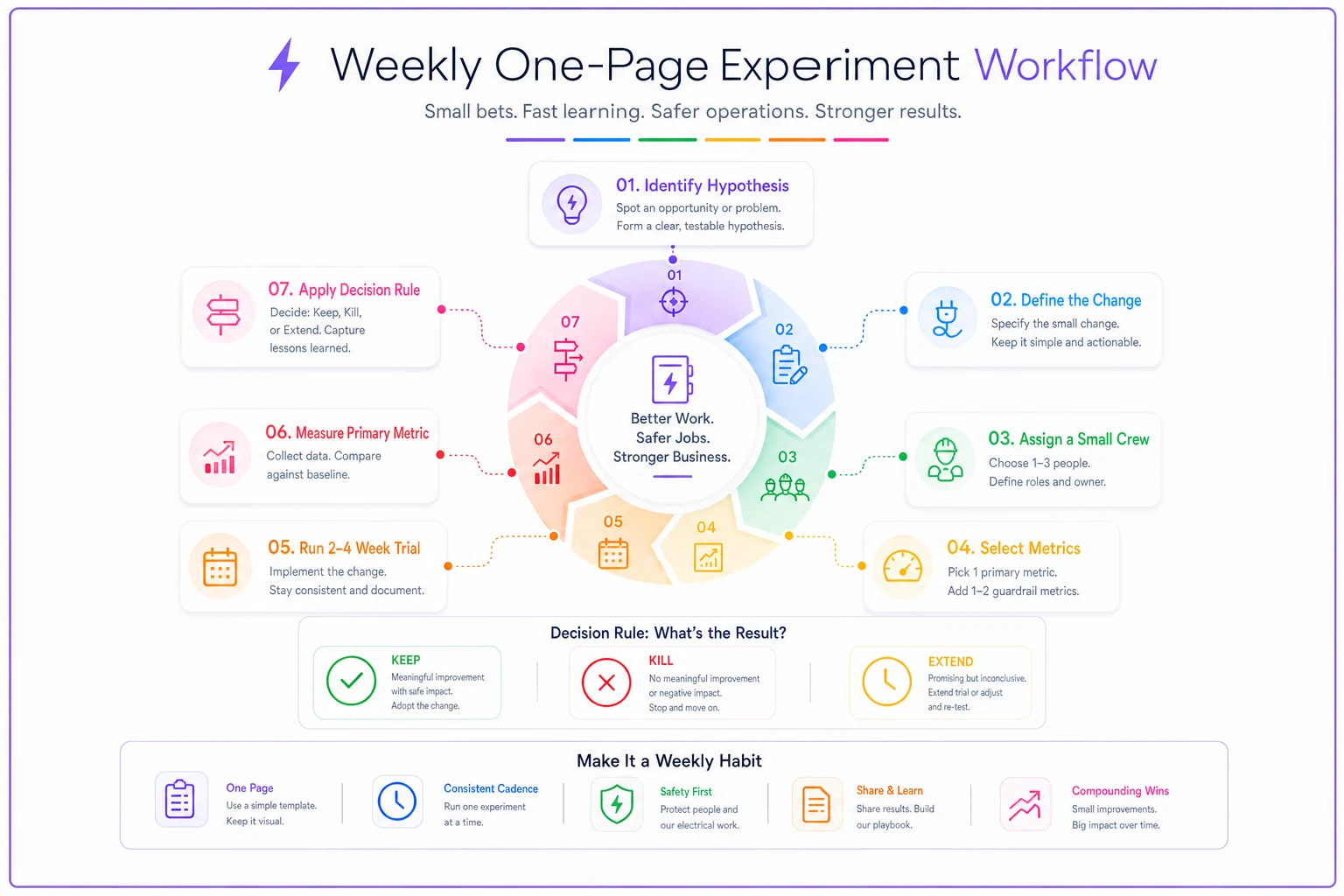
A quick visual of the experiment workflow.
The decision rule written in advance matters just as much. If you set the threshold after seeing the results, you'll rationalize whatever you already wanted to believe. Human nature. Lock the bar before you look.
Picking the right KPI (and how many)
Every experiment gets one primary metric. The mistake is picking something too slow or too fuzzy to move in a few weeks. "Customer satisfaction" is a bad experiment metric for a small shop — the sample is small, the signal is noisy, and it takes months to shift. "Average drive time per job" moves fast and is easy to pull.
| Metric | Good for | How often to read | Notes |
|---|---|---|---|
| Avg drive time per job | Weekly experiments | Weekly | Fast to move, easy to measure |
| Callback rate (per 100 jobs) | Monthly experiments | Monthly | Needs volume to be meaningful |
| First-time-fix % | Monthly | Monthly | Great guardrail metric |
| Jobs per tech per day | Weekly | Weekly | Watch for quality tradeoffs |
| Parts-not-on-truck rate | Weekly | Weekly | Ties directly to callbacks |
| Estimate-to-actual hours gap | Monthly | Monthly | Slower, but high value |
Fast metrics for weekly tests, slower metrics for monthly ones. Don't try to run a callback experiment on a weekly cadence if you only do 40 jobs a week — the numbers bounce around too much to trust. You need enough volume before the signal beats the noise.
One more thing worth saying: pick metrics you can already pull without building a new system. If measuring the experiment requires three days of manual data entry, it won't happen. Use what's already sitting in your dispatch or scheduling records.
Sample experiment 1: reduce drive time
Say your techs are averaging around 42 minutes of drive time per job across a 5-tech crew, and a chunk of that is backtracking across town because jobs get assigned in the order calls come in.
Hypothesis: If we cluster each tech's daily jobs by zip code before dispatch, average drive time will drop because we cut cross-town backtracking.
The change: Every morning, the dispatcher groups the day's confirmed jobs by area and assigns each cluster to the nearest available tech, instead of assigning first-come-first-served.
Primary metric: Average drive time per job. Guardrail metric: On-time arrival within the customer's window. Duration: 3 weeks. Decision rule: Keep it if drive time drops 8%+ and on-time rate doesn't fall.
A realistic outcome here isn't dramatic. You might see drive time go from about 42 minutes to somewhere around 36–38 minutes per job. On a 5-tech crew doing maybe 20 jobs a day combined, shaving 5 minutes each is roughly 100 minutes a day — enough for an extra job or two per week without adding hours. Not life-changing on paper, but that compounds across a year.
If you want to go deeper on the routing side specifically, the mechanics in Route sequencing rules for 2–6 tech crews pair well with this experiment — it covers the low-tech tactics that make the clustering actually stick.
Sample experiment 2: reduce callbacks
Callbacks are trickier because they're slower to measure and more emotionally loaded — nobody likes admitting a job came back. But they're also where the money leaks. A single callback can wipe out the margin on the original job once you count the drive, the labor, and the parts.
Hypothesis: If techs complete a 6-point end-of-job verification before leaving, callbacks will drop because the most common miss-causes get caught on site.
The change: Before marking a job complete, the tech runs a short checklist — verify all connections torqued, test every affected circuit under load, confirm panel labeling, photograph the finished work, walk the customer through it, and confirm cleanup.
Primary metric: Callback rate per 100 jobs. Guardrail metric: Average job duration (you don't want the checklist adding 30 minutes to every job). Duration: 6 weeks — callbacks need time and volume to show a real trend. Decision rule: Keep it if callback rate drops meaningfully and job duration doesn't balloon past a few minutes per job.
The realistic story: a shop running around a 9% callback rate might get down to the 5–6% range over a couple months. If you're doing roughly 300 jobs a month and each callback costs somewhere in the $120–$180 range in true cost, dropping ten callbacks a month is real money that shows up straight in margin.
The verification-and-photo side of this connects directly to a proper QA loop. If you're serious about the callback experiment, the process in a photo-based warranty and post-job QA process gives you the structure to make the checklist stick instead of becoming a box-ticking exercise.
The governance cadence: what keeps this alive
An experiment system dies without a rhythm. Not meetings for the sake of meetings — a short, predictable cadence that forces a decision on each experiment.
Here's a workable structure for a small shop:
-
Weekly, 15 minutes (Friday or Monday) Read the primary metric on any active experiment. No discussion of new ideas, just "here's the number, are we on track." Fast.
-
Monthly, 45 minutes Review completed experiments against their decision rules. Keep, kill, or extend each one. Pick the next one or two to launch.
-
Quarterly, one hour Look back at what stuck. Which changes are now just "how we work"? Retire the experiment log entries that graduated into standard practice.
The weekly check exists purely to catch experiments going sideways before they run their full course. If drive time is somehow getting worse in week one, you want to know before week three.
The monthly review is where the real discipline lives. This is where you apply the decision rule you wrote in advance and actually kill things. A shop that never kills an experiment isn't experimenting — it's just accumulating rules. Killing a failed test is a win. It means you learned something cheaply.
One pattern worth naming: shops that run this well tend to keep active experiments to one or two at a time, max. When you've got five going simultaneously, you can't tell which change caused which result, and the whole thing turns to mud.
A quick real scenario
A residential-focused shop with 6 techs was frustrated by callbacks eating into a busy summer. They weren't tracking anything formally — the owner just felt like too many jobs were coming back.
They ran exactly one experiment: the 6-point end-of-job checklist, on two of their six techs, for six weeks. They tracked callback rate on those two techs versus the other four as a rough comparison.
Over those six weeks, the two checklist techs went from roughly 8–9 callbacks down to about 3, while the untouched group stayed flat. Job duration went up by maybe 4–5 minutes per job — well inside their guardrail. The decision was easy: roll it to the whole crew as standard practice.
The interesting part wasn't the callback number. It was that the owner finally had a method. The next experiment — clustering jobs by area to cut drive time — launched the following month using the same one-page template. The habit was the real win.
When this makes sense — and when it doesn't
This approach fits shops in a specific spot. If you're doing enough volume that metrics mean something — say, more than a couple hundred jobs a month — and you've got at least a few techs so you can test on a subset, it works well.
When it's a bad idea: if you're a two-person shop doing 15 jobs a week, the numbers are too small to run clean experiments. Your callback rate will swing wildly from one job to the next. At that scale, just fix the obvious problems directly — you don't need a governance cadence to know that one specific job type keeps coming back.
Who should skip this entirely: any shop that isn't already tracking basic job data. If you can't currently pull average drive time or callback counts without hand-counting paper tickets, fix your record-keeping first. The experiment system assumes you have numbers to read. Building that data foundation comes before running tests on it.
And a warning: don't let this become bureaucracy. The moment the experiment template grows to three pages, the moment you're running six tests at once, the moment the monthly review becomes a two-hour meeting — you've lost the plot. The entire value here is that it stays small, cheap, and reversible.
The takeaway
You don't need a Lean consultant or a wall of sticky notes to improve a small electrical shop. You need one-page experiments, one metric each, a decision rule written before you look at the results, and a monthly rhythm that forces you to keep or kill each test.
Start with a single experiment this month. Reduce drive time or reduce callbacks — pick one, run it on a couple of techs for a few weeks, and hold yourself to the decision rule you wrote at the start. The first experiment teaches you the method. After that, the habit does the heavy lifting, and improvement stops depending on whether anyone remembers that good idea from the truck bay.
Start with a single experiment this month. Reduce drive time or reduce callbacks — pick one, run it on a couple of techs for a few weeks, and hold yourself to the decision rule you wrote at the start. The first experiment teaches you the method. After that, the habit does the heavy lifting, and improvement stops depending on whether anyone remembers that good idea from the truck bay.
Ready to optimize your electrical service operations?
Join 500+ electrical service companies using Voltzly to improve scheduling accuracy, enhance client satisfaction, and boost operational efficiency.