


Your technician completes a panel upgrade. Three weeks later, the customer calls claiming a breaker wasn't properly secured. Was it loose when your tech left? Did the homeowner mess with it? Without documentation, you're sending someone back for free—eating the cost whether it's your fault or not.
This scenario plays out constantly across electrical contractors. The financial damage compounds quickly. Warranty callbacks typically run $180–220 per visit when you factor in truck roll, technician time, and the opportunity cost of not billing that hour elsewhere. A 15-tech operation averaging just three questionable callbacks monthly loses somewhere around $7,800 annually to disputes they can't defend against.
The core problem isn't bad workmanship. Most callbacks come from documentation gaps that leave you defenseless when customers claim something wasn't done right. Without photo evidence and systematic verification, you're stuck choosing between eating costs to preserve the relationship or fighting customers without proof.
Why electrical work creates unique warranty disputes
Electrical installations present documentation challenges other trades don't really face. A plumber's leak shows up immediately. HVAC issues manifest within days. Electrical problems can simmer for weeks before triggering that angry callback.
Consider outlet installations. Your tech properly grounds 12 outlets during a kitchen remodel. Six weeks later, the homeowner's contractor claims three aren't grounded correctly. Maybe their guy loosened connections while pulling wire. Maybe vibration from nearby demo work affected torque specs. Without timestamped photos showing proper installation and testing, you're driving back to "fix" work that was done right the first time.
The 7-day and 30-day windows matter because different failure modes show up at different intervals. Loose connections typically surface within a week under normal load. Arc fault issues might take 3–4 weeks of cycling to manifest. Panel heating problems often don't appear until the first high-demand period, which could easily be a month after installation.
Commercial jobs add another layer. Your crew installs emergency lighting perfectly. Two weeks later, the ceiling tile contractor claims your junction boxes weren't secured properly—they probably knocked them loose running their grid—but without documentation, the GC holds your payment until you "repair" it.
The hidden costs beyond truck rolls
Most contractors only count the direct callback cost—technician time plus vehicle expense. The real damage runs deeper.
Never miss a job or delay a dispatch again.
Voltzly helps you schedule, assign, and track every electrical job efficiently.
- Unified job scheduling
- Real-time technician tracking
- Automated client notifications
No credit card required
Schedule disruption hurts worst. That warranty callback doesn't just cost 90 minutes onsite. It fragments your senior tech's day and forces you to reshuffle paying jobs. Now you're apologizing to customers who booked weeks ago, risking their future business.
Tech morale takes a beating too. Nothing frustrates skilled electricians more than redoing work they did correctly. After a few bogus callbacks, they start wondering whether management has their back. Your best people start browsing job boards during lunch.
The reputational damage lingers longest. Even when you're right, arguing with customers about warranty work creates friction. They tell neighbors you tried dodging responsibility. Online reviews mention "warranty hassles" even when you eventually made things right. One contested callback can quietly poison three referrals you never even knew you lost.
Then there's the knowledge gap. Without documentation, you can't identify patterns. Maybe certain breaker brands genuinely do loosen more often. Maybe one tech consistently under-torques connections. Maybe callbacks spike on jobs quoted during your busy season when site assessment gets rushed. Without data, you're guessing.
Building a photo-first verification system
The foundation starts with mandatory photo points for every job type. Not random pictures—specific angles that prove proper installation and protect against the disputes you actually face.
-
Wide shot showing the full panel before work starts
-
Close-up of the main breaker and bonding before touching anything
-
Individual shots of each breaker after installation showing torque marker alignment
-
Full panel shot with cover off showing wire management
-
Infrared image after energizing showing no hot spots
-
Final shot with cover on and labels placed
The trick is making this automatic, not burdensome. Smart contractors build photo sheets—a printed checklist where techs check boxes as they capture each required image. The sheet lives on their clipboard and gets signed at each milestone.
Timing matters as much as content. Photos during installation prove more than after-the-fact documentation. Capture that ground wire actually being connected, not just the finished connection. Show the torque wrench on the lug, not just the tightened terminal.
For warranty-prone work like GFCI installations, video beats photos. A 20-second clip showing the test/reset cycle working properly destroys any claim about faulty installation. Storage is cheap compared to callbacks.
For warranty-prone work like GFCI installations, video beats photos.
A quick visual of the photo-first workflow:
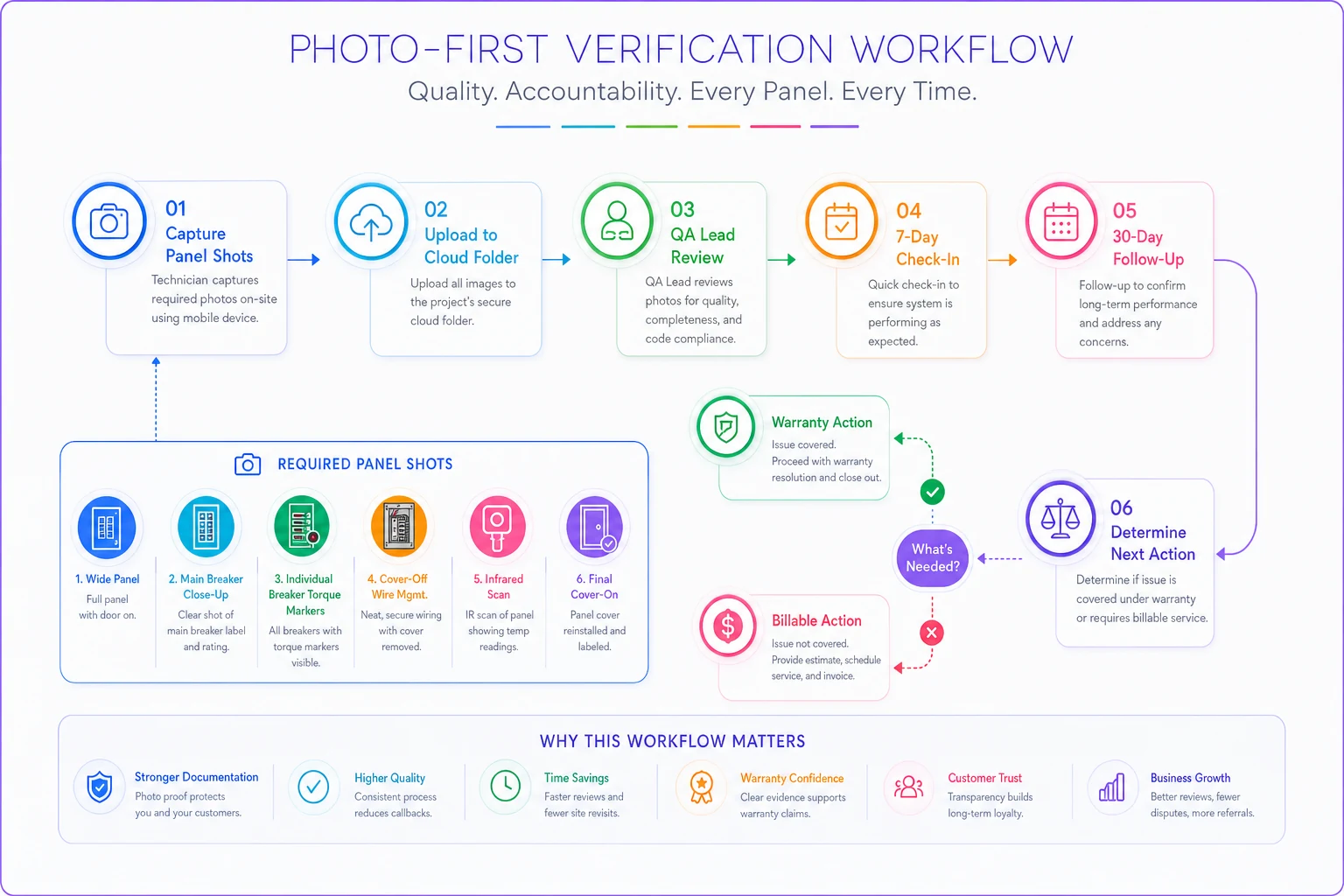
The 7-day verification adds another layer. For critical installations—panels, services, EV chargers—schedule a brief check-in within the first week. Not a full inspection, just a 15-minute verification hitting the common problem points. Did breakers stay torqued? Any unusual warmth? GFCIs still testing properly?
Document that check with another photo set. When the callback comes three weeks later, you have proof the system worked perfectly a week after installation. The burden shifts to explaining what changed since then.
The 30-day follow-up that prevents escalation
The 30-day check serves a different purpose—catching legitimate issues before they turn into angry calls. Most electrical problems that aren't immediate give warning signs by week four.
This doesn't mean another truck roll. A systematic phone call using a standard script works fine. "Hi Mrs. Johnson, it's been a month since we upgraded your panel. Quick check—any breakers tripping unexpectedly? Unusual sounds from the panel? Outlets or switches behaving differently?"
Track responses someplace simple. Note concerns for proactive follow-up. Most customers appreciate it and mention nothing. But occasionally you'll catch something developing—a breaker tripping under a specific load combination—and can address it before the customer gets frustrated.
The psychological effect matters. Customers who receive follow-up calls complain less. They feel like someone's paying attention. When a genuine issue does arise at day 45, they call calmly rather than already angry about feeling abandoned.
For commercial accounts, make this systematic. Create a shared document the facility manager can access showing all verification dates and findings. When their boss questions the electrical work three months later, they can pull up documentation showing multiple successful checks.
Creating the technician accountability matrix
Photos mean nothing without clear ownership. Who took them? When? Who verified them? This is where most documentation systems fall apart—no chain of custody.
| Role | Responsibility |
|---|---|
| Installation Tech | Captures all during-work photos. Signs off on completion photos. Uploads within 2 hours of job completion. |
| QA Lead (can be a senior tech) | Reviews photo set within 24 hours. Confirms all required angles were captured. Flags concerns for follow-up. |
| Operations Manager | Spot-checks roughly 10% of photo sets weekly. Ensures standards are maintained. Identifies training needs. |
| Service Coordinator | Triggers 7-day and 30-day follow-ups. Documents outcomes. Escalates concerns. |
Make it visible. Post who owns what. Update it when roles change. When callbacks happen, trace the chain. Did photos get taken? Did QA actually review them? Did follow-up occur?
This isn't about blame—it's about figuring out where things break down. Maybe your QA lead needs training on what to look for. Maybe certain techs consistently miss critical angles. The matrix shows you where the documentation fails before the callback proves it.
For smaller shops, adapt to reality. Maybe your lead tech handles QA review. Maybe you personally spot-check photos each evening. The structure matters more than the titles.
The decision tree for warranty versus billable work
Documentation only helps if you actually use it when customers push back. Most shops wing it when complaints come in, making emotional decisions that cost money.
Clear warranty issue (component failed, installation error visible in photos):
-
Dispatch immediately
-
Free repair
-
Document the failure mode
-
Review installation process
Unclear responsibility (works fine but customer claims looseness without evidence):
-
Pull photo documentation first
-
If photos show proper installation, offer a paid inspection
-
If customer declines, document their refusal
-
If they accept, credit the inspection fee toward any required repair
Obviously not warranty (customer modified work, damage from another contractor visible):
-
Share photo documentation showing proper installation
-
Offer a paid repair quote
-
Document customer response
No documentation available (photos missing or unclear):
-
Default to a free inspection
-
Determine the actual issue
-
Make a strategic call based on customer value
Having photos changes the entire conversation. Instead of arguing about what was or wasn't done, you're reviewing evidence together. Most customers back down when shown clear documentation. Train your service coordinator to navigate this decision tree and give them authority to make calls within clear guidelines. A $200 callback might be worth eating to keep a $30k/year commercial account. But don't give away $500 in free work to a one-time residential customer claiming issues your photos disprove.
Using data patterns to reduce future callbacks
After six months of systematic documentation, patterns show up that random callbacks never revealed.
Maybe callbacks cluster around specific installation types. Junction box connections generating 3x more disputes than device installations is worth investigating. Dig into those photos. Perhaps your junction box documentation doesn't clearly capture wire nut torque. Adjust photo requirements to capture the specific detail that's causing disputes.
Time patterns tell stories too. Callbacks spiking 3–4 weeks post-installation rather than distributed randomly suggests connection thermal cycling issues. That points toward torque verification in your standard process and training on aluminum versus copper connection specs.
Geographic clustering might surprise you. Certain neighborhoods generating excessive callbacks while others rarely complain often points to older homes with aluminum wiring or specific builders' work creating challenging conditions.
Tech-specific patterns require delicate handling. If one tech generates double the average callbacks, review their documentation first. Maybe the photos are unclear. Maybe verification steps are getting skipped. Address training before assuming workmanship issues.
The KPI dashboard for electrical contractors covers broader metrics, but warranty-specific tracking adds another layer. Callback rate per tech, per job type, per customer category. When rates exceed thresholds, investigate documentation first, work quality second.
Real-world implementation: Phoenix electrical contractor
Desert Peak Electrical was struggling with warranty disputes on their bread-and-butter service upgrades. With 8 trucks running full schedules, they averaged 11 callbacks monthly. At roughly $190 per callback, that's around $25,000 annually on disputed work.
The owner started a photo-first policy on panel upgrades only. Six specific photos per panel, uploaded before leaving site. No exceptions.
Initial pushback was real. Techs complained about time. The upload app crashed constantly. Two senior techs threatened to quit over what they called micromanagement.
Three months later, callbacks on panel upgrades dropped to 2 per month. Not from better work—their quality hadn't changed. They won disputes by showing documentation. Word spread among customers that Desert Peak documented everything, and bogus complaints quietly disappeared.
The success on panels led to expanding requirements across the board. Outlet installations, fixture replacements, service calls—each got a photo checklist. The upload app got replaced with a simpler cloud folder system. Techs started competing over who had the clearest documentation photos.
Year one results:
-
Callbacks dropped from 132 to 41 annually
-
Warranty costs reduced by roughly $17,400
-
Zero escalated disputes went to legal
-
Customer satisfaction scores increased 22%
-
Tech turnover dropped from 4 per year to 1
The unexpected benefit was training. New techs studied photo archives to understand standards. Mistakes got caught during photo review instead of during angry customer calls. The documentation system became their quality training program without anyone planning it that way.
Making documentation sustainable long-term
The biggest risk with documentation systems isn't starting them—it's maintaining them when busy season hits. Every contractor has tried photo requirements that lasted three weeks before falling apart under schedule pressure.
Sustainability requires integration, not addition. Don't bolt documentation onto existing workflows—weave it in.
Replace your current job completion checklist with one that includes photo checkpoints. Instead of signing "Panel secured," the line reads "Panel secured (photo captured)." The tech can't complete paperwork without documentation.
Choose tools that work offline. Rural service calls and basement panels often have no signal. If your documentation system requires internet to function, techs will skip it and promise to upload later. They won't.
Build verification in without nagging. Set up automatic reports showing documentation compliance by tech. Post the numbers publicly—not to shame, but to maintain awareness. When someone sees they're at 67% photo compliance while the rest of the team is above 90%, they self-correct.
Make retrieval fast. If finding photos requires logging into three systems and remembering job numbers, nobody checks them during disputes. Organize by address, date, and tech. Your service coordinator should pull any job's photos in under a minute.
Incentives require some thought. Some shops pay a small bonus per complete photo set. Others dock pay for missing documentation. The carrot tends to work better than the stick, but consistency matters most. Whatever system you choose, apply it universally.
AI-assisted operational platforms help here. Modern software built for trades can integrate photo capture directly into job workflows—so the same system tracking van stock and replenishment triggers also enforces photo requirements at each job stage. When everything lives in one platform, documentation becomes part of the workflow rather than extra work bolted on afterward.
Beyond callbacks: the competitive advantage of documentation
Strong documentation systems deliver value well beyond warranty protection.
Insurance claims resolve faster with photo evidence. That customer claiming electrical fire damage? Timestamped photos showing proper installation shift liability quickly. Insurance companies move faster when contractors provide comprehensive documentation upfront.
Training accelerates when new techs can study real installations. Instead of vague explanations about "proper technique," they see exactly how experienced techs handle tricky situations. Photo archives become a training library that builds itself over time.
Estimates improve with historical documentation. Reviewing photos from similar past jobs reveals hidden complexities before you price the next one. That panel upgrade quote gets more accurate when you can see how previous similar panels were actually configured.
Some contractors monetize the documentation itself. They offer premium service agreements that include photo documentation of all work. Commercial clients pay extra for the peace of mind, and property managers like having visual records for their files.
The market is shifting toward transparency anyway. Customers increasingly expect documentation. The shops providing it win more bids without having to explain why they're worth the price.
Warranty callbacks drain profit through direct costs, schedule disruption, and reputation damage that's hard to measure but very real. The problem usually isn't workmanship—it's documentation gaps that leave you defenseless in disputes.
A photo-first verification system with clear technician accountability changes callback management entirely. Instead of arguing about what was done, you're reviewing evidence. The 7-day and 30-day checkpoints catch developing issues before they turn into angry calls.
Documentation patterns also reveal improvement opportunities you'd never see otherwise—which installation types generate disputes, which techs need training, which customers habitually complain.
Start simple. Pick your highest-callback job type. Build a six-photo checklist. Require uploads before leaving site. Review disputes using photo evidence. Watch callbacks drop—not from better work, but from better proof of good work.
Your techs do quality installations. Make sure you can prove it when it matters.
Ready to optimize your electrical service operations?
Join 500+ electrical service companies using Voltzly to improve scheduling accuracy, enhance client satisfaction, and boost operational efficiency.