



Most electrical shops build their comp plan backwards. They pick an hourly rate that "feels competitive," toss in a bonus when things are going well, and then wonder why margins swing wildly from month to month even when revenue looks fine. The pay plan and the staffing math never talk to each other. So you end up overpaying in slow weeks, underpaying your best guys during the busy stretch, and quietly training your top techs to look elsewhere.
The core problem: a technician compensation plan for electricians isn't a number. It's a system that has to sit on top of your capacity model. If you know how many billable hours a tech can realistically produce, what your average ticket looks like, and what quality standard you refuse to drop below — then pay design becomes math. If you don't know those numbers, you're guessing and calling it strategy.
This piece walks through how capacity, revenue, and CSAT connect to compensation, and where the whole thing tends to break when you scale from a couple of trucks to a real crew.
Start with capacity, not with the paycheck
Almost everyone makes the same mistake: they design the comp plan first, then try to make the workload fit it. It has to go the other way.
Every tech has a realistic ceiling of billable hours. Not clocked hours — billable. A residential service tech on a 40-hour week doesn't bill 40. Drive time, restocking the van, warranty callbacks, waiting on a customer to move their car — it all eats into it. A solid residential tech bills somewhere between 26 and 32 hours out of a 40-hour week once you're honest about it. Install crews run a bit higher, maybe 32–36, because they're on one site longer with less windshield time.
That billable-hour number is the foundation of the entire comp plan. If you don't know yours, everything downstream is built on sand.
A quick sanity check: take a tech's total revenue over a quarter, divide by your billing rate, divide again by hours on the clock. That gives you a real utilization percentage. When shops run this for the first time, the number is almost always lower than the owner assumed — 65% when they thought it was 85%. That gap is exactly why the "competitive hourly rate" they picked doesn't produce the margin they expected.
Once you've got honest capacity per tech, you can start attaching dollars to it.
The three things pay has to reward at once
A comp plan that only rewards hours produces slow, careful techs who never push. One that only rewards revenue produces techs who oversell and cut corners. One that only rewards speed produces callbacks.
Never miss a job or delay a dispatch again.
Voltzly helps you schedule, assign, and track every electrical job efficiently.
- Unified job scheduling
- Real-time technician tracking
- Automated client notifications
No credit card required
-
Throughput — tickets closed, jobs completed, capacity actually used
-
Revenue quality — average ticket size and margin, not just top-line dollars
-
CSAT / rework — customer satisfaction and callback rate, which keeps the first two from being gamed
The tension between these three is the whole point. If a tech can boost their revenue number by ignoring quality, and quality isn't in the pay math, they will. Not because they're bad — because you built an incentive that told them to. The plan has to make it impossible to win on one rope while dropping another.
This is why your comp design and your KPI dashboard can't be separate projects. The same metrics that trigger a hire, retrain, or reprice decision should feed the paycheck. If your dashboard tracks callback rate but your pay plan ignores it, you're measuring one thing and paying for something else entirely.
Sample pay mixes: base + productivity
There's no single right structure, but the good ones share a shape: a base that covers the tech's floor, a productivity component that scales with the value they create, and a quality modifier. Here's how three common mixes compare for a residential service electrician:
| Mix Type | Base | Productivity Component | Quality Modifier | Best For |
|---|---|---|---|---|
| Stability-heavy | ~70% of target pay as hourly base | 30% tied to revenue over a threshold | CSAT gate (bonus voids below 4.5/5) | New techs, tight labor markets, apprentices ramping up |
| Balanced | ~55% base | 45% commission on billed revenue above break-even | Callback penalty: rework hours deducted from commissionable revenue | Established mid-level techs |
| Performance-heavy | ~40% base | 60% commission, tiered by revenue band | CSAT + first-time-fix bonus/clawback | Top closers on high-ticket install/upgrade work |
The stability-heavy mix keeps a newer tech from panicking during slow ramp weeks — you can't put someone on 60% commission when they're still learning to quote and expect them to stick around. The performance-heavy mix works for veterans who can consistently push average ticket without hand-holding, but it's the wrong structure for someone who isn't there yet.
A realistic example: say you want a mid-level service tech landing around $72k–$78k a year. On the balanced mix, that might look like a base near $42k, with the rest earned as roughly 8–10% commission on billed revenue above a monthly break-even threshold. The exact percentage depends on your billing rate and target margin — which is why you back into it from capacity, not from a competitor's job posting.
Commission caps: why you probably need one, and why it can backfire
Caps are the part people get emotional about. Owners want them because an uncapped plan on a strong month can hand a tech a check that wrecks the labor line. Techs hate them because a cap basically says "stop trying past this point."
Both are right — which is why a cap has to be designed carefully instead of just slapped on.
A hard cap, where commission stops entirely past $X, is the blunt version. It works, but the second a strong tech hits it mid-month, their productivity drops because you've removed the reason to keep going. A tiered decline works better: full commission rate up to a threshold, then a lower rate above it. The tech still earns more for doing more, but the marginal rate drops — protecting your margin without killing motivation.
The other thing caps reveal: if your best tech is regularly blowing past the cap, that's a staffing signal, not a comp problem. One person absorbing that much volume usually means you're under-crewed and probably burning them out. A cap getting hit repeatedly should feed directly back into your hiring triggers.
When a cap makes sense
-
Margin per job is thin enough that a big commission month actually threatens profitability
-
You've got wide variance in ticket sizes and want to avoid rewarding luck
-
You're still learning your true capacity numbers and want a safety rail while you figure it out
When a cap is a bad idea
-
You have a small senior crew and every extra dollar of revenue is high-margin
-
You're trying to grow volume and need max effort from proven performers
-
The cap would be hit so often it's really just a lower base in disguise
A cap getting hit repeatedly should feed directly back into your hiring triggers.
The staffing model: where pay math meets crew math
This is where compensation stops being an HR conversation and becomes an operations one.
Your staffing model answers: how many techs do I need to cover demand without paying for idle capacity? Your comp plan answers: what do I pay each of them? These two have to be solved together, because a comp plan that ignores staffing produces coverage gaps or an overstaffed slow season — both expensive in different ways.
Walk the logic:
-
Forecast demand in billable hours, not job counts. A "job" ranges from a 45-minute outlet swap to a two-day panel-and-EV combo. Convert your pipeline into hours.
-
Divide by realistic per-tech billable capacity — the honest number, not the theoretical 40.
-
That gives you required headcount. If demand is 1,100 billable hours a month and each tech reliably produces around 120, you need roughly 9–10 techs, not 8.
-
Layer in the pay target per tech to get your fully-loaded labor cost.
-
Check that against revenue to confirm your labor-to-revenue ratio holds.
When that ratio drifts — labor creeping past your target percentage of revenue — the cause is almost always one of two things: utilization dropped, or the comp plan is paying for activity that isn't producing revenue. The staffing model tells you which.
For a deeper look at the capacity-to-headcount math and the triggers that tell you when to add a truck, the breakdown in scaling field teams without coverage gaps pairs directly with this. That's the demand-and-coverage side; this is the pay-and-incentive side of the same equation.
Here's a simple workflow visualization:
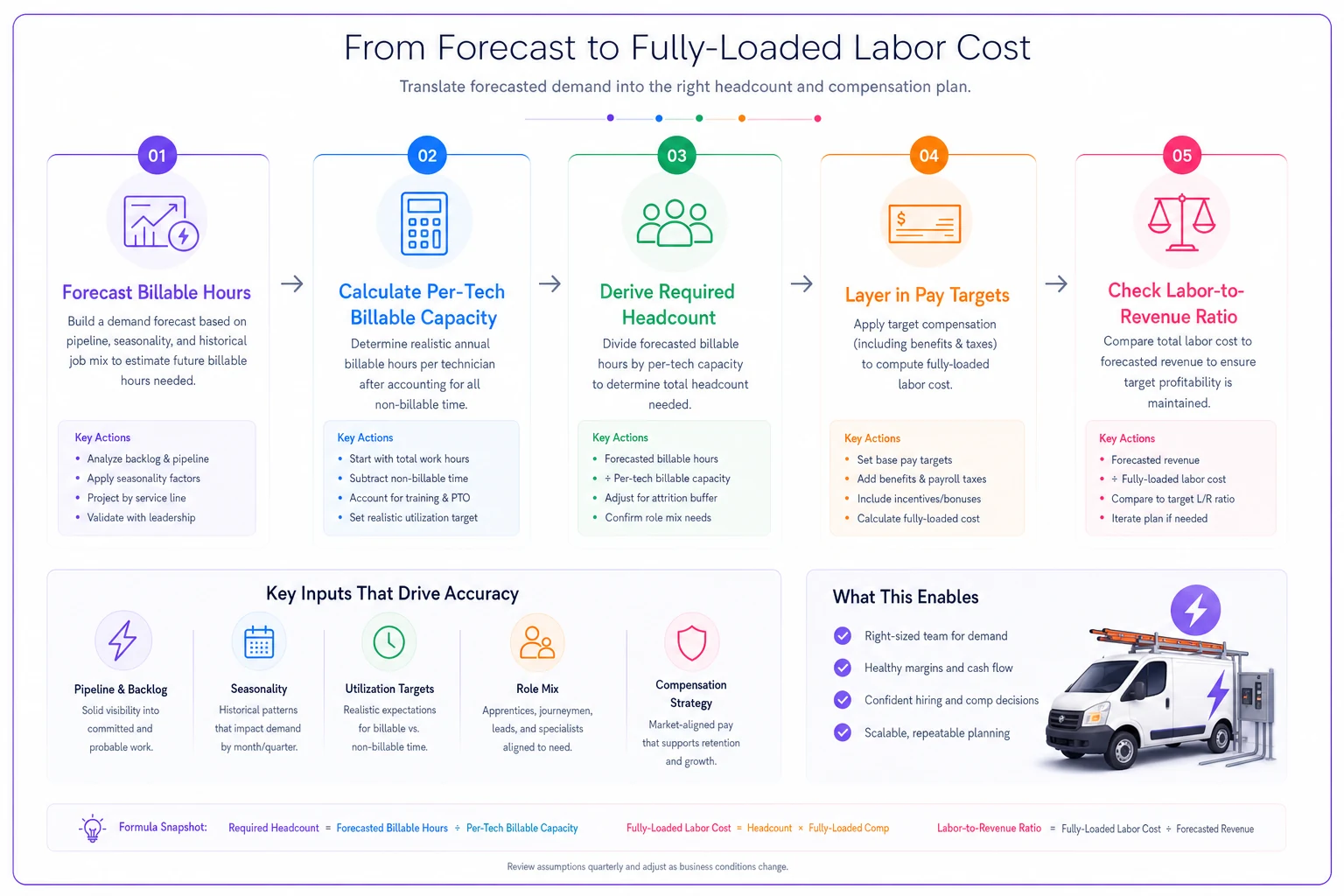
Placeholders like this help teams align hiring triggers with comp signals so a staffing gap shows up as a hiring alert rather than a surprise payroll problem.
Building CSAT into the paycheck without making it feel arbitrary
The number-one objection techs raise about tying pay to CSAT: "Customers rate me low for stuff outside my control." And honestly, they're not wrong. A customer angry about the price you quoted might one-star the tech who did clean work.
So don't tie pay to raw survey averages alone. Tie it to things the tech genuinely controls:
-
First-time-fix rate — did the problem stay fixed, or did it come back?
-
Callback / rework rate — attributed to workmanship, not parts failure
-
Documentation completeness — photos, notes, sign-off done correctly
-
A CSAT floor, used as a gate rather than a scaled multiplier
Using CSAT as a gate — you must be above 4.5 to unlock full commission — feels fairer than scaling their whole check to a survey score. It rewards a baseline of quality without punishing someone for one difficult customer. A callback penalty that deducts rework hours from commissionable revenue makes the connection direct: sloppy work literally costs the commission that could've been earned on something else.
Most owners miss that quality metrics don't just protect the customer — they protect your other techs. When one guy games revenue by cutting corners and gets paid the same as the one doing it right, your best people notice fast. A comp plan that actually pays for quality is a retention tool for the techs you can least afford to lose.
A real scenario
A residential electrical shop running six service techs was on straight hourly plus occasional discretionary bonuses. Revenue was fine, but the owner couldn't figure out why margin bounced between roughly 12% and 22% month to month with no clear pattern.
The culprit was utilization spread. Two techs were billing around 30 hours a week; two others were barely clearing 22, mostly on callbacks and slow tickets. Everyone got paid the same rate regardless. The low-utilization techs had zero reason to push, and the high performers were quietly resentful.
They moved to a balanced base-plus-productivity structure: base covering around 55% of target pay, commission on billed revenue above a monthly break-even, a CSAT gate at 4.5, and rework hours deducted from commissionable revenue. Tiered commission decline instead of a hard cap.
Over the next couple of quarters, the two lagging techs either lifted their billable hours into the high 20s or self-selected out — one left, which turned out to be fine because the remaining five absorbed the work with better utilization. Average ticket ticked up modestly because techs had a reason to complete full scope instead of rushing off. Margin stopped swinging and settled in a tighter band closer to the high teens. Nothing dramatic overnight, but the month-to-month whiplash mostly went away — which was the actual win.
The coordination problem: keeping the numbers honest at scale
All of this works cleanly on a whiteboard. Where it breaks in the real world is data.
A comp plan tied to billable hours, revenue per ticket, callback rate, and CSAT only works if those numbers are captured accurately and on time. With two trucks, the owner knows everything in their head. At eight trucks, that fails. Someone has to reconcile timesheets against actual job durations, attribute callbacks to the right tech, pull CSAT responses, and compute commission — every pay period, without errors — or the whole trust structure collapses. The first time a tech's commission gets calculated wrong, you've lost more goodwill than the plan will earn back in months.
This is the unglamorous reason a lot of well-designed comp plans quietly die. Not because the design was wrong — because reconciling the inputs by hand across a growing crew became a part-time job nobody had bandwidth for, so it got approximated, and once it's approximated the techs stop trusting it.
This is where operational software earns its keep. When dispatch, job completion, timesheets, and customer feedback all live in the same platform, the inputs to the comp plan get captured as a byproduct of doing the work — billable hours pull straight from job records, callbacks link automatically to the original ticket and tech, CSAT flows in from post-job surveys. AI-assisted reconciliation can flag edge cases for a manager to review — a job that ran three hours over, a callback that might not be workmanship — instead of forcing someone to manually comb every record each week. The point isn't automation for its own sake; it's that a comp plan is only as trustworthy as the data behind it, and hand-tracking that data across a real crew is exactly where it falls apart.
Who should not overhaul their comp plan right now
A few honest cautions worth sitting with before you start redesigning anything.
If you don't yet know your real per-tech billable-hour numbers, don't launch a productivity-based plan. You'll set thresholds wrong and either overpay or infuriate everyone. Get 60–90 days of clean utilization data first.
If you're a two-person shop where the owner is one of the two techs, this level of structure is overkill. A simpler profit-share or straightforward bonus works fine until you've got enough people that variance between them actually matters.
And if your callback and CSAT tracking is unreliable, fix that before tying pay to it. Paying on bad data is worse than not paying on it at all — because now the errors have money attached and every mistake becomes a fight.
Bringing it together
Compensation, capacity, and quality are one system, not three. Your billable-hour reality sets what a tech can produce. Your revenue and margin targets set what that production is worth. Your CSAT and callback standards keep the first two from being gamed. Pay design is the mechanism that connects them — a base that covers the floor, a productivity component that scales with real value created, and a quality modifier that protects the whole thing.
Get the capacity math right first, back the pay into it, and use a tiered cap instead of a hard wall. Then guard the inputs like your margins depend on it — because they do. The shops that get this right aren't necessarily paying more than their competitors; they're paying in a way that pulls capacity, revenue, and quality in the same direction at the same time. That alignment, more than any single rate, is what separates a comp plan that grows with you from one you quietly rebuild every time you add a truck.
Get the capacity math right first, back the pay into it, and use a tiered cap instead of a hard wall. Then guard the inputs like your margins depend on it — because they do. The shops that get this right aren't necessarily paying more than their competitors; they're paying in a way that pulls capacity, revenue, and quality in the same direction at the same time. That alignment, more than any single rate, is what separates a comp plan that grows with you from one you quietly rebuild every time you add a truck.
Ready to optimize your electrical service operations?
Join 500+ electrical service companies using Voltzly to improve scheduling accuracy, enhance client satisfaction, and boost operational efficiency.