


Every electrical contractor knows the feeling. You're reconciling accounts at month-end and notice $8,400 in pending credits from parts returns that are somehow still "in process" after six weeks. Your tech swears he dropped off those defective breakers. The supply house insists they never received proper documentation. And somewhere in between, your cash flow takes the hit.
Parts return reverse logistics for electricians isn't just about getting money back from defective components. It's the entire workflow from the moment a tech identifies a bad part in the field to when that credit actually hits your account. Most shops handle this with sticky notes, text messages, and hoping someone remembers to follow up. The result? Lost credits, delayed reimbursements, and techs burning billable hours driving back to supply houses to resolve disputes that shouldn't exist.
The real problem isn't that returns happen—defective parts are just part of the business. The problem is that most electrical contractors don't have a field-friendly system that works when your tech is standing in a customer's garage with a faulty AFCI breaker at 4 PM on a Thursday.
Why standard RMA processes fail in electrical service work
Traditional return merchandise authorization systems were built for warehouse operations, not field service. They assume someone's sitting at a desk with a computer, original purchase orders nearby, and time to fill out forms. That's not how electrical service works.
Your tech discovers a defective part during installation. Maybe it's a smart switch that won't pair, a GFCI that won't reset, or a panel that arrived with damaged bus bars. The tech needs to document it, get a replacement fast, and keep the job moving. But here's what usually happens instead:
The tech texts the office about the bad part. Office staff creates a note somewhere. The defective part goes in the van, then maybe to the shop, possibly to someone's truck who's "heading to the supply house tomorrow." Three weeks later, you're trying to piece together what happened while the supplier asks for proof of purchase, original invoice numbers, and photos they should have gotten weeks ago.
Meanwhile, you've already bought the replacement part at full price because the job couldn't wait. Now you're floating both the cost of the defective part and its replacement, hoping to eventually recover one of them. Multiply this across 15-20 returns per month, and you're looking at serious working capital tied up in limbo.
The kicker? Most of these returns are completely valid. The money should be yours. But without proper documentation captured at the point of discovery, you lose leverage with suppliers. They know you can't prove when or how the part failed, so they delay, dispute, or offer partial credits.
Building a photo-first RMA workflow that works in the field
The moment a tech identifies a defective part, your return process needs to start—right there in the field, not hours or days later. This means giving techs a dead-simple way to capture everything needed for a successful return while they're still on site.
Never miss a job or delay a dispatch again.
Voltzly helps you schedule, assign, and track every electrical job efficiently.
- Unified job scheduling
- Real-time technician tracking
- Automated client notifications
No credit card required
-
the part in its failed state
-
the part's label or model number
-
the original packaging or invoice if available
-
the installation location showing why replacement is needed
Photos alone aren't enough, though. You need structured data capture that can happen in 30 seconds from a phone. Create a simple return form that captures: job address, customer name, part description, supplier, approximate purchase date, failure description, and whether you need a replacement rushed. This isn't a novel-length RMA form—it's five quick fields that can be filled while walking back to the van.
Here's what this looks like operationally: Tech finds a defective dimmer switch. Opens the return form on their phone. Snaps four photos. Fills in "Smith residence, Leviton smart dimmer, ABC Supply, purchased this week, won't connect to app, need replacement today." Hits submit. Whole process: maybe 45 seconds.
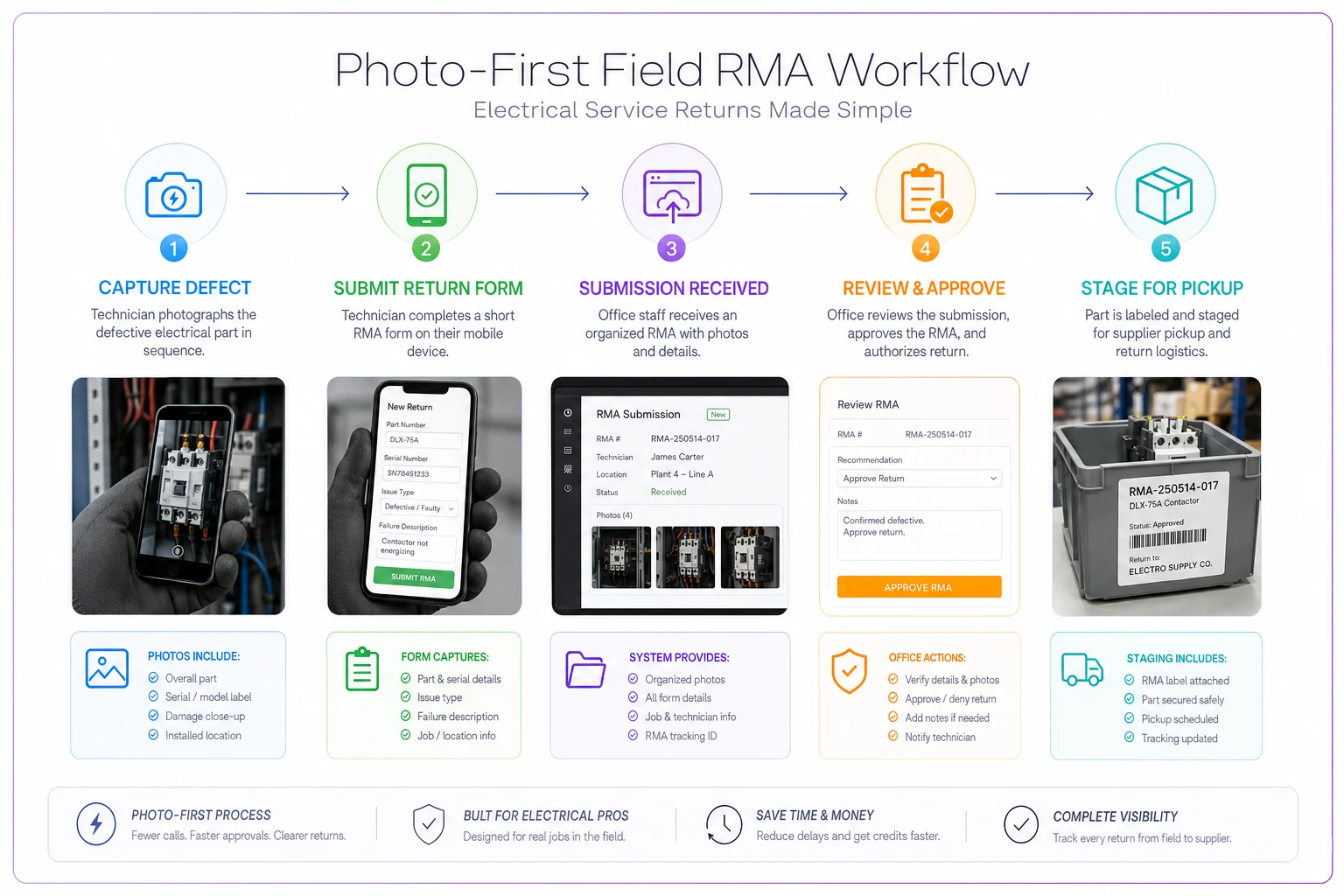
This simple image shows the photo-first field RMA steps from on-site capture to office intake.
That submission triggers your return workflow. The office gets notified immediately. Photos and details are organized by supplier. You can batch returns to each supplier weekly instead of dealing with random one-offs. Most importantly, everything is documented while memories are fresh and evidence is available.
The pickup and labeling system that eliminates lost parts
Documentation is only half the battle. The physical part still needs to get from the field back to the supplier. This is where most return processes fall apart—parts floating around in vans, sitting in shop corners, or getting mixed up with good inventory.
Create designated return zones in every van. Not just "somewhere in the back" but an actual labeled bin or bag specifically for defective parts. When a tech documents a return, they immediately place the part in this zone. No exceptions. This prevents the classic "I think it's in Steve's truck" situation that derails returns weeks later.
At the shop, establish a return staging area with clear supplier zones. When vans come back, defective parts move immediately from van return zones to the appropriate supplier section. Each part should already have documentation from the field, so there's no guessing what it is or where it came from.
For labeling, simple beats complex.
| Label fields |
|---|
| your company name |
| return date |
| which tech found it |
| a reference number from your field documentation |
Tape this to each part or its bag. When you batch returns to suppliers, everything's already organized.
The pickup side needs equal attention. Instead of random trips to supply houses, schedule weekly return runs. Every Tuesday morning, for example, someone takes all accumulated returns to the respective suppliers. They bring printed summaries of each return and get receipt confirmation. That receipt confirmation is crucial—it's your proof of delivery that starts the credit clock.
Some suppliers offer pickup services for returns. Use them, but document everything. Take photos of what they're picking up. Get the driver's name. Email the supplier immediately with pickup confirmation and your return references. Don't assume their driver will properly log your returns.
Credit reconciliation that actually recovers your money
Suppliers don't prioritize processing your returns. They're not trying to be difficult; returns are just administrative burden for them. Credits you're owed sit in limbo not from malice but from lack of follow-up. This is where most contractors actually lose money—not from denied returns but from credits that never get processed at all.
Build a credit tracking system that matches your return documentation to actual credits received. Every return logged from the field should have an expected credit amount and date. When statements arrive from suppliers, someone needs to verify each credit against your return log. Not glamorous work, but it's literally money recovery.
Set escalation triggers based on supplier payment terms. If a supplier typically processes credits within 14 days, flag any return older than 16 days. Don't wait for monthly reconciliation to notice missing credits—by then, the supplier might claim they never received the return or that too much time has passed.
For high-value returns, anything over $500 or so, don't rely on standard processing. Call the supplier when you submit the return. Get a contact name and confirmation number. Follow up weekly until the credit appears. It sounds like overkill, but a $2,000 motor starter return that goes missing costs more than the time spent following up.
Create a dispute resolution process before you need it. When a supplier denies or reduces a credit, you need documentation ready. This is where your photo-first field documentation pays off. You have timestamped photos, failure descriptions, and installation context. Most suppliers will process disputed credits when faced with comprehensive documentation.
Track patterns by supplier too. If ABC Supply consistently takes three weeks to process credits while XYZ Electric handles them in five days, adjust your cash flow planning accordingly. Some shops even adjust supplier preferences based on return processing speed—a 2% price difference might not be worth a six-week credit delay.
Integration with job costing and accounting
Returns affect job profitability, but most contractors don't properly track this impact. When you quote a panel upgrade with specific margin targets, a defective main breaker that needs expedited replacement can wreck those margins. Your reverse logistics process needs to feed this information back to job costing.
Every return should link to its original job. This lets you track the true cost impact: labor time spent dealing with the defective part, any expedite fees for replacements, and customer satisfaction issues from delays. A $50 defective switch might actually cost $200 when you factor in the return trip, lost time, and rushed replacement.
For accounting handoffs, create clear documentation packages. When credits finally arrive, your bookkeeper shouldn't have to hunt for information. Each credit should match to a return record that includes: original purchase documentation, return authorization, proof of return, and job impact summary. Captured progressively from the field up, it's just organized information you already have.
Consider how returns affect inventory planning too. If you're seeing consistent failures from specific product lines, that's valuable data for van stock decisions. Maybe those budget breakers aren't worth the return hassle. Or maybe you need to stock extras of items with high failure rates to avoid job delays.
Warning signs your return process is broken
Some red flags that your parts return reverse logistics need immediate attention:
You have more than $5,000 in pending credits older than 30 days. This means credits aren't being tracked or pushed through properly. Money is sitting on the table.
Techs avoid documenting defective parts because "it's not worth the hassle." When field teams give up on the return process, you're eating the cost of every defective part.
Your supplier statements show fewer credits than returns submitted. This indicates returns are getting lost somewhere between field documentation and supplier processing.
Office staff spend hours each month trying to match credits to returns. If reconciliation requires detective work, your documentation flow is broken.
You're buying replacement parts at full price while waiting for credits on defectives. This working capital drain compounds quickly, especially on commercial jobs with expensive components.
When enhanced RMA tracking makes sense
Not every shop needs sophisticated return tracking. If you're running 2-3 trucks and seeing maybe 5 returns monthly, a simple spreadsheet might genuinely be enough. But once you hit certain thresholds, manual tracking becomes a money-losing proposition.
Consider more structured RMA tracking when you're processing more than 15 returns monthly, dealing with multiple suppliers, or when pending credits regularly exceed $10,000. At that scale, the labor cost of manual tracking starts to exceed the cost of better systems.
For shops running 8+ trucks, return logistics becomes a real operational burden. Techs need mobile-friendly documentation tools. Office staff need visibility into pending returns by supplier. Accounting needs clear audit trails for credits. This is where AI-powered operational software starts making practical sense—not as a fancy addition but as automation that recovers real money.
The better platforms integrate return documentation directly with job management. When a tech logs a defective part, it links automatically to the current job, notifies the right people, and starts tracking for credit receipt. Photo uploads happen from the field, eliminating the "I'll send those pictures later" problem that kills documentation quality. Supplier return patterns get tracked in the background, surfacing which vendors process credits quickly versus which ones need constant prodding.
Making return logistics actually work in the field
The success of any parts return reverse logistics system comes down to field adoption. If techs won't use it, nothing else matters. Your process needs to be faster than current workarounds and provide clear benefit to the tech, not just the office.
Show techs how proper return documentation saves them time. When a supplier disputes a return, good documentation means the tech doesn't waste an afternoon driving back to prove the part was defective. Make the connection clear between good return practices and things techs actually care about.
Keep the field process under 60 seconds. If documenting a return takes longer than a minute, techs will find shortcuts. This might mean pre-populated fields, voice-to-text for descriptions, or batch photo uploads. Every second counts when someone's standing in a hot attic or cramped panel room.
Regular training helps, but not the lecture kind. Quick morning huddles where someone shares a return success story work better. "Remember that $400 disconnect that failed last month? Credit came through because Tom got those photos." Make it real and relevant.
Some contractors tie return documentation to tech performance metrics—not as punishment but as professional recognition. Techs who consistently document returns properly might get first pick of new tools or preferred scheduling. Small acknowledgments that reinforce good operational habits.
Pre-fill job and tech fields in the mobile return form so documentation stays under 60 seconds.
Reverse logistics isn't exciting work. Nobody becomes an electrician to manage return paperwork. But done right, it's the difference between eating $15,000 in defective parts annually versus recovering that money. In a trade where margins are already tight, that recovered cash might fund your next hire or equipment upgrade.
Building an effective parts return process doesn't require complex technology, though the right tools certainly help. It requires consistency, documentation, and follow-through. Start with photo documentation from the field. Organize the physical flow of returned parts. Track credits without letting things slip. And make it easy enough that your field teams will actually use it.
The goal isn't perfect documentation of every single defective wire nut. It's recovering the significant money currently lost in the gap between your field operations and supplier credit departments. That recovered cash flow makes everything else in your business a little easier.
Ready to optimize your electrical service operations?
Join 500+ electrical service companies using Voltzly to improve scheduling accuracy, enhance client satisfaction, and boost operational efficiency.