


A failed inspection almost never fails because the electrical work was bad. That's the part that trips up shop owners. Your tech did clean work, the panel is labeled, the connections are tight—and the inspector still red-tags the job because the permit lists a 150A service and the tech installed 200A, or because nobody pulled the permit under the right subclassification, or because the homeowner "already had a permit" that turned out to be for the deck.
Then you're stuck. The GC or homeowner won't release the check until it passes. You have to schedule a re-inspection that's two weeks out. Your tech drives back across town to stand next to the panel and answer three questions. And the whole time, a job you finished in a day is sitting in "waiting" purgatory eating your working capital.
This is a coordination problem, not a craftsmanship problem. The fix is boring: decide who owns what, build a pre-inspection pack, and have a clear escalation path when the AHJ goes quiet. Here's a permit inspection workflow electricians can actually run without a full-time permit coordinator.
Where the handoffs actually break
If you map a residential job from quote to final inspection, the failures cluster around three specific handoffs. Not the work itself—the handoffs.
The first is estimator to office. The estimator scoped a panel upgrade and quoted it, but the scope of work that goes on the permit application is either copied wrong or summarized too loosely. The permit says "electrical repair" when it should say "200A service upgrade, meter relocation." Now the inspector shows up expecting one thing and finds another.
The second is office to tech. The permit gets pulled, but the tech never sees the actual approved plan or the specific conditions the AHJ attached. Some jurisdictions require a disconnect within sight of the meter, a specific grounding electrode configuration, or an AFCI/GFCI layout that the tech would've done differently by habit. If that condition lives in the office inbox and never reaches the van, you fail.
The third is tech to inspection. Work is done, but nobody scheduled the inspection at the right stage. Rough-in inspections get skipped because the crew was moving fast and closed the wall. Now the inspector can't verify what's behind the drywall, and you're opening it back up.
What shows up across a lot of small shops is that these three breaks trace back to the same root cause: nobody clearly owns the permit and inspection lifecycle. Everybody assumes someone else is watching it.
Clear division of responsibility
The single highest-leverage move is writing down who owns each phase. Not vaguely—specifically. Here's a division that works for a shop running 3–10 techs.
Never miss a job or delay a dispatch again.
Voltzly helps you schedule, assign, and track every electrical job efficiently.
- Unified job scheduling
- Real-time technician tracking
- Automated client notifications
No credit card required
| Phase | Owner | Specific responsibility |
|---|---|---|
| Scope definition | Estimator | Writes the exact permit scope language on the quote, including service size, meter work, and any structural elements |
| Permit application | Office | Files under correct classification, tracks approval, records all AHJ conditions in the job file |
| Pre-inspection prep | Tech (lead) | Builds the photo/measurement pack at rough-in and final, flags any deviation from approved scope before inspection |
| Inspection scheduling | Office | Books rough-in and final at the right stage, confirms inspector window, notifies tech |
| Onsite inspection | Tech | Present or reachable, has approved plan + conditions on the phone, answers AHJ questions |
| Escalation | Office | Chases stalled approvals, disputes wrong red-tags, manages re-inspection booking |
The point isn't that these are the only right assignments. The point is that each row has one name, and everyone knows it. The most common mistake is leaving "inspection scheduling" ownerless because it feels like admin nobody wants. Then a tech assumes the office booked it, the office assumes the tech would call from the field, and the rough-in gets buried behind drywall.
The estimator's role tends to get underrated here: the scope language they write becomes the permit language becomes what the inspector checks against. If your estimator writes tight scope during the quote—the same discipline you'd apply during remote site validation before dispatch—half your inspection mismatches disappear before the job even starts.
The pre-inspection photo/measurement pack
This is the piece most shops skip, and it's the one that prevents the most re-inspections. Before you ever call for an inspection, the lead tech puts together a small, standardized pack that proves the work matches the permit. The office reviews it. If something's off, you catch it before the inspector does—when fixing it takes 20 minutes instead of a two-week re-inspection cycle.
-
Permit + approved scope screenshot — so the pack is self-contained and the tech isn't guessing what was approved
-
Panel photo, cover off — showing breaker layout, labeling, and torque marks if you mark them
-
Panel photo, cover on — showing the completed dead front and legend
-
Service/meter photo — showing the service size, mast, weatherhead, and any relocation
-
Grounding electrode + bonding photos — the single most-cited item on residential red-tags
-
GFCI/AFCI locations — photos or a marked plan showing protected circuits match code and the approved layout
-
Rough-in photos (if applicable) — taken before drywall, showing box fill, wire routing, staple spacing, nail plates
-
Measurement notes — working clearance in front of the panel (30" wide, 36" deep), disconnect-within-sight distances, mounting heights
-
Deviation flag — one line
"matches approved scope" or "deviation: X, reason: Y." This is the field that catches problems.
That last item is the whole game. A tech who has to actively write "matches approved scope" is forced to compare their work against the permit. That five-second comparison is where you catch the 200A-vs-150A mismatch, the missing GFCI on the exterior receptacle, the disconnect that ended up around the corner instead of within sight.
Require the tech to upload the pre-inspection pack to the job record before leaving the site.
A typical example: a shop doing a service upgrade in an older jurisdiction that required specific ground rod spacing. The tech drove two rods but spaced them about 4 feet apart—habit, not code for that AHJ, which wanted 6 feet minimum. On the old workflow, the inspector catches it, red-tags, and the crew comes back two weeks later. With the pack, the office reviewer spots the grounding photo, flags the spacing against the approved conditions, and the tech re-drives one rod on the way to the next job that same afternoon. Re-inspection avoided.
The escalation ladder for stalled approvals
Half the payment holds we see aren't from failed inspections at all. They're from approvals and inspections that just… sit. The permit's been "under review" for eight days. The inspection was requested but the AHJ portal never confirmed a window. The inspector marked something as needing correction but the note is vague and nobody followed up.
-
Day 0 – Request logged. Office records the request date, method, and any confirmation number in the job file. No confirmation number? That's already a flag.
-
Day 3 – Silent-status check. If no scheduled window or approval by day 3, office contacts the AHJ through the same channel and logs the response. Most stalls die here if someone just asks.
-
Day 5 – Named follow-up. Escalate to a specific person, not the general line. Reference the permit number and application date. Ask for a committed date.
-
Day 7 – Supervisor / plan-review escalation. If the delay is on the review side, ask who's reviewing and whether anything's missing. Often something small is pending and nobody told you.
-
Correction disputes – immediate, not deferred. If a red-tag note is vague or seems wrong (inspector cited a code that doesn't apply to the install year, for example), the office—armed with the pre-inspection pack—requests written clarification the same day. The pack photos are your evidence.
The mistake shops make is skipping steps 1 and 2 because they feel unnecessary. The whole ladder only works if you logged the request date. Without day 0, you can't tell whether you're at day 3 or day 12, and "how long has this been sitting?" becomes a guess.
A short real scenario
A four-tech residential shop in a mid-size metro was averaging somewhere around 5–7 re-inspections a month, mostly on service upgrades and panel swaps. Each re-inspection was costing them a half-day of tech time plus a payment delay—checks releasing roughly two to three weeks late on those jobs. On a shop doing maybe 30–40 permitted jobs a month, that's a meaningful chunk of cash tied up at any given time.
They didn't add staff. They did three things: the estimator started writing exact permit scope on every quote, the lead techs started building a pre-inspection pack before requesting any inspection, and the office started logging every inspection request date and running the escalation ladder.
Within about two months, re-inspections dropped to one or two a month, and most of those were genuinely inspector-preference calls—not preventable mismatches. The bigger win was cash timing. Payment holds tied to inspection problems mostly went away because the jobs passed the first time. As the office lead put it: "we stopped finding out about problems from the inspector."
When this level of structure isn't worth it
If you're a solo operator doing mostly service calls and troubleshooting with the occasional permitted job, a full ownership table is overkill. You are the estimator, office, and tech. What you still want is the pre-inspection pack habit and a logged request date—those cost almost nothing and save the re-inspection drive.
The structure earns its keep once you have someone in the office who isn't the person doing the work, and once permitted jobs are a regular part of your mix rather than a rare event. Somewhere around three-plus techs with steady service upgrades and remodels is where the handoff failures start costing real money and the ownership table starts paying for itself.
Keeping it running without adding overhead
The reason these workflows quietly collapse is that they live in people's heads and text threads. The estimator's scope note is in the CRM, the AHJ conditions are in the office email, the pre-inspection photos are on the tech's phone, and the request date is on a sticky note. When those live in different places, the handoffs break exactly the way they broke before you wrote the workflow down.
An operational platform that ties the job record together earns its place here—less as software you interact with all day and more as the shared spine that carries the scope, the permit conditions, the photo pack, and the inspection status through every handoff. When the estimator's scope, the AHJ conditions, and the tech's pre-inspection photos all live on the same job record, the day-0 request date and escalation status ride along with them. AI-assisted checks can flag obvious mismatches automatically—like a permit that says 150A next to a photo pack showing a 200A panel—so a reviewer sees the problem before an inspector does. The pack you build here also does double duty on the billing side, feeding straight into a fast job-finalization and invoicing process once the final passes.
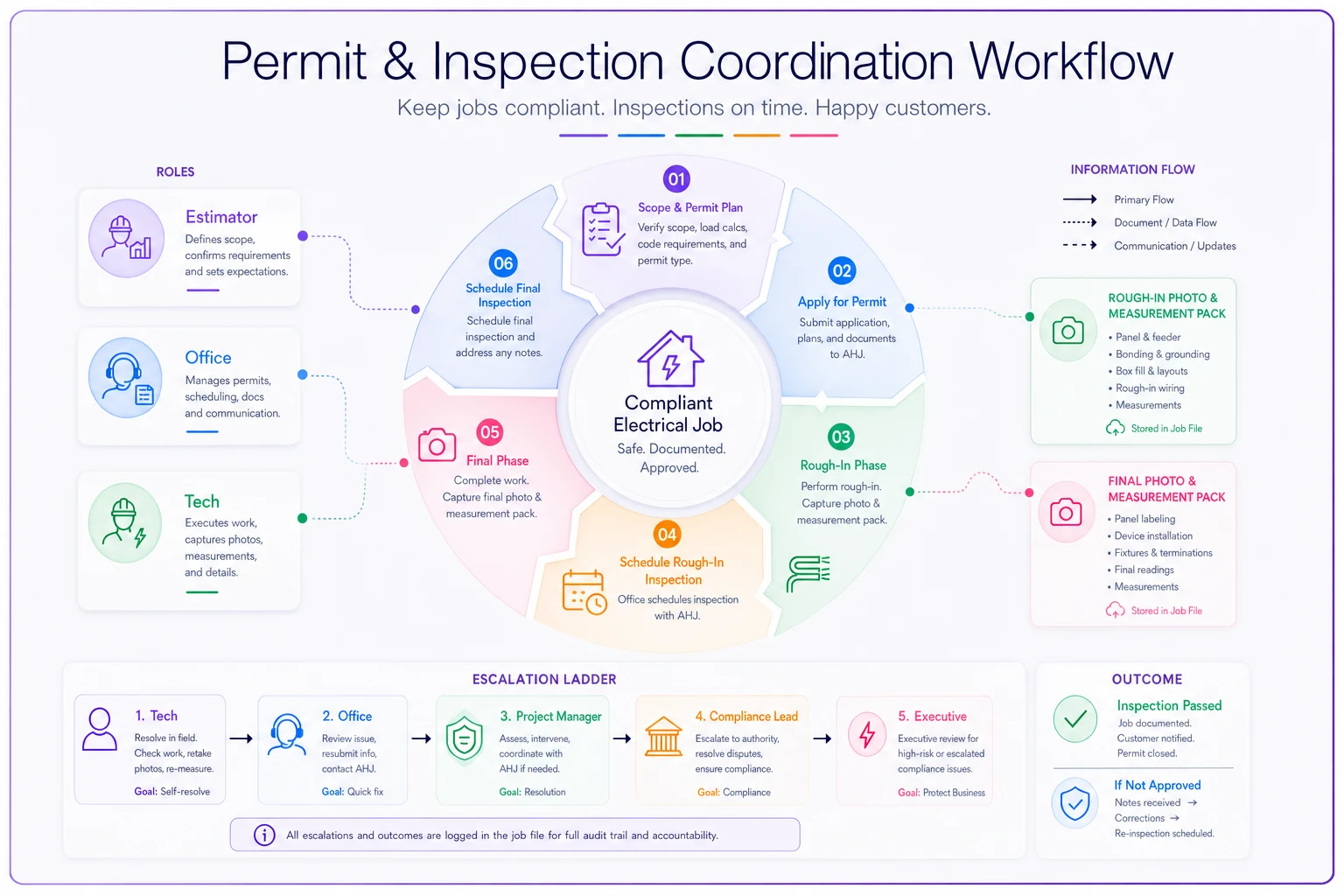
Here's a simple visual of the workflow to share at a training or put in the office.
The tool is secondary, though. Start with the ownership table and the pack. A shop that knows exactly who owns each phase, builds proof before requesting an inspection, and logs every request date will beat a shop with expensive software and fuzzy handoffs every single time.
The tool is secondary, though. Start with the ownership table and the pack. A shop that knows exactly who owns each phase, builds proof before requesting an inspection, and logs every request date will beat a shop with expensive software and fuzzy handoffs every single time.
Ready to optimize your electrical service operations?
Join 500+ electrical service companies using Voltzly to improve scheduling accuracy, enhance client satisfaction, and boost operational efficiency.