

Your tech drives 45 minutes to a panel upgrade, walks into the basement, and finds the main panel sitting directly behind a water heater nobody mentioned. Or worse—there's asbestos wrap on the service entrance cable that the homeowner "forgot" about. Now you're eating travel time, disappointing a customer, and scrambling to reorganize tomorrow's routes.
This keeps happening because most electrical contractors treat site validation like a phone conversation instead of a visual inspection process. They rely on homeowners to accurately describe electrical situations they don't fully understand, then act surprised when reality doesn't match.
The hidden cost of blind dispatches
Every electrical contractor knows this frustration. A "simple outlet replacement" turns into rewiring knob-and-tube behind plaster walls. The "straightforward panel swap" becomes a service entrance rebuild when you discover aluminum feeders. These scope explosions don't just kill margins—they wreck scheduling efficiency across your entire operation.
Think about what actually unfolds when your tech encounters an unexpected scope change. They call you from the field. You negotiate with the homeowner while your tech stands around. Maybe you approve overtime to finish today, or you reschedule and eat the travel cost. Either way, that afternoon's service call gets pushed, tomorrow's install gets compressed, and suddenly one bad validation creates a week of chaos.
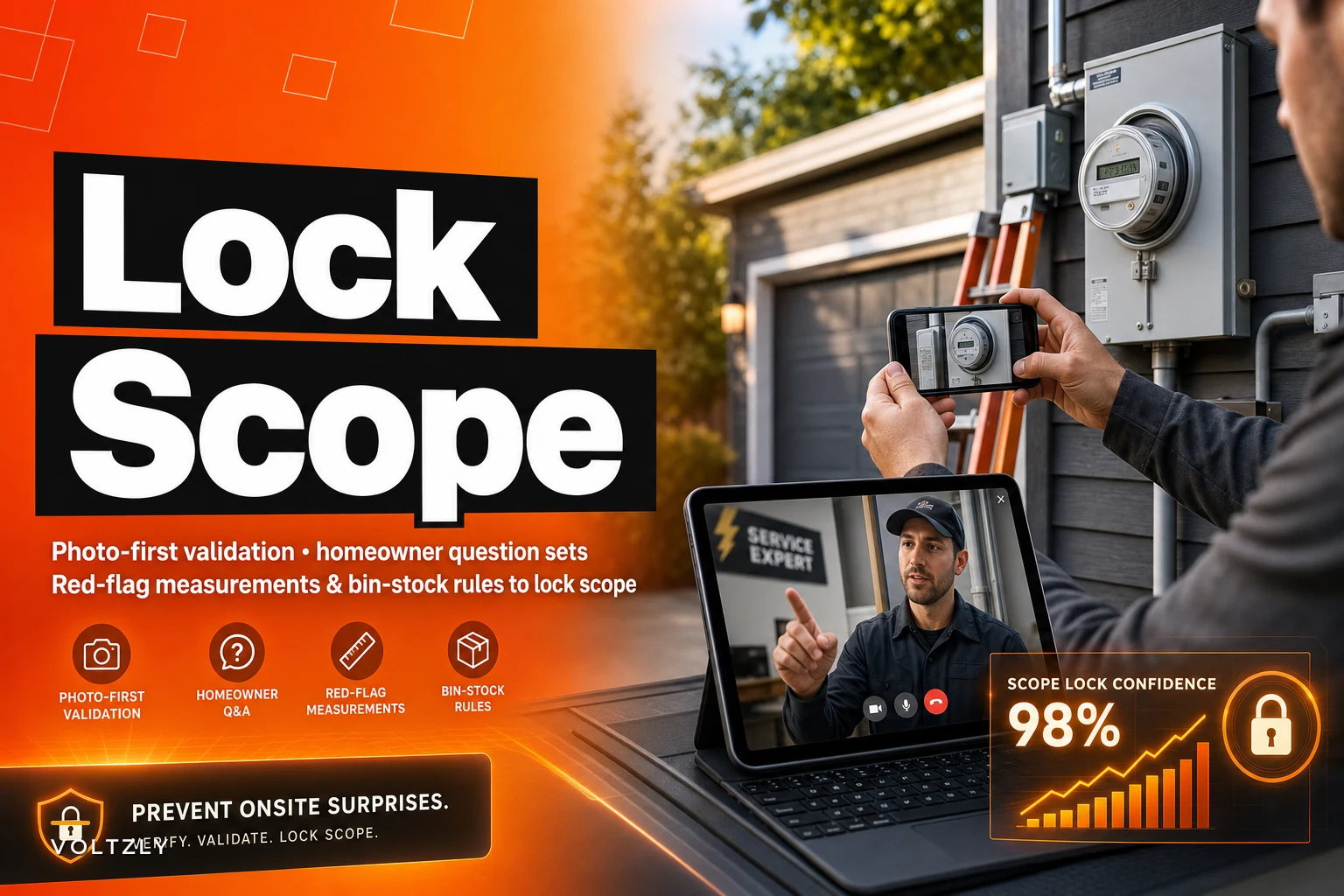
Contractors who've figured this out aren't sending techs blind anymore. They're using structured photo validation to lock scope before anyone gets in a truck—not casual "send me a pic" requests, but systematic visual checklists that capture exactly what matters for accurate quoting and proper truck loading.
Building your photo-first validation framework
Start with the assumption that homeowners don't know what information you need. They'll send you a blurry photo of the wrong panel, miss critical obstructions, and forget to mention that their electrical room floods twice a year. Your validation process needs to guide them through capturing exactly what determines scope, pricing, and materials.
Never miss a job or delay a dispatch again.
Voltzly helps you schedule, assign, and track every electrical job efficiently.
- Unified job scheduling
- Real-time technician tracking
- Automated client notifications
No credit card required
Panel assessment photos
-
Full panel with door closed showing manufacturer and amperage rating
-
Panel interior with breakers visible and labeled
-
Wide shot showing clearance and obstructions around the panel
-
Service entrance cable where it enters the building
-
Grounding system including water pipe bonds and ground rods
Each photo request needs specific instructions. Don't just ask for "a picture of your panel." Say: "Stand 3 feet back and capture the entire panel including the wall around it. We need to see any pipes, ducts, or equipment within 3 feet of the panel location."
Ask customers to include a tape measure or ruler in photos for scale when capturing panel and clearance shots.
Conditional photo triggers
Build decision trees that trigger additional photo requirements based on initial images. If the panel photo shows Federal Pacific or Zinsco, immediately request photos of all visible wiring in the attic and basement—you're probably looking at a full rewire, not just a panel swap.
If you see aluminum branch wiring, request close-ups of every accessible outlet and switch to check for proper connectors. When a panel sits in a finished basement, get photos of the ceiling to understand fishing routes. These conditional requests prevent the "surprise rewire" that destroys your schedule.
Red flag measurements that change everything
Photos tell part of the story, but specific measurements determine feasibility and pricing. A panel might look accessible until you realize there's only 22 inches of working clearance instead of the required 30. Service entrance cable might seem fine until you measure and discover it's undersized for the requested upgrade.
| Measurement Type | Why It Matters | Red Flag Threshold |
|---|---|---|
| Panel working space | Code compliance for installation | Less than 30" depth |
| Service cable size | Determines upgrade feasibility | Smaller than 2/0 aluminum for 200A |
| Attic access opening | Equipment and material transport | Under 22" x 30" |
| Crawlspace height | Tech mobility and working position | Under 24" clearance |
| Distance to shutoff | Emergency access during work | Over 25 feet from panel |
When measurements hit red flag thresholds, pricing multipliers kick in automatically. That 18-inch crawlspace? Your standard panel upgrade price just increased by 40% for difficulty. The attic access that barely fits a person? Add $400 for material handling time.
Train your office staff to extract these critical measurements during validation:
Homeowner question sets that reveal hidden complexity
Photos and measurements catch visible issues, but targeted questions uncover the expensive surprises. Most contractors ask general questions that get useless answers. "Any electrical problems?" gets you nowhere. Specific, scenario-based questions extract the information that actually affects scope.
Historical modification questions
"Have you added any major appliances in the past 10 years?" sounds simple but reveals bootleg wiring. The homeowner who added a hot tub, workshop, or EV charger without permits probably has undersized feeders and double-tapped breakers waiting for you.
"Has anyone ever mentioned aluminum wiring during previous work?" catches the partial rewire situations where some circuits got updated but others didn't. You'll know to check for improper copper-to-aluminum connections that create callback nightmares.
Environmental hazard questions
"Does your electrical room ever get wet?" identifies the jobs where you'll find corroded connections and failing equipment. One contractor started asking this after finding a panel with active water damage that the homeowner considered "normal basement dampness."
"Have you noticed any unusual smells near your electrical panel?" catches overheating connections and failing breakers before you commit to a simple panel swap. That burnt plastic smell means you're probably looking at additional troubleshooting and repairs on top of whatever the original scope was.
Access and timing questions
"Are there any pets that need to be secured during work?" seems basic, but the unleashed German Shepherd changes your entire approach. Same with "Will anyone be working from home during the service?"—you need to know if killing power for 4 hours costs someone their job.
Creating bin-stock rules from validation data
This is where pre-job remote site validation really pays off operationally. Every validated job generates a precise materials list before dispatch. No more "grab extra just in case" depleting van stock. No more return trips for the one fitting nobody expected to need.
-
Federal Pacific panel detected → Pull AFCI breaker kit for required updates
-
Aluminum wiring visible → Include proper AL/CU connectors and antioxidant
-
Cloth wiring in photos → Add extra junction boxes for splice points
-
Moisture evidence → Include weatherproof components and corrosion inhibitor
Smart contractors maintain a "red flag inventory"—materials specifically stocked for common validation discoveries. When photos reveal knob-and-tube wiring, your system automatically adds retrofit boxes and wire nuts rated for mixed conductor types. Evidence of previous homeowner work? The truck gets loaded with extra materials to fix the code violations you'll inevitably find.
Implementing conditional pricing rules
Static pricing breaks down when validation reveals complexity. Your standard $2,200 panel upgrade becomes $3,400 when photos show a cramped utility closet requiring equipment relocation. The key is building pricing rules that trigger automatically based on validation findings, removing the guesswork from field quotes.
-
Confined space (under 30" clearance)
+30%
-
Aluminum service entrance replacement
+$800
-
Asbestos-wrapped cable
+$650 for certified removal
-
Weekend scheduling requirement
+25%
The customer sees a detailed quote explaining each component, understanding exactly why their job costs more than their neighbor's "identical" panel upgrade. This transparency reduces price objections while protecting your margins on complex work.
The documentation trail that prevents disputes
Photo validation does more than prevent surprises—it creates an indisputable record of pre-existing conditions. That water stain near the panel the homeowner swears appeared after your work? You have timestamped photos showing it existed before your tech arrived. The outlet that "never worked right after you were here"? Your validation shows it was already damaged.
Structure your photo storage system for easy retrieval. Create folders by job address, not just customer name. Tag images with specific conditions: "pre-existing damage," "code violation," "access restriction." When a callback comes three months later claiming you caused damage, you can pull the validation photos in seconds.
Converting validation into dispatch efficiency
The real power of thorough validation shows up in dispatch optimization. When you know exactly what each job requires, you can sequence routes based on actual complexity, not estimated duration. That panel upgrade with perfect access and modern wiring? Schedule it between two small service calls. The nightmare rewire in a 1920s house? That gets its own day with your most experienced tech.
Your morning dispatch meeting changes completely. Instead of "Johnson has a panel upgrade that should take 4 hours," you're saying "Johnson is a straightforward 200A upgrade with good access, no aluminum, modern grounding—Marcus can handle this between his 8am outlet repair and 2pm doorbell install."
Some contractors score jobs based on validation findings. Simple system: 1 point per complication (confined space, aluminum wiring, old construction, access restrictions). Jobs scoring 3+ points only go to senior techs. Jobs scoring 5+ get scheduled as full-day projects. This eliminates the experience guesswork that creates delays.
When validation reveals walk-away triggers
Not every job is worth taking. Validation sometimes reveals situations where the smart call is declining the work. Maybe the photos show extensive knob-and-tube wiring the homeowner insists doesn't need replacement. Or the customer refuses to clear the storage mountain blocking panel access. These are disputes waiting to happen.
-
Customer refuses to address obvious safety hazards
-
Discovered scope exceeds customer budget by more than 50%
-
Environmental hazards require specialty contractors
-
Customer demonstrates unwillingness to follow safety requirements
-
Access restrictions make the work technically impossible
One contractor's validation process revealed a panel sitting behind a built-in entertainment center the homeowner "couldn't" move. They quoted $4,500 including furniture removal and reinstallation. The homeowner complained about price gouging. Three months later, another contractor attempted the job, damaged the furniture, and ended up in small claims court. Your validation process isn't just about finding work—it's about avoiding problems.
Real numbers from systematic validation
A residential contractor running 4 trucks implemented photo-first validation about 8 months ago. Before, they averaged 3.2 jobs per truck daily with roughly 15% requiring return visits for missing materials or scope changes. After implementing systematic validation, they're at 3.8 jobs per truck with return visits down to around 4%.
The bigger impact showed up in margins. Jobs that previously ran over budget by 20–30% due to surprises now stay within 5% of quoted prices. They're catching expensive complications during validation, not after driving across town. Average ticket increased from roughly $1,850 to $2,150—not from raising prices, but from capturing all the billable work before quoting.
The time investment is minimal. Office staff spend about 12 minutes per job managing validation—sending photo request lists, reviewing submissions, asking follow-up questions. That replaces hours of windshield time and schedule chaos from blind dispatches.
Building validation into your operations platform
Manual photo validation works at low volume, but it doesn't scale cleanly. When you're running 20+ jobs daily, tracking photo submissions through email becomes a mess. Text messages disappear into thread graveyards. Someone forgets to review images before dispatch, and you're back to surprise discoveries.
Modern operational platforms let you build validation directly into your intake workflow. Customer submits a request, system automatically sends a photo requirement checklist based on job type. Images upload directly to the job record, triggering review tasks for your office team. Conditional logic requests additional photos based on initial submissions. Similar to how you'd structure after-hours call handling, the system guides customers through providing exactly what you need without relying on anyone to remember the process.
AI-assisted platforms add another layer in pattern recognition. After processing hundreds of panel photos, the system starts identifying Federal Pacific panels, aluminum wiring, and code violations automatically—flagging potential issues for human review, suggesting material lists based on visual conditions, estimating job duration based on similar past projects. It doesn't replace your expertise. It just amplifies your team's ability to catch issues before dispatch.
The validation workflow that scales
Day 1 - Initial Contact:
-
Customer requests service
-
System sends photo checklist within 1 hour
-
Automated reminder at 4 hours if no response
Day 1-2 - Photo Review:
-
Images uploaded trigger review task
-
Office staff reviews using red flag checklist
-
Conditional photo requests sent if needed
-
Measurement requests sent for flagged items
Day 2 - Scope Confirmation:
-
Pricing calculated with conditional modifiers
-
Quote sent with detailed scope explanation
-
Materials list generated for approved jobs
-
Special equipment needs flagged
Day 3 - Pre-Dispatch:
-
Final validation call to confirm access
-
Material pull list sent to warehouse
-
Tech briefed with photos and notes
-
Route optimized based on complexity scoring
Nothing falls through the cracks. Every job gets validated, every complication gets priced, every tech arrives prepared. Like building comprehensive EV charger assessments, the structure ensures consistency while leaving room for the jobs that don't fit neatly into a category.
Visual workflow:
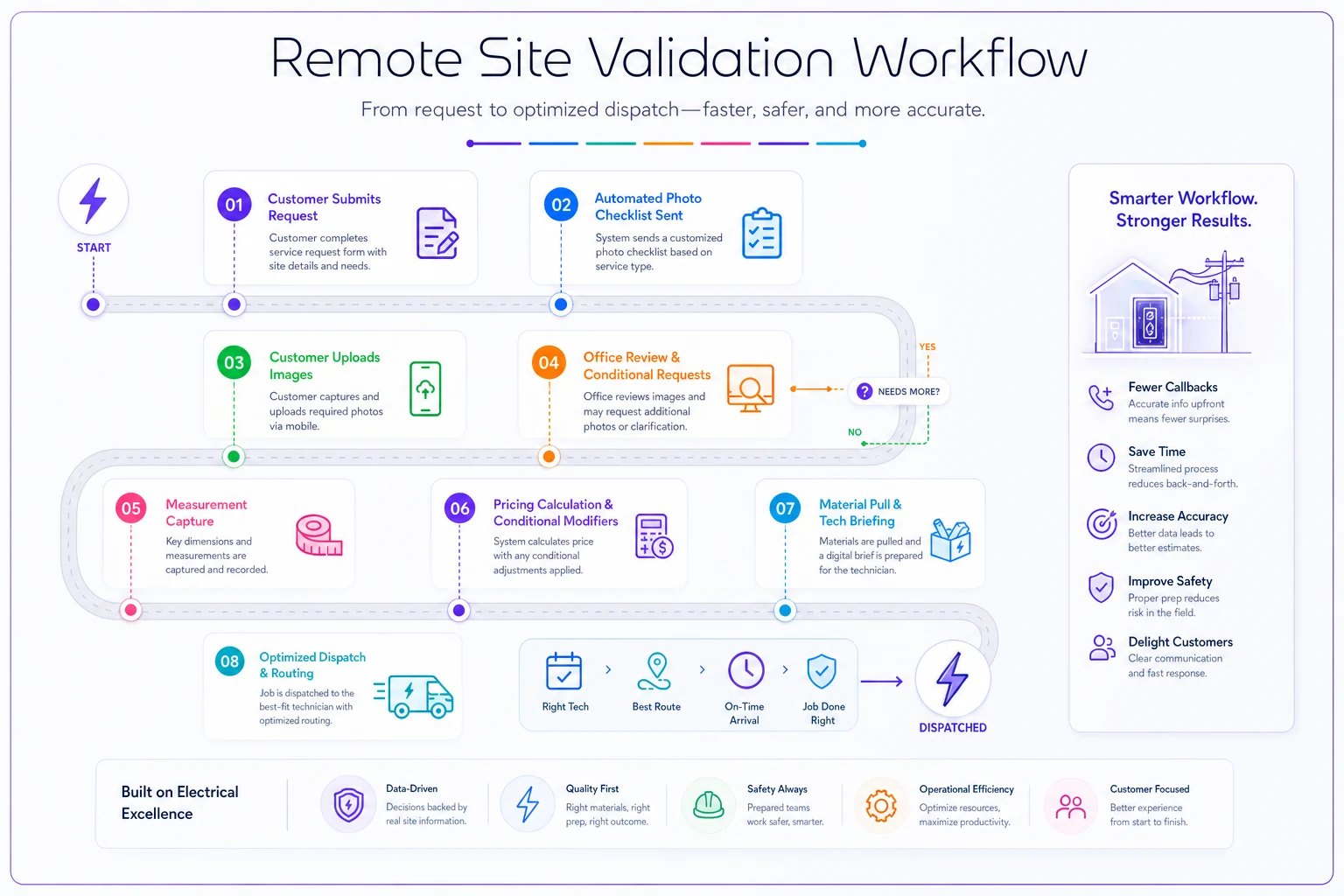
This simple visual maps the stages from initial contact to dispatch so teams can follow the same process every time.
Pre-job remote site validation isn't about eliminating all surprises—it's about eliminating the expensive ones that destroy schedules and margins. The contractors who've figured this out aren't just collecting random photos. They're running systematic visual inspections that reveal complexity, trigger appropriate pricing, and ensure trucks arrive with the right materials and realistic expectations.
The investment is minimal compared to the return. Spend 12 minutes validating a job properly, save 2 hours of windshield time from missing materials. Catch the aluminum wiring during validation, price it appropriately instead of eating the cost. Identify the access restriction before dispatch, send your smallest tech instead of watching your biggest guy struggle in a crawlspace.
And maybe most importantly, validation changes how customers experience your business. Instead of surprise costs and delays on-site, customers know exactly what they're paying for and why. Your techs arrive confident, not scrambling. Your dispatch runs on actual information instead of estimates.
Start simple. Pick your five most common job types and build photo checklists for each. Train your office staff on red flag indicators and conditional questions. Track return trips and surprise scope changes for a month. When those numbers drop while margins improve, you'll understand why the best contractors don't dispatch blind anymore.
Ready to optimize your electrical service operations?
Join 500+ electrical service companies using Voltzly to improve scheduling accuracy, enhance client satisfaction, and boost operational efficiency.