


Your estimator just spent 45 minutes at Mrs. Rodriguez's house measuring circuits for a panel upgrade. The quote comes to $4,200. She hesitates, mentions her neighbor paid $3,500 for "the same thing," and your estimator drops to $3,800 without checking margin impact or getting approval.
Why price objection handling is an operational problem, not a sales problem
That $400 discount just wiped out roughly a third of your profit on the job.
This happens constantly in electrical contracting. Not because estimators want to give away margin—they just don't have clear scripts or escalation rules for when homeowners push back. The result is inconsistent discounting, margin erosion, and estimators who either lose winnable jobs or give away too much to close them.
Companies with documented objection scripts and margin-based escalation rules consistently run higher margins than those who let estimators wing it. The difference isn't sales talent. It's structure.
Why estimators cave under pressure
Most electrical contractors train estimators on technical assessment and code requirements. Maybe some basic sales techniques. But almost none provide actual scripts for the moment a homeowner says "that seems high" or "I need to think about it."
Never miss a job or delay a dispatch again.
Voltzly helps you schedule, assign, and track every electrical job efficiently.
- Unified job scheduling
- Real-time technician tracking
- Automated client notifications
No credit card required
Without clear guidance, estimators default to one of two extremes—they hold firm and lose jobs they could have won with minor adjustments, or they discount immediately to avoid confrontation. Both hurt the business.
A lot of estimators came up from the field. Excellent electricians who know the work cold but never got formal negotiation training. They can size a service upgrade in their sleep but freeze when a customer compares their quote to a handyman's lowball number.
Even experienced estimators struggle without structure. One might drop 5% for a hesitant customer while another gives away 15% for the exact same objection—based on mood, time pressure, or how much they liked the homeowner. That variance is an operational problem, not a personnel one.
The four-category objection matrix
Effective objection handling starts with classification. Not all price resistance means the same thing.
Category 1: Information gaps The customer doesn't understand what they're paying for. They see a number without context.
Category 2: Comparison confusion They're comparing your quote to something that isn't actually comparable—different scope, unlicensed work, or missing components.
Category 3: Budget reality They genuinely can't afford the full scope but might be able to afford a modified version.
Category 4: Negotiation tactics They can afford it but want to see if you'll drop the price.
Each category requires a different response. Information gaps need education, not discounting. Comparison confusion needs differentiation. Budget reality might need scope adjustment. Only negotiation tactics should trigger actual price discussion—and even then, within strict guidelines.
The classification happens through specific probing questions:
-
"Help me understand what part of the quote seems high to you?"
-
"Are you comparing this to another quote? What did that include?"
-
"If we found a way to get within your budget, what would that number need to be?"
Based on the response, the estimator knows which path to follow.
Scripts mapped to margin impact
This is where operational discipline beats sales talent. Instead of letting estimators improvise, you give them exact scripts tied to margin thresholds.
Information Gap Script (Protect full margin)
"I understand the number might seem high at first glance. Let me break down what's included that might not be obvious. This price covers your permit fees, which run about $400. We're including arc-fault breakers as required by current code—that's another $480 in materials alone. The main panel itself is a Square D QO series with surge protection built in, not a basic model. And we handle all the utility coordination for the shutoff and reconnection. When you factor in those elements plus our two-year warranty on the installation, you're looking at significant value beyond just swapping a box."
No discount offered. Pure education.
Comparison Confusion Script (Protect 95% margin)
"I appreciate you getting multiple quotes—that's smart. Can I ask what the other quote included? Pricing can vary a lot based on scope. Did their quote include the permit? Are they pulling new feeders or reusing existing ones? What brand panel are they installing? Often what looks like the same job has very different components. I'm happy to compare apples to apples, but I want to make sure we're looking at the same thing."
If they provide details showing a legitimate comparable quote, you might offer 5% to win the job. But often this conversation reveals the other quote isn't actually comparable.
Budget Reality Script (Protect 85% margin minimum)
"I hear you on the budget. Let's see what options we have. We could phase this work—do the panel now and the circuit additions later. That would bring today's investment down to $3,400. Or we could go with a CH series panel instead of the Square D, which saves about $300. What would work better for your situation?"
Don't drop below 85% of original margin through scope adjustment. If they need more reduction, it triggers escalation.
Negotiation Tactics Script (Variable based on job size)
For jobs under $5,000: "I understand everyone wants the best value. On a job this size, our pricing is calibrated pretty tightly. The best I could do is take $150 off if you can commit today and leave us a review after completion. Would that work?"
For jobs $5,000–$15,000: "On larger projects, I do have some flexibility. If you're ready to move forward today, I can apply a 4% booking discount. On your project that saves you around $360. Should I update the proposal?"
For jobs over $15,000: requires manager approval for any discount.
The escalation tree: who can approve what
Uncontrolled discounting kills margins faster than almost any other operational failure. But a rigid "no discount" policy loses winnable jobs. The fix is clearly defined escalation thresholds based on gross margin impact.
| Level | Authority | Discount Range | Requirements |
|---|---|---|---|
| Level 1: Estimator | Up to $200 or 3% (whichever is less) | 0–3% | Must attempt appropriate script first; document objection category in CRM; max one discount attempt per quote |
| Level 2: Senior Estimator / Sales Manager | $200–$500 or 3–7% | 3–7% | Quick text or call to verify objection category; can approve scope modifications maintaining 85% margin; can offer payment terms instead of discount |
| Level 3: Operations Manager / Owner | Anything over $500 or 7% | 7%+ | Reviews full quote and margin analysis; considers customer lifetime value; makes the call on walking away vs. winning at lower margin |
This structure prevents both failure modes: estimators giving away margin without authorization, and good jobs walking because nobody could approve a reasonable concession.
The 48-hour rule
Price objections often resolve with time. Most estimators either pressure for an immediate decision or let quotes die in limbo. The 48-hour pause is a better middle ground.
When facing price resistance, the estimator says: "I completely understand wanting to think this through—it's a significant investment. I'll hold this price for 48 hours while you consider it. I'll follow up Thursday morning to see if you have any questions or if you'd like to explore any adjustments. Sound fair?"
This removes pressure while maintaining urgency and gives customers time to realize your value. It also allows comparison shopping that often validates your pricing rather than hurting it.
No response to follow-up: "Hi Mrs. Rodriguez, just circling back on the panel upgrade quote. Wanted to make sure you received everything and see if any questions came up."
Still considering: "I understand you're still evaluating options. Before this quote expires tomorrow, is there anything about the scope or investment that would help you make a decision?"
Price still too high: Now you engage the formal objection handling process with scripts and potential escalation.
Contractors using this approach tend to see around 30% of customers who initially object on price accept the original quote after the 48-hour pause. Another 25% or so re-engage with specific questions that lead to scope adjustments. Only the remaining customers require actual price negotiation.
Real numbers: what this looks like in practice
A residential electrical contractor in Phoenix implemented this framework about six months ago. Before, estimators had full discretion on discounting and routinely dropped prices 8–12% at the first sign of resistance.
Month 1–2: Adjustment period. Estimators found the scripts unnatural. Close rate dropped from 34% to 29%. But average margin on closed deals climbed from 31% to 36%.
Month 3–4: Scripts became more natural. Estimators started classifying objections correctly. Close rate recovered to 32% while margins held. The operations manager fielded fewer escalation requests as estimators got better at distinguishing real objections from tactical ones.
Month 5–6: Full adoption. Close rate hit 37%—higher than before the system. Average margin stabilized at 38%. Discount variance dropped significantly. The standard deviation on discounts went from around 6% to under 2%.
Total impact: roughly $47,000 in additional profit over six months on about the same volume of work.
The tracking they use captures:
-
Initial quote amount
-
Objection category
-
Script used
-
Discount given (if any)
-
Who approved it
-
Final disposition
-
Time from quote to close
That data feeds quarterly reviews where scripts get refined based on what's actually working in the field.
Why scripts outperform general sales training
Traditional sales training focuses on techniques—building rapport, creating urgency, handling objections in the abstract. Techniques require judgment about when and how to apply them. Under field pressure, that judgment varies wildly.
Scripts remove the judgment requirement. The estimator doesn't have to decide what to say when someone objects on price. They already know based on the objection category. That reduces cognitive load, especially for technically-minded estimators who didn't exactly sign up to be salespeople.
Scripts also protect estimators from their own assumptions. Without structure, an estimator might assume a customer in a modest home can't afford full-price work and preemptively discount. Or assume a wealthy customer will pay anything, and lose the job to a competitor who showed more flexibility. Scripts force the conversation that reveals actual customer position rather than assumed position.
Consistency matters more than most contractors realize too. Whether the customer gets your veteran estimator or your newest team member, they get the same professional response. That operational consistency builds reputation over time in ways that are hard to measure but very real.
Rolling this out without disrupting operations
Most contractors who try to implement objection handling fail because they dump a complex system on estimators all at once. A phased approach over 6–8 weeks works better.
Hold weekly 15-minute check-ins where estimators share what's working and what feels awkward. Refine scripts based on field feedback. They should sound like something your estimators would actually say—not polished marketing copy that nobody believes coming out of their mouth.
-
Week 1–2
Baseline measurement.
Track current discounting patterns without changing anything. Document what objections estimators face and how they handle them. Get real data on margin impact and variation before you start changing behavior. -
Week 3–4
Introduce classification only.
Train estimators to categorize objections into the four buckets. Don't give them scripts yet—just have them log the category for each objection. This builds pattern awareness first. -
Week 5–6
Roll out scripts for one category.
Start with information gap objections—the easiest to handle. Estimators use the script here while handling other objection types as they normally would. This builds confidence with the approach without overwhelming them. -
Week 7–8
Complete system rollout.
Add remaining scripts and escalation thresholds. Implement the 48-hour rule and follow-up protocols. Start formal outcome tracking.
They should sound like something your estimators would actually say—not polished marketing copy that nobody believes coming out of their mouth.
Visual workflow for the phased rollout:
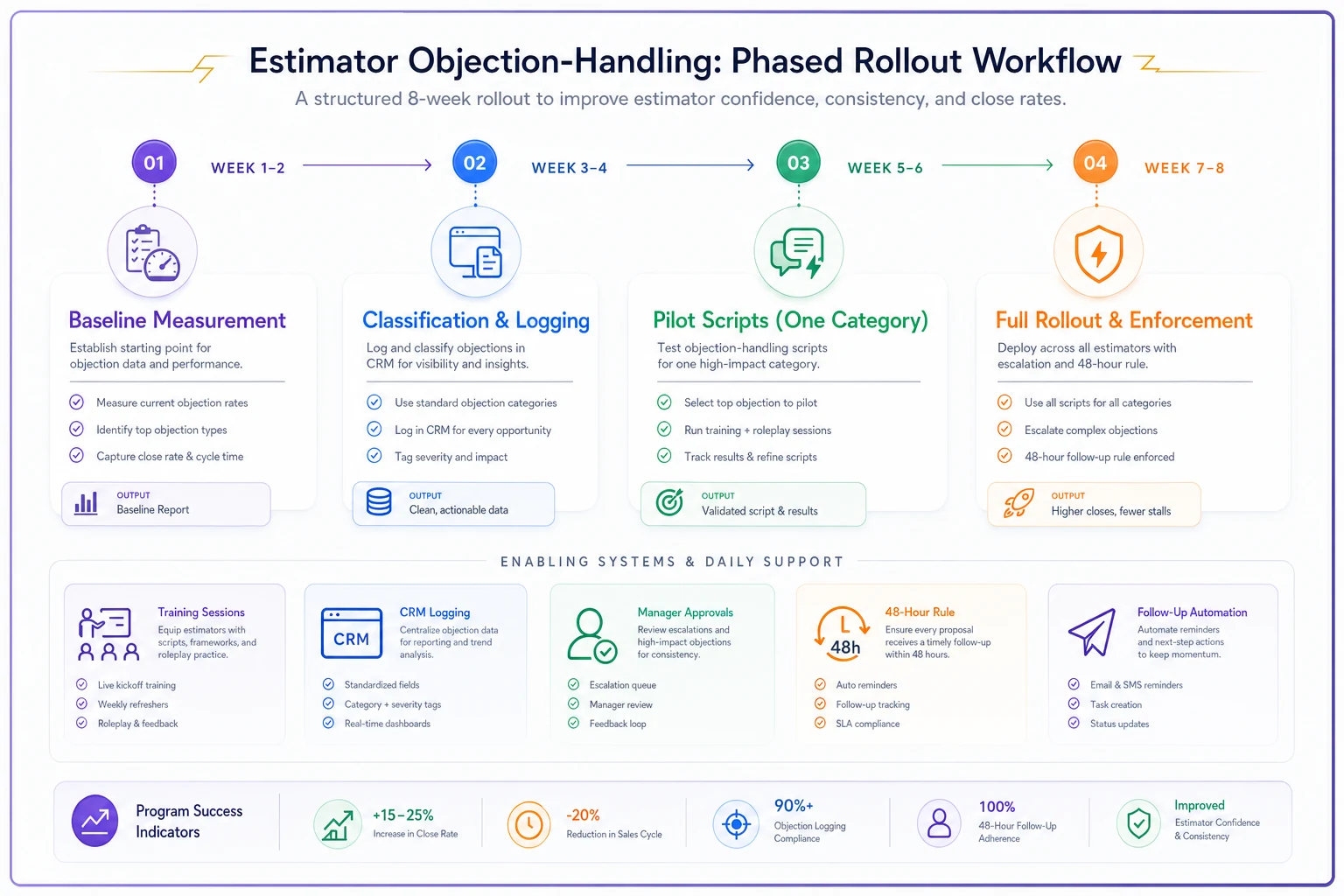
A phased rollout and short weekly feedback loops make adoption gradual instead of disruptive.
When to walk away
Not every objection should be overcome. Experienced contractors know when a customer is going to be a problem regardless of price. The systematic approach actually makes these situations easier to identify because you go through the same process every time and certain patterns become obvious.
Red flags worth walking away from:
-
Customer is comparing your quote to unlicensed work doing unpermitted jobs
-
Unrealistic timeline expectations that persist even after education
-
Pushback on code requirements or safety recommendations
-
Previous contractors have placed liens or pursued legal action
-
Demands discounts specifically on necessary safety work
The script for code-related pushback is firm: "I understand the added cost is frustrating. We're legally required to bring any work we touch up to current code. I can't in good conscience or legal standing do this work without including those updates. If another contractor is offering to skip those requirements, I'd strongly encourage you to verify their license and insurance status."
That ends the conversation professionally with customers who would have become problems later.
Where software fits into this
The manual version of this system—printed scripts, paper tracking, manager phone calls for approvals—works, but it requires constant discipline to maintain. This is where AI-powered operational software helps electrical contractors maintain consistency without the administrative burden.
Modern platforms can embed scripts directly into the quoting interface. When an estimator logs an objection, the appropriate script appears on their tablet. They can read it verbatim or paraphrase while hitting the key points. The system enforces escalation rules automatically—preventing discounts beyond authorized levels without manager approval actually going through.
The software also catches patterns humans miss. It identifies which estimators consistently face certain objections, which can flag either training needs or assignment adjustments. It spots customers who request multiple quotes and push back every time. Some platforms can analyze which script variations produce better close rates, enabling refinement based on real data rather than gut feel.
Follow-up automation is probably the biggest practical win. Instead of relying on estimators to remember the 48-hour callback, the system queues it automatically with appropriate scripting based on customer behavior. If the customer opened the emailed quote three times, the follow-up script acknowledges their review. If they never opened it, the script takes a different approach.
This doesn't replace human judgment—it supports it. Estimators still read the room and adjust their tone. They operate within a framework that protects margins and keeps the process consistent.
Why this matters more now
Customers get multiple quotes as standard practice. They research prices online. They post quote comparisons in neighborhood Facebook groups. The days of winning jobs just by showing up on time are gone.
In this environment, how you handle price objections directly determines profitability. Companies that immediately cave on price train customers to always push back. Those with no flexibility lose jobs to competitors who show even minimal accommodation. The sweet spot requires operational structure—which is exactly what scripts and escalation rules provide.
When you're the only company in your market with systematic objection handling, you win jobs competitors walk away from and maintain margins they sacrifice. Your estimators feel more confident instead of stressed at every quote. That kind of operational advantage compounds over time in ways that show up clearly in your annual numbers.
Discipline beats talent
Every electrical contractor faces price objections. The difference between profitable growth and margin erosion isn't having better estimators—it's giving those estimators better systems to execute within.
The objection matrix removes guesswork. Scripts create consistent responses. Escalation thresholds protect margins while enabling flexibility. The 48-hour rule preserves both close rate and profitability. Together, these elements turn price objection handling from a persistent weakness into a real operational strength.
Start with basic classification, add simple scripts, establish clear escalation rules, track outcomes, and refine based on what actually happens in your market. You don't need complex software or expensive training to get started—a printed one-page reference and a simple spreadsheet gets you most of the way there.
The contractors who win long-term aren't the ones with the smoothest talkers or the lowest prices. They're the ones with operational discipline around every customer interaction—especially the moment when someone says "that seems expensive."
Your estimators face that moment every day. Give them the scripts and structure to handle it profitably.
Ready to optimize your electrical service operations?
Join 500+ electrical service companies using Voltzly to improve scheduling accuracy, enhance client satisfaction, and boost operational efficiency.