

The worst substitution decisions don't happen because a tech is careless. They happen because the breaker isn't on the shelf, the customer is standing right there, the supply house closed twenty minutes ago, and nobody ever told the tech what they're allowed to swap in. So they improvise. Sometimes they nail it. Sometimes they install a load center from a brand that voids the panel's interconnect listing, and now you've got a failed inspection and a very awkward callback.
A part substitution policy for electricians isn't about banning substitutions. Substitutions are going to happen whether you sanction them or not. The question is whether your techs are working from a pre-approved list with clear guardrails, or whether every swap is a one-off judgment call you only find out about when something goes wrong.
This post is narrow on purpose. It's about emergency and field substitutions specifically: what's approved, how you get customer consent, how you handle the pricing difference, and what you physically stock so the "approved alternate" is actually sitting in the van when the moment comes.
The actual failure: a substitution that never should have been a judgment call
Here's the pattern that burns shops. A tech is mid-job on a service call — say a 20A GFCI breaker replacement in a Square D QO panel. The van stock is out of that specific breaker. Supply house is 35 minutes each way, and it's 3:40pm. The customer wants it done today.
The tech has three bad options and no policy to lean on:
-
Drive for the part, blow the time window, maybe lose the next job on the route.
-
Install a non-listed or cross-brand breaker that physically fits but isn't on the panel's approved classified list.
-
Leave the circuit dead and reschedule, which the customer hates.
What you see across a lot of shops is that techs default to option 2 under pressure, because it keeps the customer happy today. The problem surfaces weeks later: an inspector flags the classified breaker, or a warranty claim gets denied because the panel manufacturer's listing was violated. Now the "quick fix" costs you a return trip, a re-permit in some jurisdictions, and a customer who thinks you did sloppy work.
The root cause isn't the breaker. It's that nobody decided — in advance, in writing — which substitutions are blessed and which are off-limits. The tech was forced to be an engineer, a compliance officer, and a salesperson all at once, standing in someone's garage.
Build the decision matrix first (everything else hangs off it)
Before you write consent scripts or stock a kit, you need the core artifact: a decision matrix that tells a tech, in seconds, whether a substitution is allowed and what to do next. Keep it to three tiers so it's actually usable in the field.
Never miss a job or delay a dispatch again.
Voltzly helps you schedule, assign, and track every electrical job efficiently.
- Unified job scheduling
- Real-time technician tracking
- Automated client notifications
No credit card required
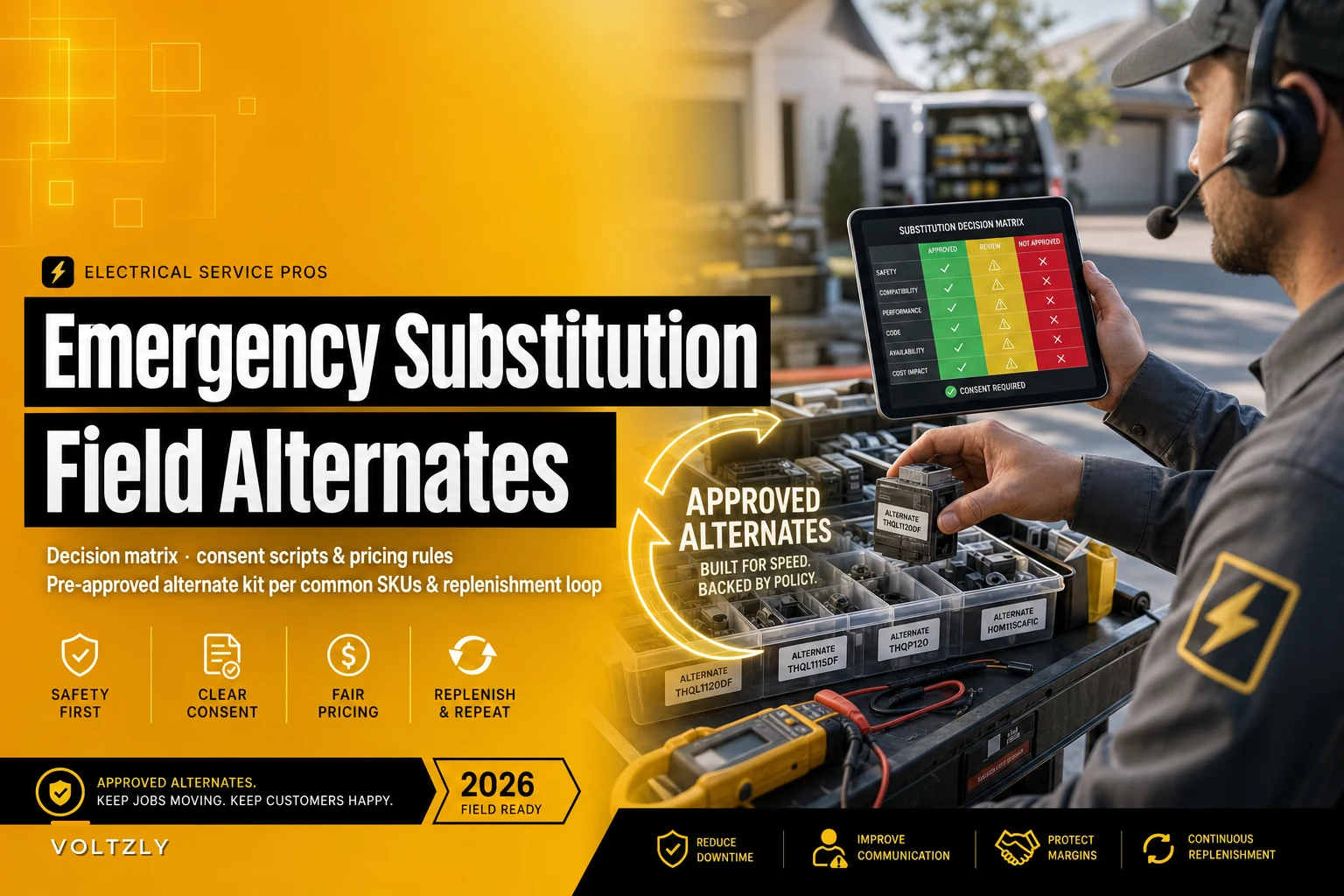
| Tier | What it covers | Who decides | Action |
|---|---|---|---|
| Green — Pre-approved | Direct equivalents already vetted (same listing, same ratings, approved cross-brand classified breakers, equivalent wire gauge/insulation ratings, UL-listed interchangeable devices) | Tech, on the spot | Install, log the swap, notify customer verbally |
| Yellow — Conditional | Functionally equivalent but higher cost, different brand on visible equipment, aesthetic changes (device color/style), or anything affecting warranty terms | Tech + customer consent | Get written/text consent, apply pricing rule, log |
| Red — Never substitute in the field | AFCI/GFCI type changes not on the classified list, panel brand swaps, anything altering the system's listing, load calcs, or AHJ-specified equipment | Office/owner call only | Stop. Call office. Reschedule or source the exact part |
The value is in how you populate the Green tier. That's the real work. A generic "use your judgment" policy is useless. You want named SKUs: "If the customer needs a 20A single-pole QO breaker and it's out of stock, the approved Green alternate is [specific classified equivalent], confirmed listed for QO loadcenters." The more specific the Green list, the fewer judgment calls land in Yellow or Red.
A good rule of thumb: if you find yourself constantly debating whether something belongs in Green or Yellow, it belongs in Yellow until proven otherwise. The cost of a wrongly-greenlit substitution is a callback; the cost of a wrongly-yellowed one is a thirty-second text message.
Customer consent: the language that protects you without scaring the customer
Yellow-tier substitutions require consent, and the way you ask matters enormously. Most shops either skip consent entirely (risk) or explain it so clumsily that the customer gets nervous and says no to a perfectly reasonable alternate.
> "The exact [brand/part] you'd normally get isn't in stock today, and getting it would mean coming back [day]. I've got an equivalent that's fully rated for your panel and carries the same [warranty/listing] — the only difference is [brand/color/etc.]. Cost stays the same / goes up by $[X]. Want me to go ahead with it today, or would you rather I schedule the exact part?"
Three things make this work:
-
It offers a real choice. You're not sneaking the swap in. That choice is what protects you.
-
It names the only actual difference. Customers panic when they sense vagueness. "Same ratings, same warranty, different brand" is reassuring.
-
It states cost before they say yes. Never let a pricing surprise land on the invoice after a verbal "sure, go ahead."
And then — this is the part shops skip — you capture the yes. A text confirmation ("Approved the equivalent breaker, thanks") or a signature line on the work order. A verbal yes in an empty garage is worth nothing when a dispute shows up.
Pricing handling: the three rules that stop margin leaks and refund fights
Substitutions quietly wreck margins because the alternate often costs more than the original, but the tech quoted the original price and doesn't want to reopen the money conversation. So the shop eats the difference. Do that across a few hundred service calls a year and it adds up to real money.
-
Equal-or-cheaper substitutions → price holds. If your Green alternate costs you the same or less, the customer pays the original quoted price. Don't pass savings along as a discount — it trains customers to expect it, and it's a rounding error anyway.
-
More expensive, under a threshold → absorb it, don't renegotiate. Set a dollar threshold — say anything under $15–$20 of extra cost. Below that, the tech installs and the shop absorbs the difference. Reopening the pricing conversation over $8 costs more in trust and time than the $8 is worth.
-
More expensive, over the threshold → consent + line-item adjustment. Above the threshold, the tech uses the consent script, states the new price, and the adjustment goes on the invoice as a visible line. No silent markups. Customers forgive price changes they agreed to; they do not forgive surprises.
A realistic example of why this matters: a shop running roughly 250–300 service calls a quarter found that substitutions were happening on maybe 1 in 8 jobs, and techs were absorbing cost differences averaging around $11 each because there was no threshold rule and nobody wanted the awkward conversation. That's somewhere in the range of $350–$450 a quarter walking out the door on swaps that could have been priced correctly — not catastrophic, but it's pure margin, and it was invisible until someone actually looked at the job-cost variance.
Tying substitution pricing back to your broader buying strategy helps here too. If your supplier and procurement playbook already tracks true landed cost per SKU, your thresholds can be based on real numbers instead of guesses.
The pre-approved alternate kit: make the Green tier physically real
The insight most shops miss: a decision matrix is worthless if the approved alternate isn't in the van. If your Green list says "use the equivalent breaker" but the equivalent is also out of stock, you've just moved the problem, not solved it.
A practical starter alternate kit for a residential service van usually covers:
-
Common breakers — primary brand plus the approved classified equivalent for your two or three most-serviced panel brands
-
GFCI/AFCI devices — one backup of the specific approved alternate (never a type change, only an approved equivalent)
-
Standard devices (receptacles, switches) — a second brand in the common colors, pre-vetted for equivalence
-
Wire connectors and pigtails — alternates are cheap and low-risk; overstock these
-
Weatherproof covers / box extenders — the parts that are "close enough" in a dozen variations; standardize to one approved alternate
Keep the kit small and deliberate. The point isn't to carry two of everything — that bloats your van and ties up cash. The point is to carry a second option for the fifteen or twenty SKUs that actually trigger substitution decisions in the field. If you've already built out structured van-stock logic, this layers on top cleanly; the same thinking behind van-stock lists and replenishment triggers applies — you're just adding a "primary + approved alternate" pairing to your highest-churn parts.
The field workflow, start to finish
Put together, here's how a substitution should actually flow on a job, with no improvisation required:
-
Tech hits a stockout on the needed part mid-job.
-
Tech checks the matrix (laminated card, phone, whatever's fastest). Is there a Green alternate?
-
Green available in the van → install, log the swap against the job, give the customer a quick verbal heads-up. Done.
-
No Green, but a Yellow option exists → run the consent script, state pricing per the three rules, capture the yes in writing, install, log.
-
Red, or no acceptable alternate → stop. Call the office. The office either sources the exact part fast or reschedules. Tech does not make a Red-tier call solo.
-
Every swap gets logged — original SKU, substitute SKU, reason, consent captured (if Yellow), price impact.
Quick visual of the flow:
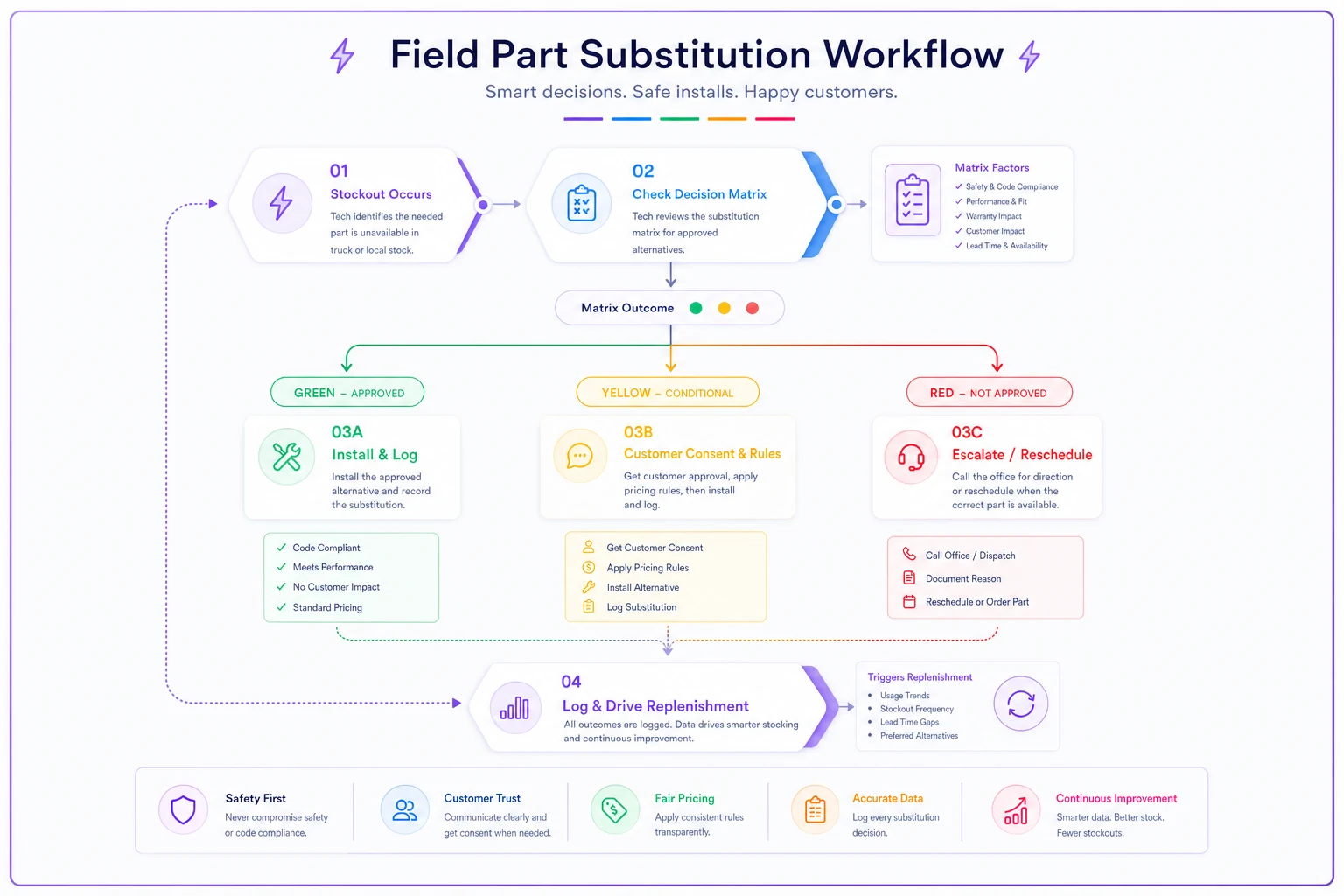
That last step is what turns this from a policy into a system.
When every substitution is logged against the job, you can actually see which SKUs keep triggering swaps. If the same breaker is out of stock on 1 in 6 jobs, that's not a substitution problem — that's a replenishment problem, and the fix is to stock more of the primary, not to keep leaning on the alternate.
When this makes sense — and when it doesn't
Worth building if you run multiple trucks, your techs are handling service calls without an owner on site, and you're seeing callbacks or inspection flags that trace back to field swaps. The more decisions happen out of your sight, the more a written matrix pays off.
Overkill if you're a solo operator or two-person shop where the owner makes every parts call anyway. You already carry the decision matrix in your head. Formalizing it only matters once you're delegating the judgment to people who weren't in the room when you learned the hard lessons.
Who should absolutely not wing it: anyone doing panel work, service upgrades, or anything touching a system's listing. Red-tier items are red for a reason. A classified-breaker mistake isn't a style preference — it's a liability and insurance problem, and no field pressure justifies a solo call on it.
A quick real-world picture
A four-truck residential shop kept getting bitten by two things: occasional failed inspections from cross-brand breaker installs, and quiet margin loss from techs absorbing cost differences on swaps. Neither one was being tracked directly — it just showed up as "a few callbacks a quarter" and a job-cost variance nobody could explain.
They built a one-page matrix with around 18 Green SKUs, added approved alternates to van stock for their three most-common panel brands, wrote a consent script onto the back of the work order, and set a $15 absorb-threshold. Nothing complicated. It fit on two pages total.
Over the next couple of quarters, substitution-related callbacks dropped to nearly nothing. The Red-tier swaps that caused inspection flags stopped happening because techs had a clear "stop and call" rule instead of a gut call. The margin leak closed up too — anything over the threshold went on the invoice with consent instead of getting eaten. Techs stopped having to improvise under pressure, and the owner stopped finding out about bad swaps after the fact.
The real takeaway
Substitutions aren't the problem. Undecided substitutions are. Every swap a tech makes in the field is a decision you either made in advance or outsourced to someone standing in a customer's garage at the end of a long day. Build the matrix, stock the alternates, script the consent, set your pricing rules — and the whole thing stops being a gamble and starts being a routine. Techs get faster, inspections get cleaner, and the margin you were quietly bleeding on swaps stays where it belongs.
Ready to optimize your electrical service operations?
Join 500+ electrical service companies using Voltzly to improve scheduling accuracy, enhance client satisfaction, and boost operational efficiency.