


Your procurement operation probably runs on spreadsheets, sticky notes, and whoever remembers to check inventory before the supply house closes. That works fine when you're running three crews and buying from two suppliers. But somewhere around six techs and $1.2M in revenue, the cracks start showing.
Materials eat 35–45% of every job's revenue. Yet most electrical contractors treat purchasing like an afterthought—something that happens between jobs rather than something worth actively managing. The difference between shops running 18% net margins and those stuck at 8% often comes down to procurement discipline, not job volume.
Why electrical shops leave money with suppliers (and never know it)
Walk into any electrical shop's office around month-end and you'll find stacks of supplier invoices, credit memos scattered across desks, and someone trying to reconcile what actually got delivered versus what got billed. The owner's usually muttering about another price increase while the office manager hunts for a missing $800 credit from a panel return three weeks ago.
It compounds every week. Your lead tech grabs materials from three different suppliers for one commercial retrofit because nobody tracked that Supplier A stocks 12-2 Romex at $0.84/ft while Supplier B charges $0.91/ft for the exact same roll. Meanwhile, your newest journeyman just bought a case of outlets at retail pricing because he didn't know about the contractor account at the secondary supplier.
-
Payment terms (net 30 vs 2/10 net 30)
-
Volume brackets that trigger discounts
-
Return policies and restocking fees
-
Delivery minimums and zones
-
Credit application requirements
Without a procurement playbook, you end up with buying chaos. Same breaker costs $47 from one vendor and $52 from another. One supplier offers free delivery over $500 while another charges $35 flat. Returns pile up because nobody knows Supplier C won't take back special-order items after 15 days.
The four pillars of procurement that actually move margins
Shops that control material costs focus on four specific areas that everyone else ignores until crisis hits.
Never miss a job or delay a dispatch again.
Voltzly helps you schedule, assign, and track every electrical job efficiently.
- Unified job scheduling
- Real-time technician tracking
- Automated client notifications
No credit card required
SKU rationalization: Stop buying 14 versions of the same thing
Most electrical contractors don't realize they're stocking seven different brands of 20-amp breakers across their vans and warehouse. Each tech has preferences. Some swear by Square D, others grab whatever's cheapest that day. The result is you're buying in quantities too small to hit volume discounts, carrying excess inventory, and creating confusion on job sites.
-
4 different 15-amp outlet brands
-
3 types of 12-gauge wire (all functionally identical)
-
6 varieties of wire nuts in the same size range
-
2 brands of panels that weren't interchangeable
They standardized on specific SKUs for roughly 80% of their regular materials. Buying power immediately concentrated. Instead of ordering 20 outlets from five suppliers, they ordered 100 from one and triggered the volume discount. Material costs dropped around 11% just from consolidation.
The rationalization process:
-
Catalog what you actually buy - Pull six months of purchase data
-
Identify redundancy - Flag functionally identical items
-
Pick winners based on
- Total cost including delivery - Availability and lead times - Return policy flexibility - Tech familiarity and preference
-
Set override rules - When substitution makes sense
-
Communicate standards - Every tech needs the approved list
Vendor scorecards: Know who's actually helping your business
You probably have that one supplier who always comes through on emergency orders but charges 15% above market. And another who offers great pricing but takes four days to deliver and won't accept returns without a fight. Without tracking performance, you're making purchasing decisions based on whoever answered the phone yesterday.
Vendor scorecards turn gut feelings into data. Track five metrics monthly:
| Metric | What to Measure | Red Flag Threshold |
|---|---|---|
| Pricing Accuracy | Quoted vs invoiced price variance | >3% variance |
| Delivery Performance | On-time, complete orders | <85% success rate |
| Credit Processing | Days to process returns/credits | >10 business days |
| Emergency Response | Same-day fulfillment rate | <70% when needed |
| Pricing Competitiveness | Benchmark against market | >8% above average |
One residential shop started scoring their seven main suppliers quarterly. They found their primary vendor had slipped to 78% delivery accuracy while a secondary supplier was hitting 94% consistently. They shifted 40% of purchases to the reliable vendor and used that leverage to renegotiate terms with the primary.
Reorder governance: Stop the 4pm panic runs to the supply house
The typical reorder process in small electrical shops goes like this: tech realizes they're out of something mid-job, calls the office, someone drops everything to run to the supplier before close. Or worse, the tech makes the run themselves, burning an hour of billable time plus any markup opportunity.
Reorder governance means establishing clear rules about when, what, and how to order. Not everything needs same-day fulfillment. Set up three reorder tracks:
Track 1: Van Stock Essentials (Order weekly)
-
Basic consumables under $20/unit
-
Items used on 60%+ of jobs
-
Trigger reorder at 40% remaining
-
Standard delivery timeline
Track 2: Warehouse Stock (Order bi-weekly)
-
Panels, breakers, common fixtures
-
Items used on 20–60% of jobs
-
Trigger at 2-week supply remaining
-
Planned delivery windows
Track 3: Job-Specific (Order as needed)
-
Special fixtures, commercial components
-
Custom or rarely-used items
-
Order after deposit received
-
Match to job timeline
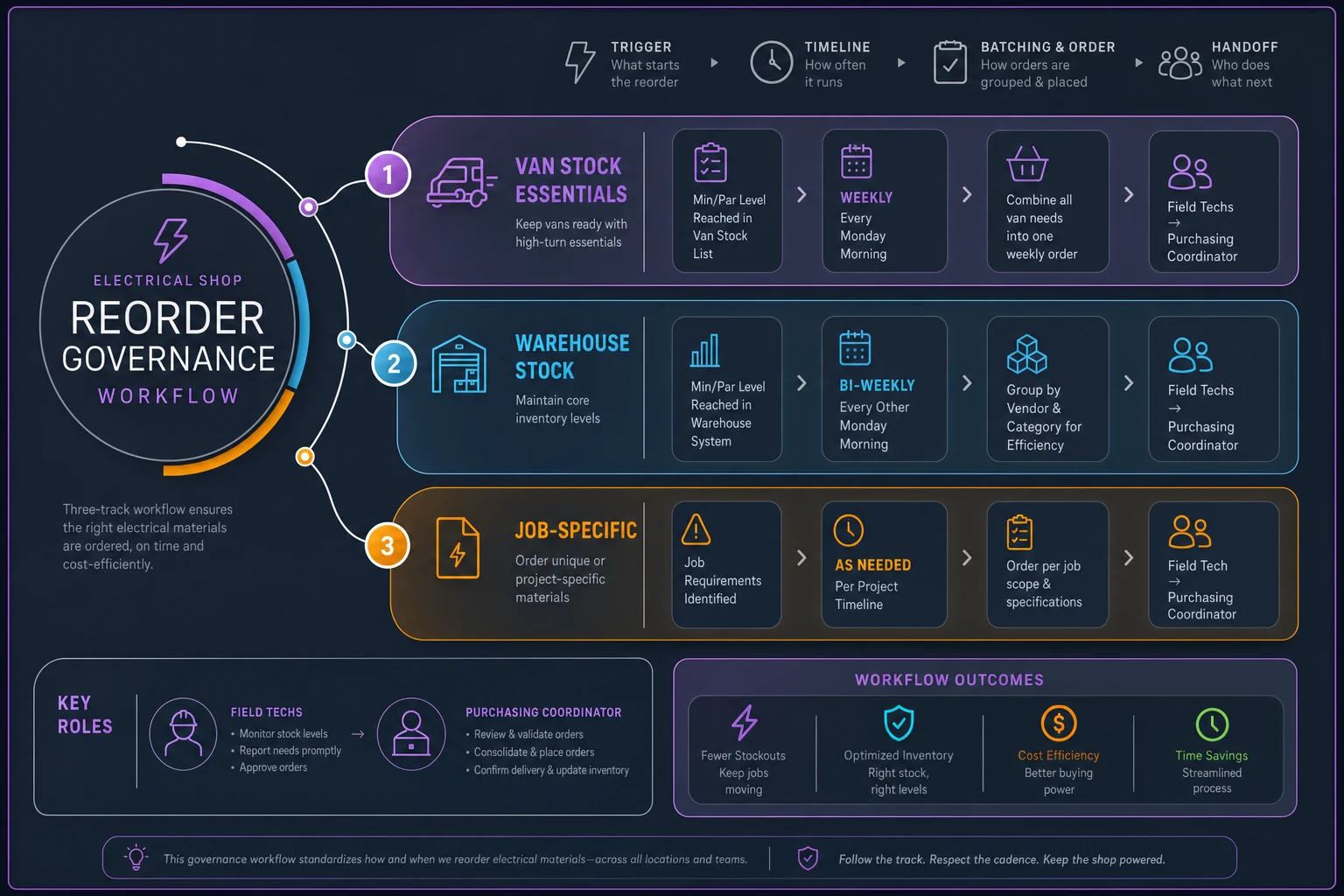
Here's a quick visual of the three-track reorder workflow.
Setting up proper van stock management prevents most emergency orders. When your trucks carry the right baseline inventory, panic purchases drop significantly.
Month-end credit reconciliation: Find the missing money
What happens in most shops: returns pile up, credits get promised but never appear, and nobody reconciles until the accountant asks why material costs jumped 20% last quarter. By then, you've lost thousands in unclaimed credits.
Week 1 of month: Pull all delivery receipts and return paperwork Week 2: Match credits received against returns submitted Week 3: Chase missing credits with proof of return Week 4: Dispute any incorrect charges before payment
One shop found $3,400 in missing credits over three months just by doing monthly reconciliation. Their office manager now blocks the last Friday afternoon each month for supplier account cleanup. Takes about two hours, recovers an average of $900 monthly.
The return logistics process needs tight documentation or credits vanish. Photo evidence of returns, tracking numbers, and confirmation emails become your proof when suppliers claim they never received items.
Building your procurement playbook (that people will actually follow)
A procurement playbook only works if your team uses it. That means keeping it simple enough for field crews to follow while detailed enough to capture real savings. Start with these components:
The approved vendor list
Document your primary and backup suppliers for each category:
-
General electrical supplies (2–3 vendors max)
-
Lighting and fixtures (1–2 vendors)
-
Low voltage and data (1–2 vendors)
-
Specialty items like generators (1 vendor)
-
Emergency/after-hours supplier
Include account numbers, key contacts, ordering methods, and payment terms. When someone new joins the team, they know exactly where to buy and how to access contractor pricing without asking around.
Pricing checkpoints
Create simple rules about when to price-check:
-
Any single item over $200
-
Total orders exceeding $1,500
-
Items not purchased in the last 30 days
-
Anything bought less than monthly
You're not checking every box of wire nuts. But that $400 meter base deserves a quick comparison before ordering.
Return windows and procedures
Different suppliers have wildly different return policies. Document the specifics:
-
Standard return window (15 days? 30 days?)
-
Restocking fees by category
-
Required documentation (receipt, packaging, etc.)
-
Special order return policy
-
Defective item process
Post this somewhere visible. When techs know Supplier A won't take returns after 15 days, they'll prioritize those returns first.
Escalation triggers
Define when purchasing decisions need approval:
-
Orders over $2,000 need ops manager signoff
-
New vendor setup requires owner approval
-
Deviations from approved SKU list need justification
-
Special payment terms need finance review
This prevents someone from accidentally committing to a $10,000 minimum order or 90-day payment terms that wreck cashflow.
What breaks when you grow beyond 10 techs
The procurement system that worked for a five-person shop falls apart around ten techs. Suddenly you're managing:
-
8–12 vans with individual stock needs
-
3–4 people with purchasing authority
-
Multiple jobs running simultaneously
-
$40,000–60,000 monthly material spend
-
200+ different SKUs across all categories
The informal "Jim handles all ordering" approach can't scale. Jim's overwhelmed, purchases fragment across suppliers, and nobody knows if you're actually hitting the volume discounts you've earned.
At this scale, you need role separation:
-
Purchasing coordinator - Handles all routine orders
-
Field supervisor - Approves job-specific materials
-
Operations manager - Manages vendor relationships
-
Owner - Reviews monthly procurement metrics
You also need systematic vendor reviews. Every quarter, analyze:
-
Total spend by vendor
-
Average discount captured
-
Credit recovery rate
-
Delivery performance trends
Use this data to renegotiate terms. If you're spending $180,000 annually with a supplier but getting the same pricing as shops spending $50,000, something's wrong.
The compound effect of procurement discipline
Most electrical contractors think procurement optimization might save 2–3% on materials. The real number is closer to 12–15% when you factor in:
-
Volume discount capture (3–4%)
-
Reduced emergency purchases (2–3%)
-
Credit recovery (1–2%)
-
SKU rationalization savings (3–4%)
-
Fewer pricing errors (1–2%)
On $500,000 annual material spend, that's $60,000–75,000 straight to the bottom line. For a shop running 10% net margins, that's the equivalent of landing an extra $600,000 in revenue without adding a single tech.
The operational impact is just as significant. When materials arrive on time, jobs don't stall. When everyone orders from the same suppliers, those relationships get stronger. When returns get processed quickly, working capital isn't sitting in limbo waiting on a credit memo.
From spreadsheet chaos to systematic procurement
The gap between procurement chaos and control usually comes down to tooling. Shops running everything through Excel and email hit a ceiling. Important details slip through—that special-order cancellation deadline passes, the volume discount threshold gets missed by $200, or duplicate orders ship because two people didn't communicate.
Modern AI-powered operational platforms designed for trades can automate the painful parts. These systems handle things like:
-
Automatic price comparison across suppliers
-
Reorder point monitoring and alerts
-
Credit reconciliation matching
-
Spend analysis and vendor scorecarding
-
Purchase approval workflows
When the system tracks that you're $300 away from a volume discount, it suggests combining orders. When a credit doesn't appear after 10 days, it flags it for follow-up. That kind of automated tracking isn't magic—it's just removing the manual work that was previously falling through the cracks. Your team spends less time chasing spreadsheets and more time on the vendor relationships and negotiations that actually require human judgment.
Implementation roadmap for the next 30 days
Week 1: Document current state
-
List all suppliers and current terms
-
Pull 3 months of purchasing data
-
Identify top 50 SKUs by volume
Week 2: Build the foundation
-
Create approved vendor list
-
Develop SKU rationalization plan
-
Design simple vendor scorecard
Week 3: Set up processes
-
Implement reorder governance rules
-
Create return tracking system
-
Establish monthly reconciliation schedule
Week 4: Launch and adjust
-
Train team on new procedures
-
Run first vendor scorecard
-
Complete first monthly reconciliation
Start with your highest-volume supplier first.
Get that relationship optimized before expanding to others. Most shops see meaningful savings within 60 days just from credit recovery and consolidated ordering.
The real difference between surviving and scaling
A solid supplier procurement playbook determines whether materials stay a necessary evil or become a competitive advantage. The shops struggling with cashflow despite full schedules usually have procurement chaos running underneath everything. The ones expanding into new markets with healthy margins have procurement discipline built into their operations.
Every percentage point saved on materials drops straight to profit. And beyond the numbers, reliable procurement eliminates the daily fires that burn out your team. When materials show up correctly and on time, when pricing stays consistent, when credits process without a fight—everything else in the business runs better.
Keep running procurement through memory and spreadsheets and you'll keep leaving money with your suppliers every month. Build a systematic approach and those supplier relationships start working for you instead of against you. Most shops that implement even basic procurement discipline see payback within the first quarter. The question isn't whether to build the playbook—it's how long you're willing to wait.
Ready to optimize your electrical service operations?
Join 500+ electrical service companies using Voltzly to improve scheduling accuracy, enhance client satisfaction, and boost operational efficiency.