



Most spare-parts stockout pain in small electrical shops doesn't come from bad buying. It comes from buying as if your supplier is reliable when they clearly aren't. You order a GFCI breaker on a Tuesday, you've always had it by Thursday, so you plan around two days. Then one month it takes nine days, your tech is standing in a panel room with a half-finished job, and the customer is texting about when the power comes back on.
The fix isn't a fancy inventory system. It's a handful of rules that bake supplier unreliability directly into how much you hold. This post is about safety stock for electricians' parts specifically — how to set it when your supplier's lead times jump around, which SKUs actually deserve the buffer, and a spreadsheet layout simple enough that you'll keep it updated past month one.
The real problem: you're sizing stock to the average, not the bad days
Here's the pattern that burns most shops. Someone looks at their supplier history, sees that breakers usually show up in 2-3 days, and sets a reorder point that assumes 3 days of cover. On paper that's fine. In reality, lead time isn't one number — it's a range, and the range is wide for anyone buying from distributors who are themselves waiting on manufacturers.
A typical example: a panel SKU with a "3-day lead time" that actually came in at 2, 2, 3, 4, 2, 8, 3, and 11 days over the last eight orders. The average is just under 5 days. But two of those orders took more than a week. If you stocked to the average, you ran dry twice. Averages lie to you precisely when it hurts most — on the long-tail days when the distributor is backordered.
What shows up across a lot of small inventories is that owners know their supplier is flaky but never translate that gut feeling into a number. The flakiness stays a complaint instead of becoming a buffer. Safety stock is just the formal version of "I don't trust this vendor, so I hold extra."
Rule of thumb #1: size safety stock off your worst realistic lead time, not your average
Skip the standard-deviation formula for now. In a shop with 150 SKUs and messy records, textbook safety-stock math gives false precision and nobody maintains it. A simpler, more honest approach works better.
Never miss a job or delay a dispatch again.
Voltzly helps you schedule, assign, and track every electrical job efficiently.
- Unified job scheduling
- Real-time technician tracking
- Automated client notifications
No credit card required
-
Typical lead time — what it usually is on a normal week
-
Bad-day lead time — the longest it's realistically taken recently (ignore the one freak 40-day backorder, but don't ignore the 11-day one that happened twice)
Your safety stock covers the gap between those two. If a part normally takes 3 days but has hit 9, your buffer needs to cover roughly 6 extra days of usage. Multiply your daily usage rate by that gap, round up, and that's your buffer.
The insight most people miss: safety stock isn't about total demand, it's about covering the difference between normal and bad. A part that always takes exactly 10 days — predictably — needs almost no safety stock. A part that swings between 2 and 9 needs a fat buffer even though its average is lower. Variability drives safety stock, not lead time itself.
Rule of thumb #2: use lead-time multipliers tied to supplier reliability
You don't want to calculate a custom buffer for every SKU. So bucket your suppliers by how reliable they actually are, and apply a multiplier to your normal reorder quantity. This keeps the whole thing field-friendly.
| Supplier reliability | What it looks like | Lead-time multiplier | Safety-stock approach |
|---|---|---|---|
| Solid | Hits the window almost every time; backorders rare | 1.25× | Thin buffer — a few days of usage |
| Shaky | Usually fine, but a few bad delays a quarter | 1.5× | Cover the gap to the worst recent delay |
| Unreliable | Frequent backorders, vague ETAs, partial shipments | 2× or dual-source | Heavy buffer + a backup vendor on standby |
The multiplier applies to your lead-time cover. So if a shaky supplier's part normally needs 3 days of stock on hand before reordering, you hold 4.5 days' worth (3 × 1.5). For an unreliable one, you're holding 6 days' worth and seriously thinking about a second source or an approved alternate.
One pattern worth calling out: shops tend to rate reliability based on how much they like the salesperson, not the actual delivery data. The friendly rep whose company always backorders is still an unreliable supplier. Rate the deliveries, not the relationship.
Rule of thumb #3: not every part gets a buffer — build a critical-SKU list first
If you try to apply safety stock across your whole parts list, you'll tie up cash on things that don't matter and still run out of the ones that do. The money and the discipline both go to the critical SKUs.
A part earns a spot on the critical list when a stockout would stop a job, trigger a callback, or burn an emergency run to the counter. That's the filter. A specialty lug you use twice a year doesn't make the cut even if it's annoying to source. A common 20A GFCI breaker you install weekly absolutely does.
-
How often do you use it? (3 = weekly, 2 = monthly, 1 = rarely)
-
How bad is a stockout? (3 = job stops cold, 2 = reschedule, 1 = minor annoyance)
-
How flaky is the supplier? (3 = unreliable, 2 = shaky, 1 = solid)
Add the three. Anything scoring 7–9 is a critical SKU that gets real safety stock and tight monitoring. 4–6 gets a light buffer. 3 or under you buy as needed and don't lose sleep over.
Most small shops find their critical list is shorter than they expected — often 20 to 35 SKUs out of a couple hundred. That's good. A short list is one you'll actually maintain, and it's where the pre-staging habits from your van-stock and replenishment-trigger rules do the most good.
A real scenario with numbers
A three-van residential shop was losing roughly two half-days a month to breaker and GFCI stockouts — a tech driving back to the supply house mid-job, or a reschedule when the counter was also out. Four to five lost hours a month, plus the occasional annoyed customer.
Their core problem was a single distributor they'd been rating as "fine" who was actually running 2-to-10-day lead times on common breakers. They'd been reordering at a 3-day cover.
They did three things: reclassified that distributor as shaky (1.5× multiplier), built a critical list that came out to 28 SKUs, and set safety stock on those 28 to cover the gap between normal and worst-recent lead time. For most breakers that meant holding about 6–7 days of usage instead of 3.
The added inventory cost them somewhere around $900–$1,100 in parts sitting on the shelf. In exchange, the mid-job supply runs basically stopped over the next two months. The one reschedule they did have was for a genuinely odd part, not a common breaker. For a shop where a lost half-day of billable work runs a few hundred dollars, the buffer paid for itself inside the first month.
Nothing exotic happened here. They just stopped planning around the good days.
The spreadsheet template — simple enough to actually keep
You don't need software to start. One tab, one row per critical SKU. Columns:
-
SKU / description
-
Daily usage (rough is fine — installs per week ÷ 5)
-
Normal lead time (days)
-
Worst recent lead time (days)
-
Supplier reliability (solid / shaky / unreliable)
-
Multiplier (1.25 / 1.5 / 2)
-
Safety stock = daily usage × (worst − normal), rounded up
-
Reorder point = daily usage × normal lead time × multiplier, plus safety stock
-
On hand (updated at cycle count)
-
Reorder? (yes/no — flags when on hand drops below reorder point)
The whole thing runs off two inputs you have to keep honest: your usage estimate and your delivery history. The second one is where shops quietly fail — they never log actual delivery dates, so "worst recent lead time" is a guess. Jot the delivery date next to the order date every time a box comes in. Even a scribbled note turns into real data within a quarter.
Jot the delivery date next to the order date every time a box comes in.
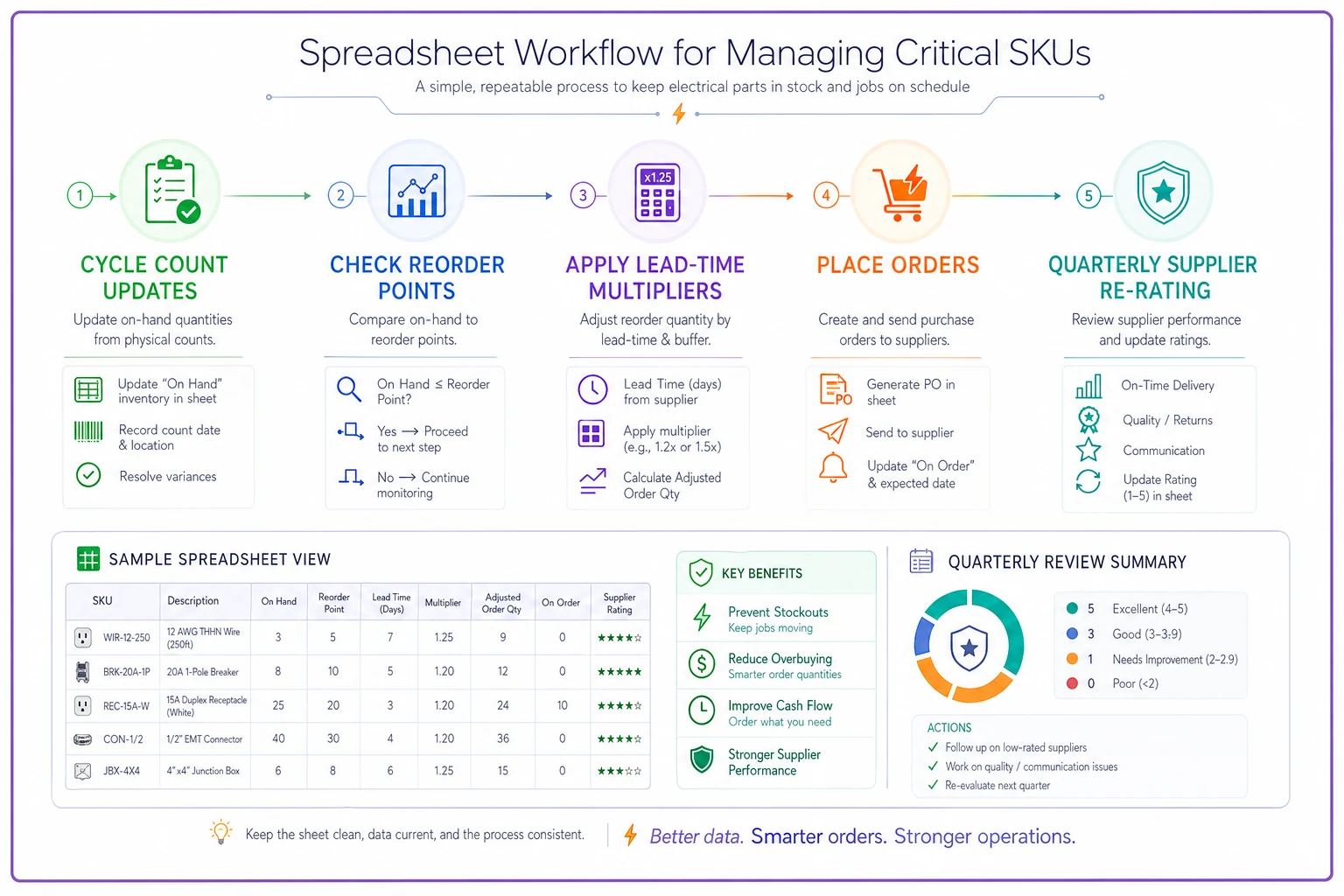
A quick visual of the update → check → order → review loop helps people follow the cadence.
In practice: at your cycle count, update the on-hand column. Any row where on-hand is under the reorder point gets ordered that day. Once a quarter, revisit the lead-time columns and re-rate your suppliers — a distributor that's gotten worse should move from shaky to unreliable, which bumps the multiplier and the buffer automatically. That quarterly review is also the natural moment to catch parts that should be returned or swapped, which ties into a clean reverse-logistics and RMA process so dead stock doesn't just pile up.
When this makes sense — and when it doesn't
When it's worth it: You've got a handful of suppliers with genuinely unpredictable lead times, your stockouts are costing billable hours, and your critical parts are common enough that holding a buffer doesn't tie up serious cash. This is the sweet spot for most residential and small commercial shops.
When it's a bad idea: For slow-moving specialty parts, safety stock is just cash on a shelf collecting dust. Don't buffer a part you use three times a year — manage those with lead-time awareness and an approved alternate instead. Buffering everything is how shops end up with $8k of inventory and still no breaker when they need one.
Who should skip the formal version entirely: If you've got a truly reliable primary distributor and your lead times genuinely don't swing, you don't need multipliers. A simple min/max on your top 15 parts will do. Adding reliability tiers to a supplier who never fails is effort with no payoff.
The habit that makes it stick
The math here is deliberately rough because precise math you abandon is worse than rough math you maintain. The shops that beat supplier unreliability aren't the ones with the fanciest formulas — they're the ones who actually write down when the box showed up, re-rate their suppliers every quarter, and keep their critical list short enough to glance at.
Supplier unreliability isn't something you fix by complaining to the rep. You fix it by holding a buffer that matches how badly they let you down on their worst days — no more on the parts that don't matter, no less on the ones that stop a job.
Get those two things right and the mid-job supply runs mostly disappear.
Ready to optimize your electrical service operations?
Join 500+ electrical service companies using Voltzly to improve scheduling accuracy, enhance client satisfaction, and boost operational efficiency.