
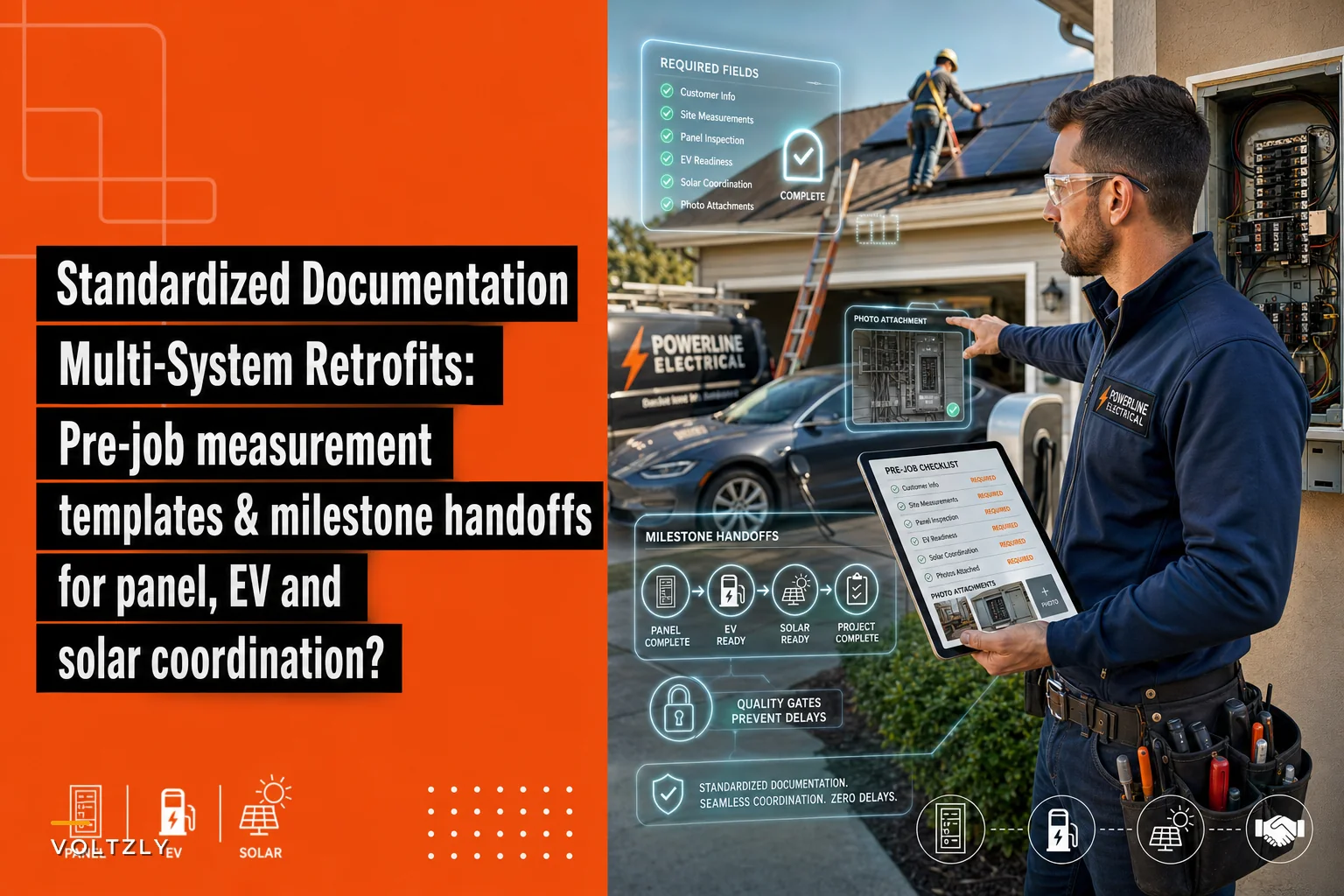

The panel upgrade finishes on a Tuesday. The solar crew shows up Thursday expecting a 200A main with two open spaces near the top of the bus. Instead they find a 200A panel with a 175A main breaker, no room for a backfed breaker without a line-side tap, and a meter socket that won't pass the utility's interconnection rules for this jurisdiction.
Now nobody can proceed. The solar foreman calls the office. The office calls the panel tech, who's already three jobs away. The homeowner wants to know why there are two vans in the driveway and nothing is happening. And the EV charger — supposed to land on the same 200A service — is stuck behind a load calculation that never accounted for solar backfeed plus a 48A charger.
This is the specific failure this article is about: retrofit job documentation for electricians breaking down at the seams between disciplines. Not the panel work itself. Not the solar install itself. The handoff — the moment one crew's assumptions meet another crew's reality, and the paperwork that was supposed to connect them was never standardized.
Why cross-discipline handoffs fail more than single-scope jobs
Single-scope work is forgiving. If one electrician does the panel and the same shop handles the EV charger a week later, the tribal knowledge lives in someone's head. They remember the main breaker size. They remember the utility quirks.
Multi-system retrofits break that. You've got a panel crew, possibly a solar subcontractor, sometimes a separate battery or ESS installer, and an EV charger install that touches all three. Each discipline measures different things, cares about different constraints, and documents in its own shorthand.
The pattern that keeps showing up: each crew documents what they did, not what the next crew needs.
The panel tech writes "upgraded to 200A, passed rough." Technically true. But solar needs the main breaker rating, the bus rating, available backfeed capacity under the 120% rule, and physical space for a breaker at the opposite end of the bus. The panel tech knows all of this — it just never made it onto paper in a form the next crew could actually use.
-
Panel → Solar Solar assumes 200A bus with a 200A main. Panel actually installed a 200A bus with a 150A or 175A main to satisfy a load calc. Backfeed math changes completely.
-
Panel → EV EV charger sized at 48A continuous, but the load calculation the panel was built around never included it. Now you're either derating the charger or redoing the calc.
-
Solar → EV Solar consumes the backfeed capacity the EV install was counting on. Whoever documents last wins, and it's usually a surprise.
-
All three → Inspection Three separate permits, three sets of assumptions, one inspector who finds the interconnection point doesn't match any of the three plan sets.
The root cause isn't skill. Every one of these crews is competent. The failure is that there's no shared measurement standard that travels with the job.
The measurement gap: what each discipline actually needs from the others
Before you can build a handoff checklist, you have to know what the receiving crew needs. Most shops build documentation around what the crew finishing the work wants to record. Flip it.
Never miss a job or delay a dispatch again.
Voltzly helps you schedule, assign, and track every electrical job efficiently.
- Unified job scheduling
- Real-time technician tracking
- Automated client notifications
No credit card required
Here's a breakdown of what each discipline must hand off, and who consumes it:
| Data point | Who measures it | Who needs it | What breaks if it's missing |
|---|---|---|---|
| Main breaker rating (not just panel amperage) | Panel crew | Solar, EV | Backfeed calc invalid, charger oversized |
| Bus bar rating | Panel crew | Solar | 120% rule violation caught at inspection |
| Available backfeed position (top/bottom of bus) | Panel crew | Solar | Line-side tap required, added cost/time |
| Existing + planned load calc (with EV included) | Panel crew | EV, Solar | Service undersized, redo required |
| Interconnection point & method | Solar crew | EV, Inspector | Utility rejection, re-inspection |
| Conductor & conduit path already run | Panel crew | EV, Solar | Duplicate trenching or conduit |
| Meter socket type & utility jurisdiction rules | Whoever's first | All | Meter swap delays interconnection |
| Available breaker spaces (physical count + location) | Panel crew | EV, Solar | Sub-panel needed, unplanned material |
Worth calling out specifically: amperage alone is a lie. "It's a 200A service" tells the next crew almost nothing they can build on. Main breaker rating, bus rating, and backfeed position are the numbers that actually govern what solar and EV can do. If your pre-job measurement template only captures service size, you've documented the least useful number.
Pre-job measurement template: what to capture before anyone starts
A cross-discipline retrofit should start with a single measurement pass that serves every trade touching the job. Do this once, at the assessment stage, before the panel crew even mobilizes.
This ties directly into how you scope and price. If you've read our line-item panel upgrade costing breakdown, this is the field-data version of the same discipline — you're capturing the numbers that protect margin, not just the ones that pass inspection.
The pre-job template should force these fields (blank fields should not be able to advance the job):
-
Existing service meter type, main breaker rating, bus rating, panel manufacturer/model, number and location of open spaces.
-
Existing load calc inputs square footage, existing large loads (HVAC, range, dryer, pool), measured demand if available.
-
Planned additions with amperage EV charger continuous rating, solar inverter output, battery/ESS if applicable.
-
Combined load calc result does the existing service survive the additions, or does it trigger a service upgrade?
-
Backfeed availability under the 120% rule, how much room exists at the opposite end of the bus? Photo of the bus with a tape measure or reference object.
-
Interconnection method decision load-side vs. line-side, and why.
-
Conduit/conductor pre-runs anything that can be run once and shared across trades.
-
Utility & jurisdiction notes interconnection paperwork lead time, meter requirements, inspection quirks for this AHJ.
Require a photo of the bus with a tape measure to clearly show backfeed availability and avoid rework.
The EV-specific portion deserves its own rigor. If EV charger scoping is regular work for your shop, the EV site-assessment decision tree covers the load-calc and pricing logic that should feed directly into this shared template rather than living in a separate estimate.
The milestone handoff checklist
Measurement is the input. The handoff checklist is what keeps that input from rotting between crews. Every discipline gets a mandatory sign-off before the next crew is dispatched — not "let dispatch know when you're done," but a structured handoff with required fields.
→ Pre-job to panel-complete (assessment gate):
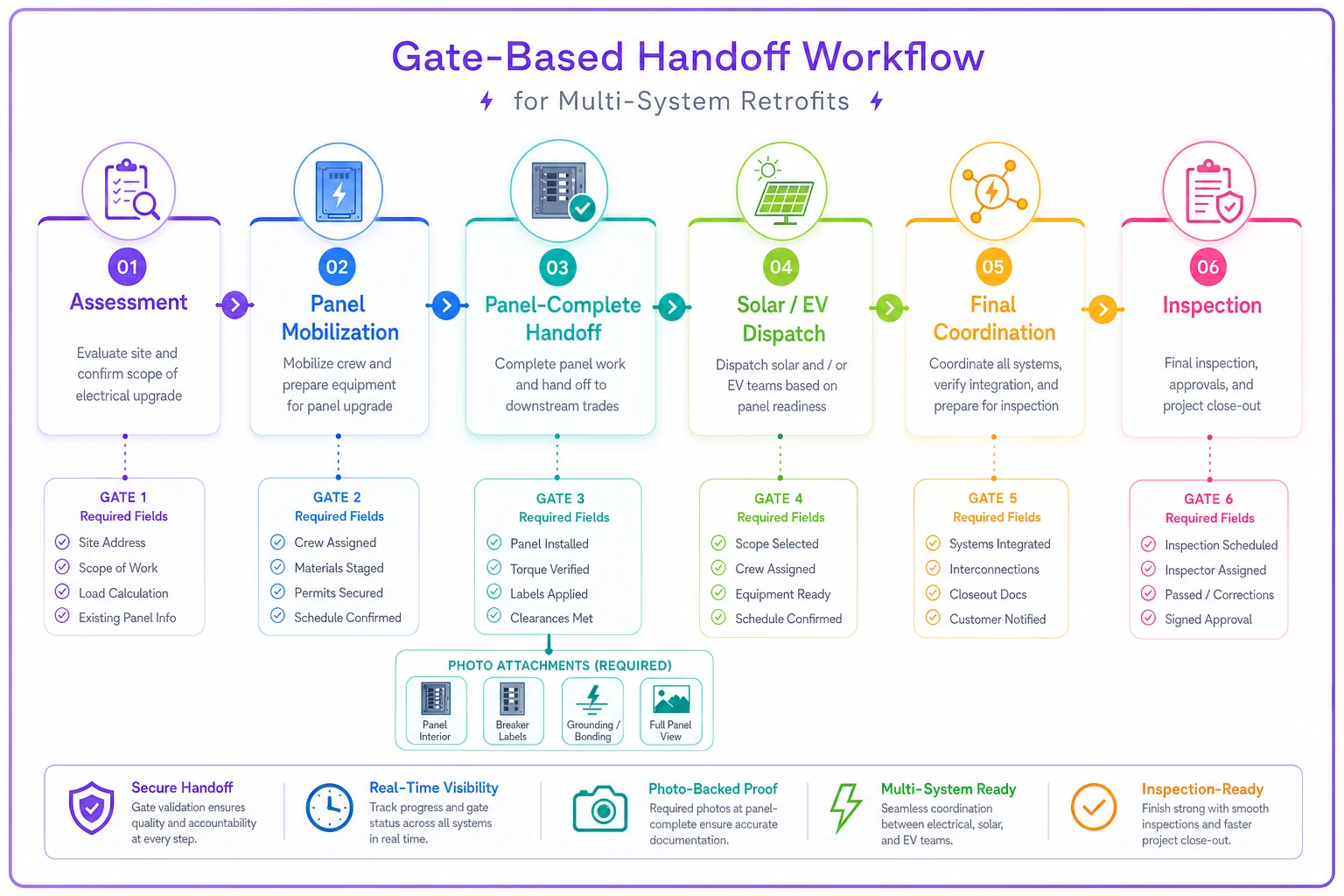
Assessment → Panel mobilization → Panel-complete handoff → Solar/EV dispatch → Final coordination → Inspection
Each arrow is a gate. No gate passes without the required fields from the stage before it.
Here's a visual of the gate workflow.
Panel-complete handoff (before solar or EV is dispatched):
-
Main breaker rating confirmed and recorded (photo of breaker label)
-
Bus rating confirmed against panel legend (photo)
-
Backfeed position available and measured (photo with reference)
-
Combined load calc attached, EV + solar included
-
Open breaker spaces counted and located
-
Rough inspection status (passed / scheduled / N/A)
-
Any deviation from original scope flagged with reason
Solar-complete handoff (before EV final or inspection):
-
Interconnection point and method documented (photo)
-
Backfeed breaker size and remaining bus capacity recorded
-
Production monitoring/CT placement noted (affects EV load management if used)
-
Utility interconnection paperwork submitted date logged
Pre-inspection consolidation (all trades):
-
Single interconnection diagram reflecting panel + solar + EV as-built
-
All three plan sets reconciled against as-built
-
Deviations from permitted plans documented with AHJ notification if required
The mistake shops make is treating the checklist as a formality the last crew fills out at the truck. It has to be a gate. If the panel handoff isn't complete with photos and the load calc, the solar crew doesn't get scheduled. That feels rigid until you've paid for a solar crew to sit in a driveway for two hours waiting on information that should have been captured days earlier.
A realistic scenario: the $6k stall
A residential shop running around 8–10 combined panel/solar/EV jobs a month kept hitting the same wall. Their process was fine on paper — panel first, solar second, EV last. But documentation was freeform. Techs texted photos to a group thread and typed notes into whatever field the software gave them.
On one whole-home electrification job, the panel crew installed a 200A service with a 175A main to satisfy the load calc — without an EV charger factored in. Nobody flagged the 175A main as different from the 200A the solar sub had quoted around. Solar showed up, found the backfeed math didn't work, and had to stop. The interconnection needed a line-side tap that wasn't in anyone's scope or price.
The damage, roughly:
-
Solar crew
about half a day lost, ~$800 in idle labor
-
Line-side tap materials and added labor
around $1,400, unbilled because it wasn't quoted
-
Job pushed roughly 9 days while a revised interconnection got re-permitted
Call it $6k in combined soft and hard costs on a single job, plus a homeowner who left a lukewarm review about "scheduling chaos."
After they moved to a shared pre-job measurement template with mandatory handoff gates, the shift wasn't dramatic-sounding — it was quiet. Backfeed math got checked at assessment instead of on install day. The main breaker rating stopped being a surprise. Over the following quarter, cross-discipline stalls on combined jobs dropped noticeably, and the ones that did still happen were caught at the handoff gate instead of in the driveway.
They didn't get faster crews or better techs. They just stopped losing the numbers between disciplines.
Where software actually helps (and where it doesn't)
The template and the checklist are the real work. You can run this on paper or in a shared doc and it will still beat freeform texting. But two specific pain points are where a workflow platform with AI-assisted automation earns its keep on multi-system retrofits.
Required-field enforcement across handoffs. The gate only works if it's enforced. A platform that won't let dispatch schedule the solar crew until the panel handoff has a main breaker photo, a bus rating, and an attached load calc removes the human tendency to "fill it in later." Automated checks flag an incomplete handoff before the next crew is booked, not after they're already onsite.
Reconciling the three data sets. When panel, solar, and EV each carry their own numbers, someone has to notice when they conflict — like solar consuming the backfeed capacity EV was counting on. Automation that cross-checks the combined load calc against each discipline's recorded values can surface that contradiction at documentation time, not during inspection. It's not doing the engineering; it's catching the conflict a busy dispatcher would miss.
Where software doesn't help: it won't fix a shop that hasn't decided what to measure. If your crews don't agree that main breaker rating and backfeed position are mandatory data points, no platform saves you. The standard comes first. The tool enforces it.
When this level of documentation is overkill
Not every job needs a three-discipline handoff protocol.
-
A standalone panel swap with no planned solar or EV doesn't need backfeed position measured to the inch. Capture it anyway if you suspect future additions, but don't gate the job on it.
-
Single-crew, single-day work where the same electrician does everything doesn't have a handoff to protect. The failure mode this article addresses simply isn't present.
-
Shops doing fewer than a couple of combined jobs a month may find the full checklist heavier than the problem warrants. Start with just the pre-job measurement template and add handoff gates only when you actually feel the stalls.
The full system pays off specifically when you're running combined panel + solar + EV work at volume, often with a solar subcontractor who doesn't share your tribal knowledge. That's the exact situation where a missing number turns into a driveway full of idle crews.
The one thing to change first
If you do nothing else, change what your panel crew records at completion. Stop accepting "upgraded to 200A." Require the main breaker rating, the bus rating, the backfeed position, and a load calc that already includes the EV and solar loads — with photos.
That single change kills the most expensive category of retrofit stall, because almost every cross-discipline failure traces back to the next crew building on a number that was never actually captured. The panel amperage was never the problem. The numbers hiding behind it were.
Get the measurement standard right, gate the handoffs so those numbers can't disappear between crews, and the multi-system retrofit stops being a coordination gamble and starts behaving like three predictable jobs that happen to share a service.
Ready to optimize your electrical service operations?
Join 500+ electrical service companies using Voltzly to improve scheduling accuracy, enhance client satisfaction, and boost operational efficiency.