



Most electrical shops find out their real financial position 30 to 45 days too late. The books close sometime around the 15th, the accountant sends a P&L that lumps everything together, and by the time anyone reads it, the decisions that actually mattered — take the big commercial job, buy the second van, cut a slow-paying customer loose — are already made and gone.
The gap isn't that owners can't read numbers. It's that the numbers they get don't answer the two questions they actually care about at month-end:
This is a walkthrough of a one-page close pack that answers both, ties them together, and hands you a short list of moves you can run yourself. No 12-tab spreadsheet. No waiting on a CPA. Something you can finish in roughly 90 minutes on the first business day of every month.
Why the standard P&L is useless for cash decisions
A normal profit and loss statement is built for taxes and lenders, not for running crews. It tells you the shop made, say, $18k in net profit last month. Fine. But it won't tell you that EV installs ran at a 12% margin while panel work ran at 34%, or that the one commercial tenant-improvement job you took ate three weeks of tech hours and still hasn't paid.
-
Which jobs made money and which quietly bled it?
-
How many weeks of cash do I have if nothing changes?
Net profit on a P&L is an average. Averages hide whatever is dragging you down. A shop can post a "profitable" month and still be sliding toward a cash crunch because the profit is sitting in receivables while payroll went out in cash.
In practice, this usually shows up like this: the accrual P&L looks fine, but the checking account keeps dipping lower every month and nobody can explain why. The answer is almost always some mix of slow collections, one or two chronically unprofitable job types, and material purchases that got front-loaded before the invoices went out.
If you've already read the job-type profitability framework, the close pack is where that job-level thinking meets the bank balance. Profitability tells you what to fix. Cash runway tells you how fast you have to fix it.
What goes on the one page
The whole point is one page. If it spills onto a second, you'll stop doing it by month three. Here's the layout that's held up best for small shops running 2–15 techs.
Never miss a job or delay a dispatch again.
Voltzly helps you schedule, assign, and track every electrical job efficiently.
- Unified job scheduling
- Real-time technician tracking
- Automated client notifications
No credit card required
-
Top third — Job-level P&L summary. Not every job. Jobs grouped by type, sorted worst margin to best. Revenue, direct labor, materials, gross margin dollars, gross margin percent. Five to eight rows.
-
Middle third — Cash runway. Current cash, average monthly burn, weeks of runway, and receivables aging in three buckets.
-
Bottom third — Alerts and the three corrective actions. Whatever tripped a threshold this month, plus the specific moves you're committing to before the next close.
One page. Where you're leaking, how much time you have, what you're doing about it.
Building the job-level P&L section
Group jobs into categories that reflect how you actually sell work. For most residential-heavy electrical shops that's something like: service calls, panel upgrades, EV chargers, rewires/remodels, and commercial/TI. Roll every completed job from the month into its bucket.
-
Revenue — what you invoiced for those jobs
-
Direct labor — tech hours on those jobs times fully-loaded labor cost (wage + payroll tax + workers' comp, not just the hourly rate)
-
Materials — parts and equipment actually consumed
The mistake almost everyone makes is using bare hourly wage for labor instead of the loaded cost. A tech at $32/hr really costs closer to $44–$48 once you add taxes, comp, and benefits. Cost labor at $32 and every job looks about 30% more profitable than it actually is. You'll keep taking work that's secretly underwater.
Here's roughly what the top section looks like for a shop doing around $95k–$110k in monthly revenue:
| Job type | Revenue | Loaded labor | Materials | GM $ | GM % |
|---|---|---|---|---|---|
| Commercial / TI | $28,000 | $16,800 | $8,900 | $2,300 | 8% |
| EV chargers | $14,500 | $6,200 | $5,100 | $3,200 | 22% |
| Rewires / remodel | $19,000 | $8,400 | $4,200 | $6,400 | 34% |
| Panel upgrades | $22,000 | $7,100 | $5,600 | $9,300 | 42% |
| Service calls | $17,500 | $5,900 | $2,200 | $9,400 | 54% |
Look at that commercial row. 8% gross margin, and it consumed the most labor hours on the board. On a standard P&L this shop looks fine — decent net profit for the month. But the one-page view makes the problem impossible to miss: commercial work is soaking up your best techs to produce your worst margin. That's a repricing or a walk-away decision, and you can see it in about four seconds.
Building the cash runway section
This is the part that turns numbers into urgency. Runway is simple math that almost nobody in the trades tracks month to month.
-
Cash on hand — sum of operating accounts. Not credit lines. Actual cash. Say $41,000.
-
Monthly cash burn — your typical monthly operating outflow
payroll, rent, insurance, loan payments, recurring overhead. Not materials tied to specific jobs, just the fixed nut. Say $34,000.
-
Weeks of runway — cash divided by weekly burn. $41,000 ÷ ($34,000 ÷ 4.3) ≈ 5.2 weeks.
-
Receivables aging — three buckets
0–30 days, 31–60, 60+.
Five weeks of runway with $38k sitting in receivables is a completely different situation than five weeks of runway with $6k in receivables. In the first case, you don't have a profit problem — the cash exists, it's just stuck in customers' accounts. In the second, you have a real burn problem and you need to cut something.
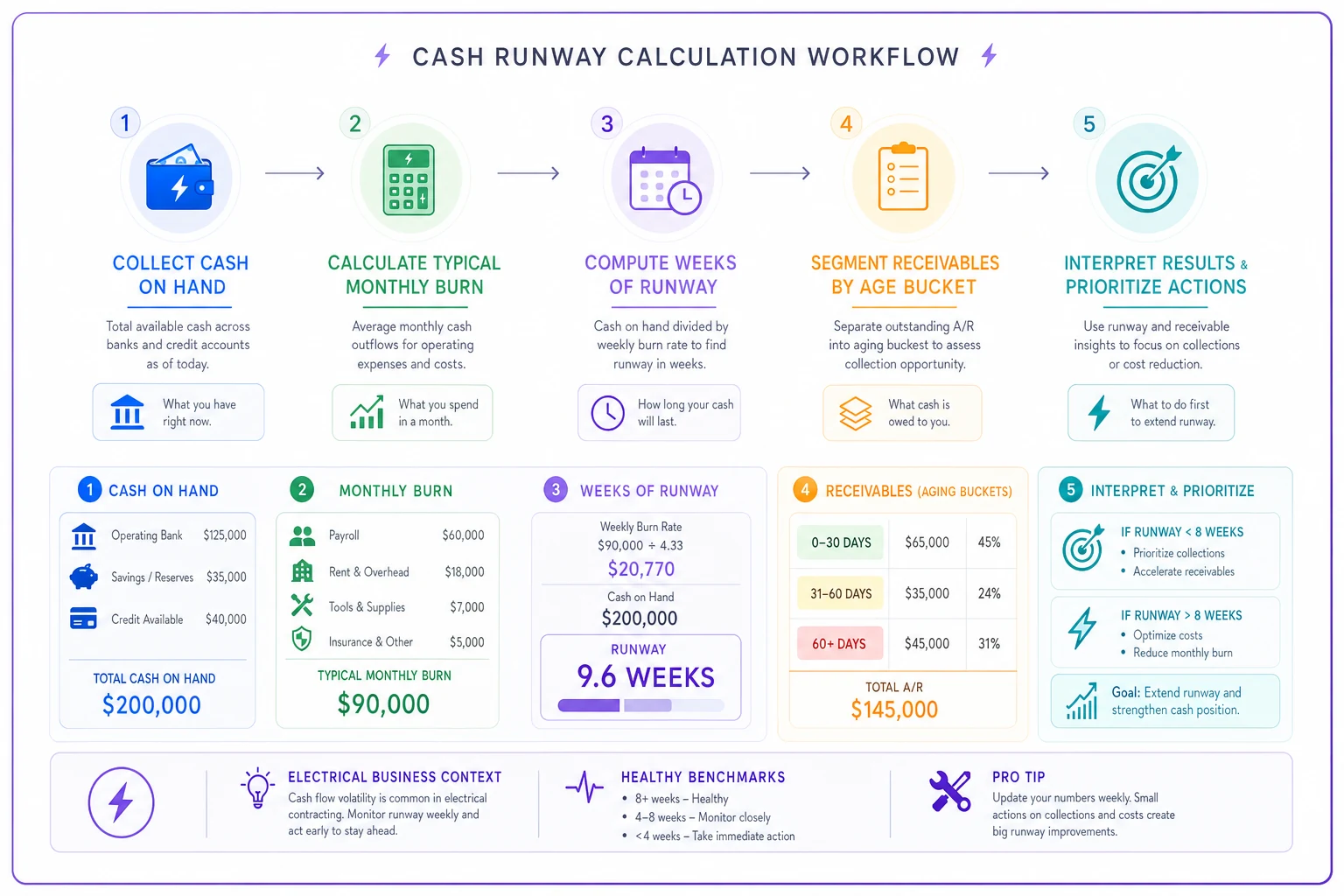
That distinction is the whole reason to put runway and aging on the same page. Owners regularly panic about the wrong thing. They start slashing overhead when the actual issue is that three commercial customers are 70 days late. The 48-hour job-finalization and invoicing checklist matters more in that situation than any cost-cutting, because pulling receivables forward buys you runway without touching a single expense line.
The alert rules that make the pack self-diagnosing
A page of numbers is only useful if it tells you when something crossed a line. Set fixed thresholds so you're not re-deciding what "bad" means every month. These are starting points — tune them to your shop.
-
Runway under 6 weeks → cash alert. Nothing else matters until this is addressed.
-
Any job type under 15% gross margin → margin alert. Reprice or investigate.
-
60+ day receivables over 10% of total AR → collections alert.
-
A single customer over 25% of open receivables → concentration alert.
-
Materials as a share of revenue up more than 5 points vs. your trailing average → cost-creep alert.
-
Loaded labor over 55% of revenue on any install job type → labor-efficiency alert.
Hard rules take the emotion out of it. When the commercial row shows 8% margin and the rule says "under 15% = investigate," you don't get to talk yourself into "it's a good client, it'll pay off eventually." The rule flagged it. Now you deal with it.
One pattern worth flagging: the concentration alert catches the trap that kills more small shops than low margins do. A shop lands one big commercial customer that's 40% of revenue, reorganizes the crew around them, and then that customer stretches payment to 75 days. Now runway is hostage to one AP department. The alert would have surfaced it two months before it became a crisis.
Turning alerts into three corrective actions
Don't try to fix everything. The bottom of the page holds exactly three corrective actions, ranked by cash impact. Three because that's what an owner running crews all day can actually execute in a month.
-
Collections first. Pulling in a 60-day invoice is instant cash at zero cost. If the collections alert tripped, action one is almost always "call the three oldest accounts this week."
-
Repricing second. If a job type tripped the margin alert, the fix is raising the number on the next estimate — not refunding the past. This takes effect on new work, so it's slower but permanent.
-
Cost or mix third. Cutting overhead or declining a whole job type is the slowest and most disruptive, so it goes last unless the burn is severe.
Prioritize by which move recovers cash fastest, not which is easiest:
-
Action 1 (cash now) Collect the two commercial invoices at 68 and 74 days — roughly $19k. Owner calls Monday.
-
Action 2 (margin) Reprice commercial/TI bids up 12% and add a materials escalation clause. Effective on all quotes from the 5th.
-
Action 3 (mix) Cap commercial work at 20% of monthly hours until margin clears 20%. Route the freed-up tech time toward panel and service work.
None of that required an accountant. It required the numbers on one page and rules that told you what mattered.
Who this is right for — and who should skip it
This makes sense when you're running roughly $50k–$300k a month, you've got a few distinct job types with genuinely different margins, and your cash position swings enough that payroll is an actual monthly question. That's the sweet spot where the job-level view changes decisions.
This is overkill when you're a solo operator or two-person shop doing mostly one kind of work. Your P&L already is your job costing at that size, and a weekly glance at the bank balance covers runway. Don't build a process to manage complexity you don't have.
Skip the runway math specifically if you carry a big cash cushion — say six-plus months of overhead sitting in the bank — and you're not growing fast. The weeks-of-runway number is only urgent when it's small. If you're sitting on a healthy balance, spend close time on margins, not survival math.
A real scenario
A residential electrical shop outside Phoenix, five techs, doing around $90k–$100k a month. On paper they were profitable most months — the accountant's P&L showed low-to-mid five figures in net profit. But the checking balance had drifted from about $60k down to $28k over seven months and the owner couldn't explain it.
The first one-page close pack surfaced two things the lumped P&L had buried. First, their remodel/rewire work was running at a real margin around 11% once labor was loaded properly — they'd been costing at bare wage and had no idea. Second, over $30k of their receivables were sitting past 60 days, mostly from two builders they did repeat work for and had gotten soft on chasing.
The corrective actions were unglamorous. They called both builders and set up standing net-30 terms with a late fee, recovering about $22k over the following six weeks. They raised remodel pricing around 15% and started declining the lowest-margin rewire jobs. Nothing dramatic on the expense side.
Four months later, runway had moved from under three weeks to just over eight, and the checking balance climbed back past $50k. Revenue was actually slightly lower — they'd shed some of the bad work on purpose. The cash situation went from quietly alarming to stable without hiring anyone, cutting overhead, or a single extra meeting with the CPA.
Keeping it a habit
The whole system falls apart if it takes too long or lives in someone's head. Two things keep it running:
-
Same day, every month. First business day. Put it on the calendar as a recurring block so it's not a decision.
-
Pull, don't re-enter. The reason most close packs die is manual data entry — copying job costs and AR into a spreadsheet by hand. If your field and invoicing data already live in a system that tracks job-level revenue, hours, and materials, the top and middle sections should populate from data you're already capturing. You're reading and deciding, not assembling. That's the difference between a 90-minute habit and a four-hour chore you quit by summer.
Put the close pack on the calendar as a recurring first-business-day task and connect your field/invoicing system so the top and middle sections pull automatically.
The pack isn't accounting. It's an operating instrument. Its only job is to tell you, on one page, where the money's leaking, how much time you have, and the three things to do about it — early enough that the decision is still yours to make.
AI-powered operational software can actually help here in a real way. Platforms that connect field data, job costing, and invoicing into one place make the "pull, don't re-enter" part automatic. Instead of spending an hour assembling numbers, you're spending 20 minutes reading them and making calls. That's the version of this process that actually sticks month after month.
Ready to optimize your electrical service operations?
Join 500+ electrical service companies using Voltzly to improve scheduling accuracy, enhance client satisfaction, and boost operational efficiency.