

You know that pit-in-your-stomach feeling when the inspector pulls into your job site parking lot? Or when your insurance adjuster starts asking for "comprehensive safety records" after an incident?
Most electrical shops handle compliance like they're cramming for an exam. They scramble through filing cabinets, text techs for photos, dig through email threads looking for that one toolbox talk sign-in sheet from three months ago. The documentation exists—somewhere—but it's scattered across job folders, WhatsApp threads, Google Drive folders nobody remembers the password to, and that one laptop in the office that crashes every other Tuesday.
The real problem isn't that shops don't document safety. It's that they treat documentation like individual checkboxes instead of an interconnected system. Your incident log doesn't talk to your training records. Your inspection reports live separately from your corrective actions. Your toolbox talks happen in isolation from your near-miss tracking.
Then something happens. Maybe it's minor—a tech gets a cut that needs stitches. Maybe it's major—someone falls off a ladder. Either way, suddenly you need to prove your entire safety culture exists. Not just that one photo of the job site. Not just that one training certificate. The whole interconnected story of how your shop prevents, tracks, responds to, and learns from safety issues.
Why traditional safety documentation fails at the worst possible moment
Shops with genuinely strong safety cultures still get hammered by OSHA because they couldn't produce organized records. They do the safety work—weekly toolbox talks, regular equipment inspections, proper incident follow-up—but their documentation looks like amateur hour when it matters.
Here's what typically exists in a 5–15 person electrical shop: A manila folder labeled "Safety" with random certificates stuffed inside. Some Word docs on someone's computer with toolbox talk topics. Text messages between the owner and foreman about that close call last month. Photos on various phones showing job site conditions. A clipboard in the shop with sign-in sheets that may or may not get filed. Maybe an Excel sheet tracking OSHA 300 logs if you're organized.
Response lag kills credibility. When an inspector asks for your ladder inspection records from the past six months, every minute you spend hunting through folders looks like you don't actually do inspections. Even if you find them eventually, that initial scramble already damaged your credibility.
Incomplete stories create doubt. Say a tech reported feeling dizzy on a hot roof in July. You addressed it immediately—sent him home, adjusted summer work schedules, bought cooling vests. But if you can't show the complete chain from incident report to corrective action to follow-up training, it looks like you ignored a heat stress issue.
Pattern blindness increases risk. When your documentation lives in silos, you miss connections. Three separate "minor" electrical contact incidents over six months might point to a systemic grounding problem—but if those reports sit in different job folders, you never see the pattern until someone gets seriously hurt.
The compound effect of bad documentation on insurance and legal exposure
Insurance companies love denying claims. It's literally their business model—collect premiums, minimize payouts. When an incident occurs, they deploy adjusters whose job is finding reasons to reduce or deny coverage.
Never miss a job or delay a dispatch again.
Voltzly helps you schedule, assign, and track every electrical job efficiently.
- Unified job scheduling
- Real-time technician tracking
- Automated client notifications
No credit card required
Weak documentation hands them ammunition.
Here's a scenario worth walking through: A journeyman electrician working on a commercial retrofit fell through a ceiling grid. Moderate injuries—broken wrist, bruised ribs, couple weeks out of work. The shop had workers' comp, general liability, all the right coverage. Should have been straightforward.
The insurance company's investigator started requesting documents. First, they wanted safety meeting records where fall protection was discussed. The shop had done these meetings but sign-in sheets were scattered across job trailers and the office. Some were missing entirely.
Then they wanted equipment inspection records for the ladder being used. The shop did inspect ladders—the foreman would check them and maybe make a note in his phone. No standardized forms, no central log.
Next came questions about the tech's training history. His OSHA 10 card was expired by two months. He'd done the renewal course online but nobody had printed the new certificate yet.
The claim that should have paid out $47,000 settled for $19,000 after months of back-and-forth. The shop still had to cover medical bills upfront, deal with a Department of Labor investigation, and watch their experience modification rate jump 20%, raising premiums for three years.
All because their actual safety practices—which were decent—couldn't be proven through documentation.
Building an electrical contractor safety program that scales with your growth
A functional safety program isn't about having more paperwork. It's about creating interconnected documentation that tells the complete story of how your shop identifies, prevents, and responds to safety risks.
The foundation comes down to four components that feed each other:
Incident logging that drives improvement. Not just OSHA 300 logs but a system that captures near-misses, first aid cases, and "good catches" where someone prevented an incident. Each entry should trigger specific actions—investigation, corrective measures, follow-up training.
Training documentation that proves competence. Beyond filing certificates, you need records showing who trained on what equipment, which job site hazards they're qualified to handle, and when refreshers are due. This includes formal courses, toolbox talks, and equipment-specific training.
Inspection records that show proactive management. Regular documented checks of equipment, vehicles, and job sites. Not just "ladder inspected" but specific criteria checked, issues found, corrective actions taken, and follow-up verification.
Living templates that standardize without constraining. Job hazard analyses, pre-task planning forms, and safety permits that actually match your work—not generic forms downloaded from OSHA's website, but templates that reflect your specific operations.
These components only work when they're connected. An incident report should automatically trigger a toolbox talk topic. An equipment inspection failure should generate a work order and a training requirement. A near-miss pattern should update your job hazard analysis templates.
The inspection-ready documentation hierarchy
When OSHA or an insurance investigator shows up, they follow a predictable pattern. Understanding it lets you organize documentation to tell your safety story effectively.
| Documentation Type | What Inspectors Check | Common Failures |
|---|---|---|
| Electrical safety program | Written procedures for lockout/tagout, arc flash boundaries, PPE requirements | Generic template not customized to actual work performed |
| Training records | Qualified person designations, task-specific training, refresher dates | Can't prove specific employee received specific training |
| Equipment testing | Insulation resistance tests, ground-fault circuit interrupters, testing equipment calibration | Testing happens but isn't documented consistently |
| Incident investigation | Root cause analysis, corrective actions, follow-up verification | Investigations stop at immediate cause, miss systemic issues |
| Job hazard analyses | Pre-task planning for high-risk work, site-specific hazards identified | Using same generic JHA for every job type |
Finally, they look for evidence of continuous improvement. Are you tracking leading indicators like near-misses and safety observations? Do incident investigations result in program updates? Can you show training topics respond to identified risks?
Shops that sail through inspections don't necessarily have perfect safety records. They have documentation systems that demonstrate active safety management. The difference between a warning and a citation often comes down to whether you can quickly show that yes, you identified that hazard, yes, you trained on it, and yes, you're actively managing it.
Creating reusable templates without falling into checkbox mentality
Templates paradoxically make documentation both better and worse. Better because they ensure consistency and completeness. Worse because people start treating them as paperwork to complete rather than tools for thinking about safety.
The key is building templates that force actual assessment while streamlining the documentation process.
Pre-task planning templates with decision trees. Instead of a generic checklist, create branching templates. Residential service call? Branch one. Commercial new construction? Branch two. Each branch asks relevant questions that actually affect how the work gets approached. Working near energized equipment? The template should force documentation of approach boundaries, shock protection, and arc-rated PPE requirements.
Incident investigation forms that demand "5 whys" thinking. Don't just ask what happened. Build forms that push investigators to identify immediate causes, contributing factors, root causes, and systemic issues. Include prompts for gathering photos, witness statements, and equipment details while memories are fresh.
Equipment inspection checklists with failure criteria. Don't just list items to check—define what constitutes passing versus failing. For a ladder inspection: "Side rails: Check for dents deeper than 1/8 inch, cracks, or separated joints. FAIL if any present." This removes subjective judgment and creates consistency across different inspectors.
Toolbox talk templates with participation verification. Beyond sign-in sheets, include discussion prompts and a section for documenting questions raised by crew members. This proves active participation, not just attendance.
The challenge with templates is keeping them current. A template created three years ago probably doesn't reflect your operations anymore. Build in quarterly reviews where you update templates based on incidents, near-misses, new equipment, or changed regulations.
The technology stack that makes compliance natural, not forced
Small shops often resist safety software because they've been burned by expensive, overcomplicated systems nobody actually uses. The foreman still does paper forms because the software takes forever to load on his phone. The office manager prints everything anyway because the inspector wants paper copies.
The right setup—often combining simple tools rather than one complex system—transforms safety documentation from a burden into something closer to business intelligence.
Start with the basics: cloud storage with clear folder structures. Not everything dumped into one "Safety" folder, but organized hierarchies:
-
2024 > Q3 > Toolbox Talks > Week 37
-
Incidents > 2024 > Near Miss > Electrical > [Date]_[Location]
-
Training > Individual Records > [Employee Name] > Certificates
This structure means anyone can find anything within 30 seconds, whether it's the owner, office manager, or a foreman covering for someone on vacation.
Layer in form automation for routine documentation. Digital forms that techs fill out on phones or tablets, automatically routing to the right folders. When someone completes an incident report, it triggers notifications to the safety manager, adds an item to the next safety meeting agenda, and schedules a follow-up reminder.
Workflow illustration: how forms and folders connect to actions.
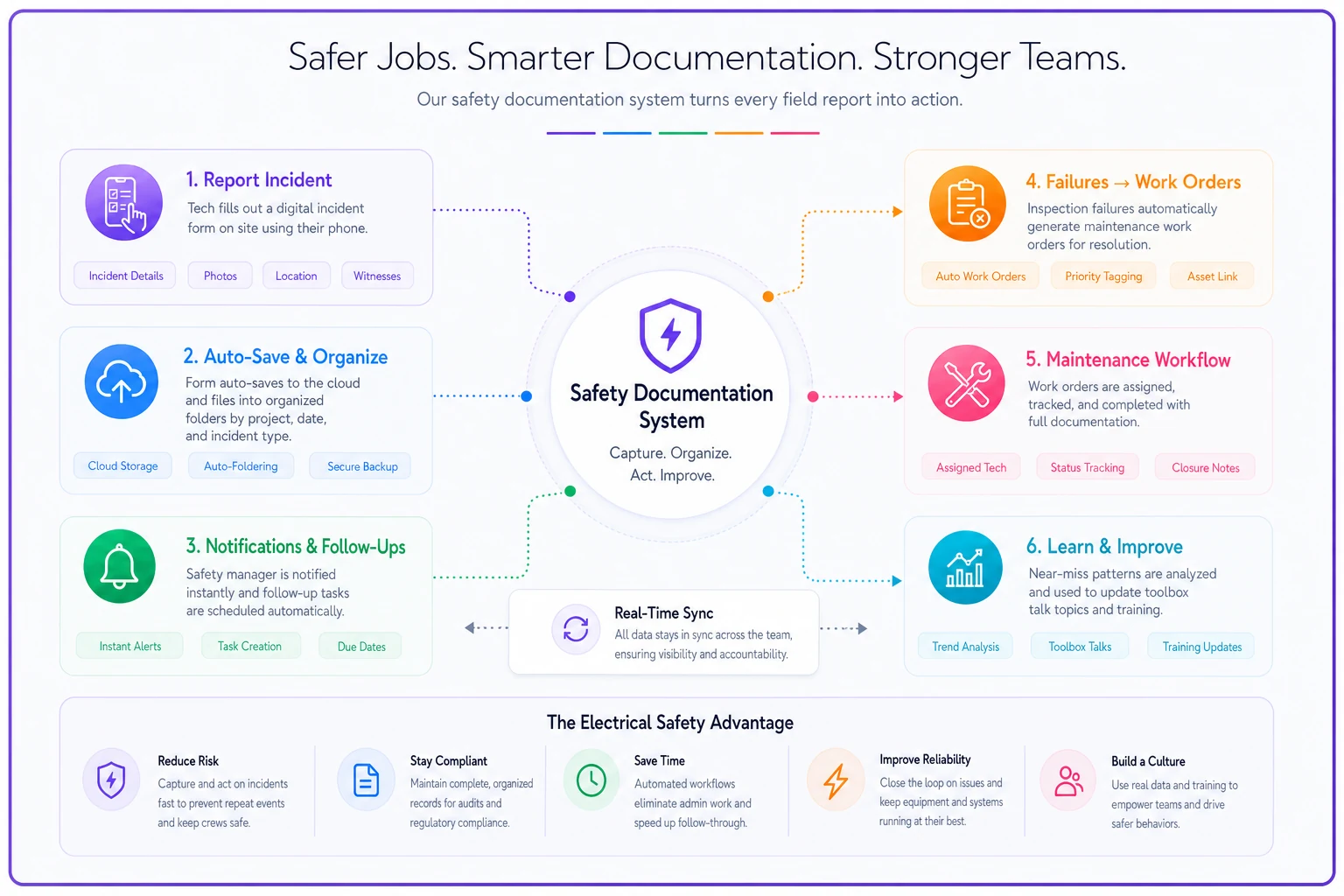
For shops ready to go further, AI-powered operational software changes how you handle safety compliance. Instead of manual entry and filing, these platforms can parse incident reports for patterns, flag when training certifications approach expiration, and suggest toolbox talk topics based on recent near-misses or upcoming job types. The real shift happens when your safety documentation connects to other operational systems—incident reports automatically check if the involved employee's training is current, equipment inspection failures generate maintenance work orders, and near-miss patterns from your callback prevention system start shaping safety meeting topics.
When incident logging becomes predictive instead of reactive
Most shops treat incident logs as historical records—something you fill out after someone gets hurt. But proper incident tracking, especially when it includes near-misses and good catches, becomes a predictive tool.
A shop I worked with started logging everything, not just OSHA-recordable incidents. Every "almost fell off ladder," every "could have been shocked if the breaker wasn't off," every "good thing I wore safety glasses." Initially, the owner worried this would make their safety record look worse.
The opposite happened. They started seeing patterns before anyone got seriously hurt. Three near-misses with extension cords across walkways led to a cord management protocol. Multiple "almost shocked" incidents on old residential panels triggered updated hot work procedures. A cluster of afternoon heat-related issues in summer drove schedule adjustments.
Workers' comp claims dropped roughly 60% over two years. Not luck—they caught problems while they were still minor. The insurance company noticed: their experience modification factor dropped from 1.15 to 0.89, saving around $12,000 annually on premiums.
The key is making incident reporting easy and non-punitive. If a near-miss report means 30 minutes of paperwork and a safety lecture, nobody reports anything. If it's a two-minute phone form with no blame attached, you start getting real data.
Build categories that match your work:
-
Electrical contact/arc flash
-
Falls from height
-
Struck by/caught between
-
Ergonomic/repetitive strain
-
Vehicle-related
-
Environmental (heat, cold, air quality)
Track contributing factors as well—time pressure or rushing, procedure not followed, equipment failure, environmental conditions, training gaps, and communication breakdowns. This categorization lets you run simple analyses: Are most incidents happening during afternoon heat? Do newer employees have more ergonomic issues? Are electrical contacts more common on retrofit work versus new construction?
Making safety meetings actually drive behavioral change
Weekly toolbox talks are like gym memberships—everyone has them, few get value from them. The typical pattern: foreman reads from a generic safety topic sheet, everyone signs, back to work. Zero behavior change, but you have documentation.
Effective safety meetings connect to your actual work and recent experiences. Structure them around three components:
Recent events discussion (5 minutes). Start with near-misses, good catches, or concerns from the past week. "Tom noticed frayed insulation on the hammer drill cord—good catch. We've replaced it. Everyone check your cord conditions today."
Focused topic training (10 minutes). One specific topic directly relevant to current work. Doing a lot of panel upgrades this week? Talk about arc flash boundaries. Starting a commercial job with scaffolding? Cover fall protection requirements. Make it immediately applicable.
Interactive verification (5 minutes). Don't just talk—demonstrate or quiz. Covering lockout/tagout? Have someone actually demonstrate the procedure. Discussing ladder safety? Go inspect one together. This proves understanding, not just attendance.
Document differently too. Instead of just a sign-in sheet, capture the topic covered and why it was selected, questions raised and answers provided, commitments made, and any follow-up items that need action from the office. Rotate who leads these meetings. When techs have to teach, they learn more deeply—and different people raise different safety observations based on their own work experience.
The insurer-facing documentation package that prevents disputes
When an insurance company investigates a claim, they're looking for reasons to reduce their payout. Your documentation needs to tell a story that makes denial difficult.
Organize records into three tiers:
Tier 1: Immediate response package. What you can produce within 24 hours of a request. Current certificates of insurance, OSHA 300 logs for the past three years, written safety program, and organizational chart showing safety responsibilities. Keep this in one clearly labeled digital folder, updated quarterly.
Tier 2: Incident-specific documentation. Everything related to a particular claim. The incident report, photos, witness statements, equipment inspection records, the involved employee's training history, similar previous incidents, and corrective actions taken. Assemble this within 48 hours of any serious incident.
Tier 3: Program proof. Evidence that your safety program is active, not just paper. Safety meeting minutes showing the incident was discussed, updated procedures based on investigation findings, additional training conducted, and follow-up inspections. This demonstrates you take safety seriously beyond just reacting to events.
For serious incidents, create a formal investigation binder—physical or digital—that includes the following:
-
Initial incident report with photos
-
Witness statements collected within 24 hours
-
Equipment/tool inspection reports
-
Site conditions documentation (lighting, weather, layout)
-
Root cause analysis using formal methodology
-
Corrective action plan with deadlines
-
Training records showing follow-up education
-
Verification that corrective actions were implemented
Insurance companies often challenge claims months or years later. The details you thought you'd remember are gone. The employee who witnessed it no longer works for you. That emergency call that seemed straightforward at the time becomes disputed without documentation.
Turning compliance burden into operational intelligence
Shops that view safety documentation as pure overhead miss a real opportunity. Your safety data surfaces operational problems before they hit your bottom line.
High incident rates on specific job types might indicate you're underpricing that work, creating time pressure that leads to shortcuts. Equipment inspection failures clustering around certain techs could reveal training gaps or carelessness that also affects work quality. Near-misses during morning startup might point to rushed scheduling that impacts first-call completion rates.
One shop discovered their Monday incident rate was roughly three times higher than other days. Digging in, they found their Monday schedule was always overbooked because the office tried to accommodate everyone who called over the weekend. The rushing led to safety shortcuts and quality issues. They adjusted scheduling and both safety incidents and callbacks dropped.
Another shop noticed most ergonomic injuries involved their two newest techs. Turns out their training program covered electrical skills thoroughly but barely touched proper lifting, carrying, and positioning. Two hours of ergonomic content added to orientation eliminated a recurring workers' comp cost.
When safety documentation connects to your operational systems, it stops being a compliance burden and starts driving actual business improvements. High vehicle incident rate? Your dispatch radius might be creating driver fatigue. Afternoon heat injuries? Split shifts could make more sense in summer. Falls from ladders increasing? Could be a sign of unrealistic time estimates pushing people to rush.
Building the muscle memory of documentation discipline
The hardest part of safety documentation isn't setting up the system—it's maintaining it when you're busy, understaffed, and fighting fires daily. The phone's ringing, three techs called in sick, and there's a big commercial job starting tomorrow. Filing toolbox talk forms isn't anyone's priority.
This is where system design matters more than good intentions. If documentation requires extra steps, it won't happen consistently. If it disrupts workflow, people find workarounds. If it feels like meaningless paperwork, compliance becomes grudging at best.
Build documentation into natural workflow breakpoints. Pre-task planning during the morning dispatch meeting. Equipment inspections during van stock checks. Incident reports during the drive back from site. Safety meetings during the regular Monday morning all-hands.
Make forms accessible where work happens. QR codes on equipment linking to inspection forms. Shortcuts on home screens for incident reporting. Voice-to-text for capturing details while they're fresh. The easier compliance is, the more consistent it becomes.
Create feedback loops that reinforce the value of documentation. When a good catch prevents an incident, call it out publicly. When documentation helps win an insurance dispute, share the win. When incident log patterns drive a helpful change, give credit to the reporting system. And most importantly—show that reports actually get read. Nothing kills documentation discipline faster than feeling like you're shouting into the void. When someone reports a near-miss, follow up within 24 hours. When patterns emerge, address them in safety meetings.
From reactive scrambling to proactive protection
A real electrical contractor safety program isn't about perfect compliance or zero incidents. It's about building systems that protect your business when things go wrong—because things always go wrong eventually.
Shops that survive OSHA inspections, insurance disputes, and serious incidents aren't necessarily the safest operations out there. They're better at proving they take safety seriously through consistent, interconnected documentation that tells the whole story.
Start with the basics: centralized cloud storage, standardized templates, consistent incident logging. Connect different documentation types so patterns become visible. Add technology that makes compliance easier than non-compliance. Build feedback loops that show documentation is driving real improvements.
Your safety program should grow with your business. What works for a three-person shop won't scale to fifteen techs across multiple sites. But the principles stay constant: capture information where work happens, make patterns visible through connectedness, and use documentation as operational intelligence—not just paperwork you file to stay out of trouble.
When that inspector pulls into your job site, you want confidence, not panic. When an insurance adjuster starts requesting records, you want organized packages, not a scattered scramble. Building this system takes real effort upfront, but the payback shows up in reduced insurance costs, fewer incidents, better employee retention, and not lying awake wondering if your documentation is actually good enough.
The best time to build a safety documentation system is before you need it. The second best time is right now, before that inspector shows up or that claim gets filed. Because when safety documentation matters, it really matters—and trying to create it retroactively never works.
Ready to optimize your electrical service operations?
Join 500+ electrical service companies using Voltzly to improve scheduling accuracy, enhance client satisfaction, and boost operational efficiency.