



The riskiest money in an electrical business isn't your own crew's labor. It's the check you cut to a subcontractor before you actually know whether their work passes. On a straight service call you control the whole job. On a multi-trade project — say a panel upgrade tied to a solar install, with a low-voltage sub running comms and a general handling drywall patch — you're the one holding the contract with the homeowner or GC, but half the work is being done by people whose quality you can't fully see until it's buried in a wall or energized on the roof.
That gap is where shops lose money. Not through some dramatic lawsuit, but through the slow bleed of paying a sub 100% on Friday and finding out Tuesday that the inspector red-tagged their conduit runs, and now the sub isn't answering the phone.
This post is about one specific fix: writing scopes of work and payment terms that hold money back at the right moments, tied to real inspection sign-offs and actual evidence, so you're never the last person standing when a sub's work fails.
The specific way this goes wrong
Here's the pattern that shows up over and over in subcontractor management for electricians running multi-trade jobs.
You win a job that needs more than your crew can cover. Let's say it's a whole-house rewire plus a service upgrade, and you bring in a sub to handle the rough-in on the addition side because your guys are stretched across two other projects. You agree on a number over the phone or in a two-line email. Maybe $6,800 for the rough. The sub finishes, sends an invoice, and because they've done decent work before, you pay it in full so you don't have to think about it again.
Then the rough inspection happens. The inspector flags three boxes set too shallow, a homerun that's undersized for the load calc, and missing nail plates on two studs. None of that is catastrophic on its own. But the sub is already three jobs down the road, the money's gone, and getting them back to fix their own mistakes now costs you either a favor, a fight, or your own crew's time to redo it.
The homeowner doesn't care that a sub did the work. Your name is on the permit. Your license is on the line. And the correction delays your final, which delays your final payment.
What makes this worse in practice is that the failures are rarely about the sub's skill. It's that nobody defined what "done" meant before money changed hands. "Rough-in the addition" is not a scope. It's a wish.
Why "we've worked together before" is not a control
Most small shops run subs on trust, and trust works right up until it doesn't. The problem is that trust doesn't survive cash-flow pressure. A sub who does clean work when things are calm will cut corners the month rent is due and they've got four jobs open. You're not managing their character — you're managing the incentive structure, and full-payment-on-invoice removes every incentive they have to fix anything after they've been paid.
Never miss a job or delay a dispatch again.
Voltzly helps you schedule, assign, and track every electrical job efficiently.
- Unified job scheduling
- Real-time technician tracking
- Automated client notifications
No credit card required
-
Undefined scope. Nobody wrote down what materials, methods, or code sections apply, so "done" is a matter of opinion.
-
No holdback. The sub gets 100% before the work is verified by anyone with authority — meaning the inspector.
-
No evidence. When something's wrong, there's no photo record of who did what, so it becomes your word against theirs, and it's your permit.
Fix those three and most subcontractor risk on multi-trade jobs disappears. Not because your subs get better, but because your paperwork stops letting them be careless.
Building a scope that actually protects you
A usable subcontractor SOW for an electrical job doesn't need to be a legal monster. It needs to be specific enough that "finished" isn't debatable. The ones that work read less like a contract and more like a spec sheet with teeth.
Here's what a tight scope for that addition rough-in should actually spell out:
-
Exact work boundaries. "Rough-in for the north addition only — bedrooms 3 and 4, hall bath, and the exterior GFCI. Does not include the main panel or the service tie-in." Draw the line so there's no gray area about who owns what.
-
Materials and methods. Wire gauges by circuit, box fill expectations, box depth, mounting heights, nail-plate requirements. Reference the code sections the AHJ enforces locally if you know them.
-
The inspection gate. State plainly that the work must pass the municipal rough inspection before final payment is released. This is the single most important line in the whole document.
-
Evidence requirements. What photos, at what stage, before anything gets covered.
-
Correction terms. If the work fails inspection, the sub corrects it at their cost within a set window, or you correct it and deduct from the holdback.
None of that is exotic. But when it's written down, the sub reads it before they start and works to it. That alone kills a huge share of failures, because now they know exactly what you're going to check.
Milestone holdbacks tied to inspection sign-offs
This is the mechanism that does the real protecting. Instead of paying on invoice, you break the sub's payment into milestones, and each release is gated by a specific event — usually an inspection sign-off, not just "the work looks done."
A holdback isn't retainage in the formal commercial sense. For a small shop it's simpler: you hold a chunk of the payment until the thing that proves the work is good actually happens.
Here's how that maps out on a typical multi-trade residential job:
| Milestone | % Released | Gate / trigger | Evidence required before release |
|---|---|---|---|
| Mobilization / materials on site | 20% | Materials verified on site, correct spec | Photos of delivered materials, box counts |
| Rough-in complete | 40% | Passes municipal rough inspection | Signed inspection card + rough-in photo pack |
| Trim / device install | 25% | Devices installed, no visible defects | Photo pack of installed devices, panel |
| Final | 15% | Passes final inspection, no open corrections | Final sign-off + your own QA walkthrough |
The two rows that carry the weight are the ones tied to actual inspections. That 40% held until the rough passes is what keeps your sub answering the phone. If the inspector flags something, the sub hasn't been paid for that phase yet — so fixing it is their problem to get their money, not your problem to chase them.
Notice the mobilization payment. A lot of shops skip it, but paying 15–20% upfront for materials is fair and keeps the sub from floating your job on their credit card. The point isn't to starve subs. Good subs actually like clear milestones because they know exactly when they get paid and don't have to nag you.
One thing that matters: don't let the final holdback be trivial. If you only hold back 5%, the sub does the math and decides the callback isn't worth their drive time — they'd rather forfeit the $340 than come back. Hold back enough that coming back to fix it is clearly the cheaper option. On most residential subs, 12–15% is the range where behavior actually changes.
A quick visual of the milestone holdback workflow:
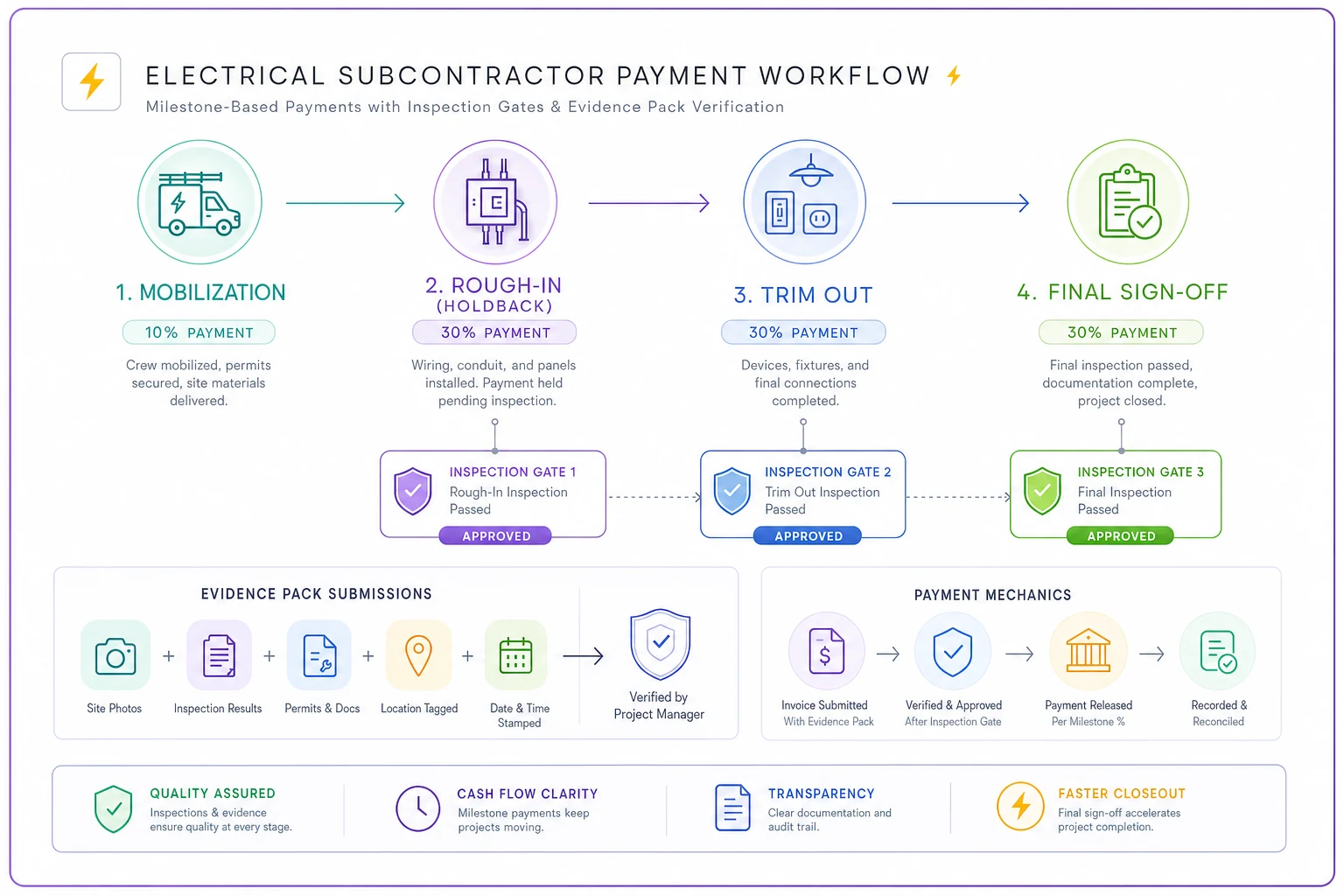
That visual shows why tying cash flow to inspection gates changes incentives: the sub has real money waiting on them, and the evidence pack makes it verifiable.
The evidence pack: what to require and when
Money terms only work if you can prove what happened. On a multi-trade job, the evidence pack is what protects you when the GC or homeowner points a finger, and it's what lets you deduct from a holdback without a shouting match.
For each milestone, require the sub to submit photos before anything gets covered. Not "some photos" — a defined set. This is the same discipline that makes your own jobs defensible, and it ties directly into the documentation habits that make a photo-based warranty and post-job QA process something you can actually stand behind.
-
Wide shot of each room showing box placement and mounting heights
-
Close shot of every homerun landing, with the wire gauge legible if possible
-
Nail plates on every drilled/notched stud in the path
-
Panel or subpanel with circuits labeled
-
Any junction boxes that will be accessible, shown open
-
A shot of the signed inspection card next to the panel or address
The trick that makes this enforceable: state in the SOW that payment for a milestone is not processed until the evidence pack is received and the inspection has passed. No pack, no release. Subs learn this fast. After the first job where they wait an extra week for a check because they forgot the panel photos, they stop forgetting.
Keep those packs filed by job and milestone, not dumped in a phone camera roll. When you need to prove a sub's rough passed clean and the problem came from the drywall crew later, you want that folder in thirty seconds.
A short real scenario
A four-tech shop doing residential upgrades started bringing in a rough-in sub regularly during a busy stretch — roughly six to eight jobs a month at peak. They paid on invoice, full amount, because the sub was reliable.
Over about a quarter, two of the sub's rough-ins failed inspection. In both cases the sub had already been paid and moved on. The shop ate the correction with their own crew — around 9 hours of tech time across both, plus the schedule disruption that pushed a final and delayed a homeowner payment by two weeks. The direct cost wasn't huge, maybe $600–$800 in labor, but the delayed final and the friction with the homeowner cost more than that in aggravation and one lost referral.
They switched to a milestone structure: 20% on materials, 40% on passed rough, 25% on trim, 15% on passed final. Same sub. The change wasn't the sub getting better — it was that the sub now had 40% riding on the rough passing. Corrections that used to happen on the shop's dime now got handled by the sub before they'd call for the check. Over the next few months, failed roughs dropped to basically zero, and the minor flags that did come up got fixed within a day because the sub wanted their milestone released.
The finals also started closing cleaner, which fed straight into faster invoicing — the same downstream benefit you get from a tight job-finalization checklist, except now the sub's phase was gated the same way your own was.
When milestone holdbacks make sense — and when they don't
When this actually makes sense:
-
Any multi-trade job where your permit covers work your own crew didn't do
-
Subs you use repeatedly and want to keep honest without micromanaging
-
Jobs with real inspection gates you can tie payments to
-
Anything over a few thousand dollars where a failed phase costs you real money
When it's overkill:
-
A one-hour helper on a residential service call
-
Jobs with no inspection involved at all
-
A sub you're paying a flat day rate under your direct supervision, where you're effectively QCing in real time
Who should not lean on this alone:
If you're bringing in a sub you've never worked with on a large commercial job, holdbacks are necessary but not sufficient. You still need proof of insurance, a signed indemnity, and a real contract. Milestone holdbacks are a cash-flow control, not a substitute for the legal layer on big work.
Making it stick without becoming a paperwork shop
The failure mode here isn't the concept — it's that shops build a solid SOW template, use it twice, and then a busy week hits and they go back to "just pay the invoice." The whole thing collapses the moment you make an exception.
The way to keep it running is to make the template dead simple and the same every time. One scope format. One milestone table. One evidence checklist per trade. When it's identical across jobs, your office person can prep a sub SOW in ten minutes and your subs know the drill before they even read it.
Use one SOW template, one milestone table, and one evidence checklist per trade to make the process repeatable and reduce exceptions.
Some shops manage this in a shared doc and a folder structure, which works fine when you're small. As volume climbs, tracking which milestone is unlocked, which evidence pack is missing, and which sub is waiting on which inspection starts to eat real admin hours. Operational software that ties job stages to payment gates and photo requirements helps here — it stops a milestone from being releasable until the evidence and inspection status are both logged. But the tool is secondary. The discipline is what protects you. A shop running this on paper beats a shop with great software and no follow-through every time.
The point to hold onto
Subcontractor risk on multi-trade jobs isn't really about finding better subs. It's about never being in a position where you've paid for work you can't yet verify.
Define the scope so "done" isn't an opinion. Gate the money to inspections, not invoices. Require the photos before the walls close.
Do those three things consistently and the sub who used to leave you holding the bag now has every reason to make sure their work passes the first time — because that's the only way they get paid.
Subcontractor risk on multi-trade jobs isn't really about finding better subs. It's about never being in a position where you've paid for work you can't yet verify.
Define the scope so "done" isn't an opinion. Gate the money to inspections, not invoices. Require the photos before the walls close. Do those three things consistently and the sub who used to leave you holding the bag now has every reason to make sure their work passes the first time — because that's the only way they get paid.
Ready to optimize your electrical service operations?
Join 500+ electrical service companies using Voltzly to improve scheduling accuracy, enhance client satisfaction, and boost operational efficiency.