

The math on hiring an electrician is brutal in a way most owners don't actually sit down and calculate until they're already bleeding. Six to eight weeks recruiting, a few thousand in ads and referral bonuses, then another two or three months before that person is billing at full capacity without a senior tech looking over their shoulder. If they walk at month five, you didn't just lose a warm body — you lost the entire investment, plus the callbacks their half-trained work kicked back.
Most shops treat recruitment and retention as two separate problems. They're not. The way you write a job ad determines the kind of person who shows up, which determines how long they stay. The playbook below runs from the first job posting through the retention rituals that keep your best people from picking up the phone when a recruiter texts them.
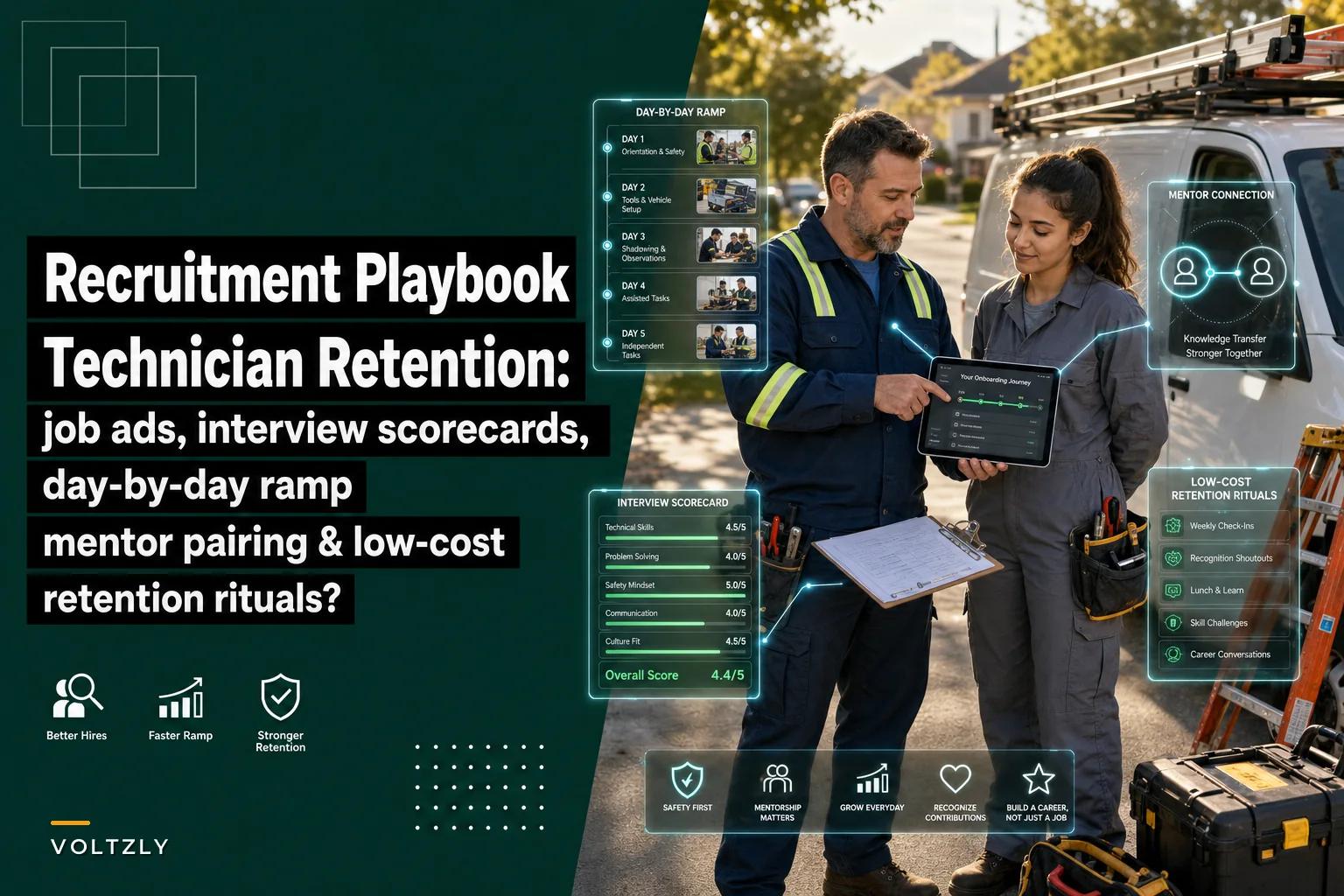
This isn't a "hiring is hard" think piece. It's the actual funnel — ads, scorecards, a day-by-day ramp, mentor pairing, and the cheap rituals that move retention more than most owners expect.
Start with the job ad, because that's where most bad hires come from
The typical electrical contractor job posting reads like it was copied from a template in 2011. "Seeking licensed electrician. Must have valid driver's license. Competitive pay. EOE." That ad attracts everyone and filters out no one, which means you spend interview time weeding out people who never should have applied in the first place.
The job ad is doing two things at once: pulling in the right people and pushing away the wrong ones. Most ads only attempt the first, and not very well. A better ad does a few specific things:
-
Names the actual work. "Residential service calls, panel upgrades, and EV installs across the north metro" tells a tech exactly what their days look like. Someone who hates service calls and wants new-construction work filters themselves out. Good.
-
States a real pay range with the structure. "$32–$41/hr depending on license and speed, plus spiffs on service-plan sales" beats "competitive pay" every time. Techs talk. They already know what competitive means in your market, and vagueness reads as "we're going to lowball you."
-
Describes the crew and the truck. "You'll run a stocked van, work off a phone-based dispatch system, and report to a lead who's been here nine years." That paints a picture of an organized shop — which is exactly what experienced techs are looking for.
-
Sets one clear filter. Something like "you'll be running your own load calcs, so if you need someone checking every one, this probably isn't the right fit yet." Honest, and it thins the pile.
Ads that pull the best candidates almost always mention how the shop is run, not just the pay. Experienced techs have been burned by chaotic operations before — missing parts, double-booked schedules, no backup when a job gets weird. An ad that signals operational competence is a magnet for people trying to escape the opposite.
Build interview scorecards so you stop hiring on gut feel
The most expensive habit in trades hiring is the "I liked him" decision. Someone shows up, seems confident, tells a good story about a tricky commercial job, and gets hired on vibes. Three weeks later you find out he can't troubleshoot a nuisance-tripping AFCI and he's slow on anything outside his comfort zone.
Never miss a job or delay a dispatch again.
Voltzly helps you schedule, assign, and track every electrical job efficiently.
- Unified job scheduling
- Real-time technician tracking
- Automated client notifications
No credit card required
A scorecard fixes this by forcing everyone who interviews the candidate to rate the same things. It doesn't need to be complicated — four or five dimensions, scored 1–5, with a short note required for anything below a 3. Here's a structure that works:
| Dimension | What you're actually measuring | How to test it |
|---|---|---|
| Technical depth | Can they reason through a fault, not just recite code? | Give a real troubleshooting scenario from last month's board |
| Speed vs. sloppiness | Do they move fast without cutting corners? | Ask them to walk through their process on a panel swap, minute by minute |
| Customer manner | Can they talk to a nervous homeowner? | Role-play explaining a $4,200 panel upgrade to someone on a budget |
| Documentation habit | Will they take photos and close jobs cleanly? | Ask how they've handled paperwork and photos at past shops |
| Coachability | Will they take correction without getting defensive? | Ask about a time they were wrong on a job and what happened |
The troubleshooting scenario is the one that separates real electricians from confident talkers. Pull an actual weird call from your history — the intermittent fault, the mislabeled panel, the situation where the obvious answer was wrong — and watch how they think through it. You're not grading whether they land the right answer. You're watching whether they ask the right questions and stay calm when they don't.
One mistake to avoid: don't let the highest-paid person in the room dominate the scoring. Have the lead tech and the dispatcher score independently before anyone compares notes. Dispatchers catch attitude problems that impress-the-boss candidates hide well in interviews.
The day-by-day ramp is where time-to-productivity is won or lost
Most shops onboard by handing the new hire a truck, pairing them with whoever's free that week, and hoping things work out. The result is a ramp that stretches to three or four months because nobody planned it. The new tech learns your systems by tripping over them.
A structured ramp cuts that down considerably. Not because the tech learns to do electrical work faster — a licensed electrician already knows the trade. It's your systems they're slow on: dispatch flow, pricing, documentation standards, where the good parts suppliers are, how you want jobs closed out. A ramp that works for a residential service shop:
-
Day 1 Paperwork, truck assignment, phone and app setup, meet the crew. End the day riding along on two calls as an observer only. No pressure.
-
Days 2–3 Ride with the mentor tech. New hire does the hands-on work; mentor handles customer conversation and job closeout so the new person can watch how it's supposed to look.
-
Days 4–5 Flip it. New hire runs the call and the closeout; mentor observes and corrects afterward, not in front of the customer.
-
Week 2 Solo on simple, well-defined jobs — outlet swaps, fixture installs, straightforward diagnostics. Mentor is one call away and reviews every job's photos that evening.
-
Weeks 3–4 Add complexity gradually. Panel work, larger diagnostics, first service-plan conversations. Daily 10-minute check-in with the mentor.
-
Weeks 5–6 Near-full schedule. Weekly check-in instead of daily. First real look at their numbers — job times, callback rate, closeout completeness.
The evening photo review in week two is the highest-leverage part of this. It catches bad habits before they harden. A tech who's mislabeling breakers or skipping the before-photos gets corrected on day nine, not on the callback three months later.
For shops already running tight territory and capacity planning, this ramp fits naturally into the staffing math — there's a longer discussion of that in the piece on scaling field teams without coverage gaps. A planned ramp means you know exactly when a new hire becomes billable capacity instead of guessing.
Here's a visual of the ramp workflow.
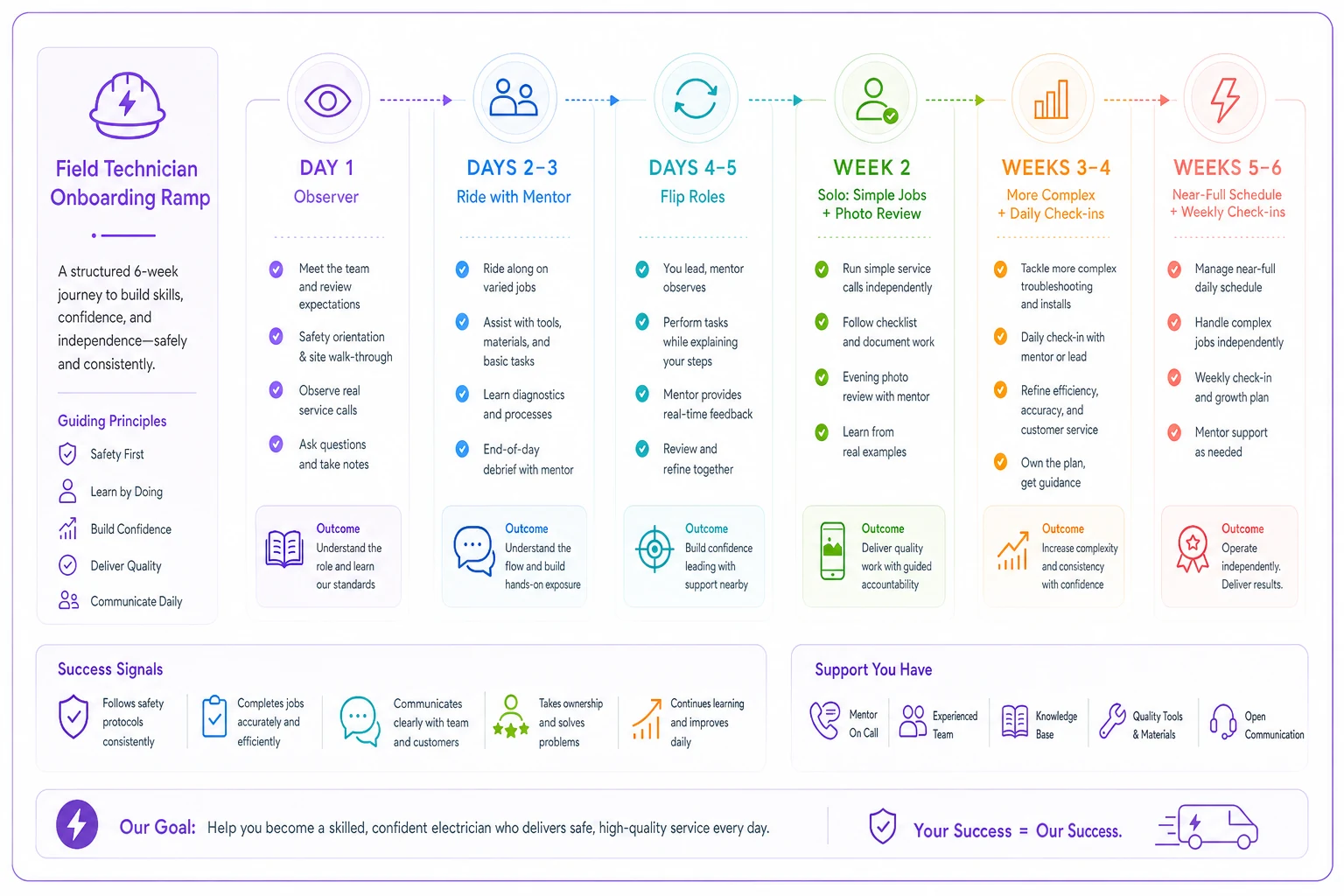
A planned ramp means you know exactly when a new hire becomes billable capacity instead of guessing.
Mentor pairing: pick the right mentor, not the available one
This is where shops quietly sabotage themselves. They pair the new hire with whoever has an open slot, which is often the fastest tech — who is fast precisely because he hates slowing down to explain anything. Two weeks in, the new person feels like a burden, stops asking questions, and starts guessing. Guessing electricians generate callbacks.
The best mentor is rarely your fastest tech. It's the steady one who's patient, documents cleanly, and doesn't mind being interrupted mid-job. Sometimes that's a mid-tier tech by raw speed but your most reliable one on quality. A few things that make mentor pairing work in practice:
-
Pay the mentor for it. Even a small bump — a flat weekly amount or a completion bonus when the new hire hits solo status cleanly — signals that it's real work, not just a favor. Mentoring done for free gets deprioritized the second things get busy.
-
Give the mentor a checklist, not just a vibe. They should know the six ramp milestones and what "ready" looks like at each stage.
-
Protect the mentor's schedule during ramp weeks. If you double-book them, mentoring is the first thing that quietly disappears, and your ramp falls apart without anyone saying anything.
Pay the mentor a small flat weekly amount or a completion bonus to make mentoring a prioritized, paid responsibility.
There's a compounding benefit here that's easy to miss: good mentors tend to stay. Being trusted to develop people makes a senior tech feel valued in a way a pay bump alone doesn't. The pairing that improves new-hire retention also props up veteran retention — one lever moving two problems in the right direction at the same time.
The retention side: it's mostly cheap rituals, not big raises
Owners assume techs leave for money. Pay matters, and if you're genuinely below market you can't ritual your way out of it — there's a full breakdown of how to structure compensation in the piece on aligning pay with capacity. But once pay is in a reasonable band, the reasons people leave shift. They leave because they feel like a number, because the schedule is constant chaos, because nobody notices when they do something well, or because they got embarrassed in front of a customer once and never forgot it.
The fixes are cheap. What matters is that they're consistent — a retention ritual done once is a nice gesture. Done every week for a year, it becomes the reason someone turns down the competitor's call. Rituals that actually move retention:
-
A real weekly check-in, five minutes, one-on-one. Not a group huddle. "How'd this week go, anything getting in your way?" Techs will tell you about the parts shortages, the bad-scope dispatches, and the frustrations that would otherwise pile up until they quit.
-
Public credit for clean work. Post the week's cleanest job — good photos, happy customer, on time — in the group chat with a name attached. Costs nothing. People compete for it.
-
First-name birthday and work-anniversary acknowledgment. Sounds trivial. It isn't. A tech who's been largely ignored for eleven months and then gets a "hey, three years today, glad you're here" remembers that.
-
Fix the recurring gripe fast. If multiple techs mention the same broken thing — bad meter, always-out-of-stock breaker, a dispatch pattern that wrecks their morning — fixing it within a week proves the check-ins aren't theater.
-
A small monthly team meal or spiff for zero-callback weeks. Tie a little money or food to the quality outcome you actually want to see.
The mistake most shops make is treating retention as an annual review event. A once-a-year raise conversation doesn't compete with the low-grade daily friction of a poorly run shop. Retention is built in small weekly moments, not big yearly ones.
When this playbook makes sense — and when it doesn't
This makes sense when you're running two or more crews, hiring at least a few techs a year, and already feeling the pain of ramps that drag and people who leave before they pay off. At that scale, an unstructured process is costing you real money every single cycle.
This is overkill when you're a one- or two-person shop hiring maybe one person every couple of years. You don't need a scorecard for a single hire you'll be working next to every day. Trust your gut, ride along together, skip the formality.
Who should be careful: shops with a genuine below-market pay problem. Don't build elaborate retention rituals on top of pay that's 15% under what your techs can get down the road. The rituals will feel like a distraction from the actual issue, and your sharpest people will see through it immediately. Fix pay first, then layer the rituals on top.
A real scenario
A residential service shop running five techs was burning through hires — losing roughly one person every four to five months and taking about three months to get each new hire to full billing. Their ad was the generic template, they hired on gut feel, and onboarding was "here's your van, follow Dave around."
They tightened the ad to name the actual work and pay range, built a five-dimension scorecard, and put a real six-week ramp in place with their most patient tech as a paid mentor. On the retention side, nothing fancy — weekly five-minute check-ins, public credit in the group chat, and a fast fix on the parts complaint that kept surfacing in check-ins.
Over the following year, time-to-full-billing dropped to around six or seven weeks. More importantly, they stopped losing people at month five. Two of the three techs hired that year were still there well past the one-year mark, which for this shop was genuinely the first time that had happened. The owner's rough estimate of what they avoided in re-hiring costs and callback cleanup was somewhere in the low five figures — not a headline number, but real money that had been leaking out invisibly every quarter.
The point that ties it all together
Recruitment and retention for electricians isn't a problem you solve once. It's a loop. A sharp job ad brings in the right candidates. A scorecard keeps you from hiring on vibes. A day-by-day ramp turns a licensed tech into billable capacity without the usual three-month drag. A good mentor makes the ramp stick — and tends to stick around longer because of the role. And cheap weekly rituals keep the people you worked hard to hire from quietly drifting toward the next offer.
Most shops are strong at one or two pieces of this and blind to the rest. The ones who close the whole loop stop feeling the constant churn — and stop paying the tax that comes with it.
Ready to optimize your electrical service operations?
Join 500+ electrical service companies using Voltzly to improve scheduling accuracy, enhance client satisfaction, and boost operational efficiency.