

Most residential electrical shops already sell some version of a response promise. "Same-day service." "We'll be there fast." "24/7 emergency." The problem isn't that these promises exist — it's that they live in marketing copy and nowhere else. The dispatcher has no rules tying those promises to pricing, scheduling priority, or who gets dispatched first. So every job becomes a judgment call made under pressure, and the margin leaks happen quietly: a premium-priced promise delivered at standard cost, a standard job bumped ahead of a higher-value one, a tech rerouted because the customer sounded upset. An operational SLA matrix fixes that. Not the legal document customers sign — the internal one your dispatcher, techs, and phone staff read every day. It defines the tiers, what each tier actually guarantees, what it costs, and the dispatch rules that decide who moves first when two jobs compete for the same slot. This is what turns vague service level agreements for electricians into something you can actually enforce.
The real problem: promises without priority math
Here's the pattern that shows up in shops that scale past three or four techs.
The phone rings. Customer says their panel is buzzing and sparks came out of an outlet. The person answering — who is not an electrician — slots it as an emergency and promises a tech within two hours. Meanwhile, a long-time customer who bought a service plan has a panel inspection booked for that same window. The dispatcher now has two jobs, one available tech, and no written rule telling them which one wins.
Nine times out of ten, the "sparks" call wins because it sounds scary. But that customer has no plan, no history, and will probably argue about the diagnostic fee. The plan member — the one paying you monthly and referring neighbors — gets bumped and quietly starts shopping around.
The margin damage isn't any one event. It's hundreds of these decisions made without a framework. You're delivering premium response times to your least valuable customers and standard treatment to your best ones.
The fix is to decide these priorities once, write them down, and make the decision mechanical instead of emotional.
Start with what a tier actually promises
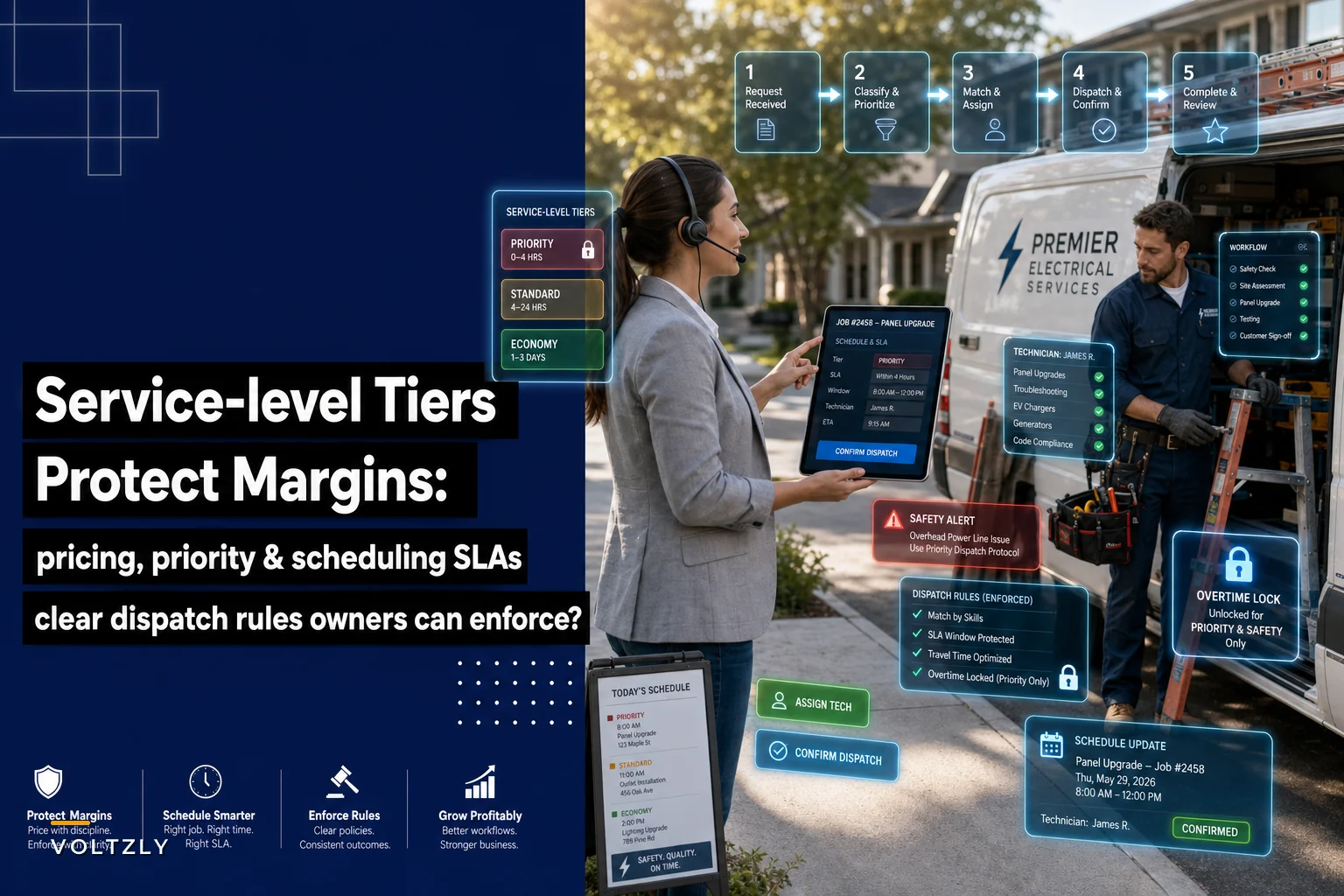
A service tier is not "gold, silver, bronze" with vague perks. A real tier is a bundle of four specific commitments:
Never miss a job or delay a dispatch again.
Voltzly helps you schedule, assign, and track every electrical job efficiently.
- Unified job scheduling
- Real-time technician tracking
- Automated client notifications
No credit card required
-
Response window — how fast you guarantee arrival, not a vague "soon"
-
Scheduling priority — where this customer sits when slots compete
-
Pricing differential — what the speed and priority actually cost
-
Dispatch rule — who gets sent and whether overtime is authorized
If a tier doesn't change at least three of those four things versus the tier below it, it's not a real tier — it's just a name. What you see constantly is shops with three "tiers" that all get the same response time and the same tech, with the only difference being a sticker price. Customers figure that out fast.
Here's a matrix structure that holds up for a residential shop running somewhere between 4 and 15 techs:
| Dimension | Priority (Plan Member) | Standard | Economy / Scheduled |
|---|---|---|---|
| Response window | Same-day, within 4 hrs during business hours | Next business day | Within 3–5 business days |
| After-hours access | Yes, reduced rate | Yes, full emergency rate | Not offered |
| Scheduling priority | Jumps the queue; bumps Standard & Economy | Bumps Economy only | Fills gaps, never bumps |
| Diagnostic fee | Waived or credited to job | Full fee | Full fee |
| Tech assignment | Qualified for job complexity, OT authorized | Standard assignment | Whoever has open capacity |
| Pricing | Monthly plan + member rates (~10–15% off labor) | Full retail | Full retail, slight discount for flexibility |
Notice the Economy tier. Most shops skip it, and that's a mistake. A customer who says "I don't care if it takes a week, just give me the best price" is volunteering to fill your dead Tuesday afternoon between appointments. Price that flexibility and your route density improves without you doing anything else.
The pricing differential is the part owners get wrong
The instinct is to price tiers based on what the customer gets. The better approach is to price based on what each tier costs you to deliver.
A same-day priority response doesn't just carry a premium — it costs you a disrupted route, possible overtime, and the opportunity cost of whatever job you had to push. A realistic example: a plan member calls at 1 PM, you reroute a tech, add roughly 25 minutes of extra drive time, and push a scheduled job to the next day. That reroute has a real number attached — fuel, labor time, and the risk the bumped customer cancels.
If your priority tier doesn't price in that disruption, you're subsidizing speed out of your own margin. For most residential shops, what works is a priority tier carrying a 10–15% labor premium on non-plan emergency work, with plan members paying a monthly fee — commonly somewhere in the $15–$35/month range — that pre-buys their priority slot. The monthly fee matters because it converts unpredictable disruption into predictable recurring revenue. You've been paid in advance for the inconvenience.
Economy tier gets the inverse logic. Because that customer lets you schedule them around your route, they cost less to serve. Passing back a small discount — 5–8% — is cheap insurance against an empty slot.
Dispatch rules: the enforcement layer
Tiers mean nothing if the dispatcher can override them every time a customer gets loud. The dispatch rules are what make the SLA real. Write them as if-then statements a dispatcher can follow without calling you:
The bump hierarchy (read top to bottom):
-
A genuine safety emergency (active sparking, burning smell, no power to medical equipment, water contact) overrides every tier. Safety is never a pricing question.
-
A Priority plan member bumps any Standard or Economy job.
-
A Standard job already en route does not get bumped by a new Standard job — first committed, first served.
-
An Economy job never bumps anything and is always the first candidate to move.
-
Overtime is authorized only for Priority members and true safety calls — never to rush a Standard customer who's just impatient.
That last rule alone protects more margin than most owners expect, because the impatient Standard customer is exactly who talks a soft dispatcher into paying a tech overtime.
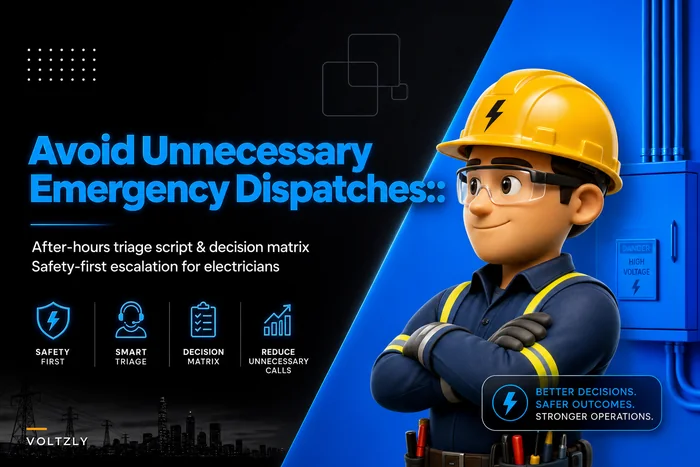
The hard part is the word "genuine" in that first bullet. Your phone staff need a script to separate real emergencies from scared customers, or everything becomes an emergency. A structured intake process earns its keep here — a tight after-hours triage script and decision matrix keeps the "buzzing outlet" calls from auto-escalating and burning your emergency capacity on jobs that could've waited until morning.
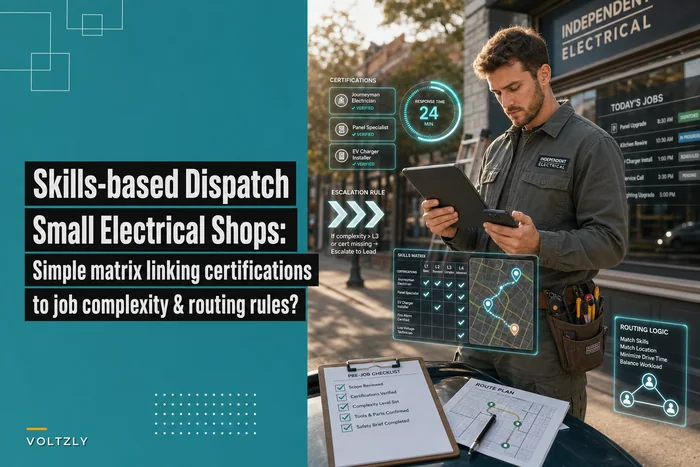
The "tech assignment" row in your matrix can't be an afterthought either. Sending your most expensive tech to a simple Economy job, or a junior tech to a complex Priority panel issue, wrecks both margin and quality. Matching the right person to the job complexity is its own discipline — a skills-to-complexity dispatch matrix pairs cleanly with the tier structure so "priority" doesn't accidentally mean "send whoever, fast."
Below is a simple visualization of the dispatch decision workflow.
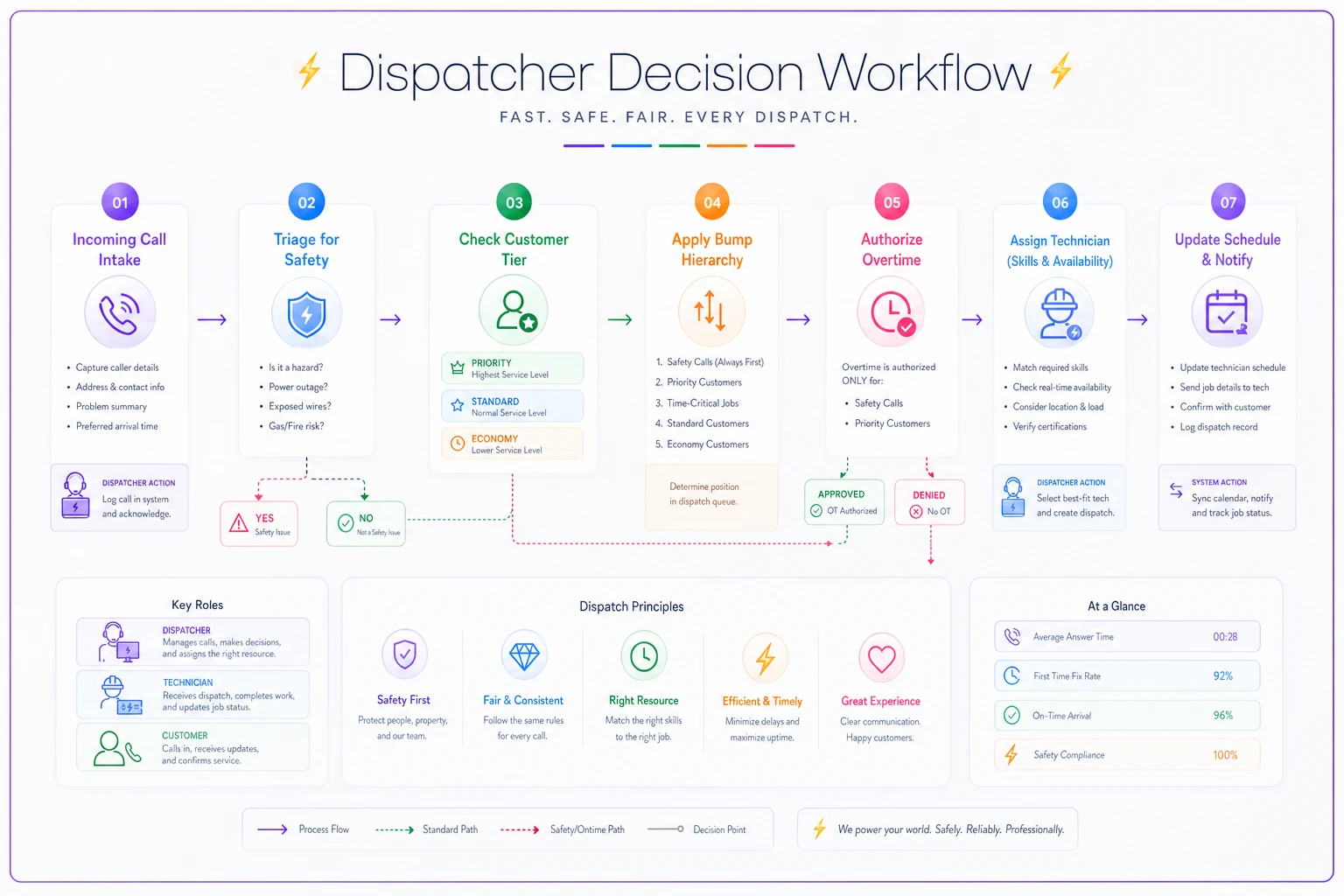
The visualization helps make the decision steps obvious so dispatchers can follow the rules without calling for permission.
Walking through one real shift
Here's how the matrix plays out across a single afternoon.
-
Plan member — flickering lights, wants someone today.
-
New customer — kitchen outlets dead, no plan, asking for same-day.
-
Scheduled Economy customer — booked three days ago for an outlet addition.
-
New customer — smells burning near the panel, called 90 seconds ago.
Without a matrix, the dispatcher panics and the Economy job gets bumped by whoever argued hardest.
With the matrix: Call 4 is a genuine safety call — one free tech goes immediately, overtime authorized if needed. The plan member (Call 1) takes the second free tech, because Priority beats everything non-safety. The dead-outlet new customer (Call 2) gets quoted the Standard next-business-day window and a full diagnostic fee — if they want faster, they're offered the priority upgrade at the premium rate, which either earns the margin or filters out the bargain hunter. The Economy customer (Call 3) stays exactly where they are, because Economy never gets bumped, which means they stay happy and refer people.
A short real scenario
A residential shop running seven techs in a mid-size metro was handling around 320–350 service calls a month. They advertised "same-day service" with no tier structure behind it. Roughly a third of their calls got treated as same-day rush jobs, and the dispatcher was authorizing overtime two or three times a week to keep those promises.
They published a three-tier matrix, trained phone staff on an intake script, and gave the dispatcher the bump hierarchy on a laminated card. Nothing complicated.
Over the next couple months, the share of "rush" jobs dropped to something closer to 12–15%, because Standard customers were getting a clear next-day quote instead of a vague promise, and the ones who genuinely needed speed paid the priority premium. Overtime spend fell noticeably — not to zero, but close to half what it had been. Plan membership started climbing because the priority tier finally meant something customers could actually feel. The owner's rough estimate was a few thousand dollars a month in recovered margin, mostly from overtime reduction and fewer bumped-then-cancelled jobs.
None of that required new technology. It required deciding the rules once and refusing to renegotiate them on every call.
When this makes sense — and when it doesn't
This makes sense when:
-
You're running 4+ techs and the dispatcher is making priority calls dozens of times a week
-
You already sell or want to sell service plans and need the priority tier to have real teeth
-
Overtime or bumped jobs are a recurring source of margin leak
This is a bad idea when:
-
You're a one or two-person shop where the owner dispatches and knows every customer — formalizing tiers adds overhead you don't need yet
-
Call volume is low enough that jobs rarely compete for the same slot
-
You haven't standardized your pricing — tiers on top of chaotic pricing just add a second layer of confusion
Who should NOT publish tiers yet: any shop that can't reliably hit its standard response time. If you promise next-business-day and routinely miss it, adding a premium tier just creates two broken promises instead of one. Fix baseline reliability first, then layer tiers on top of something that actually works.
Keeping the matrix enforceable over time
The matrix decays if it only lives on paper. Two things keep it alive.
First, the dispatcher needs the rules visible at the moment of decision — not buried in a binder, but in front of them when two jobs compete. Shops that run dispatch and scheduling through an operational software platform have a real advantage here, because the tier, the response window, and the bump rules can attach to the customer record and surface automatically when a call comes in. The dispatcher sees "Priority member — 4hr window — OT authorized" instead of trying to remember who's on a plan at 4:45 on a Friday. That's the quiet value of tying your SLA structure into the software actually running your scheduling: the rule enforces itself instead of depending on someone's memory.
Attach the bump hierarchy to the scheduling screen so the dispatcher sees the rules at the moment of decision.
Second, review the tier mix monthly. Watch the ratio of Priority to Standard to Economy jobs. If almost everything lands in Standard, your tiers aren't differentiated enough or your intake staff isn't offering the upgrade. If everything's an "emergency," your triage script has holes.
The whole structure exists to make a hard decision easy and repeatable. Decide once what each tier is worth, who it bumps, and what it costs — then let the dispatcher execute without having to win an argument every single time. That's the difference between advertising fast service and actually running a shop where speed is a product you can price and protect.
Ready to optimize your electrical service operations?
Join 500+ electrical service companies using Voltzly to improve scheduling accuracy, enhance client satisfaction, and boost operational efficiency.