

Your apprentice just showed up to a 400-amp commercial panel upgrade. Your master electrician is replacing outlets at a residential property. Nobody's tracking who has what certifications, and you're basically guessing when you assign jobs each morning.
This mismatch happens in almost every small electrical shop running 3–15 techs. You know Tom's great with generators and Sarah handles control systems, but that knowledge lives in your head. When you're not around, whoever's answering phones sends whoever's available. The result? Overpaid techs doing basic work, underqualified techs facing complex installations, and customers getting inconsistent service.
Why certification tracking falls apart in small shops
Most electrical contractors start with a spreadsheet somewhere. Maybe HR has a folder with license copies. Someone might remember who took that arc flash safety course last year. Then operational reality kicks in.
You're juggling state licenses, manufacturer certifications, safety training, specialty endorsements—each tech with different expiration dates, different skill levels, different comfort zones. Tom might have his journeyman license but zero experience with solar. Mike's solid on residential but gets nervous around three-phase systems.
Enterprise solutions assume you have dedicated dispatchers, training coordinators, maybe even a competency management system. They want you to build skill taxonomies, run assessment centers, track proficiency scores. Small shops don't operate that way. You need something that works when your dispatcher is also your estimator, your office manager is part-time, and you're making dispatch calls from your truck between jobs.
Building a practical skills matrix
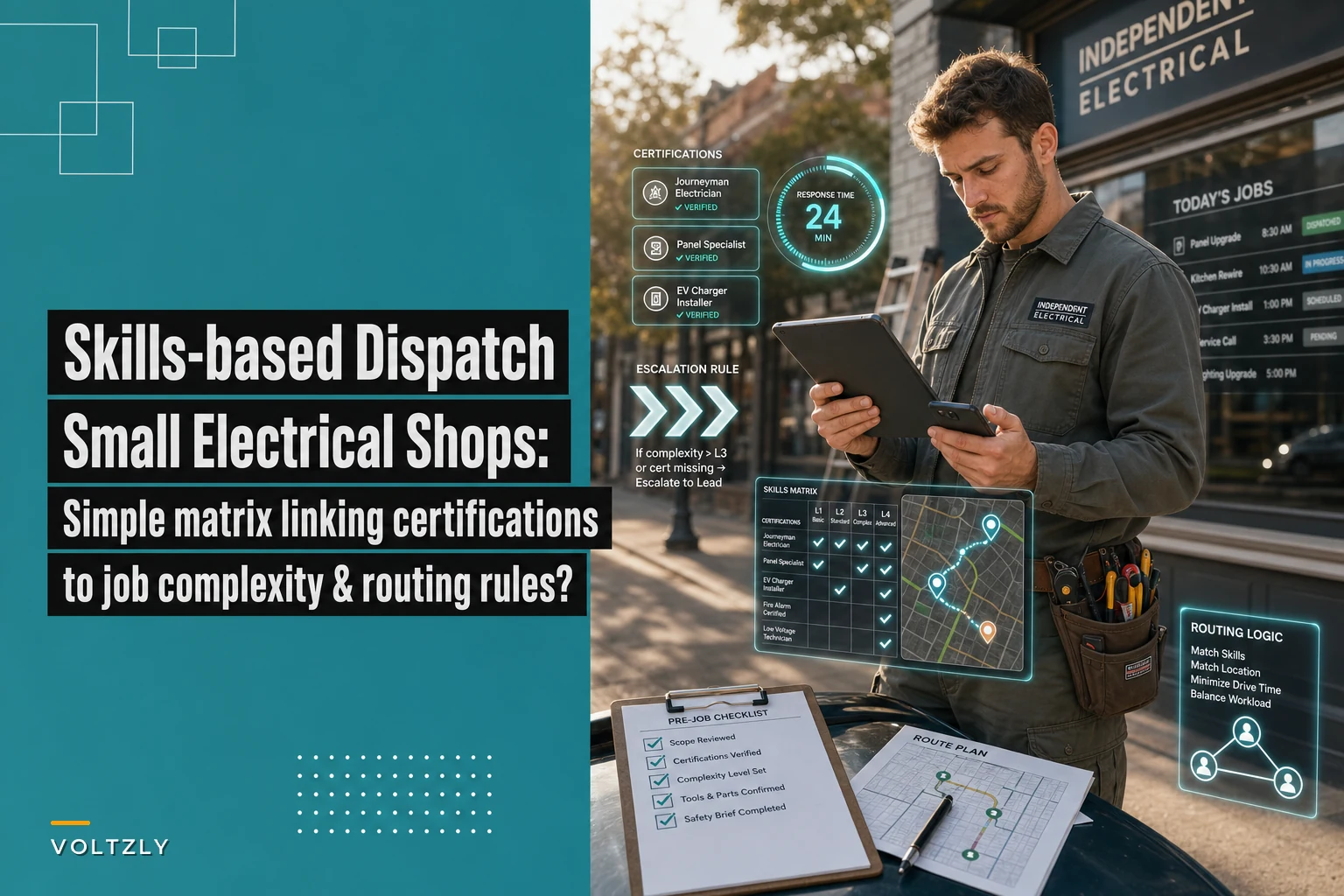
For shops under 15 techs, a simple grid works well—techs down the left, job types across the top. But skip binary checkboxes. Use a three-level system instead:
Never miss a job or delay a dispatch again.
Voltzly helps you schedule, assign, and track every electrical job efficiently.
- Unified job scheduling
- Real-time technician tracking
- Automated client notifications
No credit card required
Level 1 - Can assist: Tech can work on this with supervision
Level 2 - Can complete: Tech handles standard jobs independently
Level 3 - Can troubleshoot: Tech handles complex scenarios and can train others
Start with your main job categories. For most residential shops:
-
Basic residential (outlets, switches, fixtures)
-
Panel upgrades (100A, 200A, 400A)
-
Troubleshooting (circuit issues, intermittent problems)
-
Smart home (automation, low voltage)
-
Generators (portable, standby, transfer switches)
-
EV chargers (Level 2, hardwired)
-
Commercial basics (three-phase, lighting controls)
-
Solar/battery (if applicable)
Now the part that matters—don't just track certifications. Track real capability. Your journeyman might be certified for everything but only comfortable with half of it. Your third-year apprentice might be excellent at smart home installs despite limited formal training.
| Tech Name | Basic Res | 200A Panel | Troubleshoot | Smart Home | Generator | EV Charger |
|---|---|---|---|---|---|---|
| Tom M. | 3 | 3 | 3 | 1 | 3 | 2 |
| Sarah K. | 3 | 2 | 2 | 3 | 1 | 3 |
| Mike R. | 2 | 1 | 1 | 2 | - | 1 |
| James L. | 1 | - | 1 | 1 | - | - |
Update this monthly. Takes five minutes during regular one-on-ones. "Mike, how comfortable are you with panel upgrades now?" Simple conversation, quick update.
Update this monthly.
Update this monthly. Takes five minutes during regular one-on-ones. "Mike, how comfortable are you with panel upgrades now?" Simple conversation, quick update.
Certification expiration tracking that actually happens
Expired licenses cost money. Sometimes it's an OSHA fine, sometimes you lose a commercial bid, sometimes your insurance company denies a claim. Most shops track expirations poorly because they treat it like an HR function instead of an operational one.
Put expiration tracking where dispatch decisions happen. Shared calendar? Create recurring alerts 60 days before expiration. Still on a whiteboard? Dedicate a corner to "Certs Expiring This Quarter."
The critical certifications for most shops:
-
State electrical license (obviously)
-
OSHA 10/30 (for commercial work)
-
Manufacturer certs (especially for warranty work)
-
Arc flash/NFPA 70E (for industrial clients)
-
Confined space (if you do any industrial)
-
First aid/CPR (insurance discount)
Don't track everything. Focus on what affects dispatch decisions or customer requirements. That decorative lighting certificate from 2019 probably doesn't matter. The Lutron programming cert for high-end residential? Track that one.
Job complexity tags that match your reality
Complexity scoring gets overcomplicated fast. Enterprise systems want you to rate jobs across multiple dimensions—technical difficulty, safety risk, customer sensitivity, time pressure. Small shops need something simpler.
Green Tag - Basic: Any apprentice can handle with minimal supervision
-
Replacing devices (outlets, switches)
-
Installing basic fixtures
-
Running simple circuits
-
Basic troubleshooting
Yellow Tag - Standard: Requires journeyman or experienced apprentice
-
Panel upgrades
-
New circuit installations
-
Generator hookups
-
Most service calls
Red Tag - Complex: Needs your best tech or a specific certification
-
Commercial three-phase work
-
Solar interconnections
-
Complex troubleshooting
-
Warranty-sensitive installs
-
High-value customer properties
Tag jobs during the initial phone call—takes two seconds. "Customer wants a Tesla charger installed, checking panel capacity" is Yellow unless they need a panel upgrade, then it might go Red.
Escalation triggers based on skills
Sometimes a simple job turns into something else. Your apprentice shows up to install three outlets and finds aluminum wiring. Your journeyman starts a panel upgrade and runs into Federal Pacific breakers. These situations need clear escalation rules, not guesswork.
Immediate escalation (call senior tech now):
-
Aluminum wiring in residential
-
Federal Pacific or Zinsco panels
-
Any knob-and-tube wiring
-
Water damage near electrical
-
Customer mentioning previous electrical fires
-
Code violations affecting safety
Next-day escalation (schedule senior tech follow-up):
-
Intermittent problems the apprentice can't solve
-
Customer requesting additional work beyond original scope
-
Quotes exceeding certain thresholds
-
Commercial customers with specific compliance needs
Documentation triggers (take photos, get senior review):
-
Any non-standard installation
-
Warranty work for equipment you didn't install
-
Insurance claim jobs
-
Anything that "feels wrong" to the tech on site
Make these visible. Laminate a card for each truck. When techs hit these situations, they know exactly what to do instead of trying to power through.
Routing rules that prevent windshield time
Skills-based dispatch isn't just about matching certifications to jobs. Geography matters when you're burning $5/gallon in diesel. But pure geographic routing breaks down when your closest tech can't handle the work.
A practical approach: morning dispatch starts with skill requirements, not location. Identify must-have matches first—jobs requiring specific certifications or expertise. Lock those assignments. Then optimize the remaining jobs geographically.
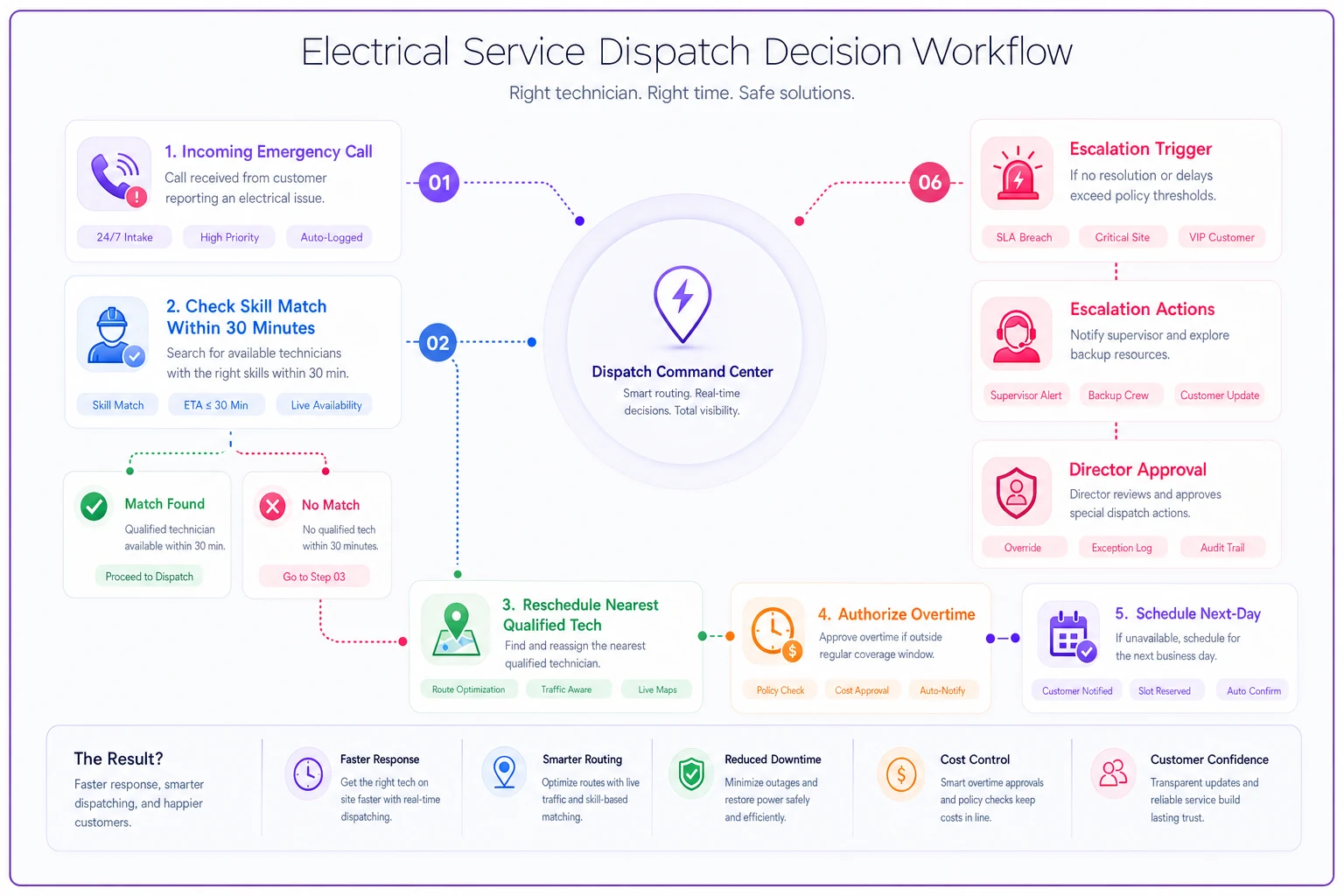
For emergency calls during the day, use this decision tree:
-
Can anyone within 30 minutes handle it? (skill match + proximity)
-
If no, can we reschedule the nearest qualified tech's current job?
-
If no, is overtime justified for the right tech?
-
If no, set expectations with the customer for next-day service
Use this decision flow for emergency routing.
Some shops try to maintain coverage zones—Tom handles north side, Sarah covers downtown. This breaks constantly. Tom's sick, Sarah's on vacation, north side has three generator installs while downtown's dead. Flexible zones with skill overlays work better. Everyone can work anywhere, but you keep Tom near his commercial clients and Sarah close to her smart home customer base where it makes sense.
The Monday morning dispatch meeting
Small shops often dispatch by text thread or a quick huddle in the parking lot. This works until someone misses critical information. A five-minute Monday dispatch meeting prevents most coordination failures.
Pull up your skills matrix and the week's job list. Walk through the complex jobs first—who's handling the industrial panel upgrade Wednesday? Who's the backup if they hit complications? Then fill in the standard work.
-
"Tom's generator cert expires Thursday, he needs to renew before the hotel job"
-
"We have three EV charger installs but only Sarah's certified, so space them out"
-
"Mike needs supervised panel experience, pair him with Tom on Tuesday"
Not about micromanaging. It's about preventing the Thursday afternoon scramble when you realize nobody on site can legally complete the work.
Real shop example: from chaos to coordination
A residential shop in Phoenix ran seven techs—two masters, three journeymen, two apprentices. Dispatching purely by availability. Senior techs driving across town for basic work while apprentices sat idle. Callbacks were running around 12% because underqualified techs were attempting complex repairs.
They built a basic matrix like the one above. Tagged incoming calls with complexity. Set up simple escalation rules on laminated cards. No software, no consultants—total setup took maybe three hours.
-
Callbacks dropped to around 4%
-
Senior techs spent more time on complex, profitable work
-
Apprentices got consistent, appropriate work instead of feast-or-famine
-
Drive time dropped roughly 20% from better routing
-
Customer satisfaction improved noticeably
The owner estimated they saved around $3,400 a month just from fewer callbacks and better tech utilization. A spreadsheet and some basic rules did all of that.
When skills-based dispatch breaks down
This system isn't perfect. Some situations make it nearly impossible:
Staff turnover chaos: When you're losing a tech monthly, maintaining accurate skill tracking becomes meaningless. Fix retention first.
Tiny teams: With only 2–3 techs, you don't have many dispatch choices. Everyone does everything.
Wildly varied work: If you're doing residential one day, industrial the next, then solar installs, your techs probably aren't specialized enough for skill-based routing to matter much.
Crisis mode operations: When you're booked three weeks out and fielding constant emergencies, survival beats optimization.
If you're in any of these situations, basic certification tracking for compliance is enough. Focus on fixing the underlying operational issues before adding dispatch complexity.
Converting paper systems to simple digital tracking
Most shops start with paper or whiteboards because it's visible and easy. But paper doesn't remind you about expiring certifications or help when you're dispatching from the field.
The move to digital doesn't require enterprise software. A shared spreadsheet handles the skills matrix. Calendar alerts track cert expirations. A simple intake form captures job complexity during the call. Even group texts can handle escalation if everyone knows the rules.
The key is simplicity. The moment your tracking system needs a manual to understand, techs stop using it. Keep it visual, keep it current, keep it where dispatch decisions actually happen.
For shops ready to go further, operational software built for trades can centralize skills tracking alongside dispatch decisions. Modern platforms can automatically match tech capabilities to job requirements, flag certification expirations, and suggest routing based on skills and location—the AI automation handles the matching logic while you keep control over the rules.
Common certification gaps that hurt small shops
Certain gaps show up repeatedly across electrical shops:
Manufacturer certifications: Techs can install the equipment but can't warranty it. You're leaving money on the table and frustrating customers who expect warranty support.
Safety certifications: One OSHA violation can seriously damage a small shop. Yet plenty operate with expired or missing safety certs, especially for newer hires.
Specialty endorsements: EV chargers, solar, generators, smart home—these higher-margin categories require specific certifications your competitors might already have.
Code update training: Electrical code changes every three years. Shops that don't track who's current on updates risk failed inspections and expensive rework.
Budget for roughly two certifications per tech per year. Let techs choose one that interests them, and you pick one the business needs. That balance builds both engagement and capability.
Tracking performance after dispatch
Skills-based dispatch only works if your assessments stay accurate. Two simple metrics per tech:
Callback rate by job type: If Tom's getting callbacks on generator installs, maybe he's not quite at Level 3 on generators.
Time to completion vs estimate: If Sarah consistently takes 50% longer on panel upgrades than estimated, she might need more experience before going solo.
Don't turn this into performance management. It's operational calibration. The goal is accurate dispatch, not employee evaluation. When you spot patterns, address them with training or adjusted skill ratings.
Some shops worry techs will feel micromanaged. Frame it as professional development. "Based on the last few jobs, seems like some more practice with three-phase would help before taking those solo. Let's pair you with Tom next week." Most techs prefer working within their comfort zone over struggling through jobs they're not ready for.
Building career paths through skill progression
Skills tracking also surfaces development opportunities you'd otherwise miss. Your apprentice who's eager to learn smart home systems—now you can intentionally assign them as helper on those jobs. The journeyman who wants to move into commercial—track their three-phase experience and safety certifications, and build toward it.
Share the matrix with techs quarterly. Show them where they stand, what certifications they need for advancement, which skills lead to higher wages. That transparency turns skills-based dispatch from a management tool into something techs actually care about.
Consider pay differentials for critical certifications. EV charger certified? Extra $2/hour. Can troubleshoot complex commercial systems? Another $3/hour. Clear incentives for skill development, and more dispatch flexibility for you.
Integration with existing operations
Skills-based dispatch connects to other parts of your operation.
Your emergency dispatch decision matrix needs to account for who's on call AND whether they can handle the work. No point sending your apprentice to a midnight commercial power outage.
The KPIs you track for hiring and training decisions should include utilization by skill level. If master electricians are doing 40% basic work, you need more apprentices—not more masters.
The progression path: from chaos to coordination
Small shops typically move through predictable stages:
Stage 1 - Gut feel: Owner knows who does what, assigns jobs from memory
Stage 2 - Basic tracking: Spreadsheet with certifications, manual dispatch
Stage 3 - Systematic dispatch: Skills matrix, complexity tags, clear rules
Stage 4 - Optimized operations: Digital platform handling matching logic
Most shops get stuck at Stage 1 or 2. They know they should track better but can't find time to build the system. The jump to Stage 3 takes maybe a week of effort and pays back quickly in fewer callbacks and better tech utilization.
Making skills-based dispatch stick
The difference between shops that maintain dispatch discipline and those that don't comes down to habit. Build these into the routine:
-
Daily Tag job complexity during intake calls
-
Weekly Review upcoming jobs against the skills matrix in the Monday meeting
-
Monthly Update skill levels based on recent performance
-
Quarterly Review certification expirations and training needs
Don't wait until the system is perfect before starting. A rough skills matrix updated occasionally beats no system at all. Start with the obvious mismatches—stop sending apprentices to complex calls, stop burning master electricians on outlet swaps—then refine from there.
This is about operational efficiency, not academic accuracy. Your skills matrix doesn't need to capture every nuance of capability. It needs to prevent the expensive mistakes: callbacks from underqualified work, overpaid techs on simple jobs, and customers frustrated by multiple truck rolls.
For most shops under 15 techs, a simple spreadsheet, basic complexity tags, and clear escalation rules will genuinely transform your dispatch operation. Right tech, first time. Less windshield time, fewer callbacks, and you actually know who can handle what—without enterprise software or complex systems.
The shops that stick with skills-based dispatch consistently see better tech utilization, higher customer satisfaction, and improved profitability. Not because their systems are perfect, but because they stopped guessing and started tracking what actually matters.
Ready to optimize your electrical service operations?
Join 500+ electrical service companies using Voltzly to improve scheduling accuracy, enhance client satisfaction, and boost operational efficiency.