

Most bad job outcomes in small electrical shops don't come from techs who don't know what they're doing. They come from techs who half-know what they're doing and keep going anyway. A junior guy opens a panel, sees something weird — double-tapped breakers, aluminum branch wiring, a service that's clearly been backfed — and instead of stopping, he makes a call on his own because he doesn't want to look like he can't handle it.
That single decision is where the money leaks. Not the mistake itself, but the fact that nobody had a rule telling him this was a stop-and-call moment, not a keep-going moment.
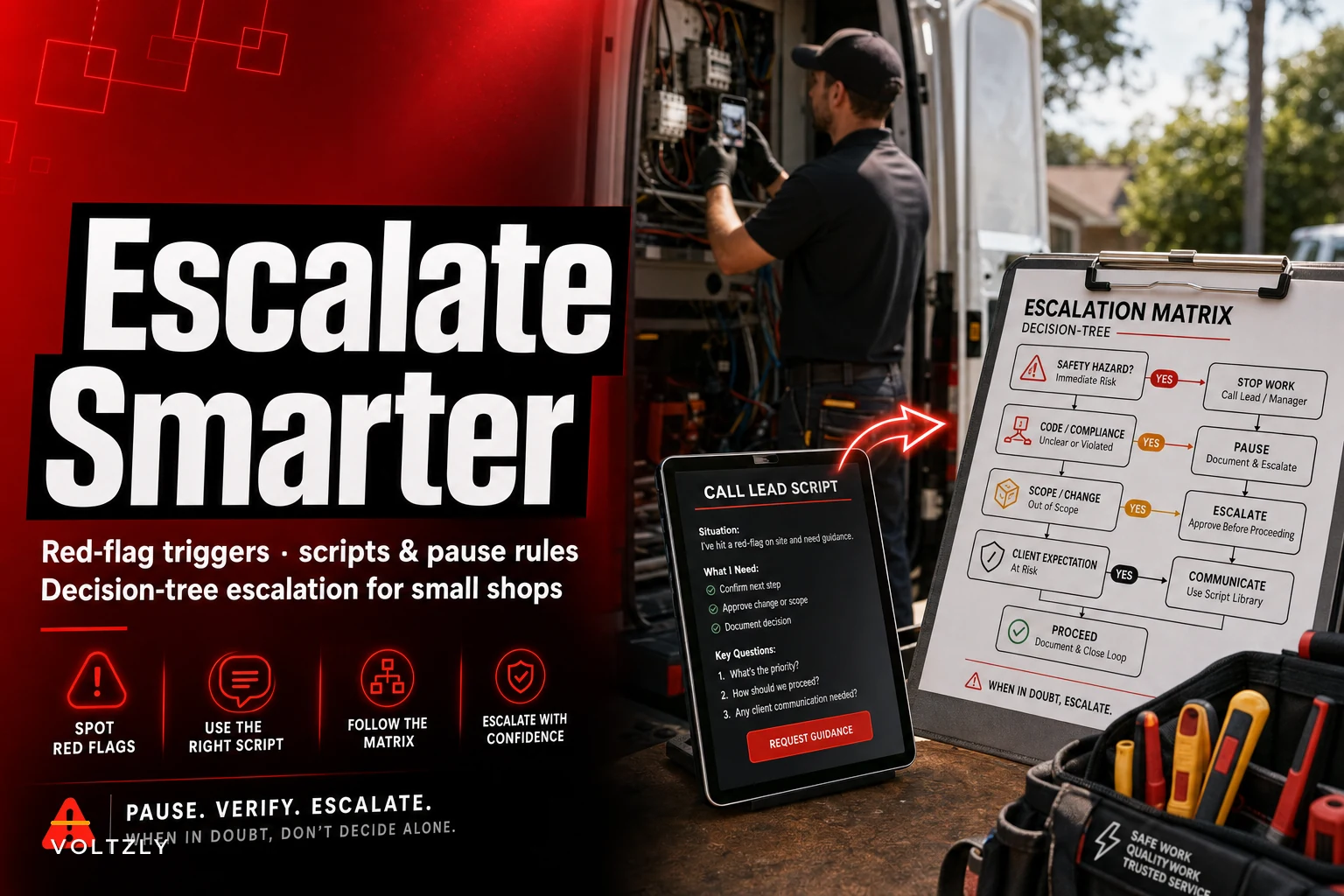
An escalation matrix for electricians isn't paperwork. It's a pre-agreed list of situations where the answer is "you don't decide this alone." When it's built right, your least experienced tech knows exactly what triggers a phone call, exactly who to call, and exactly what to say when they do. That last part — what to say — is where most shops fall apart, so we'll spend real time on scripts.
Why field techs push past red flags they can clearly see
There are three reasons a tech keeps working when they should stop, and none of them are stupidity.
First, ambiguity. Nobody ever told them where the line is. "Use your judgment" is a great instruction for someone with 15 years in. For a two-year tech, it's a trap. They'll guess, and half the time they'll guess toward finishing the job because that's what feels productive.
Second, ego and momentum. A tech is 40 minutes into a service upgrade, the homeowner is standing there, and something unexpected turns up. Stopping now feels like admitting failure in front of a customer. So they improvise.
Third — and this is the sneaky one — bad incentives. If your shop quietly punishes techs for slowing down a job or generating callbacks from asking too many questions, you've trained them to hide problems. Shops with the fewest escalation calls aren't always the best crews. Sometimes they're just the ones who learned that calling in gets them chewed out.
The fix isn't a motivational speech. It's removing the judgment call entirely for a specific set of conditions. If X is true, you stop. No interpretation needed.
Red-flag criteria: conditions that should never be a solo decision
The trick with red flags is keeping the list short enough that techs actually remember it. A 40-item checklist gets ignored. A tight list of hard triggers gets used.
Never miss a job or delay a dispatch again.
Voltzly helps you schedule, assign, and track every electrical job efficiently.
- Unified job scheduling
- Real-time technician tracking
- Automated client notifications
No credit card required
-
Service and utility issues — evidence of a backfed service, meter tampering, unknown service size, or anything requiring utility disconnect coordination
-
Legacy wiring hazards — aluminum branch circuits, knob-and-tube still energized, cloth-insulated wire crumbling on contact
-
Scope explosion — the actual job is materially bigger than what was sold (found more than roughly 20–25% additional labor hidden behind the wall)
-
Structural or permit conflicts — panel location now violates clearance, work clearly needs a permit that wasn't pulled, load calc doesn't support what was quoted
-
Safety-now conditions — burnt buss bar, melted insulation, water in a panel, active arcing signs, anything smelling like ozone or scorched plastic
-
Customer conflict — homeowner refuses recommended safety work, disputes scope, or pressures the tech to do something off-book
-
Anything the tech simply hasn't done before unsupervised
That last one gets skipped in most shops and it's probably the most valuable. "I've never done this specific thing on my own" should be a legitimate, non-embarrassing trigger. If it isn't, techs learn on live customers and you eat the callbacks.
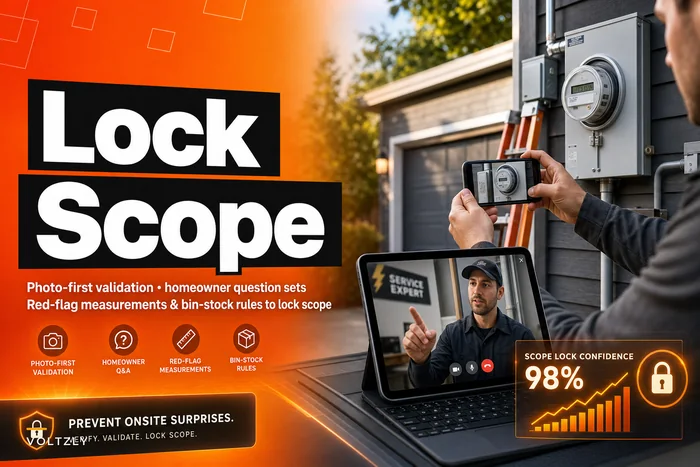
A lot of these red flags overlap with what should've been caught earlier during scoping. If you're consistently discovering big surprises mid-job, the problem might actually be upstream — worth tightening your photo-first remote site validation process so fewer of these show up as field surprises in the first place.
The three-level escalation structure
Most small shops don't need seven tiers. They need three, clearly defined by who can actually unblock the situation.
| Level | Trigger type | Who gets contacted | Expected response time | Can work continue while waiting? |
|---|---|---|---|---|
| L1 – Consult | Tech unsure, minor scope question, method confirmation | Senior tech or lead | Within ~15 min | Only non-affected work |
| L2 – Pause & decide | Scope explosion, permit conflict, customer dispute, unfamiliar high-risk task | Owner / ops / master electrician | Same day, before proceeding | No — job on the affected system stops |
| L3 – Hard stop | Immediate safety hazard, code violation with liability, utility issue | Owner + possibly outside engineer/subcontractor | Immediate | No — power down, secure site, may leave |
The important design principle: the level is set by consequences, not by how confident the tech feels. A confident tech staring at a melted buss bar is still an L3. Confidence is not a data point in this system.
Worth noting too — L1 allows work to continue on unaffected areas, L2 and L3 don't. That distinction has to be crisp. The most expensive failures happen when a tech treats an L2 like an L1, keeps working "while waiting for a callback," and turns a scope conversation into a done-deal problem you're now arguing about with the customer after the fact.
Scripts for each level (this is the part that actually gets used)
Techs freeze on the phone because they don't know how to frame the situation without sounding incompetent. Give them the exact words and the calls actually happen.
L1 – Consult script (tech to lead):
> "Quick one — I'm at the Delgado job, kitchen circuit. I've got what I think is a shared neutral on a multi-wire branch circuit and I want to confirm before I split these. Can you look at the photo I just sent? I'm not touching it until you confirm."
Specific, references a photo, ends with a clear stopping point. No rambling.
L2 – Pause & decide script (tech to owner/ops):
> "Flagging a scope issue at the Hoffman panel swap. Opened it up and the feeders are undersized for the new panel and there's clear water staining at the bottom. This is beyond what we quoted — I'm estimating another 3–4 hours plus materials. I've stopped work on the panel and I'm not proceeding until we decide how to handle it with the customer. What do you want me to do?"
The key phrases are "I've stopped work" and "not proceeding until we decide." That protects you legally and financially, and it kills the "well the tech already started so we're committed" problem.
L3 – Hard stop script (tech to owner):
> "Safety stop at the Reyes service. Buss bar is burnt and there's discoloration up the neutral. I've killed the main and I'm not re-energizing. I need a decision on utility coordination and whether we're calling this a hazard the customer has to address before we do anything else. Documenting with photos now."
Customer-facing script when a tech has to pause in front of the homeowner:
> "I want to be straight with you — I found something behind here that changes the safe way to do this, and I'm not going to guess on your home's electrical. I'm getting my lead on the phone right now so we do this correctly and I can give you an accurate number. Give me five minutes."
Homeowners almost never react badly to that. What they react badly to is a tech quietly improvising and then hitting them with a surprise later.
A workflow that makes escalation the path of least resistance
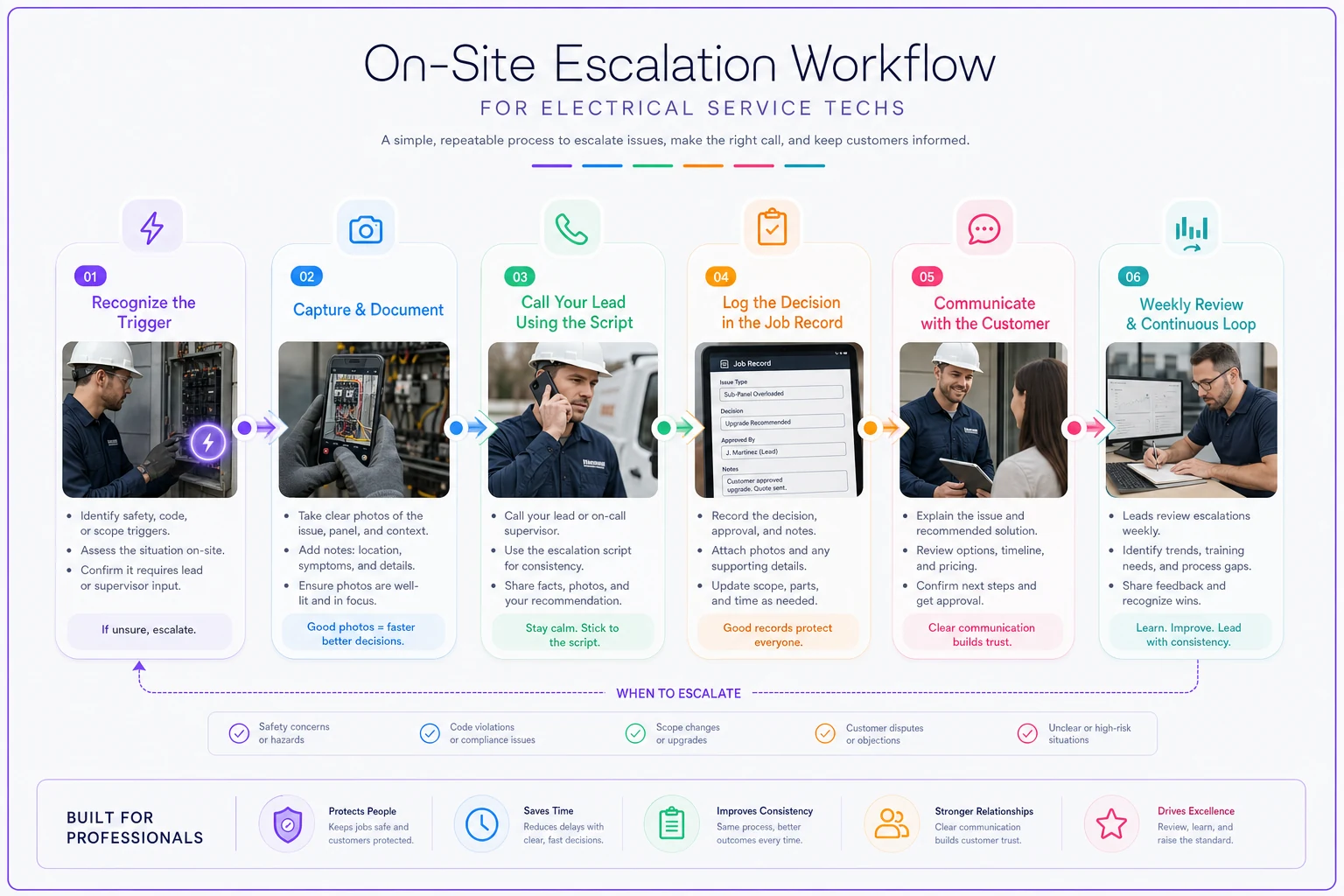
Rules only work if following them is easier than ignoring them. Here's the operational loop that holds this together:
Making the photo step mandatory before calling both forces a pause and gives the decision-maker clear context.
-
Trigger recognition — tech hits a red-flag condition from the list
-
Immediate documentation — before the phone call, tech snaps 2–3 photos of the condition (this forces a pause and gives the decision-maker real context)
-
The call — tech uses the level-appropriate script; the level is set by the red-flag category, not negotiation
-
Decision logged — whoever makes the call records what was decided and why, tied to the job
-
Customer communication — if scope or safety changes, the customer is told before more work happens, not after
-
Post-job review — escalations get looked at weekly, not to punish, but to spot patterns
Step 2 does quiet heavy lifting. A tech who has to photograph the problem before calling is a tech who can't act impulsively. The documentation step is basically a speed bump on bad decisions, and most techs don't even realize that's what it's doing.
The weekly review in step 6 is where you actually learn things. If the same tech keeps escalating the same category, that's a training gap you can close. If everyone's escalating the same panel type, maybe your estimating team is consistently under-scoping it. Escalation data is one of the cleaner signals you have about where your shop is genuinely weak.
Here's a quick visual of the loop to make it easy to train on.
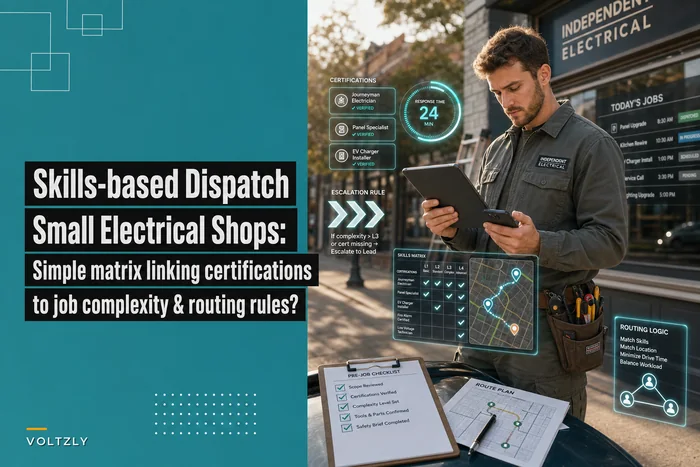
This is also where escalation ties directly into who you send where. If your dispatch already matches certification level to job complexity, a lot of L1 and L2 calls disappear because the right person was on site to begin with — that's the whole logic behind skills-based dispatch matching techs to job complexity.
What this looks like with real numbers
A three-tech residential shop doing mostly service upgrades and troubleshooting kept getting burned on a specific pattern — junior techs discovering undersized feeders or hidden scope during panel swaps, then just doing the extra work without telling anyone. The customer would get a bill that didn't match the quote, argue it down, and the shop would eat the difference to avoid a bad review.
They tallied it up over a few months: roughly six to eight swallowed overages a quarter, averaging somewhere around $400–$700 in unbilled labor and material each. Call it $3k–$4k a quarter leaking out because scope changes never triggered a customer conversation.
After putting in a simple three-level matrix — laminated card in each van, the L2 script taped to the inside of the panel-swap kit — the change wasn't overnight. But within a couple months the swallowed overages basically stopped. Not because the surprises stopped happening. The surprises still came up at roughly the same rate. The difference was that now they turned into approved change orders instead of silent losses. Same problems, different outcome, because someone paused and made a call before committing.
One unexpected side effect: the junior techs got more confident, not less. Knowing there was a clear "call now" rule took the pressure off faking competence. They stopped guessing.
When a formal escalation system is overkill
If you're a solo operator or a two-person shop where the owner is on most jobs, a three-tier matrix is probably more structure than you need. You're already the escalation path. What you actually need is just a written red-flag list so that on the rare job you send someone alone, they know the stop conditions.
It's also a bad idea to build this if you're not prepared to protect the behavior. Install a matrix, then groan every time a tech escalates, and you'll train them right back into hiding problems. Now you've got a useless laminated card nobody touches. The system is only as good as your reaction to the first few calls.
Don't over-engineer the tiers either. Shops that build five or six escalation levels end up with techs who can't remember which is which, so they default to the old behavior — guessing. Three levels, tied to consequences, is the sweet spot for small operations.
Where software quietly helps
None of this requires software. A laminated card and a phone will get you most of the value. But once you're running more than a couple of crews, the manual version starts to strain in two places: logging the decisions and spotting the patterns.
That's where an operational platform earns its keep — not by making escalation calls, but by making the paper trail effortless. When a tech triggers a pause, the photos, the decision, and the customer approval all attach to the job automatically instead of floating around in someone's texts. The weekly pattern review takes ten minutes instead of an hour of digging. Some teams use AI-assisted tools to flag when logged hours are drifting past the quote in real time, which can surface a scope issue before the tech even consciously registers it.
Useful, but secondary. The matrix and the scripts are the real machinery. The software just keeps the record clean.
The one thing to get right
Set the escalation level by consequence, never by how the tech feels about it. Every expensive field decision that unravels comes from someone applying their own confidence as the deciding factor instead of following an agreed-upon rule. A burnt buss bar is a hard stop whether the tech is nervous or cocky. Hidden scope is a pause whether they're in their first year or their tenth.
Write the red flags down. Tie each one to a level. Hand your techs the exact words to say. Then — the hard part — actually thank them the first few times they call. That's the whole system, and it'll save you more than any pricing tweak or route optimization ever will, because it stops losses you never even see on paper.
That's the whole system, and it'll save you more than any pricing tweak or route optimization ever will, because it stops losses you never even see on paper.
Ready to optimize your electrical service operations?
Join 500+ electrical service companies using Voltzly to improve scheduling accuracy, enhance client satisfaction, and boost operational efficiency.