


Most electrical shops live and die by whatever's on the board this week. Good week, three panel upgrades and a couple of EV installs. Bad week, a few troubleshooting calls and a lot of drive time. Revenue looks like a heartbeat monitor, and every owner eventually asks the same thing: how do I smooth this out so I'm not starting from zero every January?
Service plans are the obvious answer — and also the one most shops get wrong. They slap together a "maintenance membership," charge $199 a year, forget to schedule the visits, and by month eight they're carrying a liability they can't fulfill. The plan didn't fail because recurring revenue is a bad idea. It failed because nobody built the operational spine underneath it.
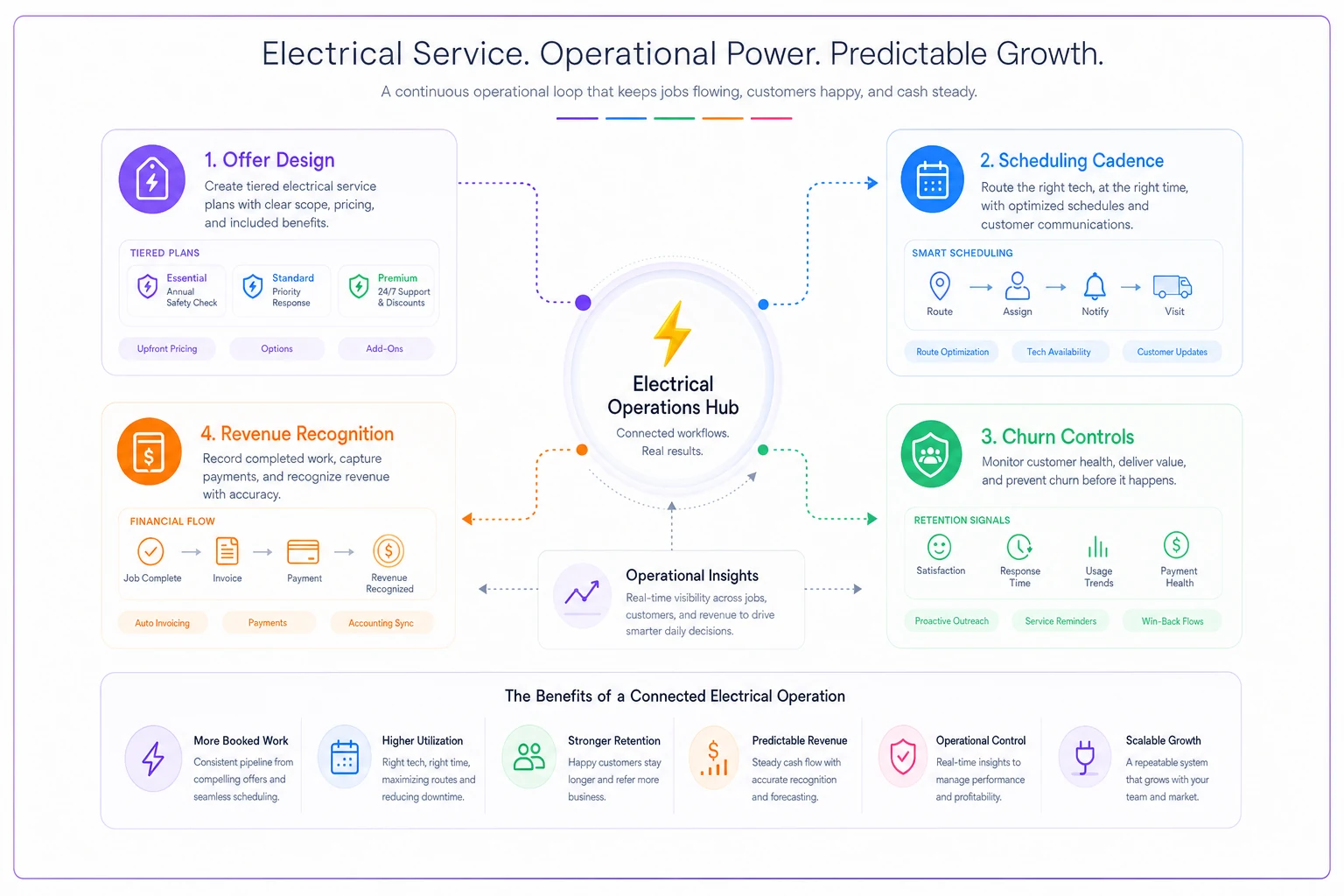
So this is less about "should you sell service plans" and more about how the whole thing connects — the offer design, the scheduling cadence that keeps you from drowning, the churn controls that keep members paying, and the accounting rules that keep your revenue numbers honest. Get those four things working together and service plans become the most reliable recurring revenue an electrician can build. Get one wrong and the whole thing quietly leaks.
Why single-tier plans almost always underperform
The first mistake is offering one plan. One price, one bucket of stuff. It feels clean, but it kills your economics two ways at once.
A single plan forces you to price for the average customer, which means you overcharge the light users and undercharge the heavy ones. The light users churn because they never feel the value. The heavy users stay forever because they're getting a bargain on your time. You end up subsidizing your worst-margin customers with the ones most likely to leave. That's backwards.
The second problem is that a single plan gives your customer no reason to spend more. No natural upgrade path. Someone with an aging 1970s panel and a hot tub they just installed is a completely different risk profile than a newer townhouse — but you're offering them the identical thing. Tiering fixes both problems. It lets price-sensitive customers self-select into something cheaper, gives your best customers room to buy more, and — this is the part people miss — it turns the middle tier into your anchor.
In practice, the middle tier is where you want 60–70% of members to land. Design the tiers so the middle one looks like the obvious value once someone compares it to the cheap option. That's not manipulation, it's just good menu design.
The three tiers, and what actually goes in each
Here's a structure that works for most residential and light-commercial shops. The names don't matter — Bronze/Silver/Gold, Basic/Plus/Priority, whatever fits your brand. What matters is that each tier does a different job in your business.
Never miss a job or delay a dispatch again.
Voltzly helps you schedule, assign, and track every electrical job efficiently.
- Unified job scheduling
- Real-time technician tracking
- Automated client notifications
No credit card required
| Tier | Target Customer | Annual Visit | Response Priority | Diagnostic Fee | Repair Discount | Panel/Breaker Check | Rough Monthly Price | Contract |
|---|---|---|---|---|---|---|---|---|
| Tier 1 — Essentials | Newer homes, low risk | 1 safety inspection | Standard queue | Reduced | 5% | Visual only | $9–$14 | Monthly, cancel anytime |
| Tier 2 — Protect (anchor) | Typical homeowner, some aging systems | 1 inspection + 1 seasonal check | Next-day scheduling | Waived | 10–12% | Thermal scan included | $22–$29 | Annual, monthly billing |
| Tier 3 — Priority | Older homes, high usage, small commercial | 2 full inspections | Same/next-day, front of line | Waived | 15% | Thermal scan + torque check | $45–$59 | Annual, monthly billing |
A few things worth calling out. The diagnostic fee waiver only kicks in at the middle tier — that's a real incentive to upgrade because homeowners feel the trip charge every time. Response priority is the actual product in Tier 3. When someone's older home loses half its outlets on a Friday night, "front of the line" is worth more than any discount you could put in front of them.
Don't over-stuff the tiers. The most common design failure is loading Tier 1 with so much value that nobody bothers upgrading. Keep the bottom tier genuinely basic. It exists to capture people who'd otherwise buy nothing, and to make Tier 2 look like the smart choice by comparison.
One more thing on pricing: if you do a lot of EV work, a priority tier that includes an annual charger health check is an easy add — the EV charger install pricing decision tree work you're already doing on new installs gives you the inspection points to reuse here almost for free.
The implementation checklist (do this before you sell a single plan)
Plans that blow up in an owner's face are almost always sold before the back-end existed. You collect the money, then realize you have no way to track who's owed a visit. Work through this first:
-
Write the fulfillment definition. For every line item in every tier, write exactly what "done" looks like. A thermal scan means what — how many photos, uploaded where? Vague deliverables become disputes later.
-
Build the member list as its own system. Not a spreadsheet buried in someone's laptop. You need a living roster showing member, tier, start date, visits owed, visits delivered, and next scheduled date.
-
Set the scheduling triggers. Decide when a member's annual visit gets automatically queued — 30 days before the anniversary is a safe default. If you wait for the customer to call, half of them never will, and you've booked revenue for work you never performed.
-
Define the discount enforcement. How does the tech in the field know this customer gets 12% off? If the discount lives in someone's head, it'll be applied inconsistently and your margins will wander.
-
Set cancellation terms in writing. Monthly cancel-anytime for Tier 1, annual commitment for Tiers 2–3. Spell out what happens if they cancel mid-year after using a visit.
-
Pick your billing engine. Recurring card-on-file, auto-retry on failure, dunning sequence for declines. Manual invoicing on memberships is how you end up chasing $27 payments for three weeks.
-
Decide the revenue recognition rule up front (more on this below — it matters more than people think).
If you can't check all seven, you're not ready to launch. You're ready to test with 10–15 loyal customers, which is honestly the smarter way to start anyway.
Scheduling cadence: the part that quietly kills these programs
Here's the failure nobody sees coming. You sell 200 plans over the course of a year, all sitting there with annual visits owed. If you don't spread those visits deliberately, they clump. Suddenly March is buried in member inspections that pay you less per hour than regular work, and your actual emergency calls get pushed.
-
Anchor the visit to the sale date, not a season. If everyone's annual check lands in spring, you've built a seasonal crush. Rolling anniversaries spread the load naturally across all twelve months.
-
Batch by geography, not urgency. Member visits are non-urgent by design, which makes them perfect filler for routes that already have you in the area. Queue them to fill gaps around scheduled jobs instead of dispatching separately.
-
Cap member visits per week. Set a maximum member-hours you'll allow per tech per week — somewhere around 6–8 — so memberships never starve your higher-margin work.
-
Give yourself a buffer window. Tell members their visit happens "sometime in [month]," not on a fixed date. That flexibility is what lets you slot these efficiently.
-
Trigger the outreach automatically. 30 days out, the member gets contacted to book. No response, a second nudge at 14 days. Track the non-responders — they're your churn early-warning list.
Batch member visits by geography to reduce drive time and increase tech utilization.
A typical example: a shop with three techs and around 240 members. If those 240 visits all needed a dedicated trip, that's a scheduling nightmare. Batched into existing routes at a cap of roughly 7 member-hours per tech weekly, the same volume absorbs into the calendar almost invisibly — and those visits start generating the repair work that pays the real money.
That last point is the whole game. The inspection isn't the product — it's the mechanism that surfaces the $1,800 panel job before it becomes a failed breaker at 9pm.
Churn controls: keeping members past the danger months
Most membership churn happens in two windows: months 2–3 (buyer's remorse, they haven't gotten value yet) and right around renewal. You can manage both, but they need different approaches.
For the early window, the single best defense is delivering value fast. Don't make a member wait ten months for their first visit. Get someone out within the first 60 days so they actually feel what they paid for. A member who's had a real interaction is dramatically stickier than one who's only seen a charge on their statement.
For the renewal window, watch the behavioral signals:
-
Missed or ignored scheduling outreach — the number one predictor of churn. Someone who won't book their included visit has already mentally quit.
-
Card declines that don't recover — a failed payment sitting for two weeks is a silent cancellation.
-
Zero interactions in a year — no calls, no bookings, no discounts used. They've forgotten they're even a member.
Build a save motion for each. For non-responders, a personal call beats another email every time. For card declines, a friendly text with an update link recovers a surprising number of "churns" that were just an expired card. Tracking these signals belongs on your operations dashboard — the same discipline behind a solid KPI dashboard for electrical contractors applies here. Churn rate, member visit fulfillment %, and revenue-per-member should be things you look at monthly, not surprises you find at year-end.
One pattern worth naming: shops that track fulfillment rate (visits delivered ÷ visits owed) almost never have a serious churn problem, because low fulfillment and high churn are usually the same disease. Deliver what you promised and most retention takes care of itself.
Revenue recognition: the rule most shops get dangerously wrong
This is the unsexy part that causes real damage. When a customer pays $348 up front for an annual plan, that money is not revenue yet. It's a liability — you owe them services. Recognizing it all in the month you collect it makes your books lie to you and can leave you fulfilling next year's obligations with money you already spent.
-
Prepaid annual plans recognize the subscription portion evenly over 12 months. Collect $348, recognize $29/month.
-
Included visits if a big chunk of the plan's value is a specific deliverable — say two inspections — you can recognize a portion when each visit is actually performed. Most small shops just straight-line the whole thing monthly and that's fine.
-
Discounts on repairs those aren't plan revenue. The repair is its own transaction, recognized when the work is done, at the discounted price.
-
Unearned balance always know what you owe. If you've collected for 240 annual members and delivered half their visits, you're carrying a real liability. That number matters if you ever sell the business or borrow against it.
The practical reason this matters beyond accounting cleanliness: shops that recognize membership cash immediately feel rich in Q1 and broke in Q4, then make bad hiring and spending decisions off phantom money. Straight-lining it gives you a revenue number that reflects reality.
A real scenario
A two-truck residential shop in a mid-size market was running the classic feast-or-famine cycle — strong spring and fall, dead stretches in between. They launched three tiers, seeded it by offering plans to their existing repeat customers first, and enrolled a little over 130 members in the first six months. The middle tier took roughly 65% of sign-ups, which is right where you want it.
The plan revenue itself was modest — somewhere in the $3k–$4k a month range in recurring billing. But that wasn't the real win. The scheduled inspections surfaced work that would've otherwise walked: aging panels, undersized service, corroded connections homeowners had no idea about. Over the first year, member-driven repair and upgrade work came out to several times the subscription revenue — and the slow months got noticeably less slow, because there was always a queue of member visits that had a way of converting.
Churn stayed manageable once they started actually calling non-responders instead of only emailing. Nothing dramatic, no overnight transformation. Just a business that stopped starting from zero every month.
When this makes sense — and when it doesn't
This makes sense when you have a base of repeat residential customers, you do enough diagnostic and repair work that inspections naturally surface follow-on jobs, and you have some back-office discipline to track fulfillment. It works best for shops trying to smooth revenue and increase the lifetime value of customers they already have.
This is a bad idea when you're purely a new-construction or project-based shop with no ongoing homeowner relationships — there's nothing recurring to sell. It's also premature if you can't reliably schedule and fulfill the visits you'd owe. Selling obligations you can't deliver is worse than having no plan at all.
Who should not do this yet: a one-truck operation already booked solid with no bandwidth to run member visits. You'll oversell, under-deliver, and torch your reputation. Get scheduling under control first, then layer memberships on top of stable capacity.
Bringing the four pieces together
The reason service plans work — when they work — is that the offer, the cadence, the churn controls, and the accounting aren't four separate projects. They're one loop. The tiers set the promise. The cadence delivers it without wrecking your calendar. The churn controls keep members paying long enough to pay off. The revenue rules keep you honest about what you've actually earned versus what you still owe.
Break any single link and the others compensate poorly. Great tiers with no scheduling engine becomes unfulfilled liability. Perfect scheduling with sloppy accounting makes you spend money you haven't earned. The shops that build recurring revenue from service plans successfully treat it as a system from day one — even a rough version — instead of bolting on a "membership" and hoping it sells itself.
Here's a quick visual of how the four pieces feed into each other.
Start small. Seed it with your best existing customers, prove you can fulfill the visits, watch your fulfillment rate, and expand from there. Predictable revenue isn't a marketing move. It's an operational one.
Start small. Seed it with your best existing customers, prove you can fulfill the visits, watch your fulfillment rate, and expand from there. Predictable revenue isn't a marketing move. It's an operational one.
Ready to optimize your electrical service operations?
Join 500+ electrical service companies using Voltzly to improve scheduling accuracy, enhance client satisfaction, and boost operational efficiency.