



Most electrical shops don't fail because the work is bad. They fail because the revenue is lumpy. One month you're slammed with panel upgrades and turning work away, the next month the phone goes quiet and you're wondering if you can make payroll without dipping into the line of credit. That whipsaw is the real enemy. It kills your ability to hire ahead of demand, invest in tools, or plan anything beyond the next two weeks.
The fix isn't a single silver bullet. It's a sequence. You don't wake up one day with recurring revenue — you build toward it in stages, with each stage funded by the cash the previous one frees up. That's what this plan is. Twelve months, broken into pilots you can actually run without betting the business, with financial gates that tell you whether to double down or pull back.
The core idea: never scale something you haven't proven at small scale. Every step below has a checkpoint. If the numbers don't clear the gate, you don't move forward — you fix it or you kill it. That discipline is what separates shops that grow steadily from shops that grow into a cash crisis.
Why revenue stays lumpy (and why "get more leads" doesn't fix it)
The instinct when cash is tight is to chase more volume. More marketing, more trucks, more calls. But volume on top of a reactive dispatch model just makes the swings bigger. You're still living job-to-job, still quoting each ticket cold, still hoping this month's mix of emergency calls happens to include enough high-margin work.
The pattern that shows up in shop after shop is pretty consistent: the business is fundamentally transactional. Every dollar of revenue has to be re-earned from scratch. There's no baseline. No matter how good you are, you start every January at zero.
Recurring revenue changes the math because it gives you a floor. Service plans, maintenance agreements, commercial contracts — these create a predictable base that covers fixed costs before you've dispatched a single reactive call. Once your monthly recurring base covers, say, 60–70% of your fixed overhead, everything downstream gets easier. You can commit to a hire. You can plan capacity. You stop making panicked pricing decisions in slow months.
The problem is most owners try to bolt recurring revenue onto a shop that isn't operationally ready for it. They sell 40 service agreements and then can't fulfill them because scheduling is chaos and nobody's tracking renewal dates. The agreements lapse, customers feel ignored, and the whole thing quietly dies. That's why sequence matters. You build the operational spine first, then layer recurring revenue on top of it.
If you haven't already mapped where your shop sits operationally, the operational maturity roadmap for small electrical contractors is worth reading alongside this — it'll tell you which of the early phases you can move through faster and which you need to slow down on.
How to read the gates
Before the month-by-month breakdown, you need to understand how the checkpoints work. Each phase ends with a financial gate — a specific number or condition that has to be true before you spend money scaling the next phase. Gates protect your runway. They stop you from pouring cash into a pilot that looked good on paper but isn't converting in real life.
Never miss a job or delay a dispatch again.
Voltzly helps you schedule, assign, and track every electrical job efficiently.
- Unified job scheduling
- Real-time technician tracking
- Automated client notifications
No credit card required
-
Pass — the pilot cleared its KPI target. Fund the next phase.
-
Fix — close but not there. Give it one more cycle with specific adjustments, don't add new spend.
-
Kill — the numbers aren't moving. Stop, reclaim the resources, and reallocate.
The mistake owners make is treating "Fix" as the default forever. If something's been in Fix for three cycles, it's a Kill. Be honest about that.
The 12-month sequence
Four phases of roughly three months each. The months aren't rigid — a slower shop might take five months for what a faster one does in three. What matters is the order and the gates, not the calendar.
Phase 1 (Months 1–3): Get the books honest and the operations legible
You cannot build recurring revenue on top of numbers you don't trust. Phase 1 is boring and unglamorous, and it's where most transformations should actually start.
Month 1 — Establish true job costing and a monthly close rhythm. Most shops know their revenue but not their real margin by job type. You need to see which work makes money and which quietly loses it. Start closing your books monthly with a clear view of job-level P&L. The one-page monthly close pack that turns job P&L into owner cash decisions walks through exactly what this looks like — don't skip it, because every gate after this depends on numbers you can actually rely on.
Month 2 — Baseline your fixed overhead and calculate your recurring-revenue floor. Add up everything you pay whether or not the phone rings: rent, insurance, base wages, truck payments, software, admin. That number is your target. If your fixed overhead runs somewhere in the $38k–$45k range per month, that's the floor recurring revenue eventually needs to cover most of.
Month 3 — Pick one small recurring pilot and pre-sell it. Don't build anything yet. Just validate demand. Offer a simple annual electrical safety inspection membership to your best 30–40 existing customers. Price it modestly and see how many say yes.
Phase 1 gate:
| Checkpoint | Target | If missed |
|---|---|---|
| Monthly close completed on time | 3 months running | Fix accounting before moving on |
| Job-type margin visible | Yes/No | Don't scale anything until Yes |
| Pre-sold pilot memberships | ≥ 20% of contacted customers say yes | If under 10%, rework the offer |
If fewer than one in five of your best customers will buy a recurring plan, the offer or the pricing is wrong. Better to learn that with 40 phone calls than after building fulfillment for 400.
Phase 2 (Months 4–6): Turn the pilot into a repeatable service plan
Now you take what worked and make it operational. This is where the three-tier structure earns its keep. A single flat plan leaves money on the table; tiers let customers self-select into the value they want.
Month 4 — Formalize the plan tiers and the fulfillment workflow. Define what each tier actually includes and, more importantly, who does the work and when. A plan you can't fulfill on schedule is a liability. The three-tier service plan playbook for electricians covers the tier design in depth — build yours off that rather than inventing structure from scratch.
Month 5 — Run fulfillment for real with the pilot cohort. Schedule and complete the first round of member visits. Track how long they actually take, whether techs upsell naturally during visits, and what your true cost-to-serve looks like. This is where you find out if your pricing survives contact with reality.
Month 6 — Fix the renewal and reminder machinery. The number one killer of recurring revenue is silent lapse. Someone's card expires, or their annual date passes with no reminder, and they're gone. You need a reliable system that flags upcoming renewals and expiring visits before they slip. Tracking renewal dates across a growing member base by memory or spreadsheet is where things fall apart — shops that centralize this into their scheduling platform, where renewal reminders and rebooking prompts fire automatically, stop losing members to neglect. It's not about fancy software; it's about not relying on a human to remember 200 different dates.
Phase 2 gate:
| Checkpoint | Target | If missed |
|---|---|---|
| Cost-to-serve vs. plan price | Plan margin ≥ 40% | Reprice or trim tier scope |
| Upsell attach rate on member visits | ≥ 25% convert to additional work | Retrain techs on the visit script |
| Renewal/reminder system live | Yes/No | Don't scale sales until Yes |
Treat member visits as sales moments: include a short, practiced upsell script techs can run in under 90 seconds.
The upsell attach rate is the one people underestimate. Member visits aren't just recurring fee revenue — they're the highest-trust sales moment you'll ever get. A customer who's on a plan and sees you twice a year converts on panel work, EV chargers, and rewires at a rate reactive leads never will.
Phase 3 (Months 7–9): Scale sales without breaking fulfillment
Now you push volume — but carefully, because this is the phase where things usually come apart. You sell more plans than you can service, quality drops, and the whole thing turns into a churn machine.
Month 7 — Turn on systematic plan sales at every touchpoint. Every completed reactive job becomes a plan-conversion opportunity. Techs and office staff offer the plan at close-out. Track the conversion rate.
Month 8 — Watch capacity closely. As member count climbs, your scheduled maintenance load grows with it. Model it out: if each member requires two visits a year at roughly 1.5 hours each, then 300 members is around 900 tech-hours annually just for fulfillment — before any reactive or upsell work. If that math starts crowding out your revenue-generating reactive capacity, you either hire or you slow sales. This gate keeps growth from becoming a trap.
Month 9 — Stabilize the mix. By now you should have a clear picture of your revenue split: recurring base, member-driven upsells, and pure reactive. The goal isn't to eliminate reactive work — it's to make sure it's the cream on top, not the whole business.
Phase 3 gate:
-
Recurring base covers ≥ 50% of fixed overhead → Pass, keep scaling
-
Fulfillment on-time rate stays ≥ 90% as member count grows → healthy
-
Member churn stays under ~10% annually → the offer is sticking
-
If on-time rate drops below 85%, freeze new sales and add capacity first
The counterintuitive move here is deliberately slowing sales when fulfillment quality slips. Owners hate doing it because sales feel like winning. But a member who gets a late or sloppy visit churns and tells people. Protecting fulfillment quality is protecting revenue.
Phase 4 (Months 10–12): Lock in margin stability and plan the next layer
The base is built. Now you make it durable and set up the next growth vector — usually commercial maintenance contracts, which are the natural big-brother version of residential plans.
Month 10 — Pressure-test margins against cost inflation. Your plan pricing was set months ago. Labor and material costs move. Build a simple annual repricing rule so your margins don't erode silently. If your cost-to-serve has crept up 6–8%, your renewal pricing needs to reflect that.
Month 11 — Pilot one commercial maintenance agreement. Take everything you learned residentially and pitch a single small commercial account — a property manager, a small retail chain, a facility with recurring electrical needs. One pilot, same discipline: validate before you scale.
Month 12 — Set next year's targets from real data. You now have twelve months of clean numbers. Set next year's recurring-base target, your capacity-triggered hiring points, and your repricing schedule based on what actually happened — not guesses.
Phase 4 gate:
-
Recurring base covers ≥ 65% of fixed overhead
-
Blended plan margin holds at or above target after repricing
-
Commercial pilot shows a clear path to profitability
-
12-month churn under ~10%
The base is built and the gates are what keeps it durable. Below is a simple visual of the month-by-month workflow and gates if you want a quick reference.
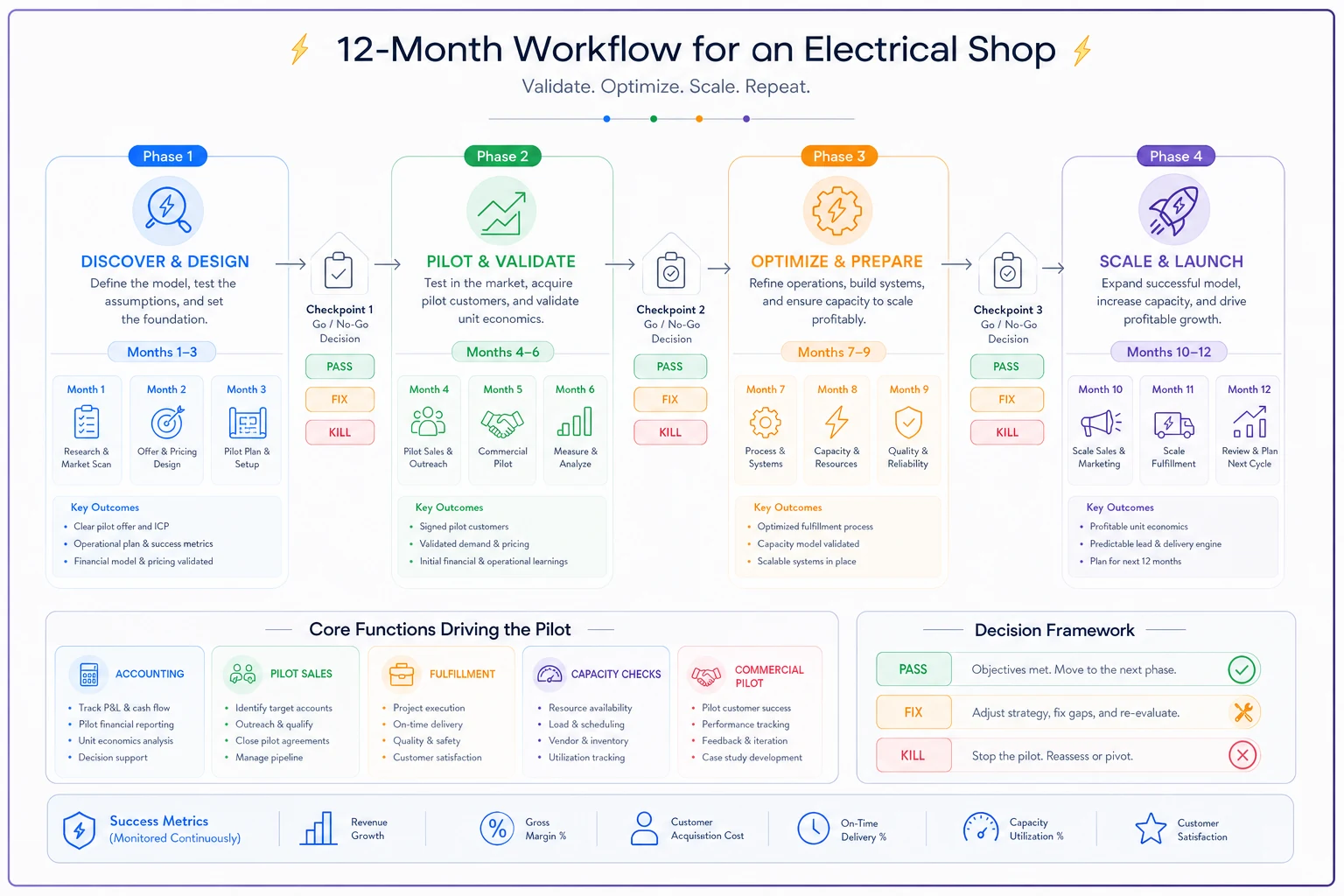
Use this as a one-page sequence to reference gates and the primary monthly focus for each phase.
Cash and runway impact: what each phase actually does to your bank balance
Recurring revenue doesn't just add income — it changes the shape of your cash flow. This table shows the rough trajectory for a mid-sized shop with fixed overhead around $40k/month.
| Phase | Recurring base (monthly) | % of fixed overhead covered | Cash impact |
|---|---|---|---|
| Start (reactive only) | ~$0 | 0% | Full monthly swing; runway fragile in slow months |
| End of Phase 1 | ~$2k–$4k | ~5–10% | Small buffer; proof of concept |
| End of Phase 2 | ~$8k–$12k | ~20–30% | Slow months noticeably less scary |
| End of Phase 3 | ~$20k–$24k | ~50% | Payroll partly de-risked; can plan a hire |
| End of Phase 4 | ~$26k–$30k | ~65–70% | Fixed costs mostly pre-covered before reactive work |
The dollar figures matter less than the pattern. Once you cross roughly 50% coverage, the psychology of running the shop changes. You stop making decisions from fear. Slow months become annoying instead of terrifying.
A quick real-world scenario
A three-truck residential shop running around $1.3M a year, all reactive. Winters were brutal — revenue dropped close to 40% for two or three months, and the owner burned through his cash cushion every year just to keep techs on payroll through the slow stretch.
They ran roughly this sequence over about fourteen months, a little slower than the plan above. By the time they cleared Phase 3, they had close to 260 members on a two-tier plan. Recurring fees plus the upsell work those member visits generated covered a bit over half their monthly overhead. The following winter, revenue still dipped — reactive work always does — but the floor held. No line-of-credit draw. The owner described it, more or less, as the first winter in eight years he actually slept through.
The number that surprised him most wasn't the recurring fees. It was the upsell conversion. Members who saw a tech twice a year bought panel upgrades and EV chargers at roughly double the rate of cold reactive leads. The recurring plan quietly became his best sales channel.
When this plan makes sense — and when it doesn't
When it makes sense:
-
You have a stable base of existing residential customers to pre-sell to
-
Your reactive work is profitable but unpredictable
-
You've got at least basic job costing, or you're willing to build it in Phase 1
-
Your fulfillment is functional enough to layer maintenance visits on top
When it's a bad idea right now:
-
Your books are a mess and you genuinely don't know your margins — fix that first, everything else is guessing
-
Your fulfillment is already breaking under current volume; adding scheduled visits will only accelerate the collapse
-
You have almost no repeat customer base and rely entirely on one-time marketed leads
Who should not do this:
Shops in active crisis — behind on payroll, drowning in callbacks, or without any admin capacity — should stabilize operations before attempting a recurring-revenue build. This plan compounds on a stable base. It punishes chaos.
The pre-flight checklist
Before you start Month 1, confirm you have:
-
- [ ] A way to see margin by job type (even a rough one)
-
- [ ] A monthly close habit, or the intent to build one
-
- [ ] A known number for your monthly fixed overhead
-
- [ ] A list of your best 30–40 existing customers to pre-sell to
-
- [ ] A scheduling system that can hold and remind you of recurring visit dates
-
- [ ] The discipline to respect the gates — including killing pilots that don't clear them
If you can't check most of these, your Month 1 is really "build the checklist." That's fine. Better to start honest.
The thing most owners get wrong
The temptation throughout this whole process is to skip ahead. To sell 200 plans in month two because demand looks strong. To ignore the fulfillment gate because sales are exciting. To leave a Fix in Fix forever because killing something feels like failure.
Resist all of it. The reason this works is because it's sequenced. Each phase funds and de-risks the next. The gates aren't bureaucracy — they're the difference between building recurring revenue and building a recurring liability you can't service.
Reactive dispatch will always be part of an electrical shop. The goal was never to eliminate it. The goal is to build a floor underneath it, so that when the phone goes quiet, the business doesn't. Twelve months of disciplined, sequenced work gets you something you can actually build the rest of your operation on top of.
Twelve months of disciplined, sequenced work gets you something you can actually build the rest of your operation on top of.
Ready to optimize your electrical service operations?
Join 500+ electrical service companies using Voltzly to improve scheduling accuracy, enhance client satisfaction, and boost operational efficiency.