

Growth breaks electrical shops in predictable places. Not random ones. The same three or four failure points show up whether you're jumping from 2 techs to 6, or from 15 to 30. What changes is the cost of hitting those walls. At 2 techs, a scheduling mistake costs you an afternoon. At 25 techs, the same category of mistake costs you a payroll cycle's worth of margin and a customer who tells everyone on their street.
Most owners scale headcount faster than they scale their operating systems. They add trucks and bodies because the phone keeps ringing, but the way they run the business is still how they ran it at 3 people — the owner in the middle of everything, decisions living in his head, and "the system" being a group text and a shared calendar.
This is a roadmap for building operational maturity in stages, mapped against real growth thresholds. It ties together your SOPs, your data, your tech capabilities, and your KPIs into 90-, 180-, and 365-day rollout windows so you're not guessing what to fix next. An operational maturity model for electrical contractors isn't about buying more software or writing a 200-page manual. It's about knowing which system needs to exist before the next hire, not after it already broke.
The four stages, and what actually changes between them
Most shops don't fail because they picked the wrong tool. They fail because they're running Stage 1 habits inside a Stage 3 business. The mismatch is the killer.
Here's how the stages break down in practice — not by revenue, but by what the operation demands of you.
| Stage | Team size | What runs the business | First thing that breaks | KPI you can actually trust |
|---|---|---|---|---|
| Stage 1: Owner-operated | 2–5 techs | The owner's memory and phone | Scheduling + follow-up | Revenue in the bank |
| Stage 2: Coordinated | 6–12 techs | A dispatcher + shared software | Job costing + parts flow | Gross margin per job |
| Stage 3: Departmentalized | 13–25 techs | Roles, SOPs, handoffs | Accountability + quality consistency | Margin by job type + first-time-fix |
| Stage 4: Systematized | 26–50 techs | Data, dashboards, managers | Middle-management coordination | Contribution margin by territory/crew |
The jump that quietly wrecks the most shops is Stage 2 to Stage 3. At Stage 2, one good dispatcher can still hold the whole operation in their head. Somewhere around 13–15 techs, that stops being physically possible. The dispatcher becomes a bottleneck, the owner gets pulled back into firefighting, and everyone blames "communication" when the real issue is that the business outgrew a human's working memory and nobody built anything to replace it.
Notice what changes in the last column. Early on, the only number you can fully trust is cash — everything else is a rough guess. As you mature, the quality of your data improves, which sharpens every decision you make on top of it. You can't run Stage 4 decisions on Stage 1 data. That's the whole game.
Stage 1 → 2: Getting out of your own head (roughly 0–6 techs)
At this stage, you are the system. You know which customer is a pain, which tech is slow on panel work, and which supplier shorts you on breakers. That knowledge lives nowhere but your skull, and it works fine — until you take a vacation or get sick and the whole thing seizes up.
Never miss a job or delay a dispatch again.
Voltzly helps you schedule, assign, and track every electrical job efficiently.
- Unified job scheduling
- Real-time technician tracking
- Automated client notifications
No credit card required
The maturity move here isn't fancy. It's extraction. Pulling what's in your head into something repeatable so the business can survive you being unavailable for a day.
What to build first, in order:
-
A single source of truth for jobs. One place where every job lives — status, address, scope, photos, price. Not one job in your texts, another on a whiteboard, another in your memory.
-
A standard intake script so whoever answers the phone captures the same information every time.
-
Basic job documentation habits — before/after photos, the panel label, the meter number — attached to the job record, not buried in someone's camera roll.
-
A simple "job done" definition so you actually know a job is finished and invoiceable, not "mostly done."
The mistake owners make at this stage is trying to build the whole playbook at once. You don't need SOPs for everything yet. You need the two or three that stop the most bleeding: intake and job completion. Everything else can stay in your head for now — that's fine at 4 techs.
What breaks if you skip this: You hire tech number five, hand them a phone, and realize you have no way to tell them how you do things because you never wrote any of it down. Onboarding takes six weeks instead of two, and the new guy invents his own version of your process.
Stage 2 → 3: The dispatcher can't hold it all anymore (roughly 6–13 techs)
This is where informal coordination hits its ceiling. You've probably got a dedicated dispatcher or office person now. Jobs are flowing. But you start noticing leakage: trucks showing up without the right parts, invoices going out three days late, two techs double-booked on the same street while a third drives 40 minutes across town.
The root cause is almost always the same. Coordination that used to happen through one person talking to everyone now needs to happen through a system everyone reads from. Verbal handoffs don't scale. When your dispatcher tells a tech something out loud, that instruction dies the moment it's spoken — nobody else can see it, nobody can check it later, and if the dispatcher's out sick, the knowledge walks out the door with them.
This is the point where a real operations playbook stops being optional. You need to move from "the dispatcher knows" to "the process knows." If you haven't mapped your core workflows yet, the guide on building an operations playbook that stops profit leaks walks through the SOPs, handoffs, and decision triggers that matter most for shops this size.
-
Parts and van-stock tied to job type, so trucks leave loaded for what they're actually doing that day
-
Job costing that captures labor and materials per job, not lumped monthly
-
A handoff protocol between office, field, and billing that doesn't rely on anyone remembering to say something out loud
-
Defined roles, even if people are still wearing more than one hat
A shop running 9 techs was closing jobs fine but bleeding on the back end. Invoices averaged 6–7 days to go out because the office was waiting on techs to text over what they used. Half the time the parts list was incomplete, so they'd guess or just leave it off. Once they made the job-completion checklist a hard gate — no photos and parts logged, no "job closed" status — invoice time dropped to around 2 days and they stopped eating roughly $2k–$3k a month in unbilled materials. Nothing high-tech. Just a step that couldn't be skipped anymore.
Stage 3 → 4: When you need managers, and data they can trust (roughly 13–30 techs)
Past 15 techs, the owner physically cannot be in every decision. You now need people managing people, and that introduces a whole new failure category: middle-management drift. Field leads make calls that seem reasonable in the moment but quietly erode margin — approving a scope add without repricing, letting a callback slide, over-servicing a warranty job to keep a customer happy.
You can't watch all of it. So instead of watching, you measure. This is where your KPIs stop being vanity numbers and start driving actual decisions. But your KPIs are only as good as the data feeding them. If your Stage 3 job costing was sloppy, your Stage 4 dashboards will just give you confident-looking garbage.
The sequence matters. Clean data capture in the field → reliable job costing → trustworthy KPIs → decisions you can delegate. Skip a step and the whole chain rots. Shops that try to build dashboards before fixing field data capture end up with managers arguing about whose numbers are right instead of making actual calls.
Once your data holds up, the metrics need to be tied to actions, not just displayed on a screen. The framework in the KPI dashboard for electrical contractors covers which numbers should actually trigger a hire, a retrain, or a repricing move — because a dashboard nobody acts on is just expensive wallpaper.
This is also the stage where geography and staffing math turn into a real discipline. You're not just adding techs anymore, you're covering territories, and coverage gaps cost you response time and callbacks. If you're wrestling with how many techs a region actually needs, the breakdown on scaling field teams without coverage gaps gets into the territory design and capacity triggers that keep growth from outrunning your ability to staff it.
The 90 / 180 / 365 rollout structure
Trying to fix everything at once is how these initiatives die. The owner gets fired up, buys software, announces new processes, and three weeks later everyone's back to the old way because it was too much change too fast.
First 90 days — Stabilize the core. Pick the one workflow that's leaking the most right now and lock it down. Usually it's intake or job completion. Build the SOP, train on it, make it a hard gate. Don't add anything else yet. The goal is proving the org can adopt one new standard and hold it. Measurement gate: Is the new process being followed at least 90% of the time without you nagging? If not, you have an adoption problem, not a process problem — fix that before layering anything else on.
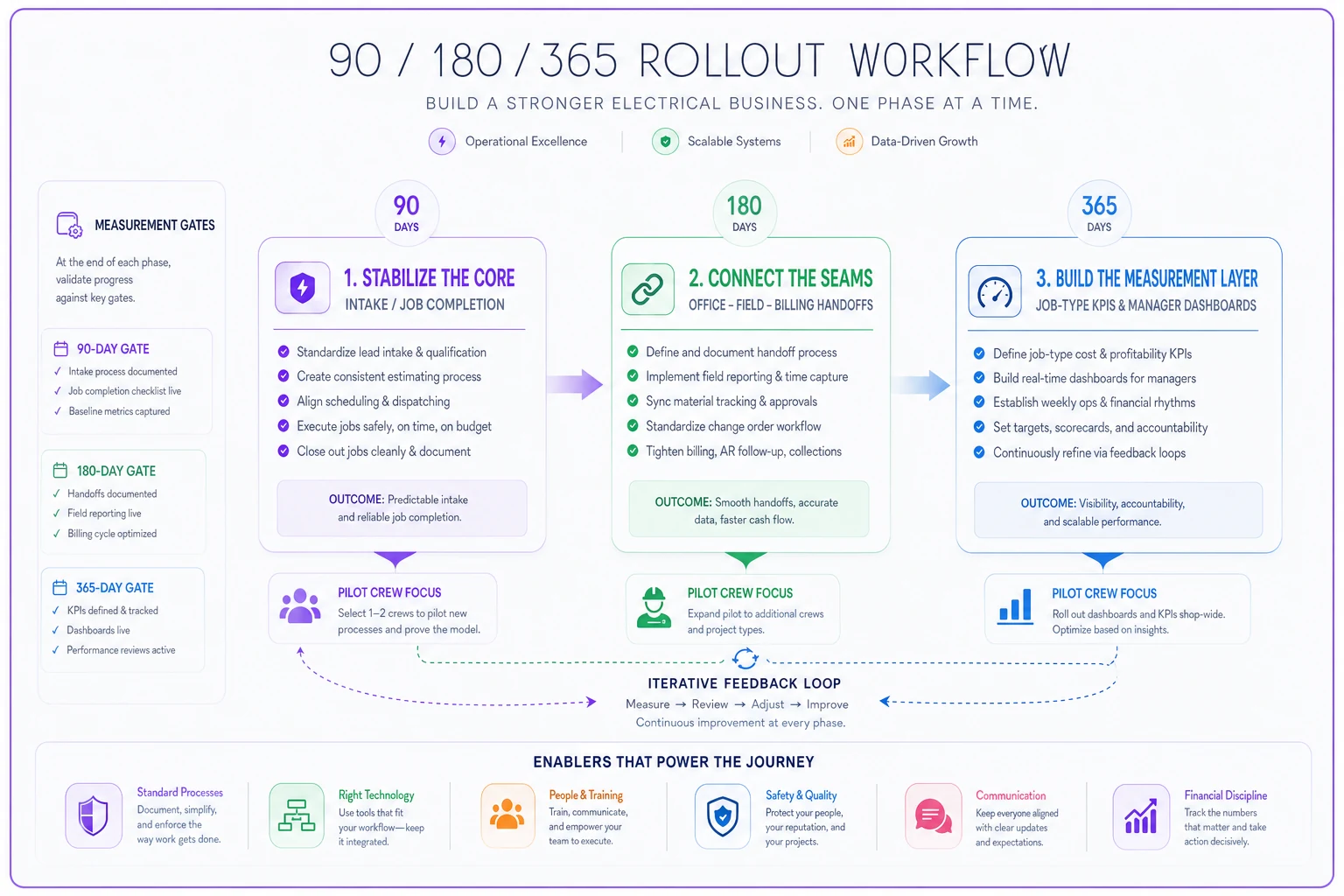
A simple visualization of the rollout helps people see the phased approach and where the measurement gates sit.
Days 90–180 — Connect the seams. Now attack the handoffs between departments. Office-to-field, field-to-billing, sales-to-install. These are where jobs fall through cracks. Standardize what information moves between each stage and who's responsible for it. Measurement gate: Has your invoice-out time and callback rate improved measurably? If the seams are working, these two numbers move first.
Days 180–365 — Build the measurement layer. Once the core and the seams hold, layer in real KPI tracking by job type and crew. This is when you can start delegating decisions to managers because you finally have numbers to hold them to. Measurement gate: Can a manager make a repricing or retraining decision from the dashboard without asking you? If yes, you've reached the point where the system runs without living inside your head.
Designing a pilot before you roll anything out shop-wide
Don't inflict a new process on all 20 techs at once. Pilot it with one crew first. This surfaces the friction points before they become company-wide problems, and it gives you a before/after comparison that makes the case for adoption.
-
Pick one crew — ideally an average one, not your best. If your best crew makes it work, that proves nothing. If an average crew makes it work, it'll work everywhere.
-
Define one metric you expect to move, and baseline it for 2–3 weeks before you change anything.
-
Run the pilot for 30 days. Long enough to get past the "this is annoying and new" phase.
-
Compare the numbers, then talk to the crew. The data tells you if it worked; the crew tells you why or why not.
-
Only then roll it wider — and use the pilot crew's results as the proof point when you introduce it to everyone else.
Pick an average crew — not your best — to run the pilot.
The reason pilots matter more as you grow: at 4 techs, a failed process change is a shrug. At 30 techs, a botched company-wide rollout can burn trust so badly that your team resists the next good idea too. Pilots protect your credibility as much as they protect your operations.
When this maturity push actually makes sense — and when it doesn't
When it makes sense: You're feeling the pain of coordination. The owner is a bottleneck, decisions are stacking up on your desk, quality is getting inconsistent across crews, and you can tell the current way of running things won't survive the next five hires. That friction is the signal.
When it's a bad idea: You're stable at 4 techs, profitable, and have no intention of growing. Building Stage 4 systems onto a Stage 1 business is just overhead. You'll spend money and energy administering processes that solve problems you don't have. Match the system to the stage you're actually in — or the one you're about to enter — not the one that sounds impressive.
Who should not do this: Any owner trying to skip stages. You cannot install Stage 4 dashboards onto a shop that never built Stage 2 job costing. The data won't exist to feed them. Every stage is the foundation for the next one, and there's no shortcut that survives contact with reality. Shops that try to leapfrog end up with expensive tools nobody trusts and a team that's learned to ignore the new system.
Where software fits — and where it doesn't
Software doesn't create operational maturity. Your SOPs and your discipline do. What the right platform does is make a good process harder to skip and easier to see.
The practical value shows up in a few specific spots. When your job data — photos, parts, labor, status — lives in one connected system instead of scattered across texts and paper, your job costing gets accurate almost for free, which means your KPIs at Stage 4 are actually trustworthy. AI-assisted operational platforms can handle the drudge work that eats your office staff's day: flagging jobs marked complete without required photos, catching invoices sitting too long, surfacing the crew whose callback rate is quietly creeping up before it becomes a pattern you'd otherwise miss.
But the sequence is fixed. Process first, then the tool to enforce and measure it. A platform layered onto chaos just gives you faster, better-organized chaos. Build the SOP, prove it in a pilot, then let the software make it stick.
A real scenario: from firefighting to a system that runs without the owner
A residential electrical shop running 11 techs was stuck at the classic Stage 2 ceiling. The owner was working 60-hour weeks and still felt like everything ran through him. Callbacks were sitting around 9–10% of jobs. Invoices lagged. Nobody could tell him which job types actually made money — panel work felt profitable but there were no real numbers to back it up.
They didn't overhaul everything. They ran the 90/180/365 sequence.
First 90 days: locked down job completion with a hard gate — photos and parts logged before a job closes. Callbacks started dropping toward 6% as the QA step caught sloppy work before the customer did. Next window, they fixed the field-to-billing handoff. Invoice-out time went from about a week to two days and they stopped losing materials off invoices.
By the back half of the year, job costing was clean enough to build real KPIs. Turned out one job type they'd been pushing was barely breaking even after callbacks. They repriced it. Gross margin ticked up a few points — not dramatic, but steady and real.
The bigger outcome wasn't a number. The owner took a full week off for the first time in years and the shop ran without him. That's what operational maturity actually buys you: a business that doesn't need you standing in the middle of it.
The takeaway
Scaling an electrical shop isn't about hustling harder at each new size — it's about installing the right operating system before you hit the wall that demands it. Know which stage you're in, know which failure point comes next, and build the SOPs, data, and KPIs to meet it in that order. Roll it out in 90-day windows with real gates so change actually sticks. Pilot before you go wide. And match the system to the size you're growing into, not the one you left behind.
Do that, and each jump — 6 techs, 15, 30 — stops feeling like a crisis and starts feeling like a step you already planned for.
Ready to optimize your electrical service operations?
Join 500+ electrical service companies using Voltzly to improve scheduling accuracy, enhance client satisfaction, and boost operational efficiency.