


Most electrical shops don't have a training problem. They have a structure problem that looks like a training problem.
Here's what that looks like on the ground: an owner hires a helper, throws them in the van with whoever's available that week, and hopes something sticks. Six months later the helper still doesn't know how to pull a service, the journeyman who was supposed to be teaching him is annoyed because it slows him down, and nobody can tell you — in writing — what this kid actually can and can't do on a job site. Then a competitor offers a dollar more an hour and the helper walks. The owner shrugs and says "you can't find good people anymore."
You can find good people. The problem is that most shops have no ladder for anyone to climb, no map of what "getting better" actually means, and no financial logic connecting skill to pay. When there's nothing to climb toward, people don't stick around — and the ones who do tend to plateau because nobody defined what the next rung even is.
An apprenticeship ladder for electricians isn't a binder of course titles. It's an operating system that ties competencies to daily work, daily work to sign-offs, sign-offs to promotion gates, and promotion gates to pay bands the owner has actually modeled and can afford. When those pieces connect, training stops being a cost you eat and starts being a machine that produces your future leads, foremen, and eventually the person running a second crew while you're focused on growing the business.
Here's how the whole thing fits together — and where it falls apart when one piece is missing.
Why the "figure it out in the van" model quietly caps your growth
Almost every small shop starts the same way. The owner is the best electrician, so the owner trains everyone, mostly by osmosis. That works fine at three people. It falls apart somewhere between the fifth and eighth hire, and here's the mechanism.
Informal training has no memory. When knowledge lives in the owner's head and gets passed down by whoever happens to be in the truck that day, three things go wrong at once:
-
Coverage is random. A helper riding with your careful journeyman learns to torque lugs and label panels. The same helper riding with your fast-but-sloppy guy picks up bad habits that cause callbacks two years later.
-
Progress is invisible. Nobody can answer "is this person ready to run a small job alone?" without a gut check — and gut checks are wrong a solid chunk of the time in both directions. You either send someone out too early (callbacks, safety incidents) or hold them back too long (they get bored and leave).
-
The owner becomes the bottleneck. Every judgment call — can Marcus handle the Henderson job, is Taylor ready for panel work — routes back through one person. That same person is also selling, quoting, and putting out fires.
The businesses that stall at 6–10 employees almost always have this in common: they never converted the owner's instincts into a written progression anyone else could run. Growth isn't capped by demand. It's capped by the shop's inability to produce competent people faster than it loses them.
The fix isn't better motivation or better hiring — though your hiring funnel and retention practices matter a lot for feeding the top of the ladder. The fix is building the ladder itself so anyone who steps on it knows where they stand and what the next rung actually requires.
The four layers that make a ladder actually work
A real competency ladder has four connected layers. Skip any one and the whole thing wobbles.
Never miss a job or delay a dispatch again.
Voltzly helps you schedule, assign, and track every electrical job efficiently.
- Unified job scheduling
- Real-time technician tracking
- Automated client notifications
No credit card required
Layer 1: The competency map (multi-year). This defines what "good" looks like at each level, in specific observable terms — not vague stuff like "strong troubleshooting." Observable means: can independently diagnose a dead circuit using process of elimination and document findings. You can watch someone do that. You can't watch someone "have strong troubleshooting."
Layer 2: Day-by-day mentor tasks. This is what turns the map into daily behavior. Each level has a rough sequence of assignments the mentor gives on real jobs, so learning isn't left to whatever the day happens to throw at the crew.
Layer 3: Evidence sign-offs. A skill isn't learned because someone sat through a toolbox talk. It's learned when a mentor watched them do it correctly, unassisted, and signed off — ideally with a photo or a note attached. Evidence is what makes promotion decisions defensible instead of political.
Layer 4: Promotion gates tied to pay and budget. Each rung has a gate: a defined set of signed-off competencies, time-in-role, and any required licensing. Clear the gate, move to the next pay band. And the pay bands need to be built into a budget template the owner has already modeled, so a wave of promotions doesn't blow up the margin.
The part people miss: these layers only create value when they're connected. A competency map with no sign-offs is a wish list. Sign-offs with no pay bands are busywork that breeds resentment. Pay bands with no budget model will bankrupt you when half your crew levels up in the same quarter. The system is the connection between the components, not the components themselves.
What the ladder looks like from helper to crew lead
Every shop should tune the exact rungs for their work type, but a workable residential/light-commercial structure looks something like this.
| Level | Rough time in role | Core competencies (signed off) | What they can run | Pay band logic |
|---|---|---|---|---|
| Apprentice 1 (Helper) | 0–12 mo | Material handling, basic terminations, safe LOTO, tool mastery, jobsite cleanup | Nothing solo; full supervision | Entry rate |
| Apprentice 2 | 12–30 mo | Rough-in, device install, basic troubleshooting, code basics, customer basics | Simple tasks under loose supervision | Entry + ~10–15% |
| Apprentice 3 / Senior Apprentice | 30–48 mo | Service diagnostics, panel work assist, load calcs, permit prep | Small service calls solo | Mid band |
| Journeyman | License + gate | Full service & install independence, mentoring apprentices, scope validation | Any standard job solo | Journeyman band |
| Lead / Foreman | Journeyman + gate | Crew coordination, job costing awareness, QA sign-off authority, client escalation | Runs a crew and a job P&L | Lead band + performance component |
The time-in-role numbers are guardrails, not guarantees. Someone sharp who clears every Apprentice 2 sign-off in eight months should move — holding them back to hit an arbitrary date is how you train someone right up until the day they quit for the shop down the street.
One pattern worth naming: the jump from Journeyman to Lead is where most shops have nothing. They promote their best technician into running a crew and are shocked when their best technician turns out to be a mediocre coordinator who hates paperwork. Running a crew is a different skill set — reading a job's economics, sequencing other people's work, knowing when to escalate. If your ladder doesn't build and test those things before the promotion, you're gambling your best field asset on a coin flip.
Making the mentor role real instead of just a title
Mentorship fails in most shops because it's unpaid, unstructured, and quietly punished by how work gets measured. If your journeyman is judged on billable hours, every minute spent teaching a helper costs him. So he doesn't teach. He does the work himself while the helper hands over wire nuts. Two years later the helper knows nothing and everyone's confused about why.
If you want mentoring, you have to build it into how people are measured and compensated. This connects directly to how you design pay around capacity and output — a mentor's comp should reflect the development of the people under them, not just their own production. A few things that actually make it stick:
-
Give mentors a defined roster. One journeyman owns one or two apprentices, not "everyone pitches in." Ownership creates accountability.
-
Pay for the sign-off, not the hour. A small bump when a mentee clears a competency gate turns teaching from a drag into a reward. Now the mentor wants the apprentice to progress.
-
Protect a little time for it. Even 20 minutes of debrief after certain job types beats zero structured teaching.
-
Make the mentor's opinion count at the gate. If the mentor's sign-offs are what unlock promotions, the role has real weight — and good people take that seriously.
The subtle mistake here is picking mentors by seniority instead of by teaching ability. Your longest-tenured journeyman might be terrible at explaining things and impatient with mistakes. Someone with five years who's naturally good at breaking down a task will produce better apprentices. Pick for the outcome you want, not the org chart.
The day-by-day layer: where most programs quietly die
Owners love building the competency map. It feels productive. Then the map sits in a folder because nobody ever translated it into what a mentor is supposed to do on Tuesday.
The bridge is a set of assignment sequences per level. For an Apprentice 2 working on rough-in, the mentor's rough progression over a few weeks might look like:
-
Watch and narrate — apprentice observes the mentor rough in a room while the mentor talks through each decision (box heights, mud ring depth, home-run planning).
-
Do one under direct watch — apprentice roughs a single room, mentor standing there, correcting in real time.
-
Do a section, mentor inspects after — apprentice works independently on a defined chunk, mentor checks and gives feedback before it gets covered.
-
Do it and self-check against a list — apprentice completes the work and runs their own pre-inspection checklist, mentor spot-checks.
-
Sign-off — mentor confirms the apprentice can rough in a standard room correctly and unassisted, logs the evidence, competency is checked off.
That five-step arc — narrate, supervised rep, independent chunk, self-check, sign-off — works for almost any skill on the ladder. The magic isn't the specific steps; it's that the mentor and apprentice both know where they are in the sequence for every competency, instead of vaguely "accumulating experience."
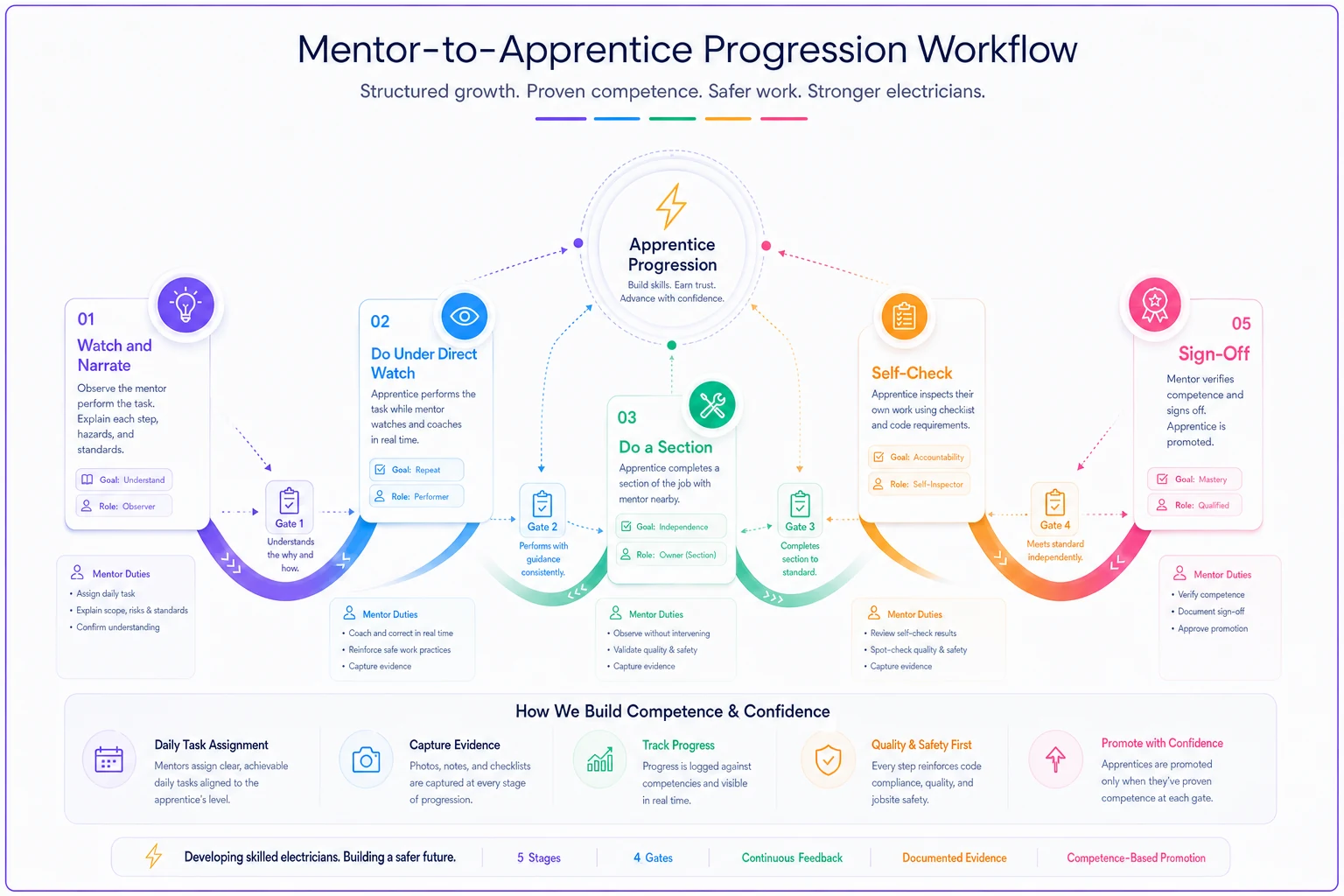
A quick visual like this helps mentors and managers spot where everyone sits across competencies.
This is also where a shop-level talent system earns its keep. Tracking which apprentice is on step 3 of rough-in, step 1 of service diagnostics, and fully signed off on LOTO — across four apprentices and three mentors — is a real coordination problem once you're past a couple of trainees. Running it on memory and a spreadsheet nobody updates is how the whole thing quietly reverts to "figure it out in the van." A platform that holds the competency map, surfaces the mentor's current assignments, and captures evidence sign-offs in one place is what keeps the ladder from decaying the moment the owner gets busy — which is always.
Evidence sign-offs and why they actually protect you
Sign-offs sound bureaucratic until the first time you need one. Three situations make them non-negotiable:
Safety and liability. When something goes wrong on a job, "was this person trained and verified competent to do this task?" carries real legal and insurance weight. A documented sign-off trail — with dates, the mentor's name, and ideally a photo — is dramatically stronger than "yeah, we figured he knew how."
Promotion fairness. The fastest way to poison a shop is to promote someone for reasons that look political. When the gate is "you cleared these 14 signed-off competencies and hold your license," the decision is obvious and un-arguable. The person who didn't get promoted can see exactly what they're missing.
Dispatch decisions. Knowing precisely what each tech is verified to do lets you match people to jobs without guessing. The evidence layer feeds directly into smarter scheduling — the same logic behind skills-based dispatch, just sourced from your own verified records instead of a gut feeling.
Keep the evidence lightweight or nobody will do it. A checkbox, a date, a mentor's initials, and one photo is enough for most competencies. The goal is a defensible record, not a dissertation.
The budget layer owners skip until it hurts
This is the part that separates a real system from a feel-good HR project. Every rung has a pay band, and every promotion moves labor cost up. If you build a beautiful ladder and don't model the money, you'll end up doing one of two things: promoting nobody (and losing everyone), or promoting everyone at once (and torching your margin).
Build a simple budget template that answers: if my crew progresses at a realistic pace, what does my labor cost look like in 12 and 24 months? Model the pay bands, make an assumption about how many people clear each gate per year, and figure out the revenue those higher-skilled people should generate. The insight most owners miss is that a promotion should be self-funding — a senior apprentice who can run small service calls solo generates far more billable value than a helper handing over wire nuts, so the raise gets paid for by capacity, not by squeezing margin.
If a promotion isn't self-funding — if leveling someone up costs more than the additional value they produce — either your rung definitions are off or your pricing is. Either way, that's worth chasing down.
A quick real scenario
A residential-and-light-commercial shop running around nine field staff had the classic churn problem — burning through helpers every 9–12 months and constantly re-hiring at the bottom. Their fully-loaded cost per failed hire (recruiting, onboarding, the drag on the journeyman babysitting someone new, then starting over) was somewhere in the $6k–$9k range, and it was happening two or three times a year.
They built out a four-rung ladder with mentor rosters, a five-step sign-off sequence, and pay bumps tied to gates. Nothing exotic. Within about a year, two things shifted. First, retention past the one-year mark went from a coin flip to most new apprentices actually staying — because for the first time they could see a path and a number attached to it. Second, one senior apprentice hit the small-service-call rung and freed up a journeyman for bigger work, which added billable capacity without a new hire. The owner's rough estimate was that reduced churn plus the freed capacity was worth "a solid five figures" over the year. But the part he kept coming back to was that he finally had two people he could actually see becoming crew leads.
When this makes sense — and when it doesn't
Build the full ladder when:
-
You have four or more field staff and any intention of growing.
-
You're losing people at the bottom and can't explain why.
-
The owner is the bottleneck on every "is this person ready" decision.
-
You want to run more than one crew eventually and need to grow foremen from within.
Keep it lightweight when:
-
You're a two- or three-person shop. You still want a rough competency checklist and clear pay logic, but a full multi-year system with mentor rosters is overkill. Don't build a factory to make three widgets.
This is a bad idea if:
-
You're not willing to actually pay for progression. A ladder with no pay bands attached is worse than no ladder — you've now explicitly shown people the rungs and told them climbing changes nothing. That accelerates the exit.
-
Your pricing can't support higher labor cost. Fix that first, or every promotion will feel like it's bleeding you, and you'll end up resenting your own best people for getting better.
When in doubt, start small: a clear checklist and transparent pay logic will buy you options without building bureaucracy.
How this connects to the rest of the shop
The talent ladder isn't a standalone HR thing. It plugs into nearly every operational system you already run. Verified competencies drive smarter dispatch. Your mentor structure depends on a compensation design that actually rewards development. Your promotion budget is a line in the same financial picture you use for pricing and margin. And the whole thing sits inside your broader operational maturity roadmap — because a shop that can reliably build its own journeymen and foremen has crossed a threshold most competitors never will.
That's the real payoff. Most shops are permanently stuck recruiting from the same shrinking pool of experienced techs, paying a premium for them, and losing them to whoever offers a dollar more. A shop with a working apprenticeship ladder becomes a producer of talent instead of just a consumer of it. You take in raw helpers, run them up a defined path, and out the other end come the people who run your crews — with the sign-off trail to prove they're ready and the budget logic to make the raises pay for themselves.
Build the map. Connect it to daily mentor tasks. Verify with evidence. Gate the promotions and fund them properly. Do that consistently, and "we train people and they leave" turns into "we train people, and they run the place while we grow it."
Build the map. Connect it to daily mentor tasks. Verify with evidence. Gate the promotions and fund them properly. Do that consistently, and "we train people and they leave" turns into "we train people, and they run the place while we grow it."
Ready to optimize your electrical service operations?
Join 500+ electrical service companies using Voltzly to improve scheduling accuracy, enhance client satisfaction, and boost operational efficiency.