


Most electrical shops don't actually have a commercial model. They have three or four types of work that all fight for the same trucks, the same techs, and the same dispatcher's attention — and whichever one screams loudest on a given morning wins. That's not a strategy. That's triage.
The uncomfortable truth is that recurring service, emergency response, and installs each behave like completely different businesses. Different margins, different cash timing, different labor requirements, different customers. When you run all three out of one shared pool with no rules about priority, the math quietly turns against you. You end up busy, tired, and less profitable than a shop half your size that made a few deliberate choices.
This post ties everything together: how your product lines connect to capacity allocation, how you route work through channels, and how your pay plan either reinforces or sabotages the whole thing. The debate over commercial model electricians recurring vs installs isn't philosophical — it's a set of trade-offs you're already making by accident. Might as well make them on purpose.
The three businesses hiding inside your shop
Before you can allocate anything, you need to see clearly what each line actually does for you. They look similar on an invoice, but operationally they're strangers.
Recurring service (maintenance plans, service agreements, repeat repair work) is your ballast. Predictable, schedulable, forgiving on drive time because you can batch it. Margins are moderate but consistent, and it feeds your pipeline — a maintenance visit is where you spot the failing panel that becomes next month's install.
Emergency response is high-margin per hour but chaotic. It blows up your route, pulls techs off scheduled work, and rewards speed over efficiency. Customers aren't price-shopping at 9pm with a dead panel, so your realized rate is excellent. The catch is that it's the most expensive work to protect capacity for, because holding a tech available for emergencies means paying for idle time.
Installs are your revenue headline and your cash trap. A $9k EV-and-subpanel job looks great on the board, but it ties up a tech — or two — for a full day or more, front-loads material cost, and often waits on permits, inspections, and customer payment. Big number, slow money, and margin that evaporates if the estimate slips.
The pattern worth internalizing: the work with the biggest invoice is rarely the work with the best return on a tech-hour. Once you accept that, capacity allocation stops being about "keeping everyone busy" and starts being about protecting the mix.
| Line | Typical gross margin | Cash timing | Capacity behavior | Strategic role |
|---|---|---|---|---|
| Recurring service | 40–55% | Fast (often same-week) | Batchable, predictable | Ballast + lead source |
| Emergency response | 55–70% realized | Fast | Disruptive, unschedulable | Margin spike + acquisition |
| Installs | 25–40% | Slow (permits/inspection/collections) | Blocks whole days | Revenue volume + growth |
The margins are ranges on purpose — your actual numbers depend on your costing discipline. If you haven't nailed down true job-type margins yet, that's the prerequisite, and the job-type profitability framework is where that work lives. Everything below assumes you know your real numbers, not your invoice numbers.
Where the model quietly breaks
The failure almost never looks like a decision. It looks like a Tuesday.
Never miss a job or delay a dispatch again.
Voltzly helps you schedule, assign, and track every electrical job efficiently.
- Unified job scheduling
- Real-time technician tracking
- Automated client notifications
No credit card required
A shop with four techs has a full board: two maintenance routes, a panel upgrade, and an EV install. At 10am an emergency comes in — commercial client, no power to half the building. The dispatcher does the obvious thing and pulls the tech off the maintenance route because that job is "just maintenance." Emergency gets handled, client's thrilled, everyone feels productive.
But look at what actually happened. The maintenance route got compressed or bumped, which means two service-plan customers got rescheduled. These are customers who pay you every month whether you show up or not, and you just taught them that their plan doesn't guarantee reliable service. The install tech, meanwhile, hit a scope surprise and needs a second set of hands for two hours — but there's no slack because everyone's committed. So the install slips a day, which pushes the inspection, which pushes the invoice.
Three weeks of Tuesdays like that and you've got:
-
Service-plan churn creeping up (nobody renews a plan that keeps getting bumped)
-
Installs consistently running long and killing the margin you quoted
-
Techs frustrated because the schedule means nothing
-
Emergency revenue looking great on the P&L, hiding all the damage underneath
This is how the highest-margin line cannibalizes the highest-value line. Emergency work feels like the winner because the hourly rate is fat. But if grabbing that revenue costs you two plan renewals and a blown install estimate, you lost money on the trade — you just can't see it because it shows up in three different places on three different timelines.
The allocation decision: reserve capacity before you sell it
The core move in a real commercial model is boring, and it's this: allocate capacity by line before the week starts, and defend those allocations with rules — not vibes.
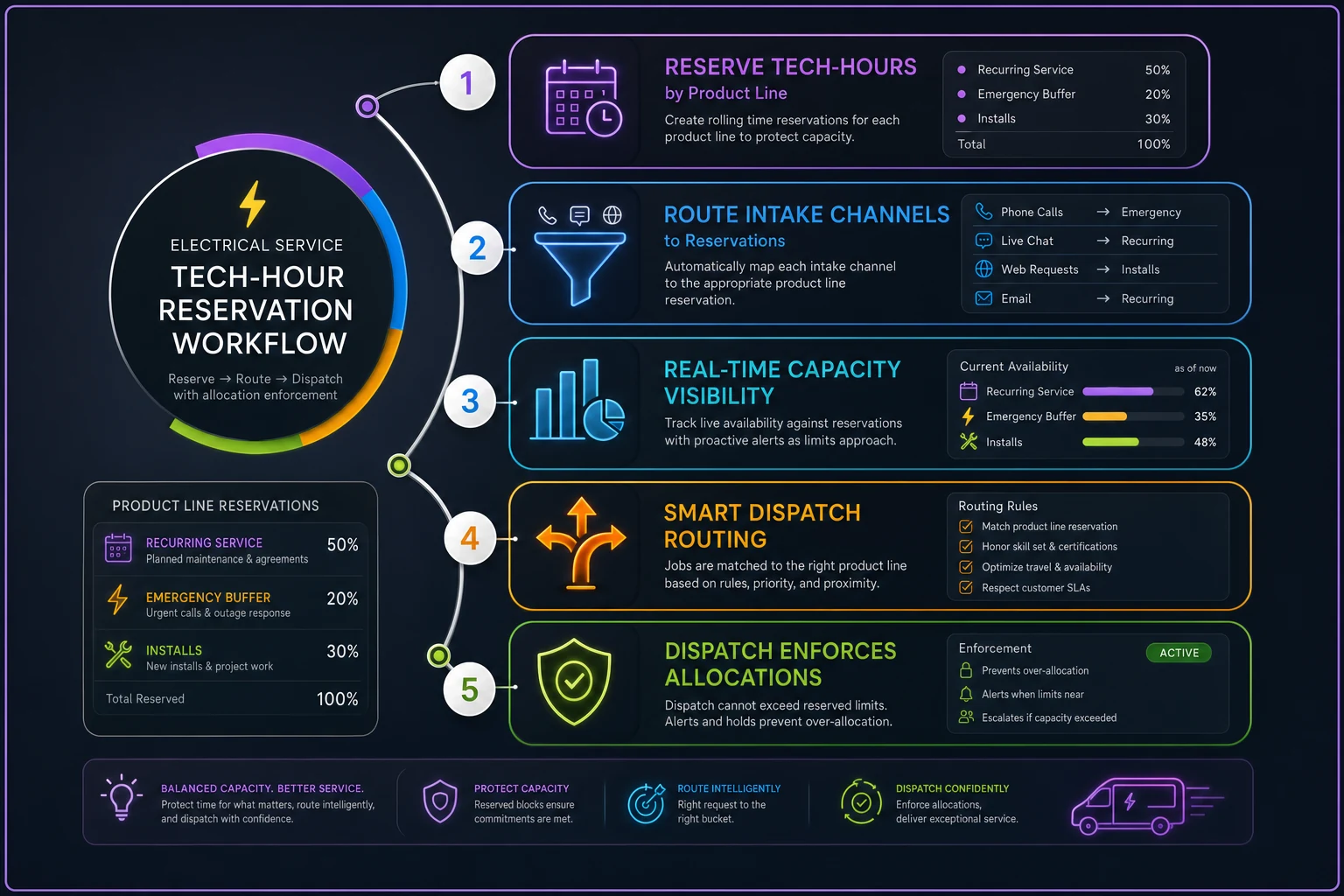
Think in terms of tech-hours per week, not jobs. Say you run five techs at roughly 40 billable-target hours each — around 200 tech-hours a week. The instinct is to fill all 200. The better play is to carve it up deliberately:
-
Set your recurring service floor. Contracted, predictable work. If you have plan customers, their service is non-negotiable — reserve it first. Say that's 70 hours.
-
Protect an emergency buffer. You can't schedule emergencies, but you can reserve slack based on history. If you average around 15 emergency hours a week, hold back maybe 20. This is capacity you intentionally leave open.
-
Allocate the rest to installs. Whatever's left — roughly 110 hours — is your install runway. That's your true install capacity. Not "as many as we can sell." That number.
The mistake shops make is selling install capacity they haven't reserved, then robbing it from service and emergency buffer when reality hits. Sell 130 hours of installs against 110 hours of runway and something has to give — and it's always the invisible stuff that gives first.
Allocation only holds if the front door enforces it. Your intake channels — phone, web, existing customers, referrals — need routing rules tied to the line, not just first-come-first-served.
The channel rules that keep the pool honest
-
Plan customers get a dedicated intake path and guaranteed slots inside the reserved service floor. They never compete with a cold install lead.
-
Emergency calls hit the buffer first. If the buffer's blown for the day, that's when your after-hours triage and escalation rules decide what's a true emergency versus what can wait until morning.
-
Install inquiries get scheduled against remaining runway only. When runway's full, the honest answer is a future date — not "we'll squeeze it in" that quietly eats your service floor.
That last one is where discipline pays. Telling a good install lead "we can start in twelve days" feels like you're losing the job. But squeezing it in this week by bumping two plan customers and shorting your emergency buffer is how you win a $9k job and lose $400/month in renewals plus your flexibility for the next real emergency. Channel rules exist so a busy Tuesday can't override a decision you already made with a clear head.
Compensation guardrails: pay the mix you actually want
This is the part most shops get backwards, and it undoes everything above.
If your techs earn more on installs — through spiffs, commission, or just because big tickets feel like wins — every tech in your shop is quietly incentivized to steer toward installs and away from service. They'll upsell the maintenance visit into a proposal, drag their feet on plan work, and treat emergency calls as an interruption to the "real money."
The guardrail principle: compensation should reward the behavior that protects the mix, not just the behavior that produces the biggest single invoice. A few ways that plays out:
-
Cap install commission as a share of pay so no tech is desperate to convert every service call into a proposal. Reward quality installs — on-margin, no callbacks — rather than raw install volume.
-
Pay explicitly for service-plan health — renewals retained, plan visits completed on time, upsells that came from genuine findings. This makes recurring work worth a tech's attention instead of a chore.
-
Reward emergency responsiveness separately. If you want techs willing to jump on a 9pm call, pay for the availability and the response, not just the ticket. Otherwise emergency work gets treated as punishment.
-
Tie a slice of pay to margin, not revenue. A tech who quotes an install that comes in on-estimate should out-earn a tech who books a bigger job that runs 20% over. This is the single most powerful guardrail, and the hardest to fake.
Cap install commission as a share of pay so no tech is desperate to convert every service call into a proposal.
The connective logic between staffing, capacity, and pay is a deep topic on its own — the mechanics of building a plan that reinforces your capacity math instead of undermining it are worked through in technician compensation design tied to staffing math and KPIs. The point for the commercial model is narrower: your pay plan is a channel rule too. It routes tech attention. Make sure it routes toward the mix you decided on, not just the fattest ticket.
A worked example: the margin trade-off in real numbers
A five-tech residential shop is deciding how to handle a Thursday. They've got:
-
Option A Accept a $9,200 panel-and-EV install that needs one tech all day plus a half-day of a second tech (roughly 12 tech-hours). Estimated gross margin around 32%, so about $2,900 gross — but it slips the inspection into next week, delaying the invoice by 10 days, and it consumes the day's emergency buffer.
-
Option B Run the planned maintenance route (8 plan visits, roughly 8 tech-hours) and keep the buffer open. Plan visits gross maybe $1,300 on the day directly — but two of those visits historically surface repair or upgrade work worth another ~$1,800 in near-term follow-on, and keeping the buffer means they can catch the emergency calls that tend to show up on Thursdays (realized rate is high — call it $900 gross on the day).
On the invoice, Option A looks like the obvious winner: $9,200 versus a pile of small tickets. Run the actual tech-hour math though:
-
Option A ~$2,900 gross ÷ 12 tech-hours ≈ $240/tech-hour, cash in 2–3 weeks, buffer sacrificed.
-
Option B (~$1,300 + $900 + a slice of that $1,800 follow-on) ÷ ~10 tech-hours committed ≈ $300–$350/tech-hour, cash in days, buffer intact, plan customers served.
The install isn't bad — it just isn't automatically better, and it costs you flexibility. The right answer is usually "do the install and protect service," which is exactly why you reserved runway separately in the first place. You take the install on a day where it fits your allocated install hours, not on a day where it forces you to rob the floor. The commercial model doesn't tell you to reject big jobs. It tells you which day to say yes.
This is also why the recurring line is worth defending harder than its per-ticket margin suggests. Plan work isn't just the day's revenue — it's the follow-on pipeline and the churn you avoid. If you're still building out that recurring base, the three-tier service plan playbook covers the structure that makes this ballast reliable enough to build a model around.
When this model makes sense — and when it doesn't
When it makes sense:
-
You're running roughly 3+ techs and juggling all three lines regularly
-
Emergency and install work are colliding often enough that you feel the friction weekly
-
You've got a real recurring base (or are trying to build one) that keeps getting bumped
-
Your margins vary a lot by job type and you're not sure why some busy months come out softer than expected
When it's a bad idea — or at least early:
-
You're a one- or two-truck shop. At that scale you are the allocation model; formal rules just add friction.
-
You do essentially one kind of work. If you're 90% installs, you don't have a mix problem, you have a scheduling problem — solve that instead.
-
Your job costing isn't trustworthy yet. If you don't know your real margins by line, any allocation you design is built on guesses. Fix costing first, model second.
Who should genuinely hold off: any shop that hasn't separated true job-type margins from invoice totals. Reserving capacity for your "high-margin" line is meaningless if you're wrong about which line that actually is.
The system view: how the pieces hold together
The reason this deserves to be treated as one model rather than three separate decisions is that the pieces only work as a loop:
-
Product-line margins tell you what each hour of work is actually worth.
-
Capacity allocation reserves hours to each line so valuable work can't get starved by loud work.
-
Channel rules enforce those reservations at the front door, so a chaotic day can't override a calm decision.
-
Compensation guardrails align tech behavior with the allocation, so the people doing the work aren't quietly pulling against the plan.
Break any one link and the others degrade. Perfect allocation with a bad pay plan means techs steer away from your protected work. Great channel rules with unknown margins means you're defending the wrong line. It's a system, and it fails as a system — usually invisibly, one Tuesday at a time.
The shops that get this right aren't the biggest or the busiest. They're the ones that stopped letting the day's loudest job dictate where their trucks go. They decided in advance what each line is worth, reserved capacity to match, and built pay and intake rules that hold when reality gets messy. The debate over recurring versus installs was never about picking one — it's about refusing to let them fight over the same trucks without rules. Make the trade-offs on purpose, and the same five techs quietly become more profitable without working a single extra hour.
Ready to optimize your electrical service operations?
Join 500+ electrical service companies using Voltzly to improve scheduling accuracy, enhance client satisfaction, and boost operational efficiency.