


Residential work and commercial project work are not the same business. You can run a profitable residential service shop on gut feel, a decent dispatcher, and fast invoicing. Try that on a $180k tenant-improvement job with three subs, two inspection gates, and a general contractor who pays on his own schedule, and you'll learn fast how much money you can lose before anyone even notices.
The electricians who get burned on commercial work rarely lose it on the quote. They lose it in the gap between what was agreed and what actually happened — the extra receptacle runs that "the super asked for," the invoice that sits because nobody can prove the rough-in passed, the holdback the GC conveniently forgets to release. Commercial project governance is really about closing those gaps on purpose instead of hoping they don't open.
This isn't about adding paperwork. It's about building a project operating system where scope, evidence, and payment are wired together so that one can't move without the others. When that wiring is solid, scope creep gets expensive for the person causing it instead of for you, and your cash doesn't get stuck behind a missing photo.
Why commercial work quietly breaks a shop that's great at residential
The jump from service calls to commercial projects changes the physics of your business, and most owners don't see it until the second or third job.
On a residential panel swap, the loop is short. You scope it, do it, your customer sees it, you invoice, you get paid — often inside a week. The feedback is fast enough that mistakes self-correct. On commercial work the loop stretches to weeks or months, and every decision made verbally instead of in writing becomes a place where money leaks.
A typical example looks like this. You win a buildout for a medical office. The SOW in your proposal says "install devices per plan." Three weeks in, the tenant decides they want under-cabinet lighting in four exam rooms and twice the data drops. The super waves it through on site. Your foreman, trying to be helpful, does the work. No change order. At closeout you're staring at roughly $9k–$12k of labor and material you can't cleanly bill, because "per plan" didn't cover it and nobody signed anything.
-
Scope drifts because change requests arrive verbally and get absorbed into "the job."
-
Cash stalls because invoices aren't tied to verifiable milestones, so they're easy to dispute or delay.
-
Risk flows downhill because when a sub underperforms, you've usually already paid them and already been blamed for it.
Fix those three with a connected system and commercial work becomes one of the most profitable things a shop does. Leave them informal and it becomes the thing that eats the margin your residential side worked hard to earn.
The core idea: nothing moves alone
A project operating system for commercial work rests on one principle — scope, evidence, and payment are a single chain, not three separate processes.
Never miss a job or delay a dispatch again.
Voltzly helps you schedule, assign, and track every electrical job efficiently.
- Unified job scheduling
- Real-time technician tracking
- Automated client notifications
No credit card required
In most shops these live in different places. Scope is in the proposal. Evidence is a pile of phone photos somebody might organize later. Payment is in QuickBooks, driven by whenever the office manager gets around to invoicing. Because they're disconnected, the links don't enforce each other. You can do work that was never approved, invoice without proof, and release a holdback to a sub before their work was ever inspected.
-
No work outside the SOW happens without a signed change order that attaches a price.
-
No invoice goes out without the evidence for that stage attached.
-
No subcontractor payment — especially final holdback — releases without the inspection or milestone it depends on being documented.
When those rules hold, the system defends your margin automatically. The electrician who nails this on commercial projects usually isn't a better electrician than the one who gets burned. They just refused to let any one link move without the others.
Templated SOWs: your first line of defense against scope creep
Scope creep doesn't start with a big argument. It starts with vague language in your statement of work. "Furnish and install electrical per drawings" is an invitation. Per which revision of the drawings? Including or excluding the fixtures the owner is supplying? Who's trenching? Who's patching drywall after your rough-in?
A templated SOW turns that vagueness into something you reuse and tighten on every job. The goal isn't legalese — it's removing every sentence a GC could interpret two ways.
-
Drawing revision and date the price is based on — so a new revision is automatically a change event.
-
Explicit inclusions by system (power, lighting, data/low-voltage, fire alarm, controls) with quantities where possible.
-
Explicit exclusions — temp power, core drilling, concrete cutting, owner-furnished equipment, after-hours work, patch/paint.
-
Assumptions — site access windows, working conditions, who provides the hoist/lift.
-
Allowances for anything genuinely undefined, with a stated rate if it's exceeded.
-
Change-order process stated up front
how requests are submitted, who can approve, and that no out-of-scope work proceeds without written sign-off.
The operational insight most shops miss: the exclusions list is worth more than the inclusions list. Anyone can describe what they're doing. The money is protected by what you clearly said you weren't doing, because that's where the "while you're here, can you also..." requests go to die — or get priced.
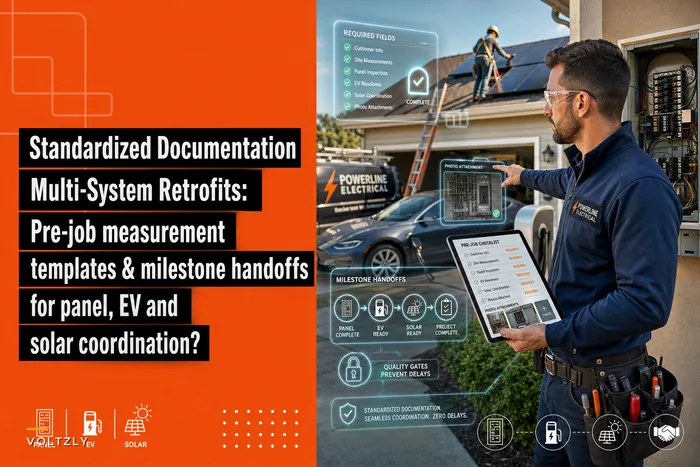
When you template this and build it from your actual job history, every project starts from a document that already learned from your last ten disputes. The detail from your standardized job documentation on multi-system retrofits feeds directly into tighter SOW language, because you already know where panel, EV, and low-voltage scope tends to blur together on site.
Start your SOW template with the exclusions list — that's where the money protects itself.
When you template this and build it from your actual job history, every project starts from a document that already learned from your last ten disputes. The detail from your standardized job documentation on multi-system retrofits feeds directly into tighter SOW language, because you already know where panel, EV, and low-voltage scope tends to blur together on site.
Staged invoicing triggers: get paid on the project's rhythm, not on memory
The single biggest cash-flow killer on commercial work is invoicing based on when someone remembers to do it rather than on what the job has actually hit. On a long project, that means you float labor and material for weeks longer than you should.
Staged invoicing fixes this by defining payment milestones up front and tying each one to a concrete, provable trigger. Not "30% at some point mid-job" — but "30% upon completed and passed rough-in inspection, documented."
| Stage | Trigger (what must be true) | Typical % of contract | Evidence required |
|---|---|---|---|
| Mobilization | Contract signed, materials ordered | 10–15% | PO confirmations, signed contract |
| Rough-in complete | Rough-in passes inspection | 30–35% | Inspection sign-off, photo pack of rough-in |
| Devices & trim | Fixtures/devices installed and energized | 25–30% | Photo evidence, panel schedules updated |
| Final/punch | Final inspection passed, punch list cleared | 20–25% | Final inspection cert, punch sign-off |
| Retention release | Warranty period / holdback terms met | 5–10% | Closeout docs, O&M manuals submitted |
The percentages flex by job, but the principle doesn't: each stage pays only when its trigger is proven. This accelerates your cash, because you're billing the moment a milestone hits instead of weeks later. And it makes your invoices far harder to dispute, because every bill arrives with the evidence that it's earned.
Worth noting: the shops with the worst commercial collections almost never have a staged structure written into the contract. They "bill monthly for work completed," which turns every invoice into a negotiation about percentages. A milestone-and-trigger model removes the argument — the trigger either happened or it didn't.
Front-loading mobilization matters too. If you're buying switchgear with a long lead time, a 10–15% mobilization draw keeps you from financing the owner's project out of your own line of credit.
Inspection evidence requirements: the link that makes everything enforceable
Every milestone trigger above depends on proof. If your evidence is scattered across three guys' phones, you don't actually have a system — you have a story you hope the GC believes.
Evidence requirements mean defining, per stage, exactly what has to be captured before that stage counts as done and billable. Not "take some photos," but a named, standardized set:
-
Rough-in
boxes, conduit runs, home runs, bonding, before cover-up — shot to a consistent naming and labeling standard.
-
Inspection
the signed card or digital sign-off, dated, tied to the permit.
-
Trim/devices
energized panels, labeled breakers, GFCI/AFCI test results where applicable.
-
Final
inspection certificate, punch list marked complete with sign-off.
The reason this matters beyond getting paid: inspection evidence is what protects you in a dispute two years later when someone claims a failure was your fault. A disciplined photo-and-sign-off trail converts "we think we did it right" into "here's documented proof, dated, tied to the inspection that passed." If you want the deeper mechanics on keeping inspection coordination from stalling payment, the workflow for avoiding re-inspections and payment holds lays out how the permit and inspection handoff should run.
The mistake shops make is treating evidence as closeout cleanup — something you assemble at the end to satisfy the office. By then the rough-in is buried behind drywall and the moment is gone forever. Evidence has to be captured at the stage, as a condition of that stage closing, or it isn't worth anything.
Subcontractor holdbacks: stop paying for work that isn't proven
When you run commercial projects, you often sit in the middle — the GC holds back on you, and you're holding subs below you. The shops that get hurt are the ones that pay subs in full and on time while they're themselves getting paid late and partial. You end up financing the entire chain's cash flow with your own money.
Holdback rules fix the asymmetry. A clean structure:
-
Mirror the terms above you. If the GC retains 10% on you, you retain at least that on your subs. Don't absorb retention you aren't getting.
-
Tie sub payments to the same evidence standard you're held to. A sub's milestone releases when their work is documented and, where relevant, inspected — not when they send an invoice.
-
Hold final retention until the sub's scope is fully closed out, including any punch items and warranty documentation. Their holdback is your leverage to get the last 5% of effort out of them.
A holdback is only leverage if you still have the money when you need it. Release it early to be the nice guy, and when a sub ghosts on punch list items you have nothing left to pull on. The holdback isn't about distrust — it's about keeping a reason for everyone to finish the job properly.
This connects directly to the broader subcontractor-risk framework. If you haven't built the SOW and milestone-holdback discipline into your sub agreements, the detailed approach in protecting your shop from subcontractor risk is the foundation this whole project OS sits on.
How the whole system runs: the project workflow start to finish
Here's how the links connect in practice on a single commercial project:
-
Scope locks first. Templated SOW built from the stamped drawing revision, with explicit inclusions, exclusions, allowances, and a change-order process everyone signs.
-
Milestones get defined in the contract. Each payment stage is attached to a specific, provable trigger and a required evidence set — before work starts.
-
Sub agreements inherit the structure. Each sub's SOW, milestone schedule, holdback percentage, and evidence requirements mirror what you're held to above.
-
Work proceeds, and change requests hit the gate. Anything outside the SOW stops until a signed change order with a price exists. No signature, no work.
-
Each stage closes on evidence. The photo pack and inspection sign-off are captured as a condition of the stage being complete — not as afterthought cleanup.
-
Invoices fire on triggers, with proof attached. The moment a milestone's trigger is documented, the invoice goes out with its evidence. No waiting for someone to remember.
-
Sub payments release against the same standard. Subs get their milestone money when documented; retention holds until full closeout.
-
Final retention releases both directions on closeout. Punch cleared, inspections passed, O&M docs submitted — you collect your retention and release your subs'.
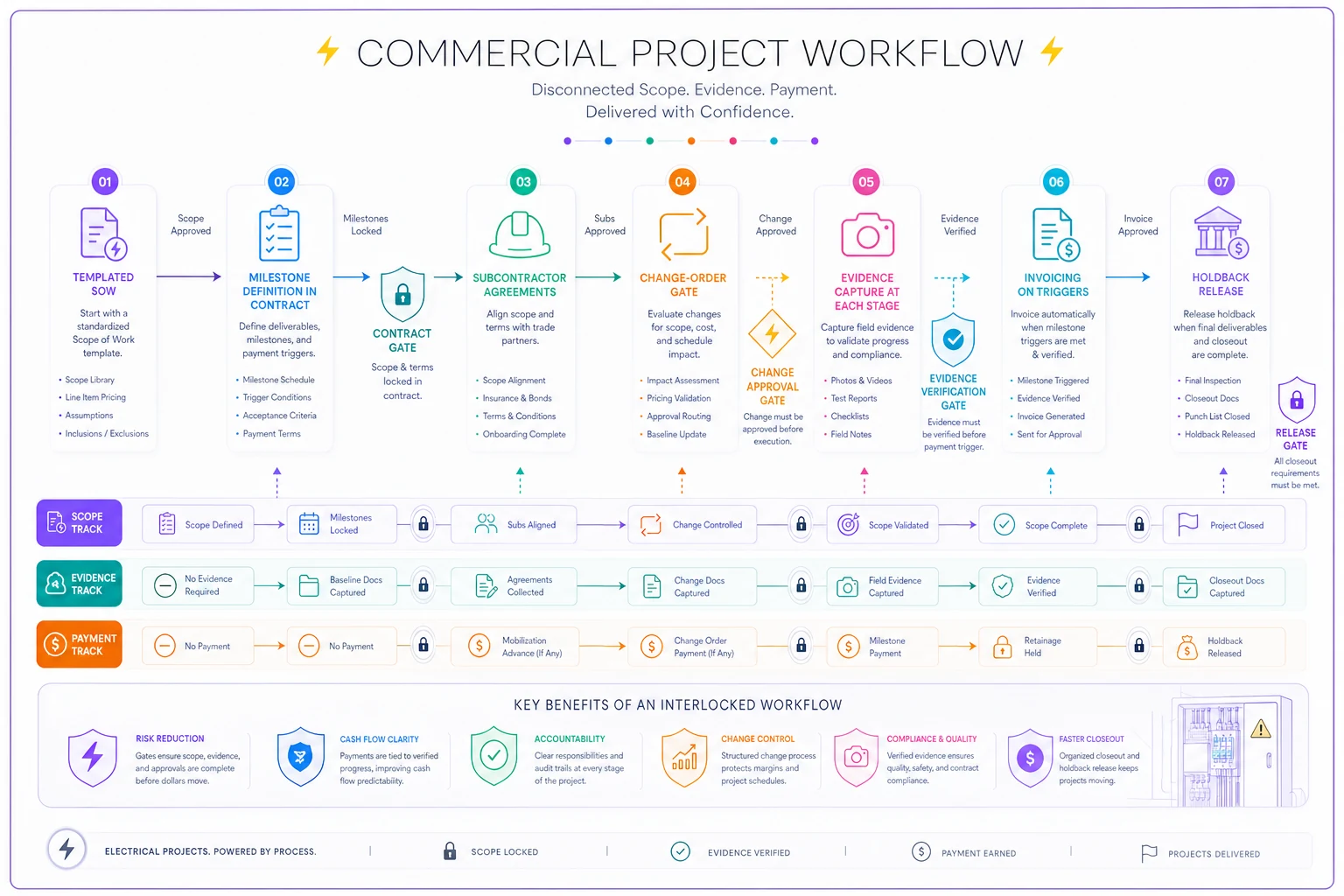
This diagram maps the sequence and the gates so you can see how each trigger locks the next step.
No single step floats free. Scope can't expand without triggering money. Money can't move without evidence. Evidence can't be skipped because it gates the stage. That interlock is the entire point.
A real scenario: a 7-tech shop and a $220k buildout
A seven-technician shop that had mostly done residential and light commercial took on a restaurant buildout — roughly $220k, two subs under them for low-voltage and fire alarm, a GC holding 10% retention.
On their first attempt at a job this size, they'd lost badly: verbal change requests they couldn't bill, invoices sent monthly and disputed down, and a low-voltage sub they'd paid 95% of before the sub disappeared during punch, leaving them to clean up roughly $6k of work themselves.
Second time, they rebuilt it as a system. The SOW listed exclusions explicitly — temp power and core drilling carved out, owner-furnished equipment named. Payment was staged against inspection triggers. Both subs signed milestone schedules with 10% retention mirrored from the GC, and their releases were tied to documented, inspected work.
The results weren't dramatic in any single number — they were just clean. Change orders on the job came to around $14k, and because the gate held, nearly all of it got signed and billed instead of absorbed. Average days-to-payment on their draws dropped by a couple of weeks because every invoice landed with its inspection proof attached and there was nothing to argue about. And when the fire-alarm sub dragged on punch items, the retained 10% was still sitting there — the sub finished within a week of being reminded what was being held.
No heroics. The money just stopped leaking out of the places it used to.
When this makes sense — and when it doesn't
When this is worth building: Any time you're running projects that span weeks, involve subs, pass through inspection gates, or route payment through a GC or owner's rep. The longer the feedback loop and the more parties involved, the more the governance pays for itself.
When it's overkill: On fast residential service and small same-week jobs, this much structure is friction you don't need. A panel swap billed and paid in five days doesn't require staged milestones and holdback schedules. Match the governance to the length and complexity of the job.
Who should be careful here: A shop that's never done commercial work shouldn't bolt all of this on at once and assume they're ready. The system controls risk; it doesn't create commercial competence. If you don't yet have people who can read commercial drawings, manage subs, and handle inspection coordination, build those skills first. The governance protects a capable team — it won't rescue an unprepared one.
Where software earns its place
You can run a version of this on spreadsheets and templates, and plenty of good shops do when they're starting out. It works until you're running three or four projects at once, at which point the manual version starts dropping links — the invoice that should have fired on Tuesday's passed inspection, the sub retention someone released early, the change order that got discussed but never signed.
AI-powered operational software does real work here: templated SOWs you reuse and refine, invoicing triggers that fire off documented milestones, evidence requirements built into each stage so nothing closes without proof, and holdback rules that enforce themselves instead of depending on someone remembering. The value isn't the software for its own sake — it's that the interlock between scope, evidence, and payment keeps holding even when you're too busy to babysit it. The right platform uses automation to flag when a stage is billable, when evidence is missing, and when a holdback is due for release, so the discipline survives being busy.
The point of all of it is simple. On commercial work, the margin you keep is mostly the margin you refused to let leak. Build the chain so scope, proof, and payment can't move without each other, and the leaks close on their own.
Ready to optimize your electrical service operations?
Join 500+ electrical service companies using Voltzly to improve scheduling accuracy, enhance client satisfaction, and boost operational efficiency.