


Most electrical shops don't have a lead problem. They have a handoff problem dressed up as a lead problem.
Marketing — or the owner's Facebook budget, or the Angi subscription — generates calls. Operations takes whatever shows up, dispatches whoever's available, and hopes it works out. When margins get thin, marketing says the leads were fine and ops fumbled them. Ops says marketing sent junk. Both are partly right, and neither can prove it, because nobody built the system that would connect the two ends.
This is the gap that quietly bleeds the most money in a growing shop. You can fix your dispatch, tighten your van stock, sharpen your estimator scripts — and still lose because the type of demand you're buying doesn't match the type of work your crews can actually deliver profitably. The channel that looks cheapest per lead often ends up being the most expensive per completed job.
What follows is a system owners can actually run: tying acquisition channel economics to qualification gates, mapping intake SLAs, building rejection codes that feed back into marketing, and putting a governance cadence on top so the whole thing self-corrects. This is the real meaning of marketing to operations alignment electricians keep searching for — not two separate departments, but one machine.
Why the two sides drift apart in the first place
The split isn't a personality thing. It's structural.
Marketing gets measured on volume and cost-per-lead. Operations gets measured on completed jobs, callbacks, and margin. Those two scorecards almost never talk to each other. A channel can look great on cost-per-lead while quietly feeding your crews jobs that close at 12% margin, generate more callbacks, and eat dispatch capacity you needed for better work.
This usually kicks in when the shop scales past the owner personally screening every call. At 2–3 techs, the owner is the qualification gate. They hear a call and know instantly whether it's a real panel upgrade or a tire-kicker shopping three shops for the lowest quote. That intuition never gets written down. So when a CSR or a new office hire takes over intake at 5–8 techs, the filter disappears overnight and job quality gets noisy — even though nothing changed with the marketing spend.
The pattern to watch: lead volume stays flat or grows, but your close rate on dispatched jobs drops and average ticket softens. That's almost always an alignment failure, not a demand failure.
Start with channel economics, not cost-per-lead
Cost-per-lead is the most misleading number in the shop. The one that actually matters is cost per completed profitable job by channel — and almost nobody tracks it because it requires marketing and ops data sitting in the same row.
Never miss a job or delay a dispatch again.
Voltzly helps you schedule, assign, and track every electrical job efficiently.
- Unified job scheduling
- Real-time technician tracking
- Automated client notifications
No credit card required
Here's the worksheet structure every channel should run through monthly:
| Metric | Google LSA | Angi/Thumbtack | Facebook/Meta | Referral/Repeat | Fleet/Signage |
|---|---|---|---|---|---|
| Leads generated | 60 | 85 | 40 | 30 | 15 |
| Cost per lead | $38 | $22 | $31 | ~$0 | low fixed |
| Qualified after gate | 42 | 31 | 19 | 28 | 12 |
| Booked jobs | 34 | 20 | 12 | 26 | 10 |
| Avg ticket | $940 | $610 | $780 | $1,350 | $1,100 |
| Gross margin % | 44% | 29% | 38% | 51% | 47% |
| Cost per booked job | $67 | $94 | $103 | ~$0 | low |
| Callback rate | 6% | 14% | 9% | 3% | 5% |
The numbers above illustrate the shape we see, not a benchmark to copy verbatim. But look at what they expose. The Angi-type channel had the lowest cost-per-lead at $22 and the worst economics once you follow it through to completed, profitable work — lower tickets, thinner margins, double the callback rate. Which means it's also stealing rework capacity from your better channels.
If you only ever looked at cost-per-lead, you'd pour more budget into the channel that's actively making the shop worse. This is probably the single most common expensive mistake in trades marketing.
The rule: no channel gets budget decisions made on cost-per-lead. Every channel gets judged on cost per booked profitable job, plus callback drag. Run this table monthly and the reallocation decisions basically make themselves.
Qualification gates: turn intuition into a repeatable filter
Once you know which channels earn their keep, you need a gate that qualifies leads before they hit the dispatch board. This is where the owner's lost intuition gets rebuilt as a written process.
A qualification gate is a short set of decision points the intake person runs on every call. The goal isn't to reject people — it's to route them correctly and catch mismatches early. This connects directly to how you score incoming work; if you haven't built the scoring side yet, the lead-quality scorecard and handoff SLA for residential electrical teams is the companion piece to this gate.
A practical gate for a residential shop:
-
Service match — Is this work we do profitably? (Panel upgrades yes; low-voltage security no.)
-
Geography — Inside our drive-time boundary, or does travel eat the margin?
-
Intent — Ready to schedule, or price-shopping? Not disqualifying on its own, but it changes the routing and estimator script.
-
Urgency vs. capacity — Emergency today when we're fully booked, or flexible next week?
-
Scope clarity — Can we describe the job well enough to send the right tech, or is it a "just come look at it" mystery?
Keep the gate short enough to run during the first contact so CSRs don't skip it under call pressure.
Each answer either advances the lead, routes it to a different track (self-pay estimate, waitlist, referral out), or flags it for rejection with a code — which is where the feedback loop starts.
Rejection codes: the feedback marketing never gets
This is the part almost every shop skips, and honestly it's what makes the whole thing learn.
When a lead doesn't convert or gets filtered out, most shops record nothing. The reason it failed just disappears. Marketing keeps buying the same bad demand because nobody ever told them in a structured way that it was bad.
A rejection-code taxonomy fixes that. Every non-converting lead gets tagged with a reason, and those codes roll up by channel. Keep the list short enough that intake actually uses it:
-
OUT-GEO — Outside service area
-
OUT-SVC — Work we don't do / not profitable
-
PRICE — Priced out, chose competitor
-
NO-SHOW — Booked but ghosted
-
SCOPE — Job smaller or different than the lead implied
-
DUP — Duplicate or spam
-
CAP — Couldn't service in required timeframe
-
UNQUAL — Tire-kicker, no real intent
If 40% of your Angi leads come back tagged OUT-SVC and SCOPE, that channel isn't sending bad-luck leads — it's structurally attracting the wrong work. That's a targeting or channel problem marketing can actually fix. If a channel throws a lot of CAP codes, you don't have a lead problem at all — you have a capacity problem, and buying more leads is throwing money into a fire.
Rejection codes are how operations talks back to marketing in a language that drives decisions instead of arguments.
Intake SLA mapping: speed is a margin lever
Lead response time is the most under-managed number in the pipeline. The difference between calling a lead back in 5 minutes versus 45 minutes is often the difference between booking it and losing it to whoever picked up first.
Map an SLA to each stage and make it visible:
-
First contact within 5 minutes for LSA/paid, same-hour for form fills
-
Qualification completed within the same call or 30 minutes
-
Booked or routed within 2 hours
-
Site validation / scope confirm within 24 hours of booking
-
Dispatch confirmed to customer day before, with tech name and arrival window
Where this breaks at scale: intake SLAs that lived in one person's head fall apart the moment you add a second CSR or move to after-hours coverage. Leads sit in a voicemail or a form inbox nobody owns. The fix isn't nagging about speed — it's assigning explicit ownership at each SLA stage and making the clock visible so a missed response gets caught the same day, not discovered in a month-end report.
Product / SLA mapping: match the job type to the promise
Not every job should carry the same service promise, and pretending otherwise is how shops overcommit their best techs to low-value work.
Map your job types to distinct delivery tracks. A quick diagnostic and a full panel-plus-EV retrofit are not the same product. They shouldn't share a response promise, a tech tier, or a scheduling window. This is also where recurring-revenue work fits in — if you're building service agreements, the tiering logic in turning service calls into predictable revenue with a three-tier service plan pairs naturally with this kind of mapping.
A simple version:
-
Emergency / no-power → 4-hour response, senior tech, premium rate
-
Standard service (outlets, fixtures, troubleshooting) → next-day, mid-tier tech
-
Planned install (panel, EV, subpanel) → scheduled, site-validated, senior tech
-
Estimate-only / price shopper → self-serve or batched estimate slot, junior or virtual
The mistake is running everything at "get there fast" urgency. It burns senior techs on jobs that don't need them and starves high-margin installs of the attention they actually require.
Ops enforcement: where alignment actually gets real
A gate and an SLA that aren't enforced are just a nicely formatted wish. Enforcement means the dispatch board won't accept a job that skipped qualification, and the month-end review sees every SLA breach and rejection code.
In practice, the pipeline runs like this:
Lead lands from a tagged channel → intake runs the qualification gate → lead is either routed, booked, or rejected-with-code → booked jobs get product/SLA mapped and site-validated → dispatch assigns by tech tier → job completes and feeds back margin, callback, and cycle-time data → all of it rolls up by channel in the monthly review.
Here's a simple visual of that flow.
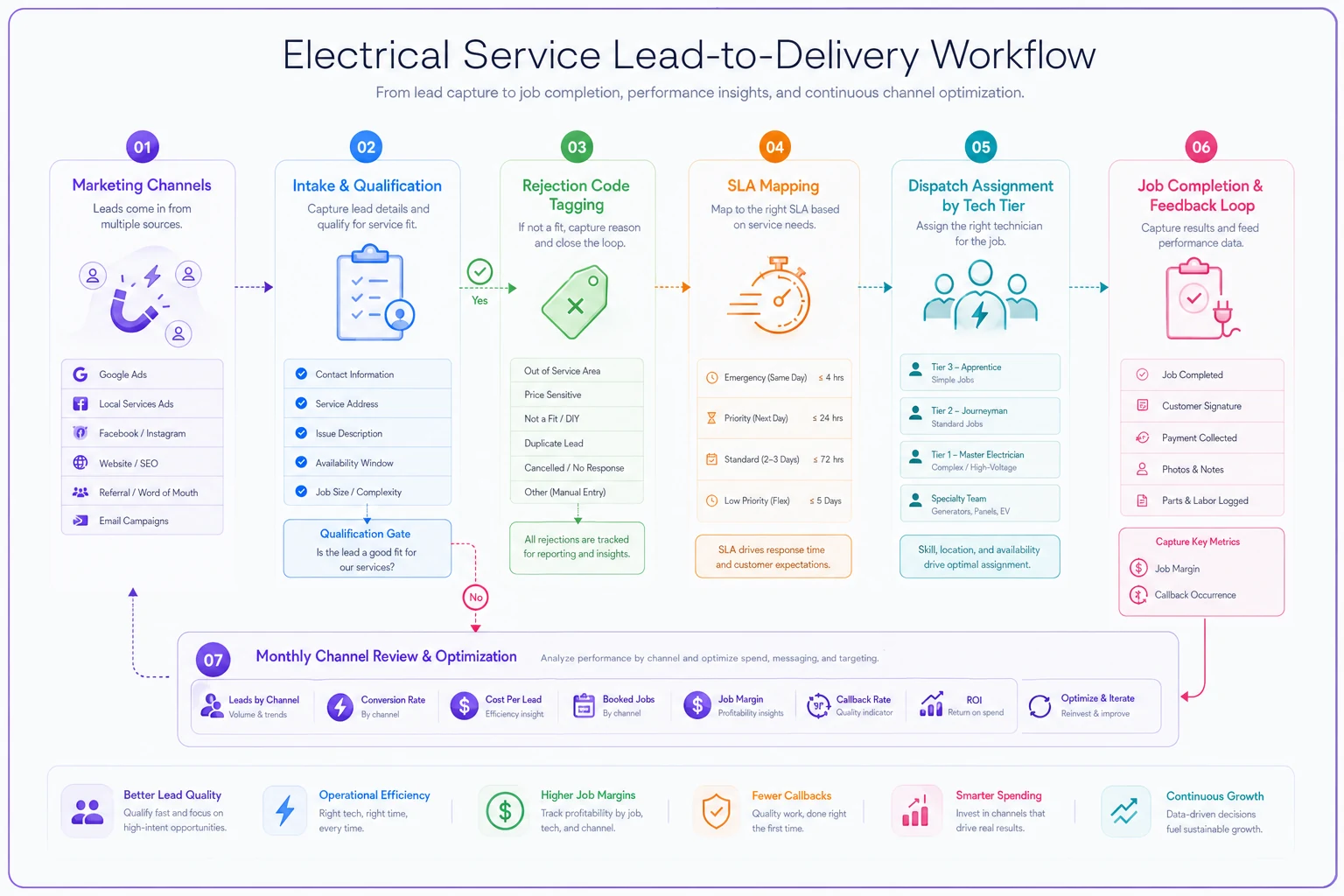
Every stage produces data the previous stage needs. Dispatch outcomes tell you if qualification is calibrated. Rejection codes tell marketing which channels to cut. Margin-by-channel tells the owner where the next ad dollar goes. If any stage drops its data, the loop breaks and you're back to two departments guessing.
The broader trades-specific lead-to-cash workflow shows how this connects downstream into invoicing and collections — this article is really about locking the front half of that same chain.
This is also where the right operational software earns its place — not as magic, but as the thing that enforces the gate, timestamps the SLAs, and rolls rejection codes up by channel automatically instead of relying on someone to remember to log it. AI-assisted intake platforms can pre-tag likely rejection reasons and flag leads that skipped stages, but the real value is the enforcement and the feedback loop, not the feature list.
The handoff RACI owners can implement
Most alignment failures trace back to unclear ownership at the seams. A lightweight RACI removes the "I thought you had it" gaps.
| Stage | Responsible | Accountable | Consulted | Informed |
|---|---|---|---|---|
| Channel budget & tagging | Marketing lead | Owner | Ops manager | CSR |
| First contact + qualification | CSR | Ops manager | — | Owner |
| Rejection coding | CSR | Ops manager | Marketing lead | Owner |
| Product/SLA mapping | Dispatcher | Ops manager | Senior tech | Owner |
| Dispatch by tier | Dispatcher | Ops manager | — | Tech |
| Monthly channel review | Ops manager | Owner | Marketing lead | Full team |
The key seam is rejection coding. Marketing is consulted, not just informed, because the codes are the entire point of feeding intelligence back to spend decisions. Skip that consult and the loop dies quietly.
Governance cadence and the KPI loop
Systems drift without a rhythm. Three cadences keep this alive:
-
Daily (5 min) SLA breaches from yesterday — any lead that sat too long, any missed callback.
-
Weekly (20 min) Rejection codes by channel, close rate on dispatched jobs, capacity vs. demand.
-
Monthly (60 min) Full channel economics worksheet, cost per booked profitable job, callback drag, budget reallocation.
The KPIs that actually matter in this loop:
-
Cost per booked profitable job by channel
-
Close rate on qualified leads
-
Intake SLA compliance %
-
Rejection-code distribution by channel
-
Callback rate by channel and by job type
-
Gross margin by channel
Most of these are ratios and rates, not raw counts. Lead volume tells you almost nothing on its own. The health of the pipeline lives in the ratios.
A real scenario
A residential shop running seven techs was spending somewhere around $6k–$7k a month across LSA, Angi, and Facebook. Lead volume looked healthy — well over 200 leads a month — but the owner couldn't figure out why margins kept slipping even as call volume grew.
When they tagged channels and ran the economics worksheet for the first time, the picture was ugly in a useful way. Their lead-aggregator channel was producing about a third of total leads at the lowest cost-per-lead, but nearly 40% of those came back tagged OUT-SVC or SCOPE, closed around 29% margin, and drove almost half their callbacks. Meanwhile LSA and repeat-customer work was closing near 45% margin with a fraction of the callbacks.
They cut the aggregator budget by roughly 60%, moved that spend to LSA, and put a written qualification gate plus rejection coding on intake. Over the next quarter, total lead volume actually dropped — but booked-job margin came up several points, callbacks eased noticeably, and the crews got hours back that had been eaten by rework. Same shop, roughly the same total ad spend, meaningfully better delivered profit. Nothing changed about their electrical work. What changed was that marketing and operations were finally looking at the same row of data.
When this system is worth building — and when it isn't
Build it when: you're past 4–5 techs, spending real money on paid acquisition, and intake has moved out of the owner's hands. That's exactly when the invisible filter disappears and channel mismatch starts compounding.
Don't over-build it when: you're a two-person shop running almost entirely on referrals and repeat work. You don't need a rejection-code taxonomy to manage 30 warm leads a month — you need to keep those customers happy and get paid on time. Adding this machinery too early just creates admin overhead with nothing worth optimizing.
Who should be careful: shops with wildly inconsistent lead volume or a single dominant channel. Fix the concentration risk and data quality first. A governance cadence built on garbage inputs just produces confident-looking wrong decisions.
The point of all this
The gap between marketing and operations isn't fixed with better ads or faster techs in isolation. It's fixed by treating demand and delivery as one pipeline — shared data, enforced gates, and a feedback loop that lets each end correct the other. Channel economics tell you what to buy. Qualification gates and SLAs protect what you buy. Rejection codes send the truth back upstream. A governance cadence keeps the whole thing honest month after month.
Get that machine running and the old argument disappears — because there's no longer a marketing side and an ops side guessing about each other. There's one system, one set of numbers, and one clear answer to the only question that actually matters: which demand turns into profitable, delivered work.
The gap between marketing and operations isn't fixed with better ads or faster techs in isolation. It's fixed by treating demand and delivery as one pipeline — shared data, enforced gates, and a feedback loop that lets each end correct the other. Channel economics tell you what to buy. Qualification gates and SLAs protect what you buy. Rejection codes send the truth back upstream. A governance cadence keeps the whole thing honest month after month.
Get that machine running and the old argument disappears — because there's no longer a marketing side and an ops side guessing about each other. There's one system, one set of numbers, and one clear answer to the only question that actually matters: which demand turns into profitable, delivered work.
Ready to optimize your electrical service operations?
Join 500+ electrical service companies using Voltzly to improve scheduling accuracy, enhance client satisfaction, and boost operational efficiency.