

Most small electrical shops don't have a dispatch problem. They have a dispatch governance problem. The board works fine until two things collide — a priority customer expecting a two-hour window and a tech who technically "can do it" but has never pulled a permit for that panel type. Somebody makes a judgment call in the moment, it goes sideways, and now you're eating a callback, a discount, or a lost commercial account.
The reason this keeps happening isn't bad dispatchers. The rules live in people's heads instead of somewhere everyone can follow them. One person knows which customers get bumped to the front. Another knows which techs should never be sent to a 400A service without backup. A third knows the unofficial "we'll credit them if we're more than an hour late" policy. None of it's written down, so none of it's enforceable, and all of it breaks the moment that person is out for a week.
This article is about building the connective tissue: a governance blueprint that maps customer tier → scheduling SLA → required skill tag → acceptable deviation and penalty — and what that means for your parts manifest and fleet once you're running more than a couple of trucks.
Why dispatch rules quietly fall apart as you grow
At two trucks, dispatch is basically a conversation. The owner knows every customer, every tech's strengths, and every job on the board. Governance is implicit because the whole operation fits in one person's memory.
At four to six trucks, that stops working. You've got a dispatcher who isn't the owner, techs who joined in the last year, and customers who were promised different things by different people. Shops keep running on tribal knowledge long after the tribe got too big to share a brain. It's a predictable failure pattern, and most owners don't notice until an account is already at risk.
What breaks first is usually the tier-to-SLA link. Somebody sold a property management company a "priority" agreement — maybe bundled into a service plan — but the dispatch board doesn't flag their calls any differently than a one-off residential job. Their "priority" ticket sits behind three walk-ins who happened to call first. The customer notices. They always notice.
The second thing to break is the skill-to-job link. A busy Friday means you send whoever's closest, not whoever's qualified. Nine times out of ten it's fine. The tenth time you've got an apprentice-level tech staring at a commercial transfer switch, calling the office for help, burning ninety minutes, and ultimately rescheduling after the customer already took a half-day off work. That's not a scheduling miss. That's a governance gap wearing a scheduling costume.
The four layers that have to connect
A real dispatch governance model isn't one rule. It's four layers that have to line up every time a ticket gets assigned. When any one of them is missing, the other three get overridden in the heat of a busy morning.
Never miss a job or delay a dispatch again.
Voltzly helps you schedule, assign, and track every electrical job efficiently.
- Unified job scheduling
- Real-time technician tracking
- Automated client notifications
No credit card required
-
Customer tier — what level of service this account is actually entitled to, based on contract, revenue, or strategic value.
-
Scheduling SLA — the response and arrival window that tier is promised, in concrete numbers, not vibes.
-
Skill tag — the minimum certification, experience level, or job-type clearance required for the work.
-
Deviation and penalty rules — what happens when you can't hit the SLA or can't send a qualified tech, and who absorbs the cost.
Writing these down together is the whole point. They stop contradicting each other. You can't promise a two-hour SLA to a tier that only has three qualified techs across the whole roster. The math doesn't work, and governance is what forces you to notice before you've already sold the promise.
Mapping tiers to SLAs to skills
Here's a worked example of what this looks like for a shop running five trucks with a mix of residential, light commercial, and a handful of property-management contracts.
| Customer tier | Example account | Scheduling SLA | Required skill tag | Acceptable deviation | Penalty / remedy |
|---|---|---|---|---|---|
| Tier 1 – Contract commercial | Property mgmt, strata, retail chains | On-site within 4 business hours; after-hours emergency within 2 hrs | Journeyman + commercial-service clearance | One SLA miss per quarter before review | Credit per contract (often 10–15% of ticket) + logged incident |
| Tier 2 – Service-plan residential | Members on recurring plans | Same-day if booked before noon; next-day otherwise | Journeyman OR cleared apprentice w/ remote backup | Weather + genuine emergency surge only | Waived trip fee + priority rebooking |
| Tier 3 – Standard residential | One-off calls | Within 2–3 business days | Any qualified tech for job type | Flexible; reschedule with notice | Courtesy rebooking, no financial remedy |
| Tier 4 – New / unvetted | First-time, no deposit | Scheduled after deposit clears | Any qualified tech | Fully flexible | None |
The table isn't actually the interesting part. What's interesting is what it forces you to confront. If you only have two techs with "commercial-service clearance" and you've signed four Tier-1 contracts promising a four-hour window, you've just mapped yourself into a coverage hole. Governance surfaces that conflict on paper so you fix it with hiring or retraining — not with an angry phone call on a Tuesday afternoon.
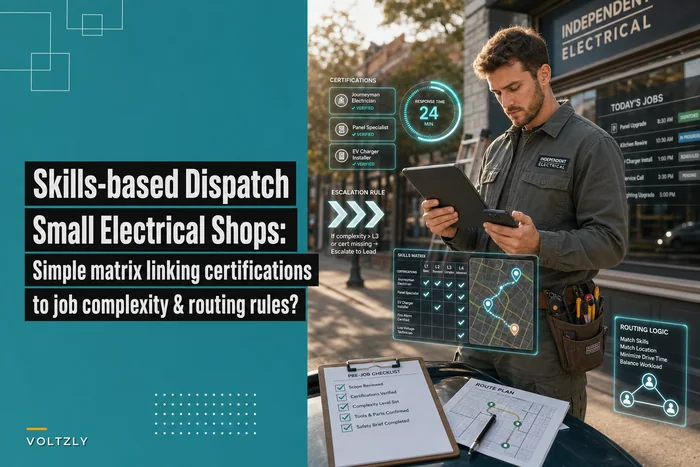
For the skill-tag side of this, it helps to have an actual matrix behind the tags rather than a gut feel about who can handle what. A skills-based dispatch matrix that matches tech certifications to job complexity is the foundation the governance layer sits on top of. Governance decides who gets priority access to your qualified techs; the skills matrix decides who's qualified in the first place.
Deviation rules: the part everyone skips
Most shops stop at "here's the SLA." Then reality hits — a truck breaks down, a job runs three hours long, two techs call in sick during a heat wave — and there's no rule for what happens next. The dispatcher improvises, and improvisation under pressure is where margin goes to die.
A deviation rule answers two questions before the crisis hits: what's an acceptable reason to miss, and what do we owe the customer when we do.
In practice, deviations fall into three buckets:
-
Force majeure (storms, grid events, genuine mass-emergency days): SLA is suspended, customers notified proactively, no penalty owed. But you still log it — because three "storm days" in a month usually means your capacity math is wrong, not the weather.
-
Internal failure (truck down, tech no-show, parts not staged, double-booking): SLA stands, penalty applies, and it gets tagged as a process miss — not just a customer credit. These are the ones that should trigger a review.
-
Customer-caused (gate locked, nobody home, scope changed on arrival): SLA resets, no penalty on your end, documented with photos or timestamps so there's no dispute later.
The distinction matters because the penalty isn't really the point. The tagging is. A shop that credits a commercial account 12% and files it under "weather" learns nothing. The same credit filed under "truck 3 down for the fourth time this quarter" tells you to fix the truck or the maintenance schedule. Same dollar cost, completely different operational signal.
A realistic penalty example with numbers
Take a Tier-1 property management contract worth roughly $4k–$5k a month in recurring and reactive work. The contract says after-hours emergencies get a two-hour response, with a 15% credit if you miss.
One quarter, you miss three times. Two are internal — a tech no-show and a truck that wouldn't start. One is a genuine regional outage. The outage gets suspended, no credit. The two internal misses cost around $300–$400 in credits combined. Not catastrophic by itself.
But that account is also reviewing a competitor's bid at renewal. Two logged internal misses in one quarter is exactly the kind of thing that comes up when they're deciding whether to re-sign. The $400 credit isn't the real loss. The $50k-a-year relationship wobbling at renewal is the loss. Governance that tracks why you missed is what lets you walk into that renewal with "we had two misses, both fleet-related, here's what we changed" instead of a shrug.
That difference — being able to explain the miss specifically — tends to matter more than the dollar amount ever does.
How governance changes your parts manifest
This is the piece most dispatch conversations miss entirely. Once you tie SLAs to tiers, your van-stock manifest stops being generic and starts being tier-aware.
If a Tier-1 commercial account is entitled to a four-hour on-site window, the tech dispatched there can't afford a mid-job supply run for a common part. That means trucks covering commercial contracts need a deeper, different manifest than trucks running standard residential calls. The SLA you sold on paper has a direct, physical consequence in what sits on the shelf behind the driver's seat.
-
Commercial-contract trucks carry broader breaker inventory, common commercial connectors, and specialty items those specific sites tend to need — because a return trip blows the SLA.
-
Standard residential trucks run leaner, higher-turn manifests, because a next-day reschedule doesn't breach anything.
-
After-hours / emergency trucks carry whatever closes around 80% of your actual emergency call types without a supply house visit, since nothing's open at 11pm anyway.
The governance blueprint is what tells you which manifest goes on which truck. Without it, every truck carries the same compromise load — too much of what residential needs, not enough of what the commercial SLA demands. The pre-staging logic here connects tightly to a dispatcher's quick-assessment approach for complex sites, where knowing the job and the tier upfront lets you load the truck correctly the first time.
Track the top 20 parts used per contract for 90 days to fine-tune manifest depth for commercial routes.
The pre-staging logic here connects tightly to operational routing and prevents avoidable reschedules that breach SLAs.
The coordination problem at the center of all this
Everything above is really a coordination problem. Tier lives in your sales agreements. SLA lives in the dispatch board. Skill tags live in whatever spreadsheet tracks certifications. Penalties live in someone's memory of what the contract said. The manifest lives on the truck. These five things have to agree at the moment of assignment, and in most shops they live in five different places that never talk to each other.
This is where a dispatch board that enforces rules instead of just displaying jobs earns its keep. An AI-assisted dispatch layer can flag conflicts before they happen — surfacing that the only qualified tech for a Tier-1 commercial job is already committed past the SLA window, or that a ticket is about to go to someone without the required skill tag, or that the truck headed to a contract site is missing a part that job type usually needs. It's not about replacing the dispatcher's judgment. It's about catching collisions that a manual board makes invisible until it's too late to do anything about them.
A quick workflow of how the five elements should agree at the moment of assignment:
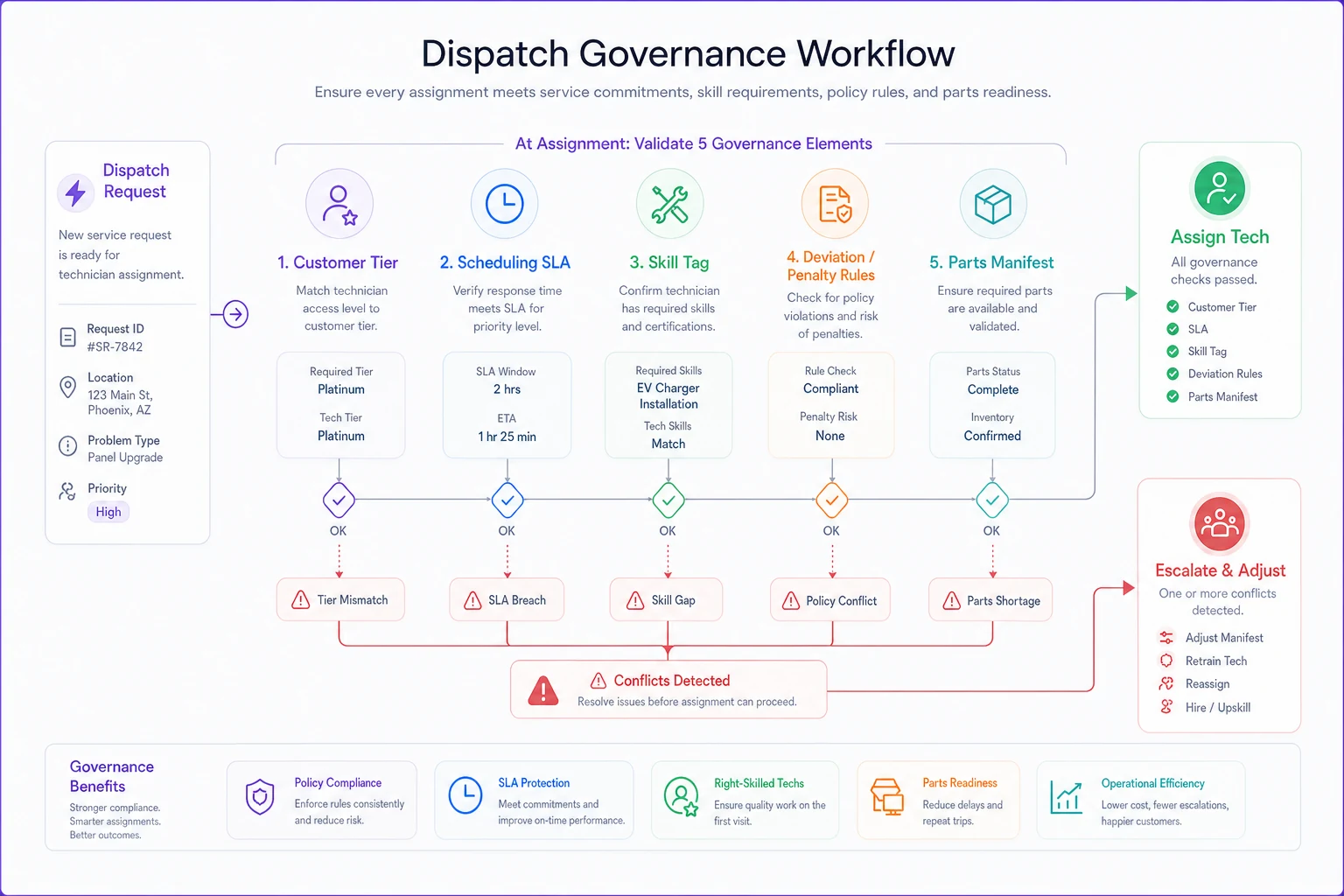
The practical effect is that the governance rules you wrote down actually get followed — every ticket, even on the chaotic Friday when the person who normally holds all this in their head is out sick. Rules that only work when the owner is watching aren't governance. They're just preferences.
When this blueprint actually makes sense
This level of structure is genuinely overkill for a one or two-truck shop where the owner still runs dispatch. At that size, the memory is the system, and adding formal tiers just creates friction without solving anything.
-
A dispatcher who isn't the owner
-
More than one or two contract or commercial accounts with real service promises
-
A range of tech skill levels where "send whoever's closest" has already burned you at least once
-
Enough volume that SLA misses are happening and nobody can say exactly why
When to hold off
If your business is almost entirely one-off residential with no contracts and no SLAs sold, you don't have tiers to govern yet — build the service-plan structure first, then add governance on top. And if your techs are more or less interchangeable in skill, the skill-tag layer adds friction without preventing anything. Don't build enforcement for problems you don't have.
A short real scenario
A six-truck shop in a mid-size metro was running somewhere around 330–360 service calls a month, split across standard residential and roughly a dozen light-commercial and property-management contracts. Dispatch was first-come, first-served, with the owner occasionally jumping in to reshuffle things for important accounts.
The symptom that pushed them to fix it: two commercial accounts flagged repeated late arrivals in the same quarter, and one hinted at shopping the contract. When they dug in, they found their two commercial-cleared journeymen were constantly getting pulled onto whatever residential job popped up first, leaving nobody qualified when a contract call came in.
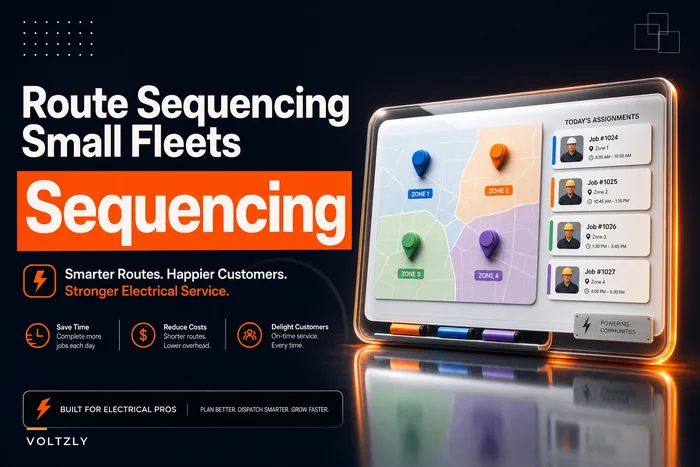
They mapped tiers to SLAs to skill tags, protected their two commercial-cleared techs so they couldn't be auto-assigned to Tier-3 residential during business hours, and split the truck manifests so the commercial trucks carried the deeper breaker and connector stock. The routing side got cleaned up in parallel using tighter route-sequencing rules for their crews so protecting qualified techs didn't wreck drive time.
Over the next couple of quarters, SLA misses on contract accounts dropped to a handful, and both at-risk accounts re-signed. The credits they paid out fell by more than half — not because they got faster, but because they stopped sending the wrong tech to the wrong tier and stopped improvising every time a truck went down.
Bringing it together
Dispatch governance for electricians isn't about adding bureaucracy to a board that currently "works." It's about making invisible rules visible and enforceable so they survive growth, turnover, and bad days.
Customer tier sets the promise. The SLA makes the promise concrete. The skill tag makes sure the right person keeps it. Deviation rules decide who pays when you can't — and the manifest makes the physical side of the promise possible. All five of those things have to connect, and in most shops they don't.
The shops that struggle are the ones running all five on memory and goodwill. Start with your contract accounts, map them end to end, and fix the first coverage conflict the exercise exposes. That one conflict is almost always already costing you money — you just haven't seen it written down yet.
Dispatch governance for electricians isn't about adding bureaucracy to a board that currently "works." It's about making invisible rules visible and enforceable so they survive growth, turnover, and bad days.
Customer tier sets the promise. The SLA makes the promise concrete. The skill tag makes sure the right person keeps it. Deviation rules decide who pays when you can't — and the manifest makes the physical side of the promise possible. All five of those things have to connect, and in most shops they don't.
Start with your contract accounts, map them end to end, and fix the first coverage conflict the exercise exposes. That one conflict is almost always already costing you money — you just haven't seen it written down yet.
Ready to optimize your electrical service operations?
Join 500+ electrical service companies using Voltzly to improve scheduling accuracy, enhance client satisfaction, and boost operational efficiency.