


Most electrical shops already collect the raw material for a smart operation. Techs snap panel photos, log torque values, timestamp arrivals and departures, mark meter readings. The data exists. The problem is it just sits there—buried in a phone gallery, a paper checklist, or somebody's memory until a callback forces you to go digging.
The gap isn't collection. It's interpretation. A photo of a lug is only useful if something acts on it: passes the job, flags a rework, opens a warranty claim, or holds an invoice. Right now that "something" is usually a human being manually eyeballing the input and deciding what happens next. And humans are inconsistent, especially at 4:45 on a Friday.
A field-intelligence operating system is really just a set of rules that map inputs to decisions. Input comes in → rule evaluates it → a gate opens or closes. That's the whole game. The shops that get this right stop relying on tribal knowledge and start running on documented recipes any tech can follow and any office person can audit.
Here's how that actually works, where it breaks, and what the rule tables look like in practice.
Why raw field data almost never turns into decisions
The pattern is pretty consistent: a shop mandates "take before and after photos" and considers the job done. Six months later they've got 40,000 photos and zero structure. Nobody can find the panel shot from the Henderson job without scrolling for ten minutes.
The failure isn't the policy. It's that a photo with no rule attached is just documentation—not intelligence. Documentation is passive. Intelligence is a photo that triggers something.
-
Passive "Tech uploaded a torque wrench reading of 42 in-lbs."
-
Active "Tech uploaded 42 in-lbs → spec requires 50 in-lbs → job fails QA gate → rework task auto-created → invoice held."
The second version is a rule. The first is a data point that helps nobody until there's a lawsuit.
This usually breaks down because the rules live in one person's head—typically the owner or the lead tech. They "know" that a certain breaker brand needs specific torque, or that a bonded neutral in a subpanel is an instant reject. But that knowledge never gets written as a repeatable gate. So quality depends entirely on who did the job, not on the job itself.
If you've already worked on your field-service data strategy, you know collecting clean inputs is step one. This article is about step two: turning those inputs into automatic decisions.
The core idea: inputs → gates → actions
Every rule recipe has three parts. Get comfortable with this shape and you can write rules for almost anything in your shop.
Never miss a job or delay a dispatch again.
Voltzly helps you schedule, assign, and track every electrical job efficiently.
- Unified job scheduling
- Real-time technician tracking
- Automated client notifications
No credit card required
-
Input — what the tech captures (photo, reading, timestamp, checkbox, signature).
-
Condition — the logic that evaluates it (threshold, presence/absence, comparison, deadline).
-
Action — what happens automatically (accept, reject, create task, hold invoice, open warranty, notify).
The elegance is that inputs you're already collecting can drive multiple gates. One panel photo can feed a QA gate, a warranty record, and a compliance archive at the same time.
A typical example: a residential service change requires a wide photo of the finished panel, torque readings on the main lugs, and a timestamp on the meter release. The rule set says if any of those three are missing, the job cannot be marked complete. If torque is below spec, auto-fail and create a rework task. If the meter-release timestamp is before the inspection-pass timestamp, flag it as a sequence error. Nobody has to remember to check. The system won't let the job close until the gates pass.
Here's a quick visualization of the rule flow.
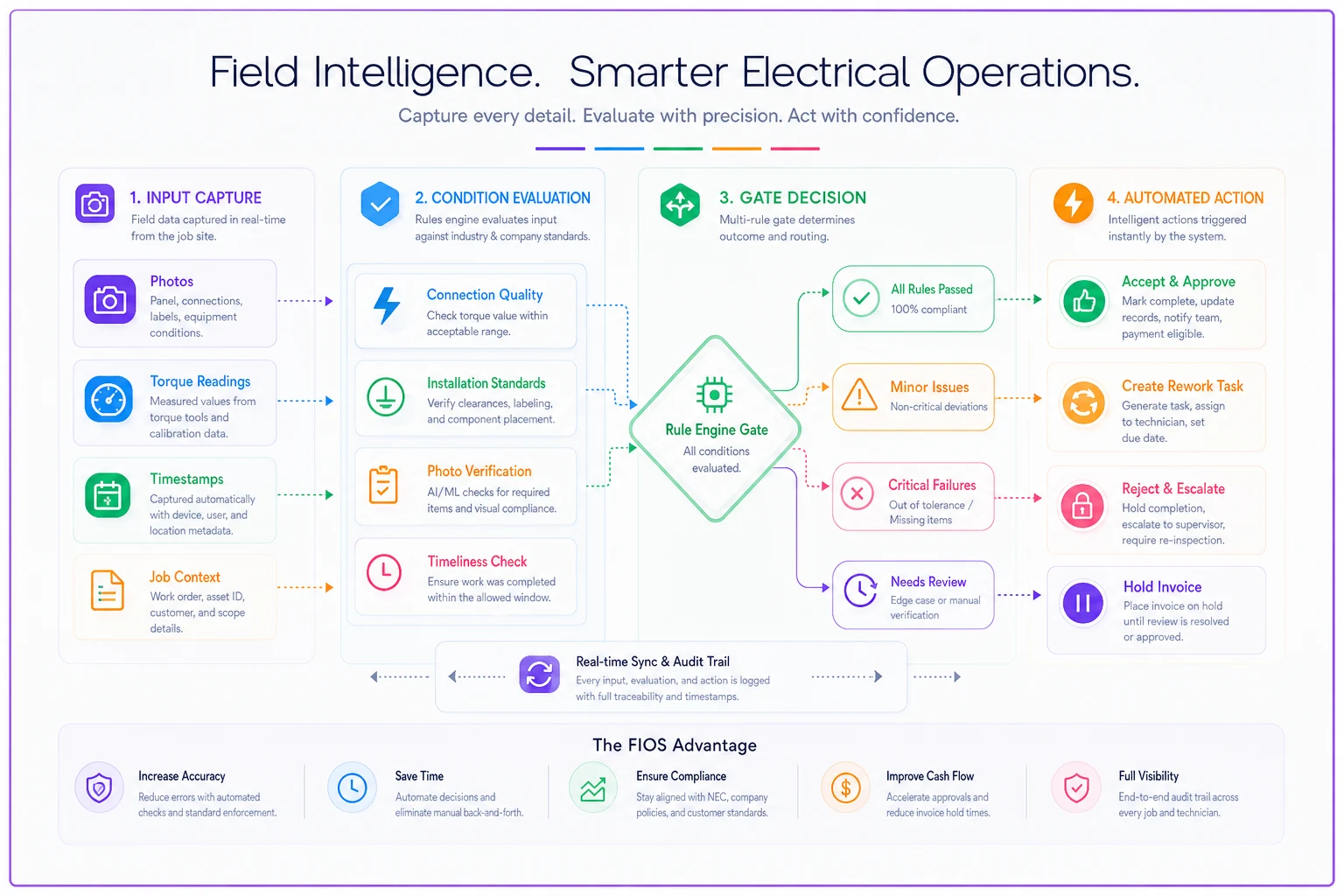
This shows how one input can feed multiple gates and actions.
Accept/reject gates: the backbone of consistent quality
Accept/reject gates are the simplest and highest-value rules to start with because they catch problems before the tech leaves the site. Every defect caught on-site is a callback you don't pay for later.
Here's a set of starter gates for a typical residential and light-commercial shop:
| Input captured | Condition | Gate result | Auto-action |
|---|---|---|---|
| Main lug torque reading | Below manufacturer spec | REJECT | Create rework task, notify lead |
| Finished panel photo | Missing or blurry | HOLD | Block job completion, prompt re-upload |
| GFCI test photo/checkbox | Not present on required circuits | REJECT | Add punch item, hold invoice |
| Arrival + departure timestamps | Departure before minimum job duration | FLAG | Route to ops for review |
| Grounding electrode photo | Absent on service change | REJECT | Block completion |
| Permit number field | Empty on permitted job type | HOLD | Notify office, block scheduling of inspection |
These aren't complicated. Each is a single condition producing a single outcome. The mistake shops make is trying to build one giant "master checklist" with 60 items and no logic. Techs ignore it because nothing happens whether they fill it out or not. Six sharp gates that actually stop a job beat sixty soft checkboxes that don't.
When this makes sense: the moment you've had more than one or two callbacks that a photo or reading would have caught. If you're eating rework on loose lugs or missing GFCIs, gates pay for themselves fast.
When it's a bad idea: gating everything on day one. Techs will push back hard, and you'll spend more time fighting false rejects than fixing real defects. Start with the two or three defects that actually cost you money.
Torque readings and the trap of "we always do it right"
Torque is worth its own section because it's the input most shops think they handle and most shops actually don't.
Loose connections account for a significant share of heat-related failures that come back as warranty work. The tech "torqued it to spec"—but there's no record, no reading, no photo of the wrench. So when the panel comes back with a scorched lug eight months later, you have no way to prove the connection was correct at handoff. You either eat the warranty or fight the customer. Both are losses.
-
Input photo of the torque wrench display OR a logged numeric reading per required connection.
-
Condition reading ≥ manufacturer spec for that device.
-
Action if pass attach to warranty record, mark connection verified.
-
Action if fail or missing reject the connection, create rework, block completion.
Once techs know the reading is required to close the job, the actual quality of connections improves—not because the techs got better, but because the shortcut disappeared. You can't fake a wrench photo the way you can fake a mental "yeah I got it."
There's a subtle payoff here too. When a warranty question comes up, you now have a defensible record of the connection at install. That single input flips warranty disputes from "your word against theirs" to "here's the timestamped reading."
Timestamps: the input everyone ignores
Timestamps are the most underused input in field work, and they quietly solve a bunch of coordination problems.
-
Sequence check meter release logged before inspection pass → flag as a compliance risk (work energized before sign-off).
-
Duration sanity check a panel upgrade marked complete in 45 minutes → flag for review; either it wasn't really done or the scope was smaller than quoted.
-
SLA gate emergency call arrival timestamp more than X minutes past the promised window → auto-note for customer follow-up and dispatch review.
-
Photo-freshness rule "after" photo timestamp must fall within the job window, not pulled from a prior job → block reuse of old photos.
That last one matters more than people expect. Photo reuse is a real problem on busy crews—someone grabs an old panel shot to close a job faster. A timestamp-vs-job-window rule kills that habit.
The insight is that timestamps are basically free. Every phone stamps them automatically. You're not asking techs to do more work; you're just writing rules that read data the phone already records.
Turning gates into warranty and QA decisions
Once your accept/reject gates are running, the same inputs feed downstream decisions—especially warranty. This is where a lot of value hides, because warranty calls are usually made emotionally ("just take care of it") instead of by rule.
A warranty decision recipe might look like this:
| Situation | Rule check | Decision |
|---|---|---|
| Callback within warranty window | Was job closed with all gates passed? | If yes → covered as warranty; if gates were bypassed → internal QA issue, root-cause it |
| Torque-related failure | Was a compliant reading recorded at install? | If yes → likely material/device issue, pursue supplier; if no → shop error |
| Missing required photo | Was the defect area documented at handoff? | If no → can't attribute cause; treat as goodwill + tighten gate |
| Repeat callback, same circuit | How many prior visits logged? | Escalate to lead, review tech performance |
This connects directly to a photo-based warranty and post-job QA process—the gates are what make that QA process automatic instead of manual. Instead of someone remembering to review jobs, the rules review every job.
The mistake is treating warranty as a customer-service decision when it's really a data decision. If your gates were clean at handoff, you know whether the failure is your fault, the material's fault, or wear. Most shops can't answer that question, so they default to eating every claim.
A real scenario
A small residential shop—six techs, mostly service changes and panel work—was running around 8–10 callbacks a month. Nothing catastrophic, but each one burned a half-day of tech time plus materials, and a couple turned into warranty arguments where the shop had no records to lean on.
They didn't buy anything fancy at first. They wrote four gates: required panel photo, torque reading on main lugs, GFCI verification on required circuits, and a timestamp sequence check. Any missing gate blocked job completion in their field app.
The first month was rough. Techs pushed back, and a bunch of jobs got held because readings weren't there. By the second month it was habit. Callbacks dropped to roughly 3–4 a month, and the warranty arguments they'd normally have had that quarter turned into non-events because they could pull the install readings.
Rough math: cutting five callbacks a month at maybe a half-day of loaded tech cost plus parts saved them somewhere in the $2,500–$4,000 range monthly. Not transformative on its own, but the bigger win was that quality stopped depending on which tech showed up.
Low-code automations any ops person can build
You don't need a developer for most of this. The rule shape—if input meets condition, do action—is exactly what low-code automation tools handle well. Keep each automation small and single-purpose.
A practical starter set:
-
Missing-photo blocker — if required photo field is empty when tech taps "complete," block completion and prompt upload.
-
Torque threshold check — if logged reading < spec, auto-create a rework task and notify the lead.
-
Invoice hold on failed gate — if any QA gate fails, flag the job so it can't be invoiced until resolved.
-
Sequence flag — if meter-release timestamp precedes inspection-pass timestamp, route to ops.
-
Warranty auto-tag — if a job is reopened within the warranty window, pull the original gate results into the callback record automatically.
Each one is boring by itself. Stacked together, they're an operating system—inputs come in, decisions come out, and nobody has to remember the rules.
Shops that try to automate the whole workflow at once usually get overwhelmed and quit. Build one automation, let it run for two weeks, then add the next. The rules compound.
The audit table: how this holds up under scrutiny
The quiet superpower of a rule-driven system is that every decision is traceable. When an inspector, insurer, or customer questions a job, you can show exactly which gates passed, when, and with what data. That's a completely different position than "let me check with the tech who did it."
An audit-ready job record built from these rules looks like:
| Field | Source input | Rule applied | Result |
|---|---|---|---|
| Panel finished photo | Tech upload | Must be present + in job window | Pass (timestamp 3:41pm) |
| Main lug torque | Logged reading | ≥ 50 in-lbs spec | Pass (52 in-lbs) |
| GFCI verification | Checkbox + photo | Required on kitchen/bath | Pass |
| Meter release | Timestamp | After inspection pass | Pass |
| Job completion | System | All gates green | Approved to invoice |
This is where the whole system ties into broader field-data governance—photo packs, naming rules, and retention policies. The gates produce the records; the governance layer stores and names them so they're findable years later. One without the other is half a system.
Who should NOT build this yet: a one- or two-person shop where the owner personally touches every job. The overhead of writing and maintaining rules may outweigh the benefit until you have techs whose work you can't personally inspect. The moment you can't see every job with your own eyes, though, rule gates become the only way to keep quality consistent.
Where this breaks as you scale
At two or three techs, tribal knowledge works fine. The owner catches problems. At six, eight, twelve techs, that stops being possible. Quality starts drifting by crew, and callbacks creep up in a way nobody can quite pin down because there's no consistent standard being applied.
This is the scaling wall almost every growing shop hits. The instinct is to hire a QA person and have them review jobs manually. That helps briefly, then that one person becomes the bottleneck—jobs pile up waiting for review, invoices stall, and suddenly your cash cycle slows too.
Rule-driven gates scale where humans don't. A gate applies the same standard to job one and job one thousand. It doesn't get tired, doesn't play favorites, and doesn't skip the check because it's Friday. Your QA person stops being a reviewer of every job and becomes an investigator of the jobs that failed a gate—a far smaller, far more valuable use of their time.
The other thing that breaks at scale is institutional memory. Why a specific breaker needs a specific torque, or why a certain configuration is an instant reject—that knowledge walks out the door when your best tech leaves. Rules capture it in a form that survives turnover.
Getting started without boiling the ocean
Resist the urge to design the perfect system. Pick your three most expensive recurring defects—the ones that actually generate callbacks and warranty pain—and write one gate for each. Make them hard gates that block completion, not soft suggestions.
Run it for a month. Expect friction. Tune the thresholds where they're wrong (sometimes the spec you thought was universal isn't). Then add the next three rules.
Start with three gates and run them for a month before adding more to avoid overwhelm and tune false positives.
Run it for a month. Expect friction. Tune the thresholds where they're wrong (sometimes the spec you thought was universal isn't). Then add the next three rules.
The shops that succeed with this treat rules as a living library. Every callback that slips through becomes a new rule: "how could a gate have caught this?" Over a year or two, that library encodes most of what your best people know—and the operation stops depending on any single person being in the truck that day.
That's the real shift. You're not just collecting photos and readings anymore. You're turning them into decisions that happen automatically, consistently, and provably—every job, every tech, every time.
Ready to optimize your electrical service operations?
Join 500+ electrical service companies using Voltzly to improve scheduling accuracy, enhance client satisfaction, and boost operational efficiency.