


Most electrical contractors I talk to don't have a "management problem." They have a governance problem. The work gets done. Techs show up. Jobs close. But the owner is the only one holding the whole thing together in their head, and the business quietly runs on memory, gut feel, and whatever crisis is loudest that week.
That works fine at two trucks. It breaks somewhere between four and eight — not because the owner got worse, but because the number of decisions outgrew their ability to make them consistently. Pricing drifts. A tech who should've been retrained six months ago is still generating callbacks. A supplier who keeps shorting you keeps getting orders because nobody's tracking it. Everything still "works," but margin leaks out the sides.
An owner operating system fixes that without adding headcount. It's not software you buy first — it's a rhythm: a short set of meetings with pre-reads, a follow-up tracker so decisions don't evaporate, and a handful of pre-defined triggers that tell you when to act instead of waiting for things to get bad enough to notice. This is the version built for electrical contractors who don't have an ops manager, don't want one yet, and need to run the business like an operator instead of a firefighter.
Why owner-led shops lose control (and it's not what you think)
The usual assumption is that owners lose control because they're too busy in the field. Partly true. But the deeper issue is that nothing forces a decision on a schedule. Problems surface randomly, get half-handled, and recur.
Here's the pattern. An owner notices something's off — maybe a job came back three times, maybe a quote lost on price — and makes a mental note. That note competes with forty other mental notes. The one that gets handled is whichever one blows up first. So the business isn't being run; it's being triaged.
A real owner operating system does one specific thing: it moves decisions from "whenever I remember" to "on this day, with this data, I decide." That shift alone recovers more margin than most new hires, because you stop paying the slow tax of problems you knew about but never got around to.
Three failure points show up in almost every shop:
-
No forcing function. Reviews happen when there's a fire, not on a cadence. The healthy-but-slowly-worsening stuff never gets attention.
-
No memory. Decisions get made in trucks and parking lots and never written down, so the same debate happens monthly.
-
No thresholds. Everything is a judgment call. "Should I hire?" becomes an emotional question instead of a math question with a trigger.
The one that gets handled is whichever one blows up first. So the business isn't being run; it's being triaged.
The three-tier meeting rhythm
Governance for a small shop doesn't mean more meetings. It means fewer, structured ones that replace the dozens of ad-hoc conversations eating your week. Three cadences cover almost everything.
Never miss a job or delay a dispatch again.
Voltzly helps you schedule, assign, and track every electrical job efficiently.
- Unified job scheduling
- Real-time technician tracking
- Automated client notifications
No credit card required
Weekly: the 20-minute operating check
Short on purpose. This isn't strategy — it's "are we on the rails this week." You (and your lead tech or dispatcher if you have one) look at a one-page pre-read: open jobs behind schedule, callbacks from last week, parts that didn't show, anything flagged for a decision.
The weekly isn't meant to solve everything. It's to catch the things that will become next month's expensive problem while they're still cheap to fix.
Monthly: the money-and-margin review
This is where the business gets examined, not just the week. Job profitability by type, estimate-to-actual drift, which jobs lost money and why, whether your KPIs crossed any action thresholds. If you already run a close discipline, this plugs straight into it — a one-page monthly close pack that turns job P&L into owner cash decisions is basically the pre-read for this meeting.
The monthly is where most of your six decision triggers actually fire. Weekly catches operational drift; monthly catches financial drift.
Quarterly: the direction review
Zoom out. Are you hiring into the right work? Is a territory underperforming? Should you drop a service line that keeps coming in under margin? Is a supplier relationship worth renegotiating? Quarterly is slower, more strategic, lighter on raw numbers — more about patterns you've accumulated over three months of weeklies and monthlies.
A meeting with no pre-read becomes a status update where everyone talks in circles. A meeting with a tight pre-read becomes a decision session. If you only change one thing, make it this: never walk into one of these without a one-pager prepared in advance.
| Cadence | Length | Focus | Pre-read contains | Main output |
|---|---|---|---|---|
| Weekly | ~20 min | Operational drift | Behind-schedule jobs, callbacks, parts gaps, flags | Quick fixes + items escalated to monthly |
| Monthly | ~60–90 min | Margin & money | Job P&L, estimate-vs-actual, KPI thresholds | Trigger decisions (hire/reprice/etc.) |
| Quarterly | ~2 hrs | Direction | Trend summaries, service-line and territory review | Strategic bets, structural changes |
What makes this work isn't the meetings themselves — it's the pre-read. A meeting with no pre-read becomes a status update where everyone talks in circles. A meeting with a tight pre-read becomes a decision session. If you only change one thing, make it this: never walk into one of these without a one-pager prepared in advance.
The follow-up tracker: where most systems die
Shops start doing meetings, make good decisions, and then nothing happens because the decision lived in someone's notebook and got buried. By the next meeting, half the room forgot what was agreed, and you re-litigate it.
A follow-up tracker is embarrassingly simple and almost nobody does it consistently. One list, five columns:
-
Decision/action — what was agreed
-
Owner — one name, never two
-
Due date — a real date, not "soon"
-
Trigger — what prompted this (which KPI, which job, which complaint)
-
Status — open / done / dropped (and if dropped, why)
Put the tracker in a shared sheet with due dates visible — it forces accountability.
The rule that makes it function: every meeting opens by reviewing the tracker before anything new gets discussed. You don't earn the right to add new items until you've accounted for the old ones. This one habit separates shops that compound improvements from ones that keep solving the same five problems forever.
One pattern worth naming: when the tracker fills up with items stuck on "open," that's usually not a discipline problem — it's a capacity problem. The owner is the bottleneck on everything. That's itself a signal, and it often points toward a hire or a delegation decision.
The six decision triggers
This is the core of the system. Instead of agonizing over judgment calls, you pre-decide the condition that forces action. When a number crosses the line, the decision is already made — you just execute. It removes the emotion and makes delegation possible, because the rule exists even when you're not in the room.
These pair naturally with a metrics view; if you want the measurement side worked out, the KPI dashboard that should trigger hire, retrain or reprice actions covers which numbers to actually watch.
1. Hire trigger
Fires when sustained demand outruns capacity — not when you feel busy. A workable version: billable utilization sits above roughly 85% for three or more consecutive weeks and your quote-to-schedule lead time stretches past your promised window. You start recruiting. Hiring on a feeling gets you a truck you can't keep busy by winter.
2. Retrain trigger
Fires on callback rate or rework by technician. If one tech's callback rate runs noticeably above the shop average two months running, that's a retrain conversation — not a vague "keep an eye on it." The trigger protects the tech too. It catches a skills gap before it becomes a termination conversation.
3. Reprice trigger
Fires on margin drift. When a job type's actual margin falls more than a few points below target across a month's worth of work, that service gets repriced or re-scoped. Material cost swings and slow estimate updates are the usual culprits. Without a trigger, you discover the problem at tax time.
4. Route trigger
Fires on drive-time ratio. When non-billable drive time per tech climbs past your threshold — many shops get uncomfortable north of 25–30% of the day — you re-sequence territories or tighten scheduling. Rising fuel costs and sloppy dispatch tend to hide here until they're expensive.
5. Parts trigger
Fires on job-delay-from-missing-parts. When parts-related delays hit a set number of jobs per month, you revisit van stock, reorder points, or supplier reliability. One shorted supplier can quietly cost you a job a week in rescheduled visits.
6. Contractor/sub trigger
Fires on overflow and specialty load. When your backlog exceeds a set number of days, or when specialty work (certain commercial, solar, specific certifications) exceeds what your crew can safely cover, you bring in a vetted sub instead of stretching your team thin and generating callbacks.
Each trigger is a number crossing a line, each maps to a specific pre-read in a specific meeting, and each produces a tracker item with an owner and a date. That's the whole loop. If you want these triggers embedded in documented SOPs and handoffs, the operations playbook that stops profit leaks with SOPs, handoffs and decision triggers is the structural companion to this piece.
How the pieces connect into one loop
It's tempting to treat these as three separate things. They're not — they're one circuit.
The meetings generate decisions. The triggers tell you which decisions are due. The tracker makes sure decisions become actions. And the actions change the numbers that feed the next meeting's pre-read.
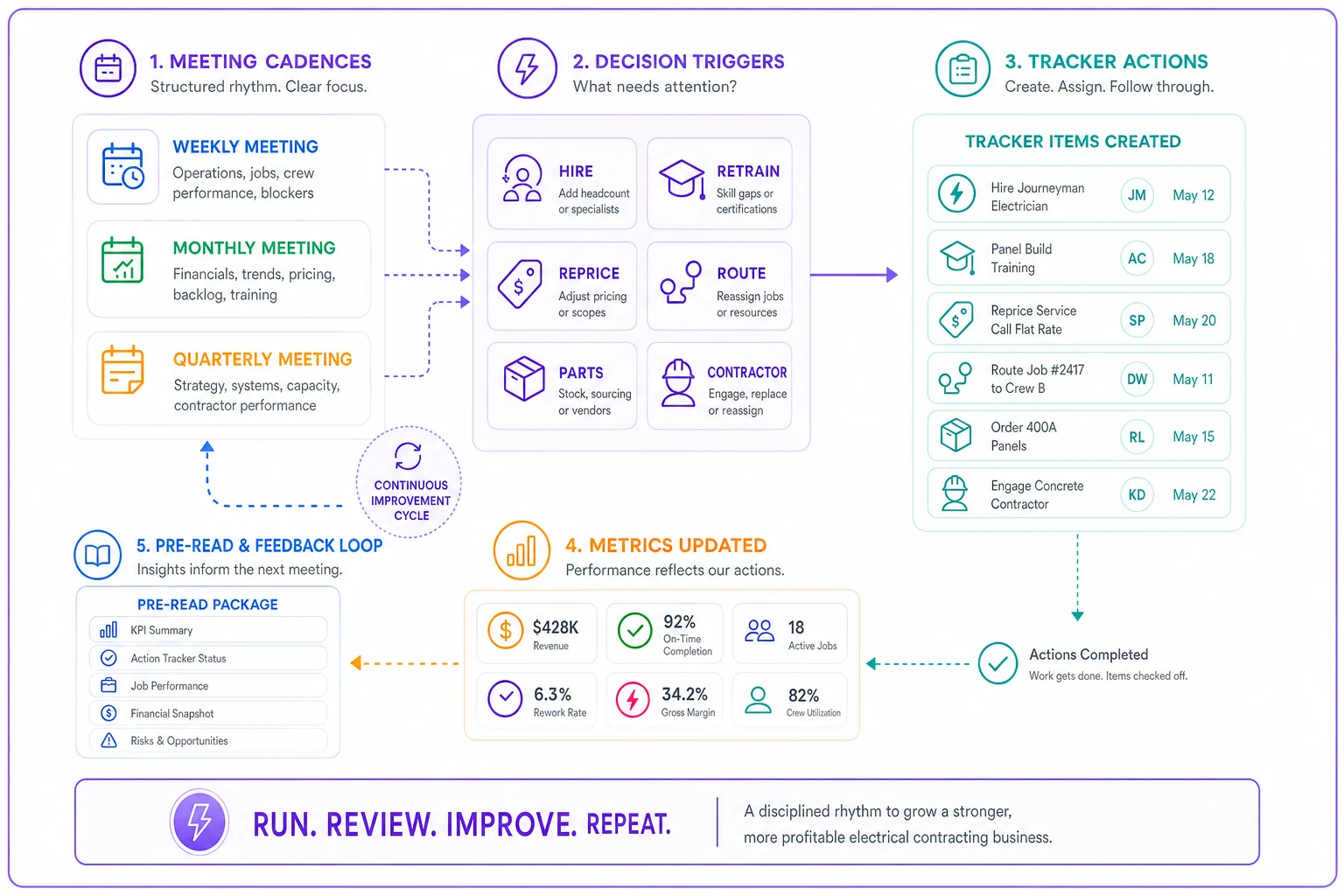
Walk it through in plain terms. In your monthly, the pre-read shows panel-upgrade margin slipped four points. That trips the reprice trigger. You decide to raise the base price and add a contingency line. That becomes a tracker item: owner — you, due — before next week's quotes go out. Next month's pre-read shows margin recovered. The loop closed itself.
Contrast that with the shop running without any of this. Same margin slip happens. Nobody's looking at job-type margin monthly, so it's invisible. You feel like panel jobs are tight but can't prove it. Six months later your accountant mentions profit's down and you have no idea which service bled it. That's the whole difference between governing a business and reacting to one.
The loop only works if the pre-read actually gets built each cycle. That's the part that breaks down in practice — not the meetings, not the tracker, but the assembly work of pulling job P&L, callback rates, and drive-time numbers into something readable before you sit down. When your operational software handles that automatically and flags crossed thresholds on its own, the loop stops depending on you having a free Sunday to build spreadsheets. That's the realistic role for automation here — not replacing your judgment, just removing the assembly work that makes owners skip governance entirely.
Export templates: why "I'll remember it" doesn't scale
The reason to template everything — pre-reads, tracker, trigger thresholds — isn't bureaucracy. It's so the system survives you being busy, sick, or stuck on a job. Templates make governance repeatable by someone other than the owner, which is the first real step toward building a business you could eventually step back from.
Keep the formats boring and portable:
-
Pre-reads as a one-page PDF or printed sheet — something readable in a truck
-
Tracker as a shared sheet anyone can update from a phone
-
Trigger thresholds written down once, reviewed quarterly, not reinvented every month
The data that feeds every pre-read — job P&L, callback rates by tech, drive-time, missing-part delays — already lives in your scheduling, invoicing, and job records. The tedious part has always been assembling it into a usable one-pager each week. Field-service platforms that pull those numbers automatically and flag threshold breaches earn their keep here, quietly, in the background. The governance still belongs to you. The assembly work doesn't have to.
A real scenario
A six-truck residential shop, owner still running a couple jobs a week, around $1.4M in revenue. No ops manager. The owner knew margins were soft but couldn't point to where.
They started the three-tier rhythm — weekly 20-minute check, monthly margin review, quarterly direction — with a one-page pre-read and the five-column tracker. They set the six triggers with real thresholds.
Within the first two months the monthly review surfaced two things the owner had vaguely sensed but never acted on: service-call jobs under a certain ticket size were running near break-even once drive time was counted, and one tech's callbacks were running well above the others. The reprice trigger fired on the small-ticket work; the retrain trigger fired on the tech.
Six months in, the callback-heavy tech's rework dropped to roughly shop average after focused retraining, and the repriced service line stopped losing money. The owner estimated recovered margin somewhere in the mid five figures annually — not from working harder, just from deciding on schedule instead of discovering problems late. The harder-to-measure change: the owner stopped carrying the whole business in their head.
When this makes sense — and when it doesn't
This makes sense when you're past two trucks, decisions are slipping through the cracks, and you can feel that you're the bottleneck on everything. If you keep re-solving the same problems, you need the tracker. If you're surprised by your own financials, you need the monthly.
This is overkill when you're a true solo operator with no crew. At that size the full three-tier rhythm is more structure than the business needs — a monthly self-review and the six triggers alone will do it. Don't build governance machinery for a business that's still just you.
Who should not do this: anyone looking to avoid the real work. The system doesn't make decisions for you; it forces you to make them on time. If the honest issue is that you already know what needs doing and won't do it, no pre-read is going to fix that.
Bringing it together
An owner operating system isn't about becoming more corporate. It's the opposite — it's how an owner-led electrical shop stays nimble while getting bigger, by making sure the right decisions happen on a schedule instead of waiting for a crisis to force them.
The three meeting cadences give you rhythm. The follow-up tracker gives you memory. The six triggers give you thresholds so you act on math, not mood. And the templates mean none of it collapses the week you get slammed. Start with one monthly review and the tracker. Add the weekly once the monthly feels natural. Layer in the triggers from there. You don't need an analyst — you need a loop that keeps running whether or not you're thinking about it.
Start with one monthly review and the tracker. Add the weekly once the monthly feels natural. Layer in the triggers from there. You don't need an analyst — you need a loop that keeps running whether or not you're thinking about it.
Ready to optimize your electrical service operations?
Join 500+ electrical service companies using Voltzly to improve scheduling accuracy, enhance client satisfaction, and boost operational efficiency.