


Most electrical shops don't have a pay problem. They have a feedback loop problem. The paychecks go out on time, the bonus math is roughly fair, and the techs mostly stay. But nothing in that system teaches anyone to get better. Pay happens on one track, performance reviews happen on another track (if at all), training is reactive, and promotions get handed out based on tenure or who complained loudest. Four separate systems, zero coordination.
A real performance incentive system for electricians isn't a spiff on callbacks or a quarterly bonus pool. It's a loop. Compensation mix feeds into monthly variance reviews, variance reviews surface retraining triggers, retraining feeds promotion gates, and promotion gates reset the compensation mix. When those four pieces actually talk to each other, a tech's pay becomes a running scoreboard of how they're developing — not a flat number they forget about two days after payday.
This article is about wiring those four pieces together so they reinforce each other instead of slowly drifting apart.
Why pay and performance drift apart in the first place
Walk into a shop doing $2M–$4M and ask the owner how a tech's bonus is calculated. You'll usually get a confident answer that falls apart under one follow-up question. Something like "they get 5% of revenue over their target" — okay, but what's the target, who set it, and what happens when they miss it three months in a row? Silence.
The pattern is almost always the same: compensation gets designed once, usually during a hiring crunch, and then it calcifies. The shop needed to land a journeyman fast, offered an aggressive number, and that number became the template. Nobody revisits it because revisiting pay feels dangerous. So the structure freezes while the business changes around it.
Meanwhile, the KPIs that should drive pay live somewhere else entirely — in a dispatcher's head, in a spreadsheet the office manager maintains, in the owner's gut feeling about who's carrying weight. The data exists. It just never connects to the paycheck in a way the tech can see or predict.
That disconnect is the whole problem. A technician can only optimize for what they can measure and influence and get paid on. Break any of those three links and the incentive dies.
The compensation mix is the lever, not the number
The dollar amount matters less than the mix. Two techs can both earn around $85k and behave completely differently depending on how that money is split between base, productivity pay, and quality-gated bonus.
Never miss a job or delay a dispatch again.
Voltzly helps you schedule, assign, and track every electrical job efficiently.
- Unified job scheduling
- Real-time technician tracking
- Automated client notifications
No credit card required
The mistake most shops make is going all-in on one dimension. Pure hourly breeds slow techs who stretch jobs. Pure piece-rate or percentage breeds fast techs who cut corners, skip documentation, and generate callbacks. Both extremes push the business toward a predictable failure mode.
A working mix usually looks something like this, and it should shift as a tech matures:
| Role / Stage | Base | Productivity Component | Quality-Gated Bonus | What the mix is steering |
|---|---|---|---|---|
| Apprentice | 85% | 5% | 10% | Showing up, learning, following SOPs |
| Journeyman (new) | 70% | 20% | 10% | Building speed without breaking quality |
| Journeyman (seasoned) | 60% | 25% | 15% | Throughput + clean work + upsell discipline |
| Lead / Senior | 55% | 20% | 25% | Crew output, mentoring, callback prevention |
Notice the quality-gated portion grows as responsibility grows. That's deliberate. The more autonomy a tech has, the more their pay should depend on outcomes you can't directly supervise — first-time-fix rate, callback rate, documentation completeness, inspection pass rate.
The "gated" part is the detail people skip. A quality-gated bonus means the productivity money doesn't fully release unless the quality threshold is met. A tech who did $40k in billable work last month but generated three callbacks and failed an inspection doesn't collect the full productivity component. The gate forces the two to travel together.
For the deeper math on how pay structure should track actual staffing capacity and utilization, we've broken that down separately in aligning pay with capacity — this article assumes you've got the mix roughly right and focuses on the loop that keeps it honest.
The monthly variance review: where the loop actually runs
This is the engine, and it's the part almost nobody does consistently. Once a month, every tech gets reviewed against their targets — not in a vague "how's it going" way, but line by line against the KPIs their pay is tied to.
The word variance matters. You're not just looking at whether someone hit a number. You're looking at the gap between expected and actual, and more importantly, the pattern across months. A single bad month is noise. Three months drifting the same direction is a signal.
A typical monthly variance review covers:
-
Revenue/throughput variance — actual billable vs. target, and whether misses came from job mix, speed, or availability
-
First-time-fix rate — trending up, flat, or sliding
-
Callback rate — the number and, critically, the cause categories
-
Documentation completeness — photos, job notes, closeout data
-
Estimate-to-actual spread — are their quotes landing close to reality or consistently off
-
Bonus release — what gated bonus actually paid out and why
The review takes maybe 15–20 minutes per tech if the data is sitting in front of you. If it's not — if the office manager has to assemble it by hand from three different systems — the review quietly dies within two months. That's the most common failure point. The structure is sound, but the data assembly is painful enough that it gets skipped, then abandoned.
The point of the review isn't to deliver a verdict. It's to make the connection between behavior and pay visible and expected. When a tech sees the same scoreboard every month, the number stops being a mystery. They start managing toward it on their own, which is the entire goal.
Automate the KPI pull so the monthly review truly takes 15–20 minutes instead of a half-day of manual assembly.
Your KPI dashboard should be feeding this review directly. If the metrics that trigger hire/retrain/reprice decisions live in one place, the monthly variance review becomes a 10-minute pull instead of an afternoon project.
A short script for the variance conversation
> "Your throughput's solid — up about 8% over last month. The thing I want to flag is callbacks. You had three in the last six weeks, all on panel work, and that's why the quality portion of your bonus only released partway. Let's figure out whether that's a parts issue, a time-pressure issue, or something in the install process. If we close that gap, the full bonus is yours next cycle."
Three ingredients: name the win first, name the specific gap with data, tie it directly to pay, and point at the fix. No surprises, no moralizing.
Retraining triggers: when variance becomes a plan
This is where most shops leak the most value. The variance review surfaces a problem, everyone nods, and then nothing happens until it gets bad enough to threaten the client relationship. The review identifies the gap but doesn't trigger anything.
A real loop has defined triggers. When a specific metric crosses a line for a set period, retraining fires automatically — not when the owner gets around to it.
-
Callback rate above 8% for two consecutive months → scheduled ride-along with a lead on the relevant job type
-
First-time-fix below 75% for two months → diagnostic skills refresh, specific to the failing category
-
Estimate-to-actual spread consistently over 15% → estimating recalibration session with the office
-
Documentation completeness under 90% → closeout process re-training, usually a 30-minute fix
-
Inspection failure → immediate review of that job before the next similar one gets dispatched
The key: retraining should be targeted, not generic. Sending a tech with a panel-callback problem to a general "quality" seminar wastes everyone's time. The variance data tells you exactly what's broken, so the retraining should hit exactly that.
Retraining also has to be cheap and fast or it won't happen. A two-hour ride-along, a short diagnostic refresher, a 30-minute closeout walkthrough — these are the interventions that actually get used. Formal multi-day courses have their place, but they're too heavy to serve as a monthly-loop trigger.
One more thing worth naming: if the same trigger fires for multiple techs at once, you don't have a people problem — you have a process or tooling problem. Five techs all failing panel callbacks means your panel SOP, your parts stocking, or your scoping process is broken, not your crew. The loop surfaces systemic issues disguised as individual ones.
Promotion gates: making the loop point somewhere
Retraining fixes gaps. Promotion gates reward the techs who close them and keep climbing. Without a clear gate, promotions become political — and nothing poisons a pay system faster than a tech watching someone less capable get bumped up for reasons no one can explain.
A promotion gate is a defined, published set of thresholds a tech must sustain — not hit once — to move up. Sustained matters. A tech who nails every metric for one month then regresses hasn't demonstrated a new level; they've had a good month.
A journeyman-to-lead gate might require, over a rolling six-month window:
-
First-time-fix rate consistently above 85%
-
Callback rate under 5%
-
Documentation completeness above 95%
-
Estimate accuracy within target range
-
Demonstrated mentoring (apprentice sign-offs, clean handoffs)
When these are published and measurable, promotions stop being a negotiation. The tech can see the gate, track their own progress against it in the monthly variance review, and know exactly what's between them and the next pay tier. That transparency does more for retention than almost anything else — the number-one reason good techs leave is the feeling that advancement is arbitrary. We dig into the retention side of this more in the recruitment and retention playbook, but the short version is: a visible ladder beats a mystery ladder every time.
When a tech clears the gate, the compensation mix resets to the next stage in that first table. The loop closes. New mix, new targets, new variance baseline, and the whole cycle runs again at a higher level.
The whole loop in one pass
Put the four pieces in sequence and the workflow reads cleanly:
Compensation mix sets what each tech is paid on and in what proportion → monthly variance review measures actual performance against those targets and releases (or gates) the bonus → variances that cross thresholds trigger targeted retraining → sustained performance against the promotion gate moves the tech up → promotion resets the compensation mix to the next stage → and the loop runs again.
The magic isn't in any single piece. Plenty of shops have a bonus structure. Some do performance reviews. A few do retraining. Almost none connect all four so each one feeds the next.
Here's a visual summary of that workflow.
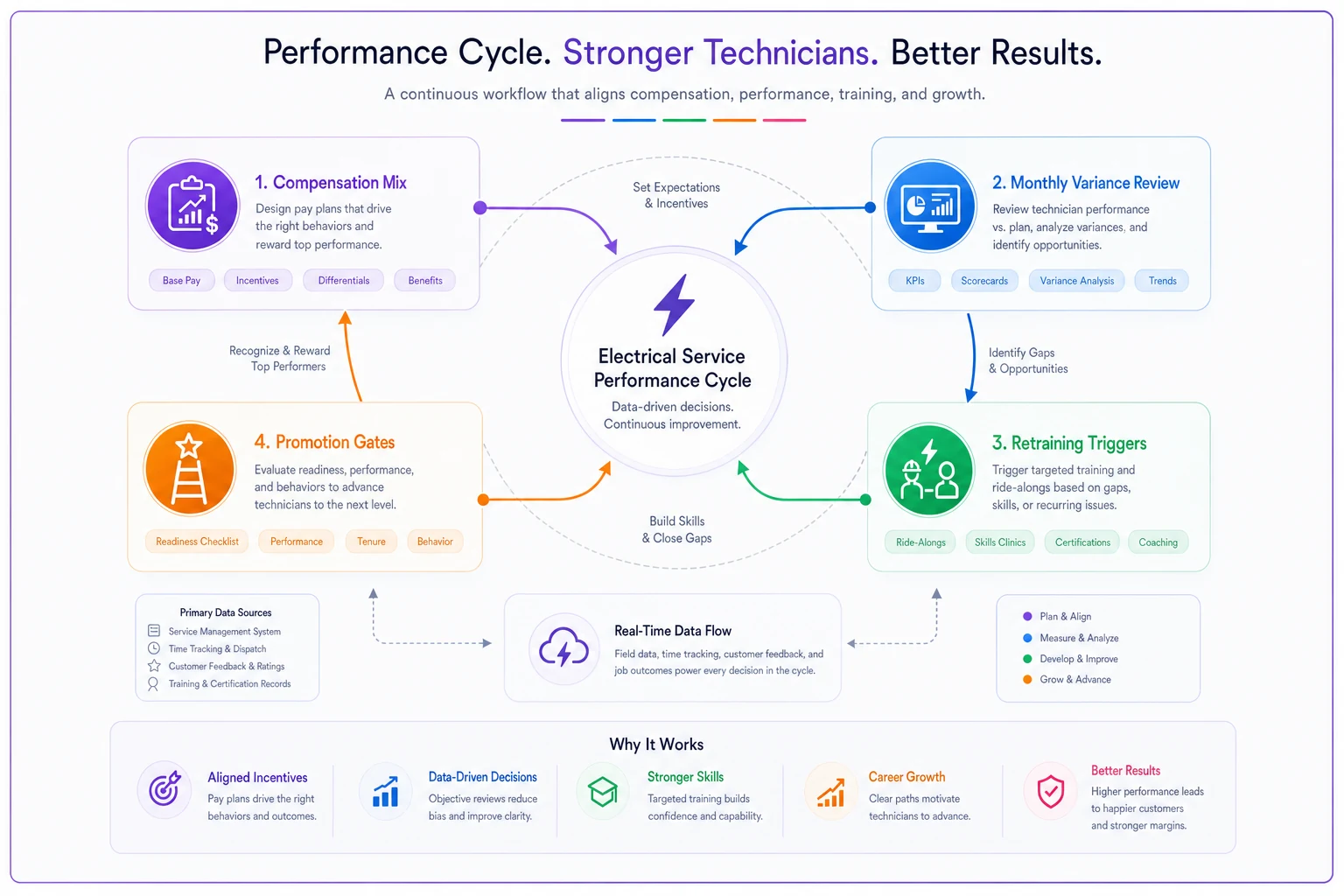
When they're disconnected, you get a bonus that doesn't change behavior, reviews that don't lead anywhere, retraining that's random, and promotions that feel political. When they're connected, pay becomes a living signal of development.
A real scenario
A residential-focused shop running seven techs, doing somewhere around $3.2M, had a classic version of this problem. Their bonus was a flat percentage over a revenue target with no quality gate. Their two fastest techs were also their two highest-callback techs — one was running callbacks near 12% while collecting full productivity bonus every month. The office knew. Nothing in the system did anything about it.
They rebuilt the mix with a quality gate on the productivity portion and started a monthly variance review off their existing dashboard. The first two months were rough — the high-callback tech lost a chunk of bonus and wasn't happy about it. But the variance review made the why undeniable, and the retraining trigger put him on two ride-alongs focused specifically on his failing job type.
By roughly the fourth month, his callback rate had dropped into the mid-single digits, his gated bonus was releasing in full, and he was actually earning more than before because the fast work now counted. Shop-wide callbacks fell noticeably, which meant fewer unpaid return trips eating the schedule. The owner's rough estimate was that reclaimed callback time freed up close to a tech-day a week across the crew. No one got fired, no one got a lecture — the loop just made the right behavior the profitable behavior.
When this makes sense — and when it doesn't
This works well when you have at least four or five techs, enough job volume to make monthly metrics meaningful, and basic KPI data you can actually pull. Below that scale it can feel like overkill — though even a two-tech shop benefits from a quality gate on bonus and a loose monthly check-in.
This is a bad idea when your data is garbage. If you can't trust your callback numbers or your estimate-to-actual figures, do not tie pay to them. You'll pay out wrong bonuses, break trust, and poison the whole system. Fix the measurement before you fix the incentives. A loop built on bad data is worse than no loop — it actively rewards the wrong things with a straight face.
Who should hold off entirely: shops in the middle of a major systems transition, or ones where the owner is still the de facto dispatcher, estimator, and bookkeeper. The loop needs clean data assembly to survive past month two, and if that assembly is a manual nightmare, it'll be abandoned. Get the data flowing reliably first.
Where the data problem actually bites
The recurring reason these loops die isn't philosophy — it's the monthly data pull. The structure is sound, everyone agrees it's the right approach, and then the office manager spends half a day stitching together callback logs, job notes, and revenue figures from systems that don't talk to each other. By month three, the review gets "pushed to next week" and quietly disappears.
This is the practical case for running your KPIs, job data, and compensation inputs through a connected operational platform rather than scattered spreadsheets. When first-time-fix, callbacks, documentation scores, and billable throughput all live in one place and update as jobs close, the monthly variance review stops being a project and becomes a quick read. It's not about the software for its own sake — it's that the loop only survives if the data behind it is cheap to pull every single month. Make the review effortless and it happens. Make it painful and no structure, however well-designed, will save it.
Closing thought
Tying pay to KPIs isn't about squeezing techs or dangling bonuses. It's about building a system where getting better and getting paid are the same motion. Compensation mix sets the direction, variance reviews keep it honest, retraining fixes what's broken, and promotion gates reward the climb — each piece handing off to the next. Build the loop, keep the data clean, run it every month, and your pay system stops being a static number and starts being the thing that actually develops your crew.
Ready to optimize your electrical service operations?
Join 500+ electrical service companies using Voltzly to improve scheduling accuracy, enhance client satisfaction, and boost operational efficiency.