


Most electrical shops don't lose money because their prices are wrong. They lose it because their pricing rules live in one person's head — usually the owner's — and that head isn't on every job, every quote, or every renewal call.
You can build the best productized price book in the world. You can set clean tiers, contingency allowances, and margin floors. But the moment you have three estimators, two service coordinators, and a couple of senior techs quoting change orders in the field, the book stops being the book. It becomes forty slightly different books, each one shaped by whoever's holding the tablet that day.
That gap — between what you priced and what actually gets sold — is a governance problem. Not a pricing problem. And it's the thing that quietly caps most shops somewhere between $2M and $6M, right when they think scaling should be getting easier.
This article is about the layer that sits above your price book: the owner-operable decision matrix that decides who can approve what, when a quote has to escalate, how contingencies get applied, and what happens when a service agreement comes up for renewal. Get this layer right and your pricing survives contact with a growing team. Get it wrong and every new hire dilutes your margin a little more.
Why productized pricing breaks the moment more than one person sells it
When it's just you quoting, governance is invisible. You know a heavy-up on knob-and-tube isn't a "standard panel swap." You know that customer three neighborhoods over always pushes for a discount and you've decided he's not worth it. You know your real floor on an EV install once you've eaten a permit surprise or two.
-
Estimator #1 discounts to close, because their comp is tied to booked revenue.
-
The senior tech quotes a change order on-site at whatever number feels fair, no margin check.
-
The service coordinator renews a maintenance agreement at last year's price because nobody told them to bump it, and asking feels awkward.
-
The owner finds out about all three at month-end, when the P&L looks softer than the revenue suggested it should.
Each of those people is doing their job. The problem is that "the price book" gave them a number but no rules around the number. A productized catalog tells you what a Level 2 charger install costs. It doesn't tell you who's allowed to knock $600 off it, or what has to be true before a renewal jumps 9% instead of 4%.
That's the difference between a price list and pricing governance. Electrical contractors who scale cleanly build the second thing. Most only build the first.
The four things your governance layer actually controls
Think of governance as four connected controls, not four separate documents. When they're wired together, a quote can't leave your shop in a state that quietly costs you money.
Never miss a job or delay a dispatch again.
Voltzly helps you schedule, assign, and track every electrical job efficiently.
- Unified job scheduling
- Real-time technician tracking
- Automated client notifications
No credit card required
1. The product catalog (what you sell and at what floor)
Your catalog is the foundation, but for governance purposes what matters isn't the sticker price — it's the margin floor attached to each item and the variance band you'll tolerate around it. A panel upgrade might carry a target margin of 42% with a hard floor of 34%. Anything quoted below the floor isn't a discount decision anymore. It's an escalation.
If you've already done the work of building out job-type profitability, this is where it pays off. Your floors should come from actual cost data, not gut feel. If you haven't measured which job types leak, that's the prerequisite — you can't govern a number you've never verified. Our breakdown on a job-type profitability framework covers how to get those real floors before you try to police them.
2. Acceptance gates (what has to be true before a quote goes out)
An acceptance gate is a checkpoint a quote must pass before anyone sends it. Not a suggestion — a gate. Common ones:
-
Site validation photos attached (or the quote is flagged "unverified scope")
-
Permit requirement confirmed and priced in
-
Margin at or above floor for every line item
-
Contingency allowance applied for the job's risk tier
The thing most owners miss: acceptance gates should live at the quote level, not the person level. You're not deciding whether you trust the estimator. You're deciding whether the quote is complete. A great estimator on a rushed Friday still forgets the permit line — the gate catches it, not because they're careless, but because the system doesn't let an incomplete quote through.
3. Contingency rules (how you price uncertainty)
Contingency is where a lot of shops either pad blindly or don't pad at all. Neither scales. What you want is a tiered rule tied to known risk signals:
-
Post-1990 construction, clean panel, photos verified → 0–5% contingency
-
Older home, some unknowns, partial photo pack → 8–12%
-
Knob-and-tube, no attic access confirmed, occupied tenant → 15%+ and a mandatory second set of eyes
Use photo requirements to reliably push clean jobs into the low-contingency band.
The rule does two things. It protects margin on the messy ones, and — just as important — it removes padding on the clean ones so you don't lose competitive bids you should've won. Blanket 10% contingency across everything is lazy governance dressed up as caution.
4. Renewal pricing (the one everybody forgets)
Service agreements and maintenance plans are where governance quietly earns or bleeds the most, because the decisions repeat every year on autopilot. If your renewals default to "same as last year," inflation is silently compressing every agreement in your book. If you've built recurring revenue the way we've described in the three-tier service plan playbook, the renewal rule is what keeps those plans profitable in year three, not just year one.
A basic renewal rule: index the floor to your cost movement, cap the customer-facing increase, and flag any agreement that's fallen below floor for owner review. Most shops don't have that flag, so they never see the agreement that's been underwater for two years.
The owner-operable decision matrix
This is the part that makes all four controls work together instead of sitting in separate binders. The matrix maps who can approve what against how far the quote deviates from your standard. The whole point is that most decisions never reach you — only the ones that actually should.
| Deviation from catalog | Estimator / Coordinator | Lead / Senior Tech | Owner (or GM) |
|---|---|---|---|
| At target margin, complete gates | ✅ Approve & send | ✅ Approve & send | — |
| Discount within 0–8%, still above floor | ✅ Approve | ✅ Approve | — |
| Discount 8–15%, above floor | Escalate | ✅ Approve | Notify only |
| Below margin floor (any line) | Escalate | Escalate | ✅ Required |
| Contingency waived on a mid/high-risk job | Escalate | Escalate | ✅ Required |
| Renewal below indexed floor | Escalate | Escalate | ✅ Required |
| New job type not in catalog | Escalate | Escalate | ✅ Required + catalog update |
The number that matters most in this table is how few rows land on the owner. If everything escalates to you, you haven't built governance — you've built a bottleneck with extra steps. The goal is that your team clears 85–90% of quotes without your involvement, and the 10–15% that reach you are genuinely worth your attention.
Two things people consistently get wrong here:
They set the escalation thresholds too tight. If an estimator has to ping you for a 3% discount, they'll either stop discounting (and lose deals) or stop asking (and route around you). Give real authority inside the safe band.
They forget the "notify only" tier. There's a middle zone where you don't need to approve, but you do want to see it. That's how you spot patterns — like one estimator consistently sitting at the bottom of their discount authority — without turning yourself into an approval machine.
How the pieces move together: a workflow
Walk a single quote through the layer and you can see how the controls chain:
-
Lead comes in, job type identified. Catalog pulls the target price, margin floor, and default contingency tier for that job type.
-
Site validation. Photos and access notes come back. If they confirm low risk, contingency drops to the clean-job band. If they surface unknowns, it bumps up — and a red-flag job triggers the mandatory second reviewer.
-
Estimator builds the quote. Acceptance gates run
permit line present, every item at or above floor, contingency applied. Any gate failure blocks send.
-
Deviation check. If the estimator wants to discount, the matrix decides: inside their band, they approve; past it, it routes to a lead or to you with the reason attached.
-
Quote goes out — clean, complete, and inside policy. You didn't touch it, but it followed your rules exactly.
-
On win, terms carry forward. If it's a service agreement, the renewal rule and indexed floor attach now, so next year's coordinator inherits a governed renewal instead of a blank guess.
There's no step where someone has to remember the rules — the workflow enforces them. That's the whole point. Governance that depends on memory doesn't survive your fifth hire.
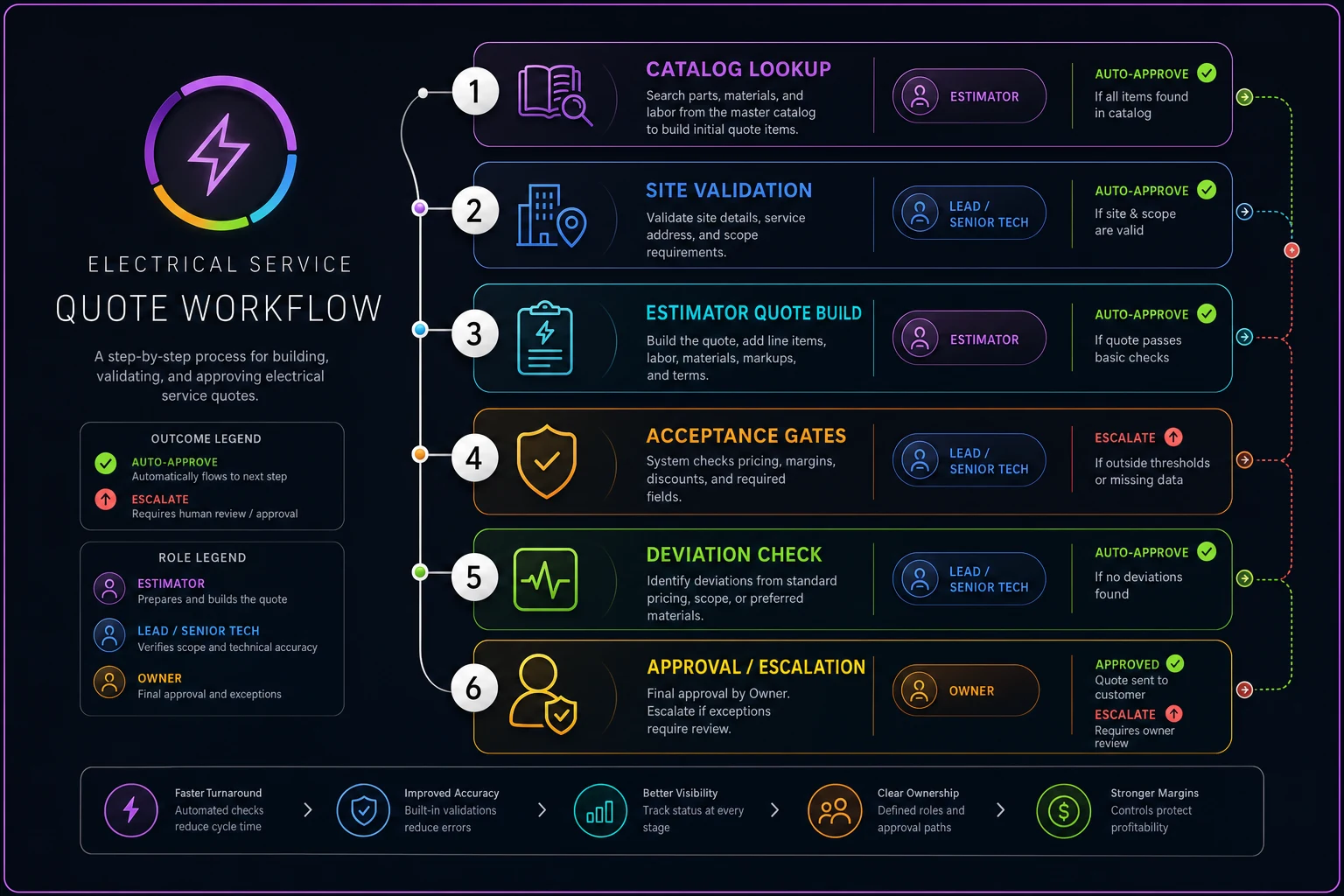
A simple diagram like this makes it obvious which steps are automated, which require checks, and which ones escalate to an owner.
A real scenario: what tightening the layer actually changes
A residential-and-light-commercial shop, roughly $3.8M in revenue, four estimators and about a dozen field staff. Solid price book, built a couple years earlier. On paper their blended target margin was around 40%. Actual, at year-end, was landing closer to 31–33%.
The leak wasn't dramatic anywhere. That's why it survived. It was spread across discount creep — estimators averaging 6–9% off to close, none of it flagged — change orders quoted on-site with no margin check, some barely above cost, and maintenance renewals rolling over flat while material and labor costs had climbed noticeably.
They didn't rebuild the price book. They built the governance layer on top: margin floors per job type, a three-tier contingency rule, a discount authority band capped at 8% before escalation, and a renewal flag for any agreement below indexed floor.
The first month was noisy — a lot of escalations, because everything that had been quietly slipping suddenly hit a gate. By the third month it settled. Blended actual margin came back into the high 30s, and change-order margin recovered the most, because "quote it and check later" became "check before you send." Nothing about the customer experience changed. The quotes just stopped leaving the shop underpriced.
The owner's comment afterward was the tell: he wasn't approving more quotes than before. He was approving fewer — but the ones that reached him were the ones that actually mattered.
When this makes sense — and when it doesn't
Worth building now: You've got more than one person quoting, or you're about to. You've productized at least part of your pricing. Your month-end margin regularly comes in below what your quotes implied. Any one of these means the governance layer is already overdue.
Too early: If you're a one- or two-person shop and you personally touch every quote, a formal matrix is overhead you don't need yet. Build clean margin floors and a simple contingency rule, keep the approvals in your head for now, and write the layer down before you hire your first estimator — not after.
Who should skip the heavy version: Shops that haven't verified their real job costs. If your floors are guesses, governance just enforces your guesses more consistently. Fix the cost data first. Everything above assumes your numbers are real.
The connection people miss
Pricing governance isn't a pricing project. It's the seam between your commercial model and your daily operations — the place where the strategy you set actually turns into the numbers your team quotes. If your commercial model says you're a premium, do-it-right shop but your estimators are discounting 9% to win on price, the governance layer is where that contradiction gets resolved, one quote at a time.
Owners tend to treat the price book as "done" once it's built. In practice, the book is the easy 20%. The governance layer — who can bend it, when it escalates, how uncertainty gets priced, and how renewals stay honest — is the 80% that decides whether your margin holds as the team grows.
Build the matrix so most quotes never reach you and only the real decisions do. That's not you letting go of pricing. That's you finally being able to scale it.
Ready to optimize your electrical service operations?
Join 500+ electrical service companies using Voltzly to improve scheduling accuracy, enhance client satisfaction, and boost operational efficiency.