


Most electrical shops treat procurement like plumbing: as long as parts show up when a tech needs them, nobody thinks about the pipes. That works right up until the shop crosses somewhere around 6–8 techs. Then the thing nobody was managing starts quietly bleeding margin in three or four places at once, and nobody can point to exactly where.
The problem isn't that you're paying too much for wire or breakers. It's that your buying has no structure behind it. You've got a dozen suppliers, no spend visibility, pricing that drifts whenever the account rep feels like it, and no leverage to push back because you've never once walked into a negotiation with a number. This article is about building that structure — the category-based procurement system that turns a pile of reorder rules into actual strategic leverage.
If you've already read the supplier & procurement playbook, think of this as the layer above it: less about reorder points and credit reconciliation, more about how you organize spend into categories, what you measure your suppliers on over a 12-month cycle, and how you use that data to actually move price.
Why shop buying stays reactive forever
Here's the pattern across small contractors. Procurement grows by accident. In year one, the owner buys everything from the supply house down the road because they know the counter guy. By year three, there are three or four suppliers, each one added to solve a specific headache — one had better breaker stock, one gave net-45 terms, one was closer to the east-side jobs.
Nobody ever sat down and designed this. It accreted. And because it accreted, a few things are quietly true that owners rarely notice:
-
Spend is scattered across suppliers with no single view of total annual volume per vendor
-
The same SKU gets bought at different prices depending on who placed the order
-
There's no record of what you were quoted six months ago, so price creep is invisible
-
Rebates and volume tiers you've already earned go unclaimed because nobody's tracking against thresholds
This usually surfaces when a new office manager tries to reconcile the month and realizes the shop is buying 14-gauge Romex from two suppliers at a 9% price difference, in the same week, for no reason. That's not a buying mistake. That's a missing system.
The deeper issue: reactive buying gives you zero leverage. When you call a rep to ask for better pricing, the only thing you can say is "your prices seem high." That's not a negotiation. A negotiation is "we spent $46k with you last year across these four categories, your competitor just quoted me 7% lower on the two highest-volume ones, and I'm consolidating next quarter — what can you do?"
You can't say that sentence without a category-based system behind it.
Start with categories, not suppliers
The first move is to stop thinking about procurement as "suppliers I buy from" and start thinking about it as "categories of spend I manage." This flip changes everything downstream.
Never miss a job or delay a dispatch again.
Voltzly helps you schedule, assign, and track every electrical job efficiently.
- Unified job scheduling
- Real-time technician tracking
- Automated client notifications
No credit card required
A typical residential/light-commercial electrical shop can group almost all parts spend into maybe 8–12 categories:
| Category | Example SKUs | Why it's grouped this way |
|---|---|---|
| Wire & cable | Romex, THHN, MC cable | High volume, commodity, price-sensitive |
| Panels & breakers | Load centers, breakers, AFCI/GFCI | Brand-locked, warranty matters |
| Devices & plates | Receptacles, switches, cover plates | High unit count, low unit cost |
| Boxes & fittings | Junction boxes, conduit bodies, connectors | Commodity, bulk buying wins |
| Conduit & raceway | EMT, PVC, flex | Bulky, freight-sensitive |
| Lighting & fixtures | Cans, LED retrofits, trims | Margin opportunity, spec-driven |
| EV & specialty | Chargers, load management | Growing, fewer suppliers, higher stakes |
| Consumables | Wire nuts, tape, staples, anchors | Easy to over-order, easy to waste |
Once spend is organized this way, you can treat each category differently. Commodities like wire and consumables are pure price plays — you want the lowest landed cost and you'll switch suppliers to get it. Brand-locked categories like panels and breakers are relationship plays — switching is painful, so you negotiate on terms, rebates, and availability instead of raw price.
Mixing these up is the most common mistake. Shops either try to hardball a supplier on breakers (where they have no leverage because the GC specced the brand) or they stay loyal on wire (where loyalty costs them real money every month). Category thinking fixes that.
Build your target-SKU list
Inside each category, you can't manage every SKU with the same intensity. A mid-size shop might touch 600–900 distinct SKUs in a year, and 80% of the spend sits in maybe 60–80 of them.
Those 60–80 are your target SKUs — the items you benchmark, track price history on, and actively negotiate. Everything else gets bought on autopilot.
To build the list, pull a full year of purchase history and sort by total annual spend per SKU — not unit price, total spend. A $2 connector you buy 4,000 times a year matters more than a $400 fixture you bought twice. Then for each target SKU, record:
-
Current price and which supplier it came from
-
Annual volume (units and dollars)
-
Last price change and the date it happened
-
At least one competing quote so you have a benchmark
-
Substitution flexibility — can you swap brands, or is it locked?
That last column is quietly the most powerful. Target SKUs with high substitution flexibility are where your leverage lives. If you can prove to a supplier that you have an identical-spec alternate at a lower price, you control the conversation. This ties directly into having an approved-alternates discipline — the same logic that keeps jobs moving when a part's out of stock also gives you a negotiating stick.
The negotiation KPIs that actually matter
Most contractors "negotiate" once a year by complaining about prices and accepting whatever bump the rep offers. If you want actual leverage, you need KPIs tracked per supplier, per category, over time.
The ones worth tracking:
-
Price variance vs. benchmark — how far above (or below) your lowest competing quote each supplier sits, by category
-
Price stability — how often and how much a supplier raises prices in a 12-month window
-
Fill rate — percentage of ordered lines delivered complete and on time
-
Credit/return turnaround — how fast they process RMAs and issue credits (this one hides a lot of lost money, which is why a tight reverse-logistics and RMA workflow matters as much as the price on the invoice)
-
Rebate realization — rebates actually earned vs. rebates you qualified for
-
Terms — net days, early-pay discounts, and whether they're honored consistently
Price is only one KPI, and it's not even the most expensive one to get wrong. A supplier who's 3% cheaper but misses 1 in 8 order lines is costing you far more in delayed jobs and emergency runs than the 3% saves. Fill rate problems don't show up on an invoice — they show up as your techs standing around or driving back to the supply house, which is exactly the cost you're trying to kill with solid van-stock and replenishment rules.
The 12-month cadence
Leverage isn't built in one meeting. It's built on a predictable annual rhythm that suppliers learn to expect. When a rep knows you benchmark every quarter and run a formal review each year, they price you differently than the shop that never looks.
Monthly — Reconcile spend by category. Flag any SKU where the price moved more than a few percent without notice. Quiet work, but this is where you catch creep before it compounds.
Quarterly — Refresh benchmarks on your top 20–30 target SKUs. Get one competing quote per high-volume commodity. Update the scorecard numbers for each supplier.
Semi-annually — Hold a check-in with each primary supplier. Not a negotiation — a review. Share how they're scoring on fill rate and price stability. Reps hate surprises; this gives them a chance to fix things before the annual review, and it signals you're paying attention.
Annually — The real event. Full scorecard review, formal RFP for your two or three largest commodity categories, and a consolidation decision. This is where you move volume, lock in tiered pricing, and reset terms.
Shops who skip the quarterly benchmarking lose the annual negotiation before it starts, because they walk in with stale numbers and the supplier knows it.
Monthly spend reconciliation ↓ Quarterly benchmark refresh + scorecard update ↓ Semi-annual supplier review (share scores, flag issues) ↓ Annual RFP + consolidation decision + terms reset ↓ Back to monthly reconciliation
Here's a simple visual of that cadence.
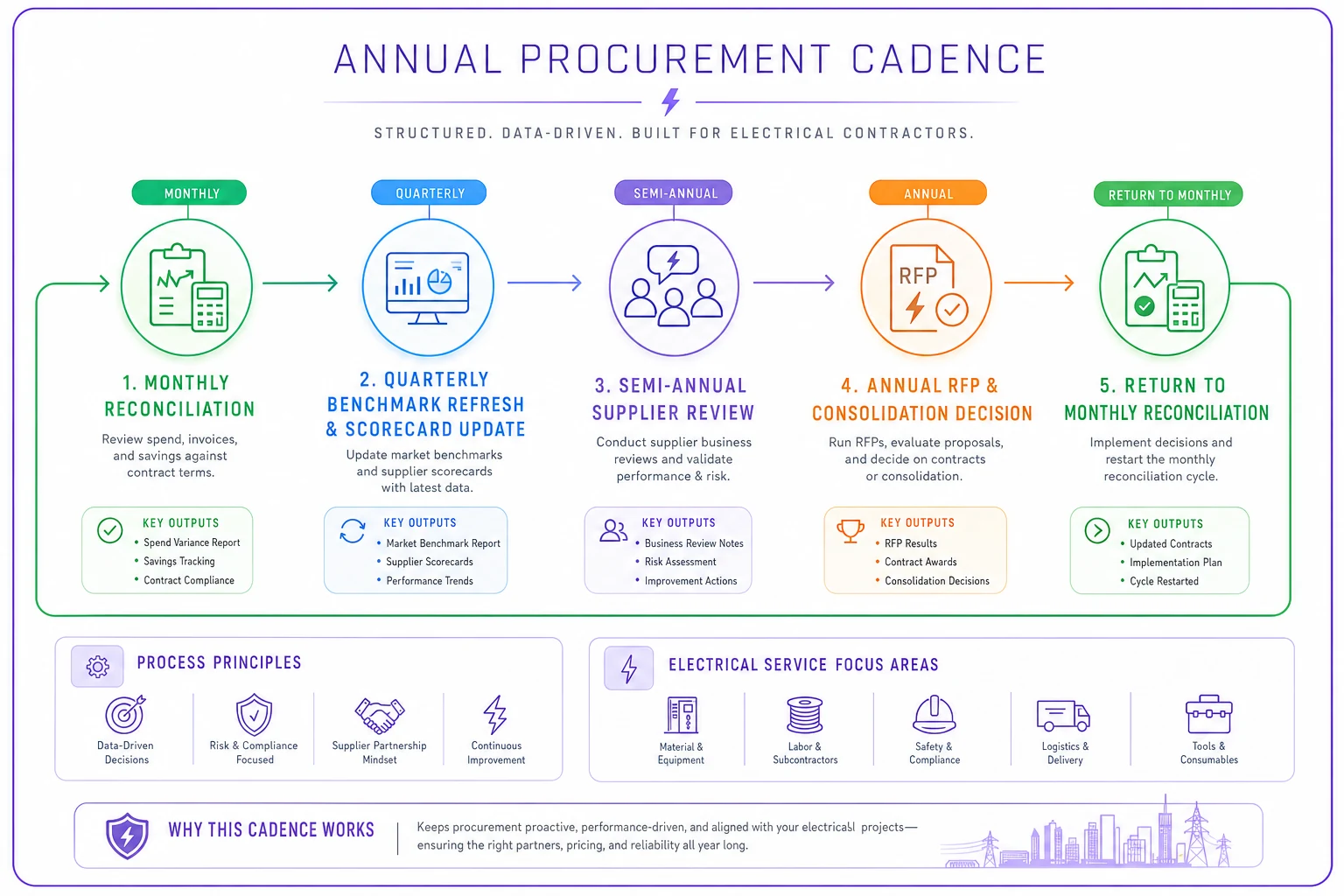
A consistent cadence trains suppliers and prevents last-minute surprises at negotiation time.
Vendor scorecards that drive decisions
A scorecard is only useful if it changes what you do. Too many shops build a nice spreadsheet, score their suppliers, nod, and change nothing. The scorecard has to connect to a decision rule.
A workable format weights the KPIs by what matters for that category. For a commodity category, price variance might carry 40% of the score. For a brand-locked category, fill rate and terms carry more weight because price is mostly fixed.
Here's how a scorecard flows into action:
-
Score above threshold → supplier keeps or grows their share of that category
-
Score in the middle → supplier gets specific improvement targets at the semi-annual review, with volume held flat
-
Score below threshold two periods running → category goes out to RFP, volume shifts
The scorecard's real job is removing emotion from supplier decisions. The counter guy might be your buddy, but if his fill rate has been under 85% for two quarters while his prices climbed, the number makes the call, not the relationship. That's uncomfortable, which is exactly why the system exists — so the decision actually gets made. Shops that skip this step end up loyal to suppliers who stopped earning it, usually because nobody wanted the awkward conversation.
Tie specific score thresholds to automatic actions (e.g., RFP trigger at two low-score periods) so reviews lead to real change.
The scorecard should be updated on your quarterly cadence so it's always actionable.
What a working RFP looks like for a small shop
"RFP" sounds like something a general contractor does on a hospital job, not something a 10-truck electrical shop needs. But a lightweight RFP is probably the single highest-leverage procurement move available to a small contractor, and almost nobody uses it.
It works because it forces suppliers to compete on paper, on your terms, for a defined chunk of volume. When you call and ask for a discount, you're asking for a favor. When you send a structured RFP for your wire-and-cable category with real annual volumes attached, you're offering a prize they have to win.
A small-shop RFP doesn't need to be fancy. It needs:
-
The category and the specific target SKUs with annual volumes
-
Your required terms — delivery windows, fill-rate expectations, return policy, payment terms
-
A clear decision date and how you'll score responses
-
A statement of the prize — "the winning supplier becomes our primary for this category, roughly $X in annual volume"
Send it to three or four suppliers. The quotes that come back will surprise you — reps hold back pricing until they believe real volume is on the line, and a formal RFP is the signal that it is.
A real scenario
A residential and light-commercial shop running about 9 techs had drifted into buying from five suppliers with no spend tracking. The owner assumed they were getting "good contractor pricing" because the main rep said so.
Pulling 12 months of history showed total parts spend around $410k, scattered so widely that no single supplier saw more than about $110k of it. When they grouped spend into categories, wire and cable alone was roughly $74k — split across three suppliers at prices that varied by 6–8% on identical SKUs.
They built target-SKU lists, ran a simple RFP on their two biggest commodity categories, and consolidated wire and cable into one supplier in exchange for a tiered price lock. On devices and consumables they did the same with a second supplier. Panels and breakers they left alone — brand-locked, no leverage, not worth the fight.
The effect over the following year wasn't dramatic on any single invoice. It was a steady few percent off their two largest categories, plus rebates they'd been leaving on the table, plus a measurable improvement in fill rate because the consolidated supplier now treated them as a priority account. Somewhere in the range of $18k–$24k in combined savings and recovered rebates — on spend they were already committing anyway. No new sales required.
The quieter win was that emergency supply-house runs dropped noticeably, because the primary supplier's stock reliability improved once the volume was concentrated. That showed up in less tech downtime, which never hits a procurement report but absolutely hits the P&L.
When this is worth building — and when it isn't
When it makes sense: Once you're past about 5–6 techs and annual parts spend clears roughly $200k, the structure pays for itself quickly. At that volume you have real leverage; you just aren't using it. The scorecard-and-cadence system is also worth it if you're running multiple vans buying independently, because that's where price drift and duplicate suppliers multiply fastest.
When it's premature: A 2–3 person shop buying $60k a year doesn't have enough volume to make suppliers compete hard, and the admin overhead of quarterly benchmarking will outweigh the gains. At that stage, keep it simple — one or two good suppliers, consistent SKUs, and clean records so you're ready to formalize later.
Who should not do this: If your work is overwhelmingly spec-driven commercial where the GC dictates brands and the owner supplies materials, category negotiation leverage is thin. Your energy is better spent on terms, labor efficiency, and billing. Procurement structure still helps on consumables and your own stock, just don't expect the big commodity wins.
Where the system tends to break
A few failure points show up repeatedly as shops grow into this:
-
The scorecard gets built once and never updated. A stale scorecard is worse than none, because it gives false confidence. Tie updates to the quarterly cadence or it dies.
-
Spend tracking lives in the office manager's head. When that person leaves, the whole system walks out the door. The data has to live somewhere permanent, not with a person.
-
Consolidation goes too far. Putting a whole category with one supplier is leverage; putting everything with one supplier is risk. If that supplier has a bad quarter, you have no fallback and no competing benchmark. Keep a credible alternate alive in every major category.
-
Negotiation wins aren't locked in writing. A verbal "yeah we'll hold that price" evaporates in six months. Every negotiated price, tier, and rebate threshold goes in the agreement.
The thread running through all of these is the same: procurement leverage is a system you maintain, not a deal you cut once. The shops that keep their edge are the ones who made benchmarking and scorecard reviews a boring, repeated routine — boring enough that it actually happens every quarter without the owner having to chase it. AI-powered operational software can help here by centralizing spend data, flagging price drift automatically, and surfacing scorecard metrics without someone manually pulling reports each month. It won't replace the judgment calls, but it removes the excuse for not having the numbers ready.
Pulling it together
Category-based procurement isn't about squeezing suppliers or chasing the lowest price on every line. It's about organizing your spend so you can see it, measuring suppliers on the things that actually cost you money, and running a predictable cadence that keeps you negotiating from data instead of frustration.
The reorder rules and van-stock discipline keep jobs moving day to day. This layer sits on top of that and answers a different question: are you buying well, or just buying often? For most small electrical shops, the gap between those two is a few percent of their largest categories — quiet money, already in the budget, waiting for someone to build the structure that goes and gets it.
Category-based procurement isn't about squeezing suppliers or chasing the lowest price on every line. It's about organizing your spend so you can see it, measuring suppliers on the things that actually cost you money, and running a predictable cadence that keeps you negotiating from data instead of frustration.
Ready to optimize your electrical service operations?
Join 500+ electrical service companies using Voltzly to improve scheduling accuracy, enhance client satisfaction, and boost operational efficiency.