



There's a specific kind of chaos that only shows up once an electrical shop gets past three or four techs. Two estimators look at nearly identical panel swaps and quote them $900 apart. One tech throws in an extra AFCI breaker "to be safe," another skips the load calc entirely. The office has no idea what was actually promised until the customer calls, upset, because what got installed doesn't match what they thought they bought.
The root cause isn't bad people. It's that the "product" — the thing you're actually selling — lives in people's heads instead of on paper. Every quote is a one-off negotiation with the estimator's memory, mood, and risk tolerance. That's the exact thing productization fixes, and it's why service catalog electricians productization is becoming the operational backbone separating shops that scale cleanly from shops that scale into a mess.
This isn't about building a pretty price book. It's about building a system where the catalog entry, the acceptance criteria, the parts list, and the scope-lock rules all travel together — so the quote, the field work, and the invoice describe the same job.
Why "we have a price book" isn't the same as productization
Most shops already have something. A spreadsheet of flat rates. A pricing app with line items. Maybe a laminated card in each van. And they'll tell you they're "productized."
They're usually not. A price book answers how much. A productized catalog answers what exactly, under what conditions, with what included, and what happens when reality doesn't match the assumptions. That last part is where the money leaks.
The pattern that keeps showing up: the price is standardized but the scope is not. So the estimator quotes a "standard panel upgrade" at a fixed number, but there's no written definition of what "standard" means. Is a mast replacement included? What if the grounding electrode is non-compliant? What if there's knob-and-tube on the load side? Each estimator fills those gaps with their own judgment, and the margin variance you see is really variance in unspoken assumptions.
Productization closes those gaps on purpose. The goal is to shrink estimator discretion down to the decisions that actually require judgment, and systematize everything else.
The four building blocks that make a catalog entry real
A productized catalog entry isn't a price. It's a small package of four things that have to exist together. Miss one and the whole thing leaks.
Never miss a job or delay a dispatch again.
Voltzly helps you schedule, assign, and track every electrical job efficiently.
- Unified job scheduling
- Real-time technician tracking
- Automated client notifications
No credit card required
1. The catalog entry template. This is the spec sheet for the product. Name, plain-language description, standard inclusions, explicit exclusions, assumptions, and the tier it belongs to. The exclusions list is the part everyone skips and the part that matters most — it's where scope creep starts.
2. The acceptance criteria checklist. This is how the field knows the job is "done" and how the customer knows what they bought. It's the bridge between the sale and the QA. If the acceptance criteria for a "whole-home surge protection install" says "Type 2 SPD installed at main panel, tested, labeled, photo of installed unit uploaded," then there's no argument later about whether it was finished correctly.
3. The parts list (bill of materials). Every catalog entry carries its standard BOM. Not "roughly what you'll need" — the actual SKUs, quantities, and approved alternates. This is what makes van-stock and purchasing predictable, and it's what stops a tech from grabbing a $40 breaker when a $14 one was specced.
4. The scope-lock rules. These define the boundary. What triggers a change order? What's the threshold where the tech has to stop and call? What's included within the fixed price versus billed as an add-on? Scope-lock is the difference between "we'll just handle it" (margin gone) and "that's outside the locked scope, here's the add-on price" (margin protected).
When these four travel together, the quote becomes a contract the field can execute without interpretation.
What actually breaks as you scale
The reason a two-person shop can get away with no catalog is that the owner is the catalog. He quotes everything, he knows what's included, and he's physically present to correct drift. The system is his brain.
| Stage | What holds it together | Where it breaks |
|---|---|---|
| 1–2 techs | Owner quotes and inspects everything | Nothing yet — but nothing is written down |
| 3–5 techs | Owner delegates estimating, keeps QA | Estimator variance appears; quotes diverge |
| 6–12 techs | Multiple estimators, a dispatcher | Scope creep, margin drift, callback disputes |
| 12+ techs / multi-crew | Needs a system of record | Without a catalog, every job is a renegotiation |
The break at 3–5 techs is the one that sneaks up on people. The owner hands estimating to a trusted senior tech, things feel fine for a while — then the month-end numbers show that the senior tech's jobs run 6–9 points lower on margin than the owner's did. Not because he's doing anything wrong. Because he's being generous with inclusions that were never defined, and he's eating small scope additions to avoid friction with customers.
Multiply that across 40–50 jobs a month and that "generosity" quietly costs real money. A shop doing around $1.8M a year with 8–10 points of avoidable scope drift is leaving something in the range of $100k+ on the table annually, and most owners never see it as a single line item because it's spread across hundreds of tiny decisions.
Scope-lock: the mechanic that does the heavy lifting
If you only implement one thing from this entire article, make it scope-lock rules. They're the governor on estimator discretion.
-
The included boundary — written plainly. "Panel upgrade includes up to 20 existing circuits re-landed. Circuits beyond 20 are billed at the per-circuit add-on rate."
-
The stop-and-check trigger — the condition that forces a pause. "If grounding electrode system is non-compliant, stop. Do not proceed. Generate the grounding remediation add-on and get written approval before continuing."
-
The change-order path — the exact process when scope changes. Not a verbal "yeah I'll add that." A documented add-on with a price the customer approves before work continues.
Put the stop-and-check triggers front-and-center on the estimator form and the tech's field checklist so pauses happen before unpriced work proceeds.
The insight most shops miss: scope creep isn't usually caused by big surprises. It's caused by a hundred small "while I'm in here" additions that no one priced. The tech who adds a GFCI, tightens a loose neutral, relabels the panel, swaps a corroded lug — individually trivial, collectively a margin sinkhole. Scope-lock doesn't mean you refuse to do those things. It means you price and document them instead of absorbing them silently.
This connects directly to the broader discipline of pricing governance that lets you scale productized electrical pricing — a catalog without governance just becomes a bigger spreadsheet nobody follows.
Building acceptance criteria that the field can actually use
Acceptance criteria tend to fail in one of two directions. Either they're so vague they're useless ("install per code, clean up after") or so exhaustive that techs ignore them.
-
Load calculation completed and attached
-
Dedicated circuit sized per unit nameplate
-
Charger mounted level, within customer-approved location
-
GFCI protection confirmed (breaker or unit-integrated)
-
Energized, tested with vehicle or test load
-
Labeling complete at panel
-
Before/after photos uploaded
-
Customer walkthrough completed and signed
These double as QA gates and as proof of what was delivered. When a dispute comes up three weeks later, you're not relying on memory — you have a checklist and photos tied to the exact product the customer bought. For the pricing side of that same work, the EV charger site-assessment decision tree and margin guardrails pairs naturally with the acceptance checklist to keep both the quote and the install inside the same boundary.
Worth noting: acceptance criteria are where productization stops being a sales tool and becomes a quality tool. The same document that protects your margin protects your reputation.
Where recurring and renewal mechanics fit
Productization isn't only for one-time installs. The highest-leverage move is attaching recurring mechanics to catalog entries so revenue doesn't reset to zero after every job.
-
A defined renewal interval baked into the catalog entry (annual, biannual).
-
A scope definition for the recurring visit — what's actually inspected or serviced, so the recurring product isn't vague "we'll check on things."
-
An auto-generated renewal trigger so the office isn't manually remembering who's due.
-
A grandfathered price with a defined escalation so recurring revenue tracks inflation without renegotiation each cycle.
This is where productization compounds. A shop that attaches even a modest recurring entry to 30–40% of its one-time jobs builds a revenue base that doesn't depend on next month's lead flow. If you're building toward that, the three-tier service plan playbook shows how the recurring tiers slot on top of the catalog structure.
A real scenario
A residential shop running 7 field techs and 2 estimators was doing somewhere around $1.6M a year. Their estimators were quoting from a flat-rate app, so prices looked consistent. But job-level margins were all over the place — some panel upgrades landed at 48% gross, others at 31%, same job type, same market.
When they actually mapped it, the problem wasn't pricing. It was that neither estimator had a written inclusions/exclusions boundary, so one routinely included mast work and permit runaround in the base price and the other billed them separately. The field techs, meanwhile, were absorbing an average of around $140–$180 in unbilled "while I'm here" additions per job.
They built catalog entries for their top 12 job types — each with inclusions, exclusions, a BOM, acceptance criteria, and scope-lock triggers. No fancy software at first, just disciplined templates. Within about two quarters, panel-upgrade margins tightened into a 43–47% band, estimator quote variance on identical jobs dropped to near nothing, and the per-job unbilled additions mostly disappeared because techs now had a documented change-order path instead of silently eating the work.
Revenue didn't explode. It got predictable. And predictable margin on 45 jobs a month is worth more than a lucky high-margin month followed by three leaky ones.
When productization makes sense — and when it doesn't
When it makes sense: You're past 3–4 techs, you have more than one person quoting, and your job types repeat. If 70%+ of your work falls into a dozen recognizable buckets, productization will pay off fast. It's also essential before you try to open a second location or hand estimating to anyone but yourself.
When it's premature: If you're a solo owner-operator doing highly custom work with no repeatable patterns, building an elaborate catalog is overhead you don't need yet. The owner's brain is still the cheapest system. Build the catalog when delegation forces you to externalize what's in your head.
Who should hold off: Shops with no job-costing discipline at all. If you don't know your actual costs per job type, you'll just productize bad numbers and lock in the wrong prices. Get your cost data clean first — productization amplifies whatever accuracy or inaccuracy you feed into it.
How to actually build it (a working sequence)
You don't build all 50 catalog entries at once. You build the ones that carry your volume and margin, then expand.
-
Pull your last 6 months of jobs and sort by type. Identify the 10–15 job types that make up most of your revenue.
-
For each, define the standard scope — inclusions and, critically, the exclusions.
-
Build the BOM with real SKUs and approved alternates for each entry.
-
Write the acceptance checklist — binary, field-usable, photo-backed where it matters.
-
Set scope-lock rules — the stop-and-check triggers and the change-order path.
-
Attach a recurring/renewal product to every entry where it makes sense.
-
Pressure-test with your estimators. If two estimators can't quote the same job identically from the entry, the entry isn't tight enough yet.
-
Lock it, then review quarterly against estimate-to-actual variance and adjust.
That last step matters more than it sounds. A catalog isn't a one-time build — it's a living document that should get corrected every time reality diverges from the entry. Jobs that consistently blow their BOM or their acceptance criteria are telling you the entry is wrong.
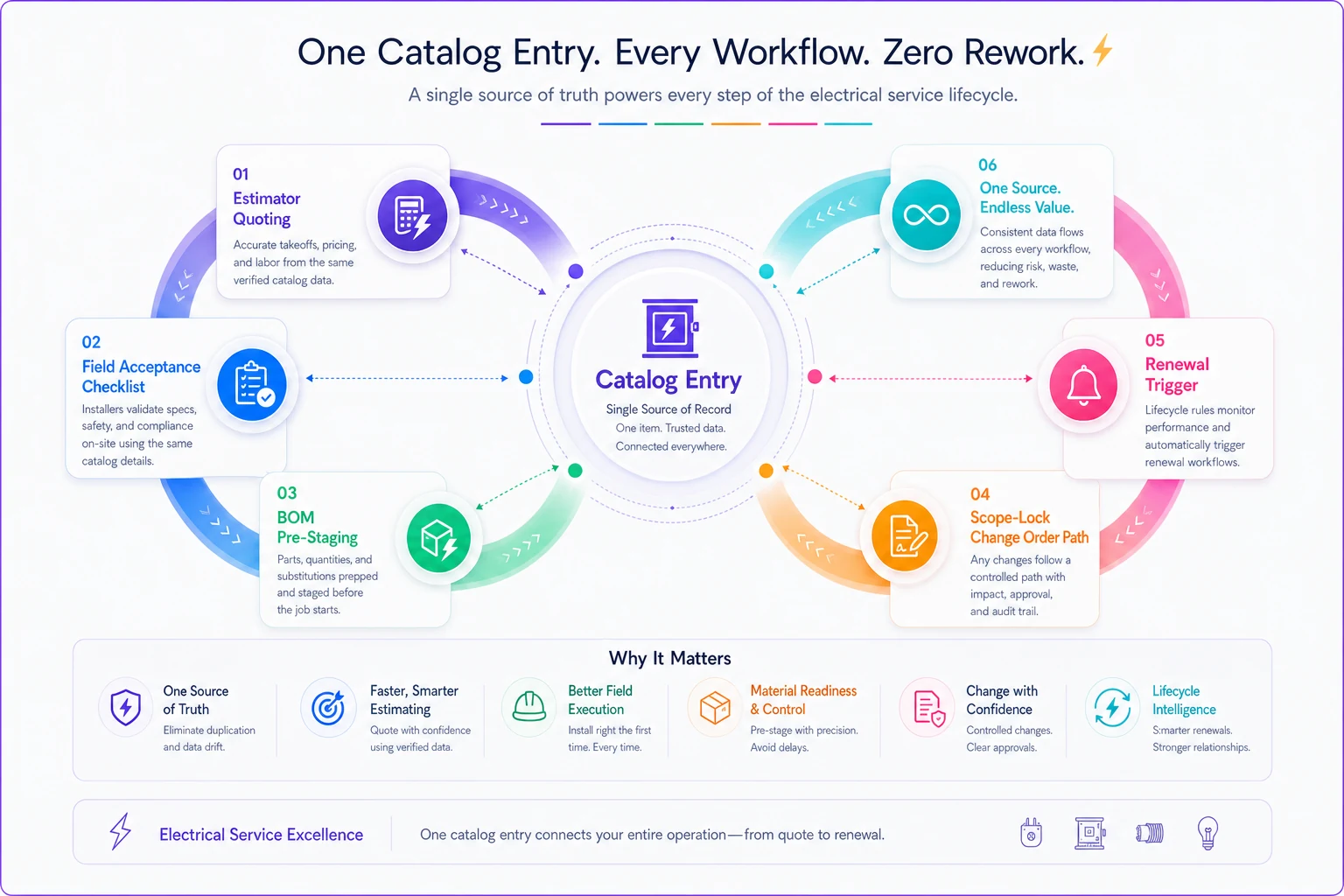
The diagram shows the core connections a catalog entry must drive so quoting, fulfillment, and renewals all come from the same source.
Where software earns its keep
Templates in a shared folder get you surprisingly far, and plenty of shops run this on spreadsheets for a while. But the coordination problem shows up fast — keeping the catalog, the BOM, the acceptance criteria, and the scope-lock rules in sync across estimators, dispatch, field, and invoicing is genuinely hard by hand. Update a price in one place and three other documents go stale.
A workflow platform that treats the catalog as a single source of truth starts to matter when you hit that wall. The catalog entry the estimator quotes from becomes the same record that generates the tech's acceptance checklist, pre-stages the BOM for the van, enforces the scope-lock change-order path, and triggers the renewal when it's due. The value isn't automation for its own sake — it's that everyone is working from one definition of the product instead of four drifting copies.
AI-assisted workflow tools can also flag when a job's actuals keep diverging from its catalog entry, which is exactly the signal you want surfaced automatically instead of discovered at month-end. The software doesn't replace the discipline. It just makes the discipline hold at scale, which is precisely where manual systems fall apart.
The real shift
Productization is less about pricing and more about removing invisible decisions from the critical path. Every undefined inclusion, every unspoken assumption, every "I'll just handle it" is a tiny decision made under pressure by someone who may not have the full picture. Multiply those across hundreds of jobs and you've got a business whose margins depend on luck and goodwill instead of design.
A real service catalog takes those decisions off the field and off the estimator and bakes them into the product itself. The estimator's job shrinks to the handful of calls that genuinely need judgment. The tech's job becomes execution against a clear spec. The office's job becomes verification, not translation.
That's the whole point — not to control your people, but to free them from re-deciding the same things every single day, so your margins stop being a surprise and start being a choice you made intentionally.
Ready to optimize your electrical service operations?
Join 500+ electrical service companies using Voltzly to improve scheduling accuracy, enhance client satisfaction, and boost operational efficiency.