


Most residential electrical shops don't have a service design problem on paper. They have one in practice. The tiers look fine in the brochure. The pricing looks reasonable. But when a call comes in and someone has to decide who goes, how fast, at what rate, and under what rules — that's where the whole thing starts falling apart.
What you've really built in that moment isn't a service catalog. It's a set of promises nobody wrote down. The dispatcher is guessing. The tech is improvising. The customer thinks they bought one thing and got another. And the owner finds out three weeks later when a "priority" member waited two days for a callback they technically paid to skip.
This post is about treating your service catalog as a governed system — where customer-facing tiers connect cleanly to scheduling priority, technician skill gates, pricing rules, and the enforcement mechanics that make renewals and penalties actually mean something. Not as separate policies. As one connected machine where a decision made at intake automatically determines what happens at every downstream step.
The Gap Between What You Sell and What You Can Enforce
The pattern that shows up in shop after shop: the sales side designs tiers around what sounds good to a customer — "Priority scheduling," "Discounted rates," "Annual safety inspection included." Operations never gets consulted on whether any of that holds up when the schedule is full and three trucks are down.
So you end up with a catalog that promises things the dispatch board can't honor. A "same-day priority" tier means nothing if the person booking the call has no way to see who's a member, no rule telling them to bump a standard job, and no record of whether the promise was kept.
-
Tiers are defined in marketing language, not operational rules
-
Scheduling priority is handled by whoever answers the phone, based on mood and memory
-
Skill gating happens informally — the dispatcher "knows" who can do panel work
-
Pricing rules live in someone's head or a spreadsheet that's three versions out of date
Each of these works okay in isolation at small scale. The problem is they never talk to each other. And service design is entirely about whether they do.
Why This Breaks Specifically as You Grow
At two or three techs, the owner is the governance system. You know every customer, you know which tech can handle what, and you remember who's a member. The catalog can be loose because your brain is enforcing it.
Never miss a job or delay a dispatch again.
Voltzly helps you schedule, assign, and track every electrical job efficiently.
- Unified job scheduling
- Real-time technician tracking
- Automated client notifications
No credit card required
The break happens somewhere between five and twelve techs — usually when you add a second dispatcher or the owner stops answering the phones. Suddenly the invisible rules that lived in one person's head have to become explicit, and nobody realizes they were rules at all until they stop being followed.
A typical example looks like this. A shop with around eight techs sells a "Gold" plan promising 4-hour priority response and a 15% discount on labor. Works great for a year while the owner runs dispatch. Then they hire a dispatcher to free up their own time. Within two months:
-
Gold members aren't getting prioritized because the new dispatcher can't see tier status at a glance
-
The 15% discount is being applied inconsistently — sometimes on parts too, which was never the deal
-
A junior tech got sent to a Gold member's panel issue because he was the only truck free, and the callback cost roughly $600 in rework
-
Two members didn't renew because the "priority" they paid for never materialized
None of these are people failing. They're a system that was never designed to run without the owner inside it.
Start With the Decision Table, Not the Brochure
The fix isn't fancier tiers. It's writing down the decisions that each tier forces so a dispatcher never has to improvise. A service tier is really a bundle of commitments across four dimensions, and each dimension needs a rule that a non-owner can follow.
Here's what a governed tier structure actually looks like when you map all four dimensions together:
| Dimension | Standard | Priority (Member) | Premium (Member) |
|---|---|---|---|
| Response window | Next available, 3–5 days | Within 24 hrs | Same-day / 4-hr window |
| Scheduling rule | Fills open slots | Bumps standard, holds 1 daily reserve slot | Pre-reserved capacity, overrides standard |
| Skill gate | Any qualified tech | Mid-level or above for diagnostics | Senior tech required for any non-trivial scope |
| Labor pricing | Book rate | 10% off labor only | 15% off labor, waived diagnostic fee |
| After-hours | Full emergency rate | Reduced emergency rate | Included 2x/year, reduced after |
| Renewal trigger | N/A | Auto-renew, 30-day notice | Auto-renew, usage review at renewal |
Explicitly state in the catalog whether discounts apply to labor, parts, or both to prevent accidental leaks.
The point of a table like this isn't to copy it directly. It's that every cell is a rule a dispatcher can execute without calling the owner. If a cell says "it depends," you haven't finished designing the tier.
One thing worth flagging: notice the discount is labor-only across every tier. The most common pricing leak in member plans is discounts quietly bleeding onto parts and materials, where you have far less margin to give. If your catalog doesn't specify what the discount applies to, assume it's being applied to everything. This connects directly to broader pricing governance that keeps productized rates consistent as you scale — tier discounts are just one pricing surface that drifts when nobody owns the rules.
Skill Gates Are Where SLAs Quietly Die
Most people think of the SLA as the response time. But response time is the easy part to fake. You can get a truck there in four hours and still blow the SLA if the tech can't actually resolve the issue and now you're scheduling a second visit.
This is the part of service design most shops skip entirely. They gate on availability — who's free — instead of gating on capability — who can actually close the job on the first trip. For your highest-paying members, a second trip isn't a scheduling inconvenience. It's a broken promise.
A workable skill-gate rule reads like this in plain operational terms: for any Premium-tier job tagged as diagnostic, panel, or service-upgrade scope, the dispatch board blocks assignment to anyone below a defined certification and experience threshold. If no qualified tech is available in the SLA window, the system flags it as an escalation — not a "send whoever's closest" — so the owner or lead makes a deliberate call rather than the dispatcher defaulting to availability.
That one rule prevents the single most expensive failure mode in member plans: sending an underqualified tech to a high-tier customer because they happened to be free, then eating the callback and the churn.
Skill gates, scheduling priority, and tier promises are really the same decision wearing three different hats. Govern them separately and they'll contradict each other under pressure. Govern them together and a member's tier automatically narrows the pool of eligible techs before the dispatcher ever picks one.
The Enforcement Half Nobody Builds: Renewals and Penalties
A service catalog without enforcement mechanics is a wish list. The two things that actually determine whether tiers hold are what happens at renewal and what happens when someone breaks the deal — on either side.
Renewal Mechanics
-
90 days out — pull a usage summary per member (visits used, SLA hits vs. misses, discount value delivered)
-
60 days out — flag at-risk accounts
zero usage, or any SLA miss during the term
-
45 days out — proactive outreach on at-risk accounts, with the specific value they received or didn't
-
30 days out — formal renewal notice with next-term pricing
-
At renewal — any member with repeated SLA misses gets a service review before auto-renew, so you're not renewing a relationship you're already failing
The thing most shops miss: an SLA miss on your side should trigger a renewal conversation just as fast as low usage does. If you quietly auto-renew someone you let down twice, you're buying one more year of eventual churn plus a bad review.
Penalty Mechanics
When the shop misses an SLA: decide the make-good in advance. A missed Premium 4-hour window might auto-credit a waived diagnostic fee or a free inspection. The key is it's automatic and documented — not a negotiation the customer has to fight for, and not a judgment call the dispatcher dreads making.
When the customer violates terms: no-shows, repeated same-day cancellations, or abuse of "included" emergency visits all need defined responses. A workable rule is two documented no-shows in a term converts the account from reserved-capacity scheduling to standard scheduling for the remainder, with a note explaining why. You're not punishing anyone — you're protecting the reserved capacity that other members actually paid for.
Penalties cut both ways, and governed catalogs define both directions.
A Short Real Scenario
A residential shop running around ten techs had three member tiers and roughly 180 active members. Churn was sitting near 30% annually and nobody could explain it, because on paper the plans looked competitive.
When they mapped tier promises against actual delivery, the pattern was obvious. Priority and Premium members were hitting their SLA about 70% of the time — the other 30% they were being treated like standard calls because the dispatch board had no tier visibility and no skill-gating rule. Discounts were leaking onto parts on roughly one in five member invoices.
The changes weren't dramatic. They rebuilt the catalog as a decision table, put tier status and SLA window directly on the dispatch view, gated Premium diagnostic jobs to senior techs, and locked discounts to labor only. They added the renewal trigger sequence above.
Over the following two quarters, SLA hit rate on member jobs climbed to the low 90s. Churn dropped to somewhere around 18–20%. The parts-discount leak — which they'd never even measured before — was worth a few thousand dollars a quarter on its own. Nothing about the tiers themselves changed. Only the governance around them did.
When This Level of Structure Makes Sense — and When It Doesn't
When it makes sense:
-
You've got more than one person making dispatch decisions
-
The owner wants out of the phones and the schedule
-
You're selling membership or priority tiers and can't prove you're honoring them
-
Member churn is a mystery you can't explain
When it's premature:
-
You're two techs and the owner books everything. Writing a 6-column decision table to govern your own brain is busywork. A simple note on who gets bumped is enough.
-
You don't actually sell differentiated tiers yet. Design the tiers first, govern them second.
-
Shops whose core pricing isn't stable yet should also hold off.
Shops whose core pricing isn't stable yet should also hold off. If your book rates and job costing are still guesswork, tier discounts will just add confusion on top of an unreliable base. Get the underlying pricing and operational SOPs solid first — the same way a shop needs an operations playbook with clear handoffs and decision triggers before any of this governance has something stable to sit on.
How the Pieces Actually Connect in a Workflow
When service design is governed as one system instead of four disconnected policies, here's how an incoming job actually moves through it:
-
Intake tags the customer's tier — that single tag drives everything that follows
-
The tier sets the SLA window — which determines where the job lands on the board and whether it bumps standard work
-
Job scope combines with the tier to set the skill gate — narrowing the eligible tech pool before anyone picks a truck
-
The tier applies the correct pricing rule — labor discount, waived fees — with no manual lookup required
-
When the job closes, the system logs whether the SLA was hit — feeding the renewal and penalty triggers later on
The whole thing hangs on one idea: the tier tag at intake should cascade into every later decision without a human re-deciding each step. When a dispatcher has to manually remember the member rules, the discount policy, and who's qualified — under pressure, on a busy Monday — the system is only as reliable as their worst day.
Visualizing the intake-to-closure workflow helps align tooling and handoffs.
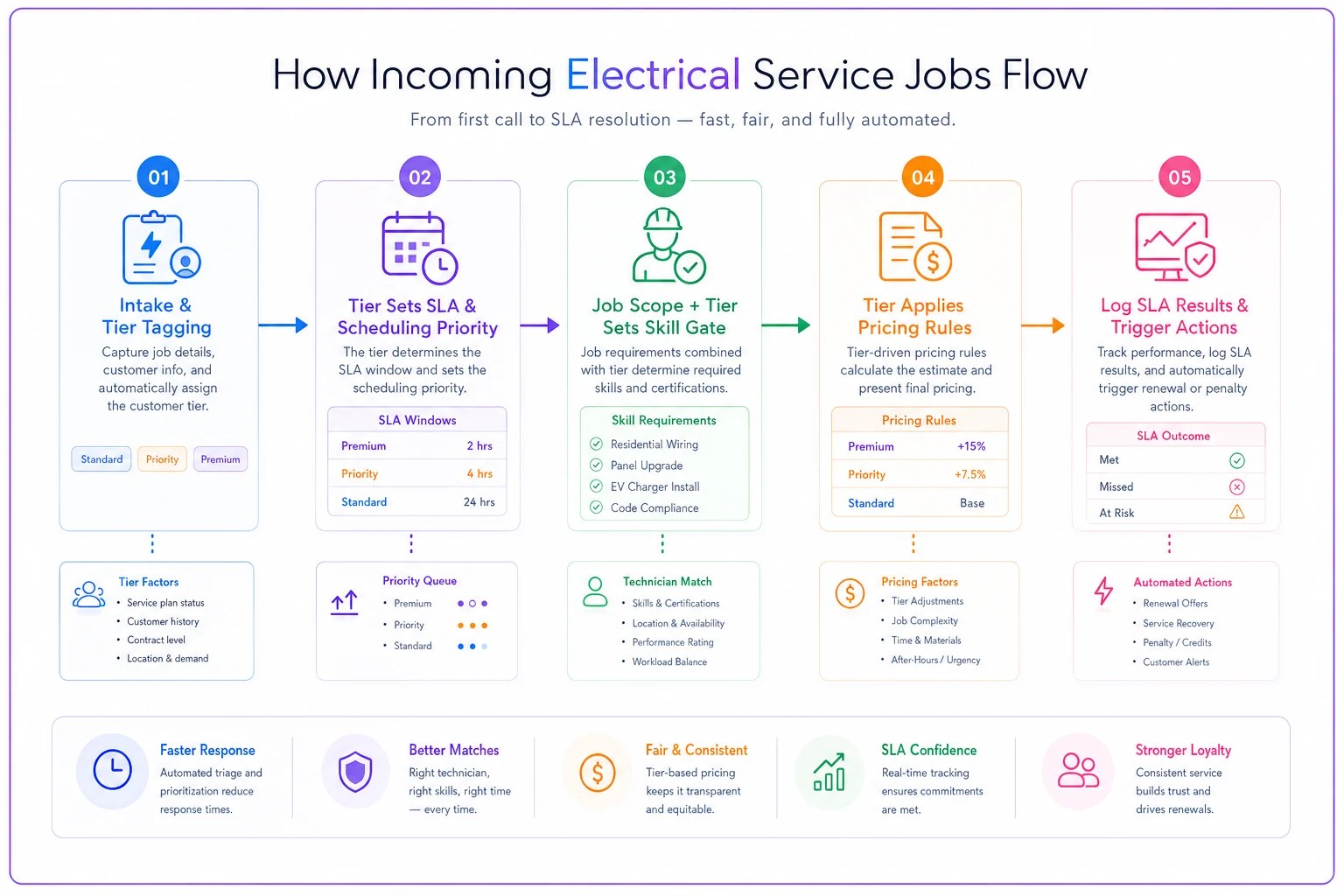
This is exactly the kind of coordination that modern operational software handles well: tier status, SLA windows, and skill gates visible on one dispatch view, with pricing and renewal rules enforced automatically rather than remembered. Not to replace judgment, but to stop the predictable failures that come from governance living in someone's head. If you've already built out three-tier service plans but struggle to make them stick in daily operations, this is usually the missing layer — the tiers were designed as a sales offer but never wired into the operational decisions that actually honor them.
The Real Takeaway
Service design isn't the brochure. It's the decision table underneath it — the one that tells a dispatcher who goes, how fast, at what rate, and under what rules, without anyone having to call the owner. Every tier you sell is a bundle of promises across scheduling, skill, pricing, and enforcement, and those four only create value when they're governed together.
The shops that scale cleanly aren't the ones with the fanciest tiers. They're the ones where the promise a customer buys at intake is the exact thing that gets delivered at the truck — because the system carried the decision all the way through instead of leaving it to memory.
The shops that scale cleanly aren't the ones with the fanciest tiers. They're the ones where the promise a customer buys at intake is the exact thing that gets delivered at the truck — because the system carried the decision all the way through instead of leaving it to memory.
Ready to optimize your electrical service operations?
Join 500+ electrical service companies using Voltzly to improve scheduling accuracy, enhance client satisfaction, and boost operational efficiency.