


Most electrical shops don't have a compliance problem. They have a coordination problem that only looks like a compliance problem when something goes wrong.
Your safety program lives in a binder. Field photos are spread across three techs' phones. Subcontractor agreements are a Word doc somebody modified in 2021. Warranty language is whatever the estimator pasted into the last proposal. And insurer paperwork gets assembled in a panic the week before renewal — or worse, the week a claim lands.
Each piece might be fine on its own. The failure happens in the gaps between them. A tech does the work correctly but doesn't document it the way the carrier expects. A sub finishes a rough-in with no signed handoff, so when the inspection fails, nobody can prove whose scope it was. The warranty you offered the homeowner doesn't match what your supplier actually covers on the panel.
That's really what this is about — not compliance as a checklist, but risk and compliance governance for electricians as a connected system where safety, documentation, subcontractor controls, contract terms and insurer evidence all feed each other instead of sitting in separate silos.
Here's how the whole thing breaks, and how it's supposed to fit together.
## The five systems most shops run separately (and shouldn't)
When you map out how a typical shop handles risk, you find five distinct workstreams that almost never talk to each other:
-
Safety — toolbox talks, PPE, lockout/tagout, incident reports
-
Field data — job photos, meter readings, panel labels, as-builts
-
Subcontractor management — prequalification, SOWs, holdbacks, insurance certs
-
Warranty and terms & conditions — what you promise customers, what your suppliers promise you
-
Insurer-facing artifacts — the evidence you hand your carrier at renewal or during a claim
Each of these usually has a different owner. Safety belongs to the senior tech or a part-time consultant. Field data belongs to whoever's on the job. Subs are handled by the owner or PM. Warranty language is the estimator's problem. And insurer stuff is the office manager's headache twice a year.
The thing most owners miss: these five systems all produce the same thing — evidence. They're all generating proof that the work was done safely, correctly, and by qualified people. But because they're managed separately, the evidence never gets assembled into one coherent story. So when a carrier, an attorney, or a customer asks "prove it," you're scrambling across five disconnected sources.
A real resilience program means treating all five as one evidence pipeline with shared gates, shared roles, and shared standards.
## What actually breaks — and when
The gaps stay invisible until a specific trigger hits. Here's what tends to expose them:
Never miss a job or delay a dispatch again.
Voltzly helps you schedule, assign, and track every electrical job efficiently.
- Unified job scheduling
- Real-time technician tracking
- Automated client notifications
No credit card required
| Trigger event | What gets exposed | Typical cost of the gap |
|---|---|---|
| Insurance renewal | No organized loss-control evidence; premium jumps | 15–40% premium increase or non-renewal |
| A claim or lawsuit | Missing photos, no signed sub handoff, vague warranty | Denied coverage, out-of-pocket defense |
| Failed inspection | No documented scope ownership between you and sub | Re-inspection fees, payment holds |
| Warranty callback | Your promise exceeds your supplier's coverage | You eat the parts + labor |
| Losing a key tech | Their phone leaves with the only job photos | Unrecoverable documentation |
Worth sitting with the pattern here. None of these are safety failures in the field. In most cases the crew did solid work. What failed was the governance — the ability to prove the work, assign the responsibility, and produce the evidence on demand.
This gets dramatically worse with scale. A two-truck shop can hold all of this in the owner's head. At six trucks, the owner isn't on every job anymore, so the informal knowledge disappears. At twelve-plus, you've got subs on jobs the owner has never visited, and the whole thing is running on trust and luck. The systems that worked at three trucks quietly stop working somewhere around five or six, and most owners don't notice until a trigger event forces the issue.
## Audit gates: the backbone of the whole program
What ties these systems together is a set of audit gates — checkpoints where work can't move forward until specific evidence exists. Tollbooths in your job workflow. No evidence, no passage.
Here's a practical gate structure for a residential or light-commercial shop:
-
Gate 0 — Pre-award (for subs) Prequalification packet complete. Insurance certs current. Licenses verified. Signed SOW with holdback terms.
-
Gate 1 — Pre-dispatch Scope documented, permit status confirmed, safety requirements flagged for the job type.
-
Gate 2 — Rough-in complete Photos captured per your naming standard, meter/load data logged, sub handoff signed if applicable.
-
Gate 3 — Inspection-ready All required documentation assembled before the inspector arrives, not after.
-
Gate 4 — Job close Final photos, warranty terms confirmed against supplier coverage, customer sign-off.
-
Gate 5 — Evidence archive Everything filed to a retention standard, tagged so it's retrievable in under five minutes.
Visualize the gates as sequential tollbooths in your job workflow.
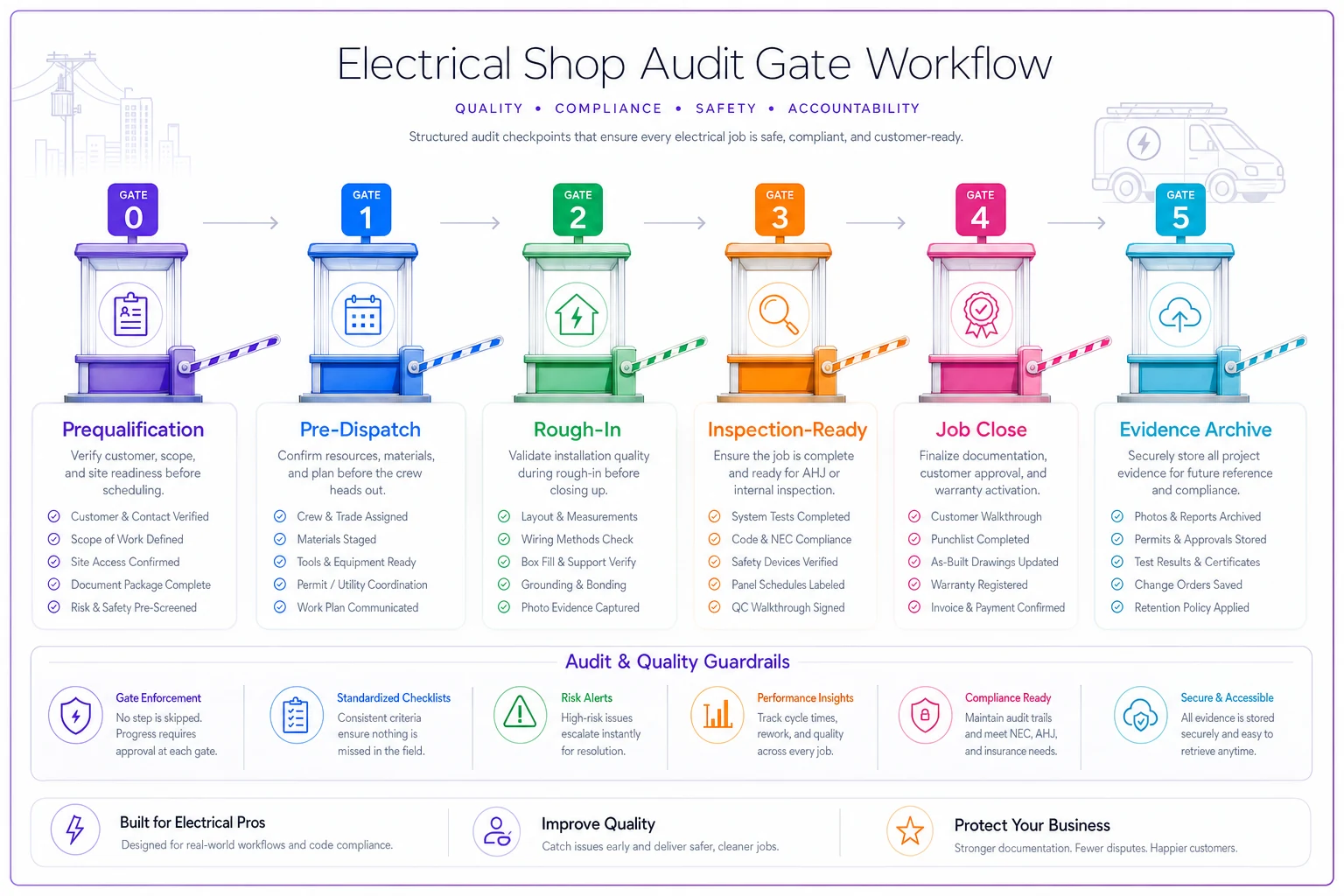
The value of gates isn't that they add steps. It's that they move documentation from "someday" to "now." The most expensive habit in this industry is deferring documentation until you need it — because by then the tech has moved on, the memory is gone, and the photo was never taken. A gate forces the evidence to exist at the moment it's cheapest to produce.
If you've already built out the inspection side of this, the permit and inspection coordination workflow slots directly into Gates 3 and 4. The same evidence you assemble to pass an inspection is most of what your insurer wants to see. You're not doing double work — you're doing one job that serves two audiences.
## Roles and responsibilities: kill the "everyone owns it" trap
The fastest way to guarantee a governance program fails is to make it everyone's job. When compliance is everyone's responsibility, it's nobody's.
Program owner (usually the owner or ops manager): Owns the whole resilience program. Sets the gates, reviews KPIs monthly, owns the insurer relationship. This person doesn't do the documentation — they make sure the system produces it.
Field lead / foreman: Enforces Gates 2 and 4 on the job. Won't let a crew leave a site without the required photos and readings. This is the make-or-break role — if your field leads don't hold the line, nothing above them matters.
Office / compliance coordinator: Owns Gate 0 (sub prequalification), certificate tracking, and Gate 5 (archiving and retention). Also assembles the insurer evidence pack.
Estimator: Owns warranty and T&C consistency at quote time — making sure what you promise never exceeds what your suppliers and your own labor warranty actually cover.
The shops that get this right have one thing in common: each gate has exactly one accountable name, not a committee. When something's missing, you know whose gate it fell through. That's not about blame — it's about fixing the actual point of failure instead of holding another all-hands meeting about "documentation."
## Evidence standards: what "documented" actually means
"We take photos" is not an evidence standard. It's an intention. The difference shows up the day a claim adjuster asks for the panel-before shot on a job from eight months ago.
-
What must be captured (specific shots, readings, signatures)
-
How it's named and tagged (so it's findable later)
-
Where it lives (one system, not five phones)
-
How long it's kept (retention tied to warranty period plus statute of limitations in your state)
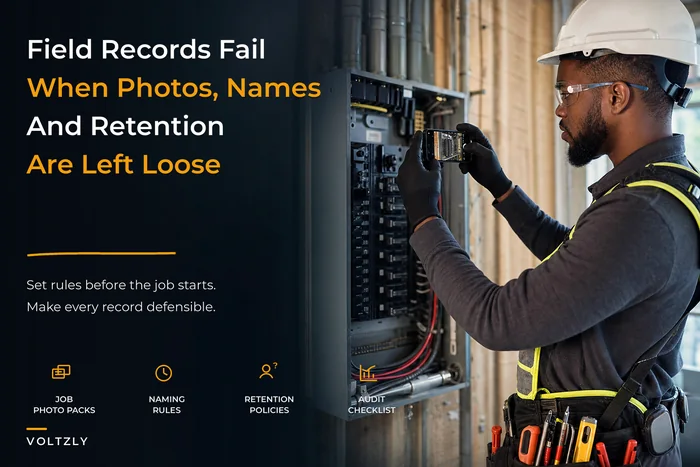
The naming and retention piece is where most shops fall apart, and it's worth getting right because it determines whether your evidence is usable or just... stored. A folder of 4,000 unnamed photos is legally almost worthless — you can't find the one that matters when you need it. The full approach to photo packs, naming rules and retention policies is its own discipline, and it's the layer that makes every other gate actually pay off.
Keep the naming convention consistent and documented where techs can reference it on the job.
One thing worth flagging: shops that document everything often do worse than shops that document the right things consistently. Over-documentation creates noise that buries the critical evidence. Define the minimum required set per job type, enforce it, and stop there.
## KPI thresholds that tell you the program is drifting
A governance program isn't something you write once. It decays. Techs get busy, gates get skipped, standards slip. You need a small set of metrics that surface the drift before a trigger event does it for you.
-
Gate completion rate — % of jobs where all required gates were passed with evidence. Below 90% means your gates aren't real.
-
Sub cert lapse count — number of active subs with expired insurance or licenses. Target: zero. Hard red flag.
-
Documentation retrieval time — how long to pull the full evidence pack on a random past job. Over ten minutes means your archive is broken.
-
Warranty callback cost ratio — warranty work you absorbed vs. warranty work covered by suppliers. Rising ratio means your promises exceed your coverage.
-
Days-to-evidence-pack — time to assemble a full insurer or claim packet. Should trend toward same-day.
The threshold that matters most is sub cert lapse. One expired certificate on an active job can void your own coverage on that job. It's a binary risk, not a gradual one — which is exactly why it deserves a hard-zero standard rather than a "we're mostly good" attitude.
## Sample SOW and holdback language
Contract language is where governance becomes enforceable. Vague SOWs are why scope disputes with subs turn into "he said / she said" during a failed inspection. Here's the kind of language that holds up:
Scope ownership clause (sample): > "Subcontractor is solely responsible for all work described in Exhibit A up to and including the [rough-in / finish] inspection for that scope. Subcontractor shall not close or conceal any work prior to inspection sign-off documented per Contractor's field-data standard. Any concealed work requiring re-exposure shall be at Subcontractor's cost."
Holdback clause (sample): > "Contractor shall retain [10%] of each progress payment as holdback. Holdback is released within [15] days after: (a) passing final inspection for Subcontractor's scope, (b) delivery of all required field documentation per Contractor's evidence standard, and (c) delivery of current insurance certificate covering the full work period."
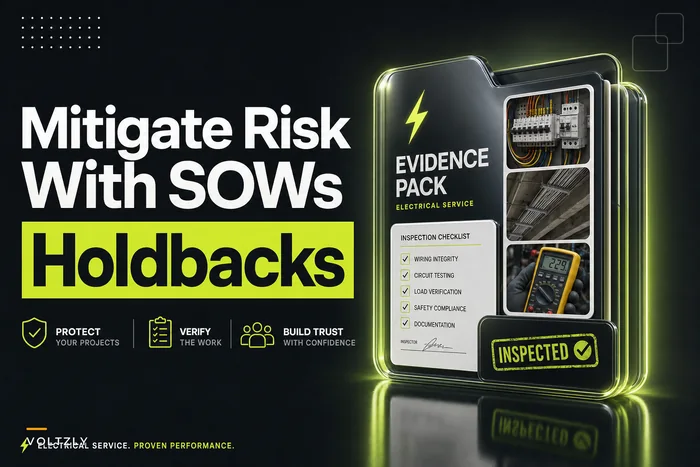
Notice how the holdback release is tied directly to the evidence and inspection gates. The money doesn't move until the proof exists. This connects to a broader system of SOWs, milestone holdbacks and inspection handoff templates, which is worth building out properly if subs are a meaningful part of your volume. The holdback isn't punitive — it's the mechanism that makes documentation a condition of getting paid, which is honestly the only thing that reliably changes behavior.
## The insurer-ready evidence pack
Instead of scrambling at renewal, you maintain a standing evidence pack your carrier's loss-control team can review on demand. Assembling it is straightforward once the gates are feeding it:
-
Safety program summary — your written program, toolbox talk log, incident history with corrective actions.
-
Sample job evidence packs — three to five completed jobs showing your full documentation standard in action.
-
Subcontractor controls — your prequalification process, sample SOW, holdback terms, and current cert tracking.
-
Warranty and T&C summary — your standard customer terms and how they map to supplier coverage.
-
KPI snapshot — your gate completion rate and callback ratios, showing the program is monitored, not just written.
Underwriters price risk on demonstrated control, not claim history alone. A shop that hands over an organized evidence pack signals a fundamentally different risk profile than one that says "we're careful." The same discipline that prevents insurer disputes is what earns you better terms in the first place.
## A real scenario
A twelve-tech shop doing residential panel upgrades and EV installs kept getting hit at renewal — premium had climbed close to 30% over two years despite a reasonably clean claim record. The problem wasn't their safety. It was that they couldn't prove anything. When a homeowner filed a claim over a warranty dispute on a panel, the shop had no organized photos, no signed sub handoff, and warranty language that promised more than the supplier covered. They ate roughly $6k on that one job.
They rebuilt around gates. Every job got a required photo set at rough-in and close, sub payments held until docs and certs were in, and warranty language pulled back to match actual supplier coverage. Nothing complicated — gates with single owners and a real evidence standard.
The following renewal, they walked in with a standing evidence pack. The premium increase came in flat instead of the double-digit jump they'd braced for, and retrieval time on any past job dropped from half a day of digging to a few minutes. The callbacks they used to absorb started getting pushed back to suppliers where the coverage actually sat.
## When this makes sense — and when it doesn't
When to build this now: You're past five trucks, you use subs, or your insurance is getting expensive or hard to renew. Any one of those three means the informal system has already outgrown you, even if it hasn't broken publicly yet.
When to keep it lighter: Solo operator or two-truck shop where the owner is on every job — a full gate structure is overkill. Focus on the two gates that matter most: evidence capture at job close and retention. Skip the sub controls until you actually use subs.
Who should NOT do this all at once: Nobody should try to roll out all five systems simultaneously. That's the classic failure mode. Shops that attempt a big-bang compliance overhaul abandon it within a quarter. Sequence it: fix your evidence standard first, add gates second, layer sub controls third, and build the insurer pack last from what the earlier steps already produce.
Pulling it together
The shops that survive a bad claim, a hard insurance market, or a lost key employee aren't the ones with the thickest safety binder. They're the ones where safety, field data, subcontractor controls, warranty terms and insurer evidence all feed a single pipeline — where every job produces proof automatically, every gate has one owner, and the evidence pack is always half-assembled before anyone asks for it.
You don't get there by writing more policies. You get there by connecting the systems you already have so the evidence flows on its own. Start with one gate. Give it one owner. Make the documentation exist at the moment it's cheapest to create — on the job, not the week before renewal. Everything else builds from that.
Ready to optimize your electrical service operations?
Join 500+ electrical service companies using Voltzly to improve scheduling accuracy, enhance client satisfaction, and boost operational efficiency.